
From Transit Tunnels to High Art: Chris “Daze” Ellis Reimagines the New York Underground at PPOW Gallery
NEW YORK — In a sweeping retrospective of spirit and technique, PPOW Gallery has announced the opening of Orchid Rain on the Underground, a landmark solo exhibition by Chris “Daze” Ellis. Marking his third major presentation with the gallery, the exhibition—running through April 25, 2026—serves as a bridge between the visceral, clandestine energy of the 1970s graffiti movement and the sophisticated, multi-layered studio practice Daze has refined over a career spanning five decades.
The exhibition is not merely a collection of new works but a complex architectural and sensory narrative. Through a combination of large-scale paintings, a site-specific mural, and a multimedia installation that replicates the sensory overload of New York’s vanished nightlife, Daze asserts that the "bygone era" of 1980s Manhattan is not a ghost, but a living foundation for the city’s contemporary creative identity.
Main Facts: A Synthesis of Street and Studio
Orchid Rain on the Underground represents a pivotal moment for Chris Ellis, an artist who transitioned from the steel canvases of the Metropolitan Transportation Authority (MTA) to the white walls of international galleries without losing the "foundational energy" of his youth. The exhibition is structured around the duality of the New York experience: the grit of the subway system juxtaposed with the delicate, fleeting beauty of urban flora.
Key highlights of the exhibition include:
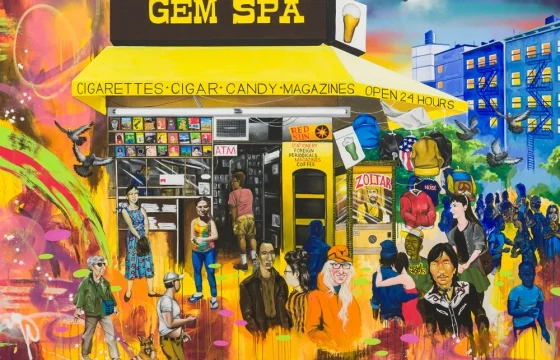
- Gem Spa In the 80s (2025): A flagship painting that functions as a historical document, depicting the legendary East Village newsstand. The work features cameos from pivotal figures in the New York art world, including the late artist Martin Wong and renowned critic Carlo McCormick.
- The Multimedia Environment: A transformative final room in the gallery that utilizes a light-up dance floor, a disco ball, and authentic subway car seating to recreate the atmosphere of 1980s clubs like the Mudd Club and Danceteria.
- Lyrical Abstraction vs. Urban Realism: The new series of paintings demonstrates Daze’s unique ability to blend the gestural language of Abstract Expressionists like Joan Mitchell with the meticulous, observational detail of the Ashcan School.
Chronology: The Evolution of a Legend (1962–Present)
To understand the depth of Orchid Rain on the Underground, one must trace the trajectory of Chris Ellis from his roots in Brooklyn. Born in 1962, Daze came of age during a period of fiscal crisis and creative explosion in New York City.
The Formative Years (1970s)
While attending the High School of Art and Design in the mid-1970s—a legendary incubator for graffiti talent—Daze was captivated by the work of early "writers" such as Blade, PHASE 2, and Lee Quiñones. This period was defined by the "subway era," where the city’s transit system served as a rolling gallery. Daze began establishing his name during this time, mastering the speed and scale required for illegal public art.
The Transition (Early 1980s)
By the early 1980s, the "Graffiti Movement" began to catch the eye of the formal art world. Daze was among the first of his peers to successfully translate the energy of the streets into a studio practice. This shift coincided with his immersion in the city’s nightlife. Landmarks such as the Lit Lounge, Danceteria, and the Mudd Club became his second classrooms. These venues were "generative sites," where the boundaries between fashion, music, street art, and fine art were porous.
The Mature Practice (1990s–2020s)
Over the subsequent decades, Daze’s work evolved from the letter-based focus of graffiti to a sophisticated form of urban realism. His move to upstate New York provided a new visual vocabulary, introducing natural elements—specifically local flora—into his depictions of the concrete jungle. This evolution culminates in the current exhibition, which showcases a master at the height of his technical powers, blending fifty years of lived history into a single cohesive vision.
Supporting Data: Artistic Influences and Visual Language
The works in Orchid Rain on the Underground are characterized by a sophisticated "layering" technique, both literal and metaphorical. Daze utilizes a combination of acrylics and spray paint, a nod to his dual heritage in fine art and street culture.
The Academic Connection
Critics have frequently noted Daze’s alignment with the Ashcan School, particularly the works of John Sloan and Reginald Marsh. Like these early 20th-century realists, Daze treats the subway and the street corner as sacred spaces of human interaction. However, he filters this realism through the lens of mid-century Lyrical Abstraction. The influence of Willem de Kooning and Joan Mitchell is evident in his "gestural swaths" of color that often frame his detailed renderings of train interiors and tunnels.
Symbolism of the Orchid
The recurring motif of the orchid in this exhibition serves a specific symbolic purpose. In several pieces, technicolor flowers are depicted ascending from "heaps of urban rubble." According to the gallery’s curatorial statement, these floral arrangements—comprising both tropical orchids and local New York wildflowers—act as "poignant memorials" to the people and places lost to gentrification and time. They represent a persistent optimism: the idea that beauty and creativity can emerge from the "destruction" of the urban environment.
Official Responses and Curatorial Perspective
PPOW Gallery, known for its commitment to artists who challenge social and political norms, views this exhibition as a vital reclamation of New York’s cultural history.
In a statement regarding the show’s debut, the gallery emphasized the meticulous nature of Daze’s current work: "While the version of New York City that fostered Daze’s beginnings may feel like a bygone era, the works in this exhibition are evidence of its enduring legacy. Daze affirms the continued relevance of those figures and places, and their profound influence on the creative spirit that persists throughout the city today."
Curators have also highlighted the importance of the site-specific mural within the gallery. By bringing an art form traditionally "relegated to the outdoors" into the controlled environment of the gallery, Daze forces a confrontation between the "raw" energy of the street and the "refined" space of the institution. This mural serves as a physical transition, leading viewers into the immersive multimedia installation that concludes the exhibition.
Implications: The Legacy of the "Nerve Centers"
The inclusion of Gem Spa In the 80s highlights a broader cultural conversation regarding the preservation of New York’s "nerve centers." Gem Spa, famously described by Allen Ginsberg as the city’s heart, closed its doors in 2020, marking the end of an era for the East Village. By immortalizing the newsstand in his work, Daze performs an act of "artistic preservation," ensuring that the subcultures that gathered there—from the Beats to the early hip-hop pioneers—remain part of the city’s visual record.
The exhibition’s multimedia room—featuring a curated track of house, disco, and hip-hop—further underscores the importance of "third places" (social spaces outside of home and work) in the development of American art. The installation suggests that the freedom found on a 1980s dance floor or a late-night subway ride was essential to the "personal and artistic development" of an entire generation of creators.
As the New York art market continues to grapple with its identity in an increasingly digital age, Orchid Rain on the Underground serves as a reminder of the power of physical space and lived experience. Daze’s work suggests that the "vibrant cultural heartbeat" of the city is not found in its skyscrapers, but in its tunnels, its dive bars, and the resilient flowers that grow in the cracks of its sidewalks.
Orchid Rain on the Underground will remain on view at PPOW Gallery through April 25, 2026. The exhibition stands as a definitive testament to Chris “Daze” Ellis’s role as one of the most significant chroniclers of the New York experience, proving that while the city may change, the "passion and spontaneity" of its creative spirit remains unbreakable.


Leave a Comment