
The Enduring Legacy of Hammurabi’s Code: A Cornerstone of Ancient Justice

PARIS, FRANCE – More than three millennia after its inscription, the Code of Hammurabi remains a towering monument to the dawn of codified law. This remarkable collection of 282 laws, carved into a seven-foot-tall diorite stele by the Babylonian king Hammurabi (reigned 1792-1750 BCE), stands as a testament to humanity’s early efforts to establish order, protect rights, and define justice within a complex society. Though not the first legal code of ancient Mesopotamia, its unparalleled clarity, comprehensive scope, and profound influence on subsequent cultures solidify its status as a pivotal document in legal history.
Housed today in the Louvre Museum in Paris, the stele’s imposing presence is matched only by the intricate legal framework it details, covering everything from commercial contracts and property disputes to family matters and criminal offenses. Its discovery in 1901 shed invaluable light on the social, economic, and moral fabric of Old Babylonian society, revealing a sophisticated legal system designed to unify a diverse empire under a singular, divinely sanctioned authority.
Chronology: The Genesis and Evolution of Mesopotamian Law
The Code of Hammurabi did not emerge in a vacuum but was the culmination of a long tradition of legal codification in Mesopotamia. It built upon earlier attempts to formalize laws, reflecting an evolving understanding of governance and societal needs in a region frequently marked by political shifts and cultural integration.
The Code of Ur-Nammu: A Patriarchal Foundation
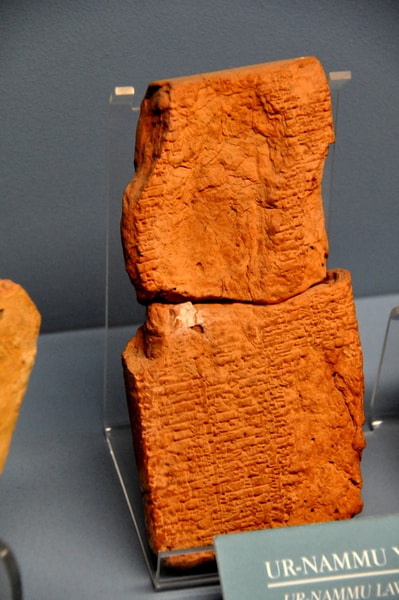
The earliest known extant set of laws from ancient Mesopotamia is the Code of Ur-Nammu, dating from approximately 2100-2050 BCE. Inscribed on clay tablets and discovered in the city of Ur, this code is attributed either to King Ur-Nammu (reigned c. 2112-2094 BCE) or his son and successor Shulgi (reigned 2094-c. 2046 BCE). Ur-Nammu rose to power following the collapse of the Akkadian Empire and the subsequent period of Gutian rule, which had brought chaos and instability to Mesopotamia. He led a successful rebellion, expelling the Gutians and establishing the Third Dynasty of Ur, ushering in a period of cultural revival known as the Sumerian Renaissance.
Ur-Nammu sought to restore order and legitimacy by presenting himself as a benevolent father figure, drawing parallels to the revered, albeit idealized, Akkadian kings. His administration fostered a "patrimonial state," where subjects were encouraged to view themselves as members of a royal family, with the king as their guardian. For this model to succeed, Ur-Nammu recognized the paramount importance of securing the "consent of the governed." To this end, his laws were presented as divine decrees, with Ur-Nammu acting merely as the gods’ administrator, transmitting their will to the people.
The Code of Ur-Nammu’s laws typically followed a conditional "if-then" structure and often prescribed monetary fines as penalties for infractions. For example:
- "If a man proceeded by force and deflowered the virgin slave-woman of another man, that man must pay five shekels of silver."
- "If a man knocked out the eye of another man, he shall weigh out half a mina of silver."
- "If a man knocked out a tooth of another man, he shall pay two shekels of silver."
This emphasis on restitution through fines suggests a society where collective values and an understanding of acceptable behavior were largely shared among a relatively homogenous population. The deterrent was the financial penalty, which avoided harsher retributive measures, indicating a social cohesion that allowed for reconciliation over vengeance.

The Code of Lipit-Ishtar: Adapting to Diversity
The stability provided by Ur-Nammu’s code continued through the Third Dynasty of Ur, but eventually, the empire weakened and succumbed to invasions by Amorites and Elamites. A new dynasty, the Dynasty of Isin, emerged, founded by Ishbi-Erra. While the kings of Isin restored order, the population they governed was far less homogenous than Ur-Nammu’s patriarchal state. By the reign of the fifth king, Lipit-Ishtar (died c. 1924 BCE), the societal landscape had become more complex and diverse, necessitating a more precise and detailed legal framework.
The Code of Lipit-Ishtar, while also fragmentary, reflects this shift. It retained monetary fines as deterrents but introduced more elaborate provisions, particularly for family law and commercial contracts. It was no longer feasible to assume a universal understanding of proper conduct among all citizens. The code, for instance, addressed scenarios like tax defaults, the rights of a harlot’s children, and property damage, demonstrating a need for specific rules to manage a varied populace. One notable law stated: "If a man’s wife has not borne him children, but a harlot from the public square has borne him children, he shall provide grain, oil, and clothing for the harlot. The children which the harlot has borne him shall be his heirs and as long as his wife lives the harlot shall not live with the wife." This demonstrates a pragmatic approach to social realities, acknowledging different family structures.
Lipit-Ishtar’s code provided crucial stability for the Dynasty of Isin, and he was remembered as a great king who maintained order in a challenging era. However, the Isin dynasty eventually fell to Sin-Muballit, the Amorite king of Babylon and father of Hammurabi, setting the stage for the rise of a new imperial power and its defining legal document.
Hammurabi’s Ascent and the Need for Universal Law
Hammurabi inherited a kingdom facing significant challenges. His father, Sin-Muballit, had struggled to compete with the powerful trade center of Larsa and was ultimately forced to abdicate. Hammurabi began his reign cautiously, focusing on domestic improvements, temple building, and canal construction, giving his neighbors no reason to suspect his true ambitions. Behind this facade of peaceful governance, however, he meticulously built and equipped a formidable army, preparing for the campaigns that would ultimately allow him to conquer and unify Mesopotamia.
To achieve this ambitious goal, internal stability was paramount. As scholar Paul Kriwaczek noted, a king needed the consent of the governed for a stable social base if he hoped to expand his power. It is in this context that Hammurabi likely instituted his law code, possibly around 1722 BCE, as a strategic instrument to ensure order and clearly define societal expectations across his burgeoning empire.
Supporting Data: The Pillars of Babylonian Justice
The Code of Hammurabi is more than just a list of rules; it is a meticulously crafted document designed to project power, ensure order, and legitimize the authority of a king ruling over an unprecedentedly diverse empire.
The Stele: A Divine Mandate in Stone
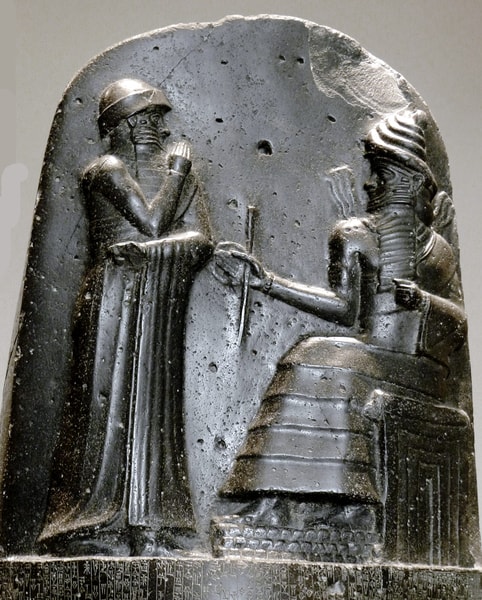
The physical stele itself is a masterpiece of ancient craftsmanship and symbolic communication. Carved from a single block of black diorite, its imposing height of over seven feet ensured its public visibility when erected. At its apex, an intricately engraved image depicts the sun god Shamash (also known as Utu-Shamash), the Babylonian deity of justice, seated majestically, handing the laws to a standing Hammurabi. This visual narrative was crucial: it unequivocally declared that the laws were not arbitrary human decrees but divinely ordained principles, making their challenge an act of defiance against the gods themselves.
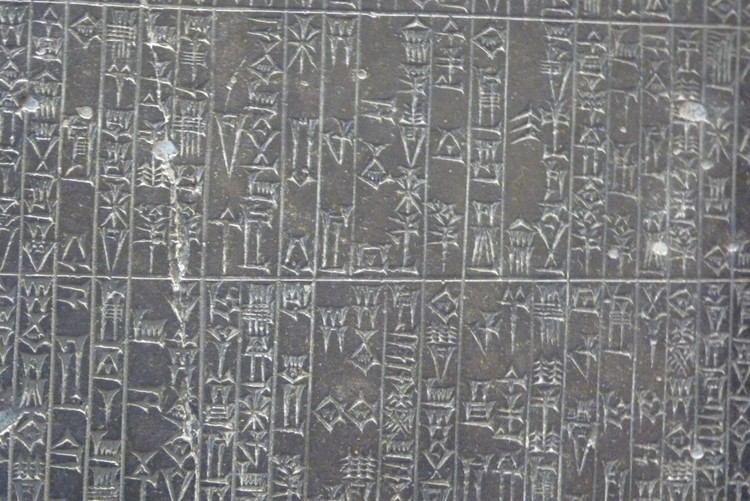
Below this iconic image, the 282 laws are meticulously inscribed in Akkadian cuneiform, organized into neat rows. The stele’s public placement meant that "no one could claim they were ignorant of the law," as the text itself asserts. This accessibility, combined with the divine mandate, reinforced the code’s authority and provided a clear, universal standard of conduct for all subjects.
Lex Talionis: Justice by Retribution
A defining characteristic of Hammurabi’s Code, and one that distinguishes it sharply from earlier Mesopotamian laws, is its embrace of Lex Talionis – the law of retributive justice, famously encapsulated by the phrase "an eye for an eye, a tooth for a tooth." While earlier codes often prescribed fines for physical harm, Hammurabi’s punishments were significantly more severe, reflecting a shift towards direct retribution.
Consider these examples:
- "If a man put out the eye of another man, his eye shall be put out."
- "If he break another man’s bone, his bone shall be broken."
- "If a man knock out the teeth of his equal, his teeth shall be knocked out."
This principle extended beyond personal injury to professional accountability. For instance:
- "If a builder build a house for someone, and does not construct it properly, and the house which he built fall in and kill its owner, then that builder shall be put to death."
- "If it kill the son of the owner of the house, the son of that builder shall be put to death."
The severity of Lex Talionis was a direct response to the social environment of Hammurabi’s empire. As Kriwaczek explains, the multi-ethnic, multi-tribal Babylonian world was a stark contrast to earlier Sumerian-Akkadian communities where shared values might facilitate restitution. With diverse populations – including West Semitic Amurru speakers and nomads alongside Akkadians – cultural misunderstandings and conflicts could easily escalate into blood feuds and vendettas, threatening imperial cohesion. Hammurabi’s absolute laws, rooted in divine authority, were designed to prevent such instability by imposing clear, harsh consequences that left no room for individual interpretation or prolonged family vengeance.
Comprehensive Scope: Governing a Complex Society
Beyond criminal justice, the Code of Hammurabi meticulously addressed a vast array of societal functions, reflecting the complexity of Old Babylonian life:
- Family Law: Detailed provisions for marriage, divorce, adultery, inheritance, and the rights of children and women (though women’s rights were subordinate to men’s).
- Commercial Law: Regulations concerning trade, loans, interest rates, deposits, and contracts, ensuring fairness and preventing exploitation in a bustling economy.
- Property and Agriculture: Laws pertaining to land ownership, tenancy, irrigation, crop damage, and the responsibilities of farmers and shepherds.
- Labor and Wages: Fixed wages for various professions, from artisans to laborers, and regulations regarding slavery.
The laws also differentiated punishments based on social hierarchy, typically dividing society into three classes: the awilu (free persons/nobility), the mushkenu (commoners/dependent persons), and the wardu (slaves). For example, harming an awilu would incur a harsher penalty or direct retribution, while harming a mushkenu might result in a fine. This stratification underscores the hierarchical nature of Babylonian society, even under a "universal" code.
Official Responses: Legitimacy, Reception, and Rediscovery
The "official response" to Hammurabi’s Code can be understood in two distinct periods: its ancient reception and its modern rediscovery and interpretation.
Ancient Legitimacy and Governance
In ancient Babylon, the code served as the ultimate official statement of the king’s authority and the gods’ will. Hammurabi’s prologue to the code is a powerful declaration of his divine mandate and benevolent intentions:
"When the lofty Anu, King of the Annunaki and Bel, Lord of Heaven and Earth, he who determines the destiny of the land, committed the rule of all mankind to Marduk… at that time Anu and Bel called me, Hammurabi, the exalted prince, the worshipper of the gods, to cause justice to prevail in the land, to destroy the wicked and the evil, to prevent the strong from oppressing the weak, to enlighten the land and to further the welfare of the people."
This "official response" from the king himself framed the laws as instruments of divine justice and societal welfare. By positioning himself as bani matim ("builder of the land") – one who raised temples, built canals, and irrigated lands – Hammurabi cemented his image as a just and effective ruler. The public display of the stele, combined with this powerful rhetoric, fostered a sense of legitimacy and encouraged adherence. For the duration of Hammurabi’s reign, his empire experienced remarkable stability, with no evidence of widespread revolt or dissent in its later years, suggesting that the code successfully garnered the consent and cooperation of the governed.
Modern Discovery and Scholarly Interpretation
The Code of Hammurabi vanished from Babylon around 1150 BCE when Shutruk Nakhunte, King of Elam, sacked the city of Sippar and likely carried the stele back to Elam as a spoil of war, along with the statue of the god Marduk. For centuries, it lay buried in the ruins of the Elamite city of Susa until its dramatic rediscovery in 1901 by a French archaeological expedition led by Jacques de Morgan.
The finding of the intact stele, broken into three pieces but easily reassembled, was a monumental event. It provided an unprecedented window into the legal and social structures of ancient Mesopotamia, immediately captivating scholars and the public alike. Its transport to the Louvre Museum in Paris marked its official placement as a global cultural treasure.
Since its discovery, the Code of Hammurabi has been the subject of intense scholarly scrutiny. Philologists translated the Akkadian text, revealing its intricacies and comparing it to other ancient legal traditions. Historians and legal scholars have debated its purpose – was it a literal code to be applied in courts, a set of legal precedents, or a monumental propaganda piece affirming Hammurabi’s justice? While interpretations vary, its value as a primary source for understanding Old Babylonian society is undisputed. Its prominence in museums and academic curricula globally represents a continued "official response" to its enduring historical and cultural significance.
Implications: A Lasting Legal Legacy
The Code of Hammurabi’s impact extended far beyond the reign of its creator, leaving an indelible mark on the development of legal thought and practice.
The Fragility of Empire and the Endurance of Law
Despite the code’s effectiveness during Hammurabi’s rule, his empire proved fragile after his death. His son and successor, Samsu-Iluna, struggled to maintain control, and the city-states that had been unified under Hammurabi soon revolted. The empire ultimately fell to successive invaders, including the Hittites and Kassites, and later the Elamites, who carried the stele away.
This outcome highlights a crucial implication: while a strong legal framework can foster unity, its long-term survival often depends on the sustained power and vision of subsequent rulers, or the development of institutions that transcend individual leadership. Yet, even as the Babylonian empire fragmented, the idea of codified law, epitomized by Hammurabi’s work, persisted.
Influence on Subsequent Legal Traditions
The most significant implication of Hammurabi’s Code lies in its profound influence on later legal systems. It served as a foundational model for subsequent Mesopotamian legal codes, including the Middle Assyrian Laws and the Neo-Babylonian Laws, which continued to reflect its structure and principles.
Crucially, scholars have identified strong parallels between Hammurabi’s Code and the Mosaic Law (Torah) found in the Bible. While there are significant theological and contextual differences, the structural similarities and specific legal provisions suggest a shared legal tradition in the ancient Near East. Both codes, for instance, include elements of Lex Talionis, laws concerning property, theft, assault, and family matters. This connection underscores Hammurabi’s code as a pivotal document not only for secular legal history but also for understanding the historical development of religious law.
A Cornerstone of the Rule of Law
In a broader sense, Hammurabi’s Code represents a crucial step in the evolution of the "rule of law." By publicly displaying a comprehensive set of laws that applied, at least in theory, to all subjects (albeit with class distinctions), Hammurabi established a precedent for transparent governance where justice was not solely at the whim of the ruler but bound by defined statutes. The concept of an objective, universal directive on how to treat others and how one should expect to be treated in a civilized society was cemented by this monumental achievement.
Today, the Code of Hammurabi is more than an ancient artifact; it is a powerful symbol of humanity’s continuous quest for order, fairness, and the establishment of a just society. It reminds us that the principles of legal codification, accountability, and the aspiration to protect the weak from the strong have roots stretching back to the earliest civilizations, forming the very bedrock of modern legal systems worldwide. Its enduring presence in the Louvre serves as a constant reminder of how far our understanding of justice has come, and how ancient wisdom continues to shape our contemporary world.



Leave a Comment