
The Architecture of Mastery: Raph Koster’s Twelve-Step Framework for Modern Game Systems Design
In the rapidly evolving landscape of interactive entertainment, the definition of "game design" often remains elusive, caught between the technical rigors of software engineering and the nebulous creativity of narrative arts. Raph Koster, a veteran designer and the influential author of A Theory of Fun for Game Design, has recently synthesized his decades of experience into a comprehensive "twelve-step program." This framework serves as a pragmatic strategy guide for understanding game design not merely as an art form, but as a disciplined system of problem-solving and psychological engagement.
Koster’s thesis posits that games are, at their core, "learning machines." By deconstructing the mechanics of fun, uncertainty, and player motivation, Koster provides a roadmap for developers to move beyond superficial "confetti" entertainment toward the creation of deep, resonant systemic experiences.
Main Facts: Games as Engines of Prediction
The foundational premise of Koster’s framework is that "fun" in a systemic context is synonymous with the "mastery of problems." This distinguishes game design from other forms of entertainment. While a film or a piece of music may provide emotional catharsis, a game’s unique value proposition lies in its ability to pose a challenge that the player must eventually wrap their head around.
According to the framework, the "bottom line" of fun is making progress on prediction. The human brain is evolutionarily hardwired to find pleasure in recognizing patterns and successfully predicting outcomes. When a player "masters" a game, they have essentially solved the underlying mathematical or logical puzzle, rendering the game "predictable" and, eventually, no longer "fun." This lifecycle of learning is what drives the entire industry, from simple mobile puzzles to complex massively multiplayer online (MMO) ecosystems.
Chronology of Design: The Twelve-Step Progression
Koster’s framework follows a logical progression, moving from the psychological roots of engagement to the complex systems of economy and metaphor.
1. Defining Fun through Mastery
The first step is a critical distinction: not all things called "fun" are useful for game design. Koster separates "shallow fun"—the momentary excitement of visual effects—from "deep fun," which is the terror and triumph of overcoming risk. Mastery is the core metric; if there is no problem to solve, there is no game.
2. The Transition from Toys to Games
A "toy" is a system defined by rules and constraints but lacking a specific goal. Designing a "chewy" toy—an object that invites interaction through its inherent constraints—is the starting point. A game only emerges when a goal is applied to that toy, a process often performed by players themselves in "sandbox" environments.
3. Engineering Uncertainty
Games are essentially machines built to convert uncertainty into certainty. Koster argues that the most successful games remain unpredictable for as long as possible. If a problem has only one binary answer, it is a "puzzle" rather than a "game." Once a game is "solved" by a player (or a mathematician), it loses its ludic value.
4. Operational Loops and Progression Spirals
Designers must distinguish between two types of loops:
- Operational Loops: The immediate interaction between the player and the problem (forming a hypothesis, poking the system, seeing the result).
- Progression Spirals: The long-term repetition of the core verb (e.g., "picking up a stick") within changing situations. Koster emphasizes that while verbs remain constant, the situation must evolve to prevent the spiral from collapsing back into a repetitive puzzle.
5. The Necessity of Robust Feedback
Information is the currency of learning. Koster identifies several layers of feedback: affordance (what can I do?), juice (did I do it?), state space (what changed?), and reward (was it good?). Without clear feedback, players cannot update their internal hypotheses, leading to frustration and abandonment.
6. Variation and Escalation
True systems design is not about creating specific scenarios (level design) but about creating "multiplication tables" (mechanics). A robust mechanic, like the movement in Pac-Man, should be able to confront thousands of different topographical situations, forcing players to abandon old strategies in favor of more refined theories.
7. Pacing and the "Zone of Proximal Development"
Drawing from educational psychology, Koster notes that players learn best when challenges are just beyond their current reach. Effective pacing follows a rising sine wave of tension—starting slow, peaking at a "boss" challenge, and providing a "breather" before the next escalation.
8. Fractal Design: Games Within Games
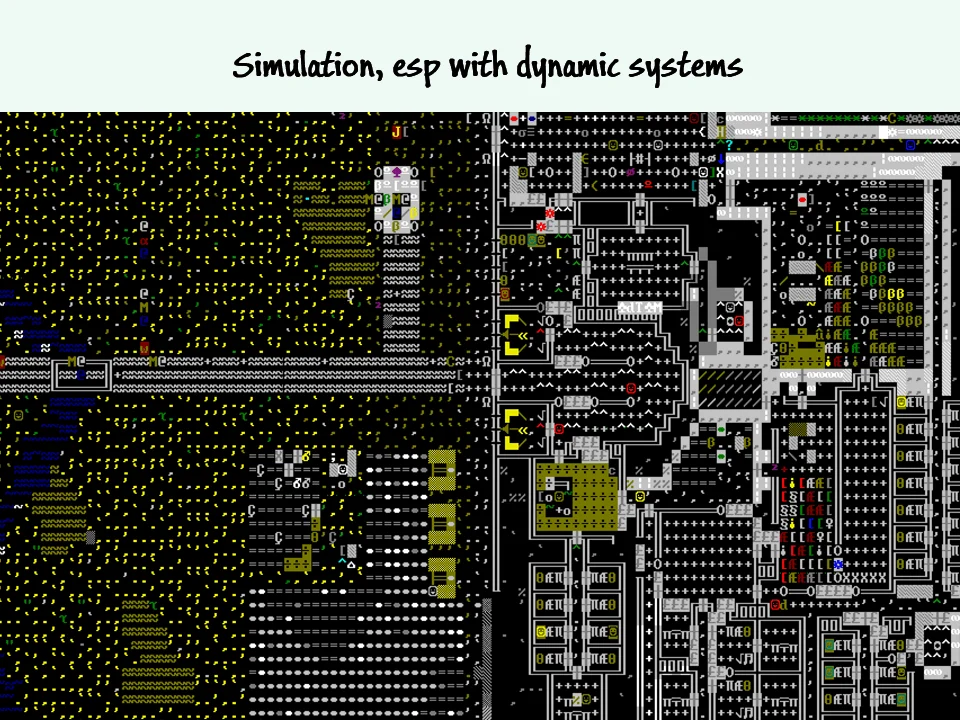
Modern games are rarely composed of a single loop. Instead, they are webs of "value chains" where the output of one loop (e.g., gathering resources) becomes the constraint or tool for another (e.g., crafting). This creates a "game economy" defined by stocks and flows rather than just currency.
9. The Workbench of Mechanics
Koster identifies several fundamental categories of problems that serve as the designer’s "workbench":
- Space and Topology: Navigation and orientation.
- Time and Pacing: Managing rhythms.
- Logic and Math: Calculation and resource management.
- Social and Psychological: Cooperation and betrayal.
- Physical: Reflexes and precision.
10. Dressing and Metaphor
The "feedback layer" includes art, lore, and narrative. This is where game design intersects with the humanities. However, Koster warns against "ludonarrative dissonance," where the metaphor of the game (e.g., a tragic story) clashes with the underlying systemic problem (e.g., high-score chasing).
11. Psychographics and Motivation
Designers must recognize that "fun" is subjective. Based on research from groups like Quantic Foundry, Koster notes that players have different "filters" for problems. Some seek destruction and competition; others seek social bonding and creative expression. A successful game knows exactly who it is posing problems for.
12. The Synthesis of Compound Art
The final step is the realization that game development is a compound art form. Expertise in a single area—be it coding, art, or narrative—is insufficient. A designer must have a "smattering" of all twelve steps to ensure the system does not dissolve into "noise" for the player.
Supporting Data: The Science of Engagement
Koster’s framework is supported by various psychological and systemic theories. Central to his argument is the Dopaminergic Reward System. Neuropsychological studies suggest that dopamine is released not necessarily when a goal is reached, but during the prediction of a reward. This aligns with Koster’s "Bottom Line" in Step One: fun is the process of making progress on prediction.
Furthermore, the concept of the Zone of Proximal Development (ZPD), originally proposed by Lev Vygotsky, provides the academic weight for Koster’s Step Seven. In a game context, if the challenge-to-skill ratio is too high, the player experiences anxiety; if it is too low, they experience boredom. The "flow state," a term popularized by Mihaly Csikszentmihalyi, is essentially the successful navigation of this zone through the twelve steps outlined above.
Data from Quantic Foundry, which Koster references, shows that player motivations are statistically clustered. For instance, players who enjoy "Action" (reflex-based problems) are often distinct from those who enjoy "Design" (resource-based problems). This data validates Koster’s insistence that designers must choose their "problems" based on specific player psychographics rather than attempting to please everyone.
Official Responses and Industry Perspectives
While Koster’s blog post serves as a personal "strategy guide," it reflects a broader movement within the industry toward "Systemic Design."
Mark LeBlanc, a fellow theorist mentioned by Koster, has long advocated for the MDA Framework (Mechanics, Dynamics, Aesthetics), which mirrors Koster’s focus on the interaction between rules and player experience. Similarly, Nicole Lazzaro’s "Four Keys to Fun" (Easy Fun, Hard Fun, People Fun, Serious Fun) provides a parallel taxonomy for the "problem types" Koster describes in Step Nine.
Industry veterans often point to the "death of genres" as a consequence of failing Koster’s Step Twelve. When developers stop innovating on the problems and only iterate on the dressing (Step Ten), players "solve" the genre. This was seen in the stagnation of the rhythm game genre in the late 2000s and the current saturation of the "Open World" formula. Koster’s framework is viewed by many as a corrective measure, urging designers to return to the "chewy" systemic roots of the medium.
Implications: The Future of Interactive Learning
The implications of Koster’s twelve-step program extend far beyond the entertainment industry. If games are indeed "learning machines," the principles used to design them are effectively principles for applied pedagogy.
- Education: By applying the "Progression Spiral" and "Feedback" steps to curriculum design, educators can create learning environments that are inherently "fun" because they focus on mastery and prediction rather than rote memorization.
- AI and System Dynamics: As games become more complex, the "web of loops" (Step Eight) will increasingly require AI to manage game economies. Koster’s view of hit points as "currency" and systems as "stocks and flows" provides a framework for integrating machine learning into game balance.
- Genre Innovation: The framework suggests that the next "great" game will not necessarily come from better graphics, but from the invention of a new category of "problem" (Step Nine) or a novel way to link existing loops (Step Eight).
Ultimately, Raph Koster’s framework demystifies the "magic" of game design, replacing it with a rigorous, pragmatic methodology. As he concludes, "When the game of making games is played right, it is always right outside the edge of what the designers know how to do." This pursuit of the unknown is where the future of the medium—and its fun—resides.




Leave a Comment