
Caesarea Maritima: A Digital Resurrection of Herod’s Grand Port City
Main Facts
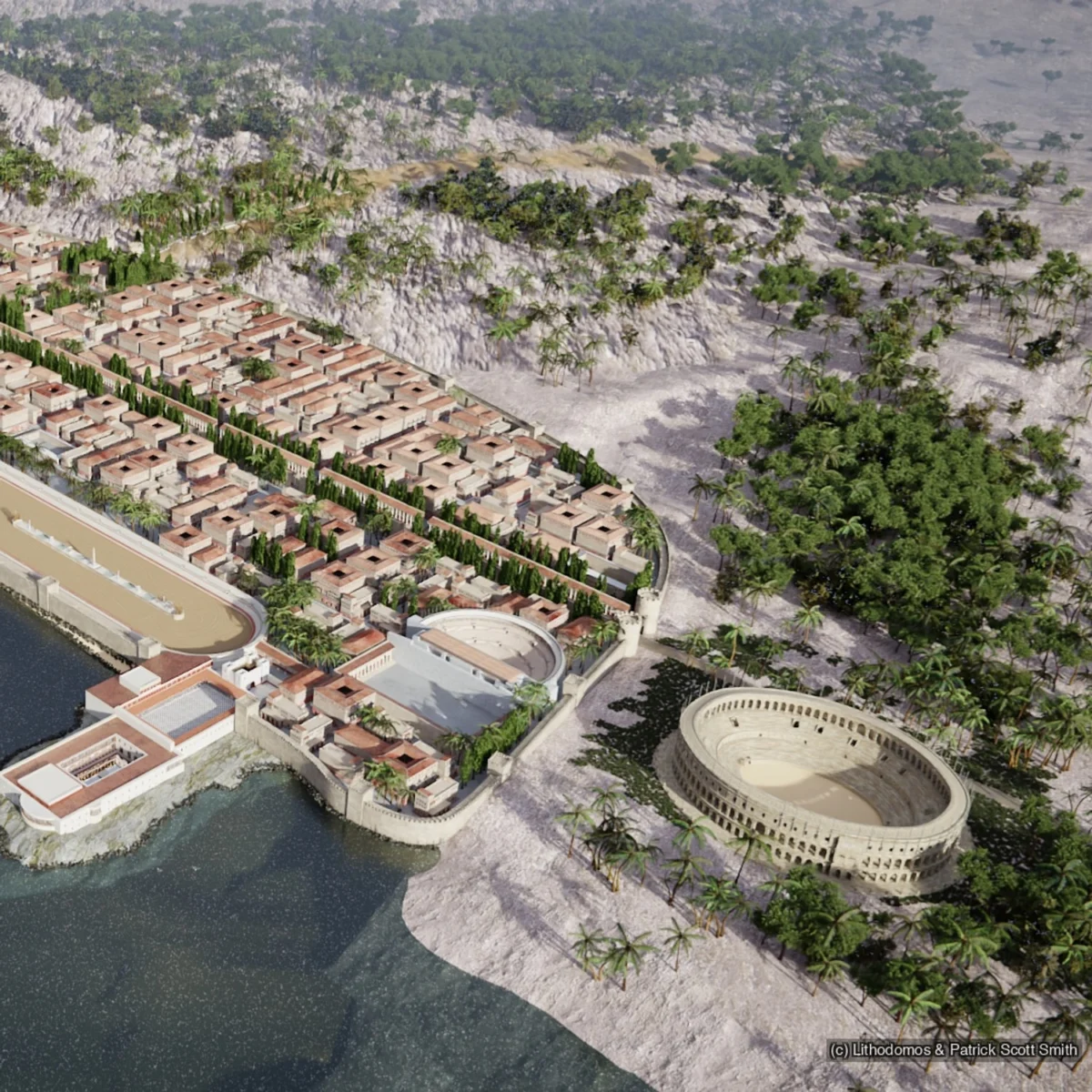
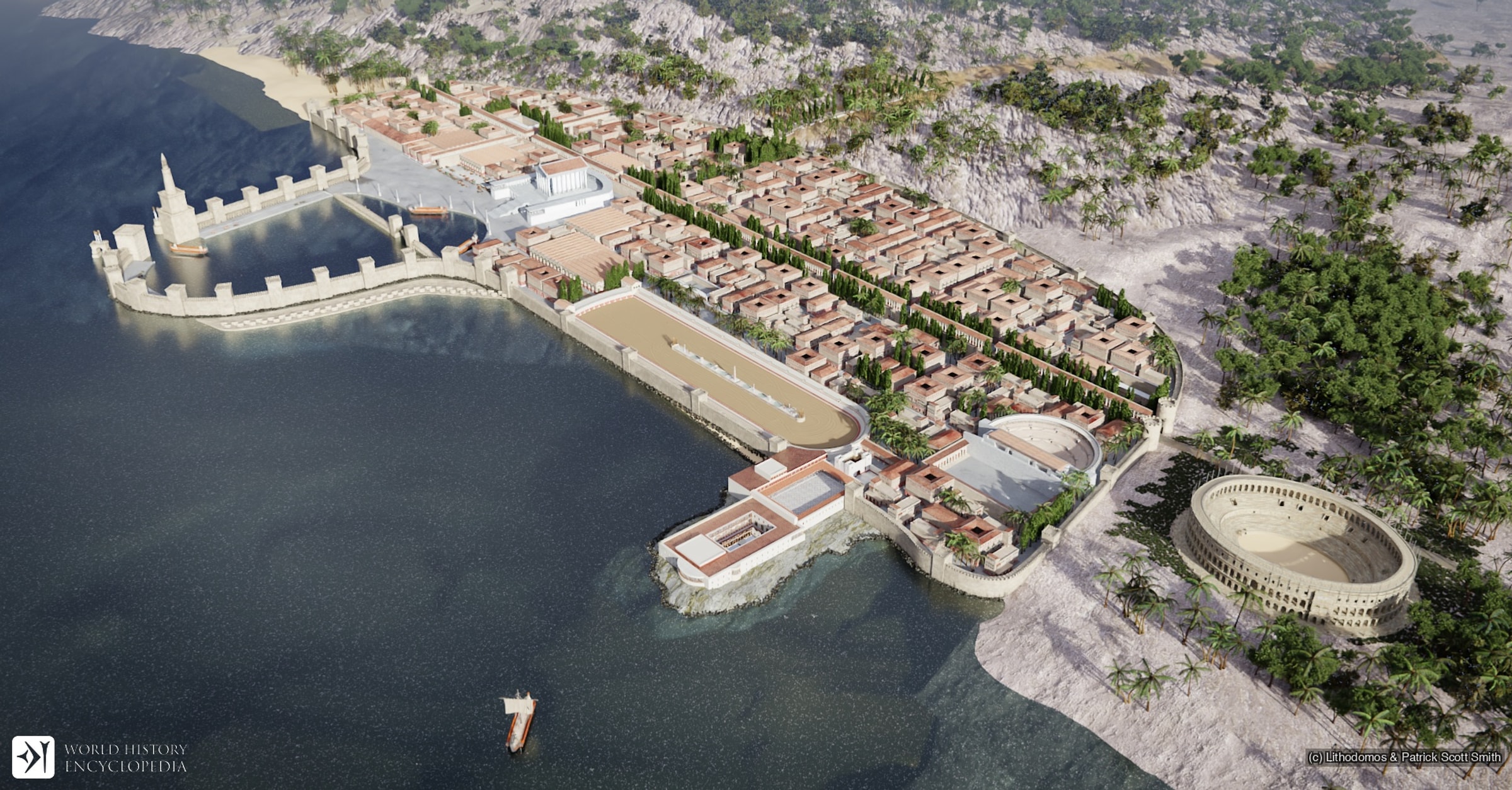
Caesarea Maritima, a name synonymous with ambition and engineering prowess, stands as a monumental testament to the architectural might of the ancient world. Commissioned by Herod the Great (reigned 37-4 BCE), this bustling metropolis on the Eastern Mediterranean coast rapidly ascended to become one of the most vital trading and military hubs of its era. Built upon earlier, more modest ruins, Herod’s vision transformed a sleepy coastal settlement into a colossal port city, boasting an unprecedented artificial harbor known as Sebastos. Beyond its maritime marvel, Caesarea was a fully realized urban center, featuring a grand temple, opulent palaces, a magnificent amphitheater, a functional theater, meticulously paved streets, and advanced waterworks, all designed to impress Rome and solidify Herod’s legacy.
Today, understanding the grandeur and intricate design of this ancient city is significantly enhanced by cutting-edge digital reconstructions. A collaborative effort between Lithodomos and Patrick Scott Smith has brought Caesarea Maritima back to life, meticulously recreating its structures and environment based on extensive archaeological reports, comparative analyses of Roman construction techniques, and invaluable eyewitness accounts from ancient historians like Flavius Josephus. These digital models offer an immersive journey into a city that once served as Rome’s strategic foothold and commercial gateway in the East.
Chronology
The story of Caesarea Maritima is a compelling narrative of ambition, power, and transformation, spanning several centuries of significant historical events.
The Vision of Herod the Great: A City from the Ground Up
The genesis of Caesarea Maritima can be traced directly to Herod the Great, Rome’s client king of Judea. In the latter years of the 1st century BCE, Herod embarked on an extraordinary building project, driven by a desire to glorify Rome, secure his own power, and establish a major port that would serve both commercial and military interests in the Eastern Mediterranean. Choosing a relatively unremarkable coastal site, Herod initiated construction around 22 BCE, intending to create a city that would rival the great Hellenistic metropolises.
Named Caesarea in honor of Caesar Augustus, and "Maritima" to distinguish it from other cities named Caesarea, the city was inaugurated in 10/9 BCE. It was an astonishing feat of engineering, particularly its harbor. Herod spared no expense, importing materials and employing thousands of skilled laborers and engineers to realize his ambitious dream. The city was designed not just as a port, but as a complete urban center reflecting Roman ideals, making it a powerful symbol of Roman influence in the region.
Engineering Marvel: The Harbor of Sebastos
Central to Caesarea’s purpose and its immediate success was its colossal harbor, Sebastos (Greek for "Augustus"). This was not a natural harbor but an artificial one, an unprecedented engineering achievement for its time. Ancient accounts, particularly those of Flavius Josephus in his Jewish Antiquities and The Jewish War, marvel at its construction. Josephus describes how Herod sank massive stones, some reportedly 50 feet long, 18 feet wide, and 9 feet thick, to form breakwaters. Modern archaeology has confirmed the use of hydraulic concrete, a Roman innovation, to create massive underwater blocks, allowing the construction of two immense moles that enclosed a basin of approximately 50 acres.
The harbor served a dual purpose: it facilitated the vast trade networks of the Roman Empire, providing a safe haven for ships laden with goods from across the Mediterranean, and it served as a crucial naval base for the Roman fleet. This strategic importance allowed Rome to project its military and commercial presence far more effectively in the Levant. Its advanced design, including a lighthouse and numerous quays, made it one of the most sophisticated ports of the ancient world, enabling efficient loading and unloading of cargo and rapid deployment of naval forces.
A Metropolis of Grandeur: Urban Planning and Infrastructure
Beyond the harbor, Herod’s Caesarea was a paragon of Roman urban planning. At its heart stood a magnificent temple dedicated to Roma and Caesar Augustus, strategically positioned on a raised podium overlooking the harbor, symbolizing the city’s allegiance and gratitude to the Roman emperor. This temple, described as one of the largest in the Roman East, showcased the architectural splendor that defined Herod’s building projects.
The city also featured several palaces, including Herod’s own lavish residence, which later served as the official dwelling for Roman governors. A grand amphitheater, capable of seating thousands, hosted gladiatorial contests and other spectacles, providing entertainment for the populace and reinforcing Roman cultural norms. Adjacent to it, a classical Roman theater presented plays and musical performances. The city’s grid plan was traversed by paved streets, adorned with colonnades, leading to a bustling forum and agora, centers of civic life and commerce. An advanced system of aqueducts supplied fresh water to the city, a necessity for a growing population and a testament to Roman engineering capabilities. These structures collectively created a cityscape that was both functional and aesthetically magnificent, a true Roman metropolis in the East.
Caesarea Under Roman Rule: A Strategic Bastion
Following Herod’s death, Caesarea transitioned fully into Roman administrative control, becoming the official seat of the Roman procurators and later governors of Judea. Its strategic location and formidable harbor solidified its role as Rome’s primary military and administrative headquarters in the province. Roman legions were regularly garrisoned there, ensuring stability and control over the restive province. This presence, however, also made Caesarea a flashpoint for tensions between the Roman authorities and the local Jewish population.
The Crucible of Revolt: Caesarea and the Jewish Uprisings
Caesarea played a pivotal, often tragic, role in the major Jewish revolts against Roman rule.
The Great Jewish Revolt (66 CE): Tensions in Caesarea were a significant catalyst for the outbreak of the First Jewish-Roman War. Disputes between Jewish and Greek inhabitants often escalated into violence, with Roman authorities frequently siding with the Greeks. A massacre of thousands of Jewish residents in Caesarea in 66 CE by Roman soldiers garrisoned there, exacerbated by ongoing religious and political grievances, helped ignite the full-scale revolt across Judea. Emperor Vespasian, then a general, used Caesarea as his primary base of operations during the brutal suppression of the revolt. After the war’s conclusion in 70 CE, with Jerusalem utterly destroyed, Vespasian elevated Caesarea to the prestigious status of a Roman colony (Colonia Prima Flavia Augusta Caesariensis), further cementing its importance within the Empire. This move rewarded the city’s loyalty and its strategic role in the Roman victory.
The Bar-Kochba Revolt (132-135 CE): Decades later, Caesarea once again served as a vital Roman military hub during the Second Jewish-Roman War, known as the Bar-Kochba Revolt. The city provided a secure base for Roman legions to suppress the widespread rebellion. The brutal end of this revolt, which resulted in the destruction of remaining Jewish communities and a vast loss of life, had profound consequences for Judea. The Roman emperor Hadrian subsequently renamed the province Syria-Palaestina to erase its Jewish identity, and Caesarea, already a colony, was formally established as the capital of this new Roman province. This administrative change solidified Caesarea’s position as the undisputed center of Roman power in the region, a status it would largely maintain for centuries.
A Flourishing Capital: The Byzantine Era
Caesarea continued to thrive well into the Byzantine period, after the 4th century CE. Its role as a provincial capital and a major port ensured continued prosperity and growth. Archaeological evidence suggests that the city’s population swelled significantly during this era, spilling beyond the original Herodian walls. To accommodate this expansion and meet the demands of a larger populace, new aqueducts were constructed, tapping into additional water sources to augment the existing supply. Estimates suggest that during its Byzantine zenith, Caesarea’s population could have exceeded 100,000 residents, making it one of the largest and most influential cities in the Byzantine East. It also became a significant center for early Christianity, hosting important ecclesiastical figures and councils.
Supporting Data
The comprehensive understanding of Caesarea Maritima, from its foundational layout to its detailed architectural elements, relies heavily on a confluence of archaeological discoveries and historical texts. Modern digital reconstruction efforts serve as a powerful synthesis of this data.
Archaeological Foundations and Historical Narratives
The digital reconstructions featured in this gallery are the product of rigorous academic and technical work. They draw extensively from the meticulous archaeological reports compiled by leading experts in the field. Scholars such as Ehud Netzer, renowned for his work on Herodian architecture; Barbara Burrell, who has shed light on Roman imperial cult and civic life; Kenneth Holum, a leading authority on Caesarea Maritima’s history; and Robert Bull, who has contributed significantly to the understanding of its urban fabric, have all provided invaluable data. Their excavations and analyses have unearthed the physical remnants of the city—foundations, walls, columns, mosaics, and artifacts—providing the blueprint for its digital resurrection.
Crucially, these archaeological findings are cross-referenced and enriched by the eyewitness descriptions of Flavius Josephus, the 1st-century Jewish historian. Josephus, who lived through the events of the Great Jewish Revolt and had intimate knowledge of Herodian building projects, offers vivid and detailed accounts of Caesarea’s construction, particularly the engineering marvel of Sebastos harbor, the grandeur of its temple, and the overall impression of the city. His narratives provide crucial contextual and descriptive information that fills gaps left by the physical remains, allowing for a more complete and accurate reconstruction.
The Art and Science of Digital Reconstruction
The collaborative work of Lithodomos and Patrick Scott Smith exemplifies the cutting edge of digital archaeology. Their methodology is grounded in a multi-disciplinary approach:
- Archaeological Reports: The primary layer of information comes directly from the published findings of excavations at Caesarea. This includes site plans, elevations, architectural fragments, and material analyses that dictate the scale, form, and materials of the reconstructed structures.
- Comparative Analysis of Roman Construction Techniques: Where specific details are missing or ambiguous, the team applies knowledge gleaned from other well-preserved Roman sites. By understanding typical Roman building practices, materials, decorative styles, and urban planning principles, they can make informed inferences about Caesarea’s appearance. This comparative approach helps to ensure the reconstructions are historically plausible and architecturally consistent with the Roman world.
- Josephus’ Eyewitness Descriptions: As noted, Josephus’s textual accounts are meticulously analyzed to inform details not evident from archaeological remains alone. His descriptions of the harbor’s scale, the temple’s dedication, and the city’s overall impression guide the aesthetic and functional aspects of the digital models.
- Herodian Fortification Work at Jerusalem and Masada: Herod the Great was a prolific builder, and his distinctive architectural style and engineering solutions are evident across his various projects. By studying his known fortifications and palaces at sites like Jerusalem and Masada, the reconstruction team can identify recurring motifs, structural characteristics, and material preferences unique to Herodian construction, applying this knowledge to the digital models of Caesarea.
This rigorous, evidence-based approach ensures that the digital reconstructions are not mere flights of fancy but scientifically informed interpretations, providing an unparalleled tool for understanding the ancient city’s physical reality.

Official Responses
The historical significance of Caesarea Maritima has elicited various "official responses" throughout its existence, from Roman imperial decrees to modern-day heritage preservation efforts.
Roman Imperial Sanction and Administration
The initial "official response" to Caesarea was its very creation, sanctioned by Herod the Great with the explicit approval and patronage of Emperor Augustus. This imperial endorsement underscored the city’s importance to Roman foreign policy and regional control. Subsequent Roman emperors and administrators continued to shape Caesarea’s destiny:
- Vespasian’s Elevation to Colony Status: After the Great Jewish Revolt, Vespasian’s decision to grant Caesarea the esteemed status of a Roman colony was a formal recognition of its strategic value and loyalty. This act conferred significant legal and economic privileges upon the city and its inhabitants, effectively integrating it more deeply into the Roman system.
- Hadrian’s Provincial Capital Designation: Following the Bar-Kochba Revolt, Emperor Hadrian’s administrative reorganization of the region, including renaming Judea to Syria-Palaestina, officially designated Caesarea as the provincial capital. This move solidified its administrative preeminence and ensured it remained the center of Roman governance, justice, and military command for centuries.
- Ongoing Garrisoning and Infrastructure: The continuous stationing of Roman legions and the investment in infrastructure like aqueducts demonstrate Rome’s sustained official commitment to Caesarea as a vital outpost.
Modern Archaeological and Heritage Management
In the modern era, the "official response" to Caesarea Maritima has transitioned to one of preservation, research, and public education. The site is now a national park in Israel, managed by the Israel National Parks Authority, signifying its protected status.
- International Collaborative Research: The Israeli Antiquities Authority (IAA) and numerous international academic institutions (e.g., the Joint Expedition to Caesarea Maritima) have officially sanctioned and conducted extensive archaeological excavations. These projects adhere to strict scientific protocols, ensuring that the uncovering and interpretation of the site’s layers are meticulously documented and preserved.
- Conservation and Restoration: Official bodies are responsible for the ongoing conservation of the unearthed structures, protecting them from environmental degradation and tourist impact. This includes stabilization of ruins, selective restoration, and the development of visitor infrastructure.
- Digital Heritage Initiatives: The collaboration between Lithodomos and Patrick Scott Smith, along with similar digital projects, represents an official embrace of new technologies for heritage interpretation. These initiatives are often supported by cultural heritage organizations and academic institutions, recognizing the value of digital models in making complex archaeological data accessible to a wider audience, from researchers to the general public. They serve as "official" digital representations, validated by the archaeological community.
- UNESCO World Heritage Status Consideration: While not yet a UNESCO World Heritage Site, Caesarea Maritima is frequently discussed in the context of such recognition, indicating its global acknowledgment as a site of outstanding universal value.
Implications
The legacy of Caesarea Maritima, both in its ancient flourishing and its modern digital resurrection, carries profound implications for our understanding of history, engineering, and cultural transmission.
Enduring Historical and Geopolitical Significance
Caesarea’s creation and subsequent evolution fundamentally altered the geopolitical landscape of the Eastern Mediterranean. Herod’s ambition, supported by Roman power, established a major port that redirected trade routes and solidified Roman dominance in the Levant. Its existence had immediate and long-term implications for:
- Regional Trade and Economy: The harbor of Sebastos became a primary conduit for goods moving between the Roman heartland and the lucrative markets of the East. This boosted the regional economy but also integrated it more deeply into the Roman imperial system, shifting economic power dynamics.
- Roman Provincial Administration: As the capital of Judea, and later Syria-Palaestina, Caesarea served as the administrative nerve center, directly influencing governance, law, and order across the province. Its strategic location meant it was always at the forefront of Roman policy implementation in the region.
- Religious and Cultural Dynamics: The city was a melting pot of Roman, Hellenistic, and Jewish cultures. Its Roman character, especially the presence of imperial cults and Roman games, often clashed with Jewish religious sensitivities, contributing to the tensions that erupted into revolts. Later, its role as a significant early Christian center further highlights its enduring cultural and religious impact.
A Testament to Ancient Engineering and Urban Planning
Caesarea Maritima stands as a remarkable testament to the ingenuity of ancient engineers and urban planners. The construction of Sebastos harbor, in particular, represents a pinnacle of Roman hydraulic concrete technology and maritime engineering, challenging the limits of what was thought possible at the time. The city’s comprehensive infrastructure—aqueducts, paved streets, public buildings—demonstrates sophisticated urban planning designed for efficiency, aesthetics, and the well-being of a large population. The implications of this are:
- Technological Advancement: The methods used at Caesarea provided valuable lessons and precedents for future Roman engineering projects, contributing to the empire’s vast network of infrastructure.
- Sustainable Urbanism (Ancient Style): The intricate water supply systems and efficient layout allowed the city to sustain a large population in a challenging environment, offering insights into ancient solutions for urban living.
The Power of Digital Archaeology
The digital reconstructions of Caesarea Maritima have significant implications for how we engage with and understand the past:
- Enhanced Understanding and Education: For students and the general public, these reconstructions transform abstract archaeological data into tangible, immersive experiences. They allow for a visual understanding of the city’s scale, beauty, and complexity that static maps or fragmented ruins cannot convey.
- Research and Analysis: For scholars, digital models serve as powerful research tools. They allow for the testing of hypotheses about architectural design, urban flow, and visual impact. Different phases of construction or alternative interpretations of archaeological evidence can be simulated, providing new avenues for analysis.
- Preservation and Accessibility: Digital reconstructions offer a form of "virtual preservation" for sites that are vulnerable to decay or destruction. They also make these historical sites accessible to a global audience, overcoming geographical barriers.
- Future of Heritage Interpretation: This collaborative work exemplifies the evolving role of technology in heritage interpretation, suggesting a future where historical sites are experienced through a blend of physical visitation and rich, scientifically informed digital engagement.
In conclusion, Caesarea Maritima was more than just a city; it was a grand statement, a strategic asset, and a cultural melting pot that profoundly shaped the Eastern Mediterranean. Its physical remains, meticulously excavated and now brilliantly resurrected through digital technology, continue to offer invaluable insights into the ambition of its founder, the might of the Roman Empire, and the enduring human quest to build, innovate, and thrive.


Leave a Comment