
The Enduring Legacy of Ursula K. Le Guin: Finding Her Spirit in the World of Anime
Last fall, amidst the relentless currents of Shibuya’s notorious morning rush, I sought refuge from my temporary status as a human sardine by finally immersing myself in Ursula K. Le Guin’s Earthsea. Having acquired an anthology of the first four novels the previous year, I frequently found myself adrift in its meticulously crafted worlds, captivated by the evocative prose and the pervasive sense of philosophical ennui. The jostle of salarymen and the accidental elbow to a high schooler’s forehead faded into insignificance as Ged wrestled with dissociation on his island homeland, or Tenar explored the labyrinth she was destined to rule, later contemplating a woman’s evolving place in a magical world and the complexities of caring for a scarred, powerful adopted daughter.
Le Guin’s writing is an experience of perpetual humbling. She stands as one of the most profoundly impactful authors in my personal literary pantheon. The Dispossessed irrevocably altered my worldview at a pivotal moment, and as a young queer person, her unflinching deconstruction of assumptions surrounding love and gender in The Left Hand of Darkness proved nothing short of revelatory. It was astonishing to discover that a novel so powerful, so prescient in its exploration of androgyny and fluid gender identity, had been penned while my mother was still in elementary school. Half a century before "genderqueer" became a commonplace term on online platforms, Le Guin meticulously crafted a staggering narrative about the cultural collision and subsequent profound love that defines the relationship between a Terran man and an ambisexual individual from Gethen. Le Guin was, and remains, intellectually and thematically miles ahead of the era she occupied.
The Challenge of Adaptation: A Ghibli Misstep
Given her monumental influence and the deep, resonant quality of her storytelling, it is perhaps ironic that the sole anime adaptation of a Le Guin work, Tales from Earthsea, directed by Goro Miyazaki, proved to be a significant disappointment. The anticipation for this project was immense, fueled by the involvement of Studio Ghibli, a production house renowned for its breathtaking animation, intricate worldbuilding, and sensitive handling of fantastical narratives. Trailers promised visual splendor, hinting at the magic Ghibli could bring to Le Guin’s universe. Yet, the film ultimately failed to do justice to either Le Guin’s literary legacy or Ghibli’s sterling reputation.
The primary criticisms centered on the extensive alterations made to the source material. For devoted Earthsea fans, too much of the original narrative and thematic depth was sacrificed or distorted, resulting in a story that felt both unfamiliar and diluted. Conversely, the condensed and often convoluted plot proved challenging for many Ghibli enthusiasts who were new to the Earthsea saga, leaving them with a sense of confusion rather than wonder. While Studio Ghibli had previously demonstrated its ability to diverge successfully from source material, as seen in the magnificent Howl’s Moving Castle, Tales from Earthsea regrettably missed the mark, highlighting the profound difficulty in translating Le Guin’s nuanced philosophical explorations and character-driven narratives to the screen. Le Guin herself expressed her disappointment, noting that the film felt more like a "different story" rather than an adaptation of her work. This critical reception underscored the challenge: Le Guin’s works are not merely fantastical adventures; they are intricate tapestries of ethics, philosophy, and deeply human inquiry, which resist easy summarization or superficial visual treatment.
Echoes of Earthsea: Anime That Capture Le Guin’s Spirit
Despite the shortcomings of its official adaptation, fans eager to discover the majesty and insight that characterize Le Guin’s writing reflected in animation need not despair. Though we continue to await an adaptation that truly honors her profound vision, several exceptional anime series exist that, whether thematically, emotionally, or narratively, evoke the distinct intellectual and imaginative landscape of Le Guin’s writing and worldbuilding. Some of these anime I hold in high esteem, while others presented challenging or even alienating viewing experiences, yet in each example, the discernible parallels and the underlying thoughtfulness are undeniable. If you are seeking stories that capture some of the magic, complexity, and profound humanism inherent in Le Guin’s imagination, I would wholeheartedly recommend the following anime.

For Fans of Earthsea: Vinland Saga
Vinland Saga is not a second-world fantasy series, nor is it a fantasy series at all in the traditional sense. Instead, I contend it is among the finest historical fiction works ever brought to manga and subsequently animated, meticulously crafted by the consistently impressive Makoto Yukimura. (It’s worth noting I recently referenced another fantastic Yukimura series, Planetes, in my piece on Hard Science Fiction in anime). A dramatized biography of the Icelandic explorer Thorfinn Karlsefni might hardly sound like ideal fodder for a seinen epic, yet thanks to Yukimura’s keen historical worldbuilding, deeply researched cultural contexts, and meticulous character arcs, Vinland Saga resonates with a truth and beauty akin to Le Guin’s most cherished works.
Like Le Guin’s iconic protagonist Ged, Thorfinn is a deeply troubled soul who commits significant errors in his youth. While he does not wield magic, Thorfinn is forged into a creature of relentless violence, his early life irrevocably shaped by the brutal murder of his father. He falls in with the very Viking band responsible for the deed, driven by an unwavering determination to exact revenge upon Askeladd, the man who shattered his childhood. The narrative, however, quickly becomes far more intricate as Thorfinn, despite his initial murderous intent, begins to develop a complex admiration for Askeladd, gradually viewing him as a surrogate father figure. Just as Ged is perpetually haunted by a cursed shadow of his own creation – a tangible manifestation of his youthful hubris and magical misstep – so too is Thorfinn haunted by the spectral presence of the countless lives he takes over the course of his violent formative years. Both characters grapple with the tangible and psychological repercussions of their actions, embarking on arduous journeys of self-discovery, penance, and the search for genuine peace.
But this early phase merely marks the genesis of Thorfinn’s expansive journey. Much like Earthsea, which unfolds across multiple novels and chronicles Ged’s evolution from an arrogant apprentice to a wise Archmage, Vinland Saga is a sprawling tale that has taken Yukimura more than two decades to bring to fruition. It encompasses vast geographical landscapes, significant temporal shifts, and profound transformations in its characters. The payoff to this epic narrative is extraordinary, delivering a deeply satisfying and emotionally resonant experience. For those who find a particular void in their hearts after immersing themselves in Le Guin’s sagas, Vinland Saga is likely to fill that Le Guin-shaped hole with its commitment to character development, philosophical inquiry into the nature of peace and violence, and breathtaking scope. It explores themes of identity, the burden of past actions, the search for a meaningful life, and the struggle to forge a path beyond cycles of revenge, all delivered with a depth and seriousness that Le Guin herself would appreciate.
For Fans of The Dispossessed: Terra E (Toward the Terra)
When I first watched the 2007 anime adaptation of Toward the Terra, I distinctly remember wondering why it wasn’t a more widely discussed phenomenon. It struck me as a fantastic anime, a pristine example of classic science fiction executed with precision and profound thought. As is often the case, I was simply out of the loop; Toward the Terra, an award-winning manga penned by Keiko Takemiya between 1977 and 1980, had already seen its first animated adaptation in 1980, long before my discovery. Like The Dispossessed, Takemiya’s work feels eerily prescient, given the socio-political developments that have unfolded in the decades since its original conception.
Set in the distant 31st millennium, Terra E‘s vision of Earth is governed by an artificial intelligence network, supercomputers collectively known as Superior Dominance. This omnipresent AI exerts an unparalleled level of control over every human life, dictating genetic traits, assigning parents, and, most chillingly, wiping the memories and personalities of adolescents during a coming-of-age ceremony to program them into becoming "useful" adults for society. In stark opposition to this authoritarian regime, a faction of humanity, known as the Mu, develops latent psychic abilities and flees Earth to colonize the stars, determined to preserve their individuality and unique genetic heritage, all while harboring a deep-seated longing to return to their ancestral homeland of Terra. The expansive story unfolds across several timelines, but its central narrative thread follows two young men, Soldier Shin and Soldier Blue, as they navigate this ideological chasm. Much like The Dispossessed, where the inhabitants of the anarchist moon Anarres constantly vie against the hierarchical, capitalist society of Urras, Terra E pits an ideologically distinct society against an authoritarian one, revealing that any would-be utopia, when examined closely, is ambiguous at best, and potentially oppressive at worst.

Paralleling Le Guin’s own groundbreaking feminism and her relentless questioning of societal norms, Takemiya’s artistic vision was instrumental in creating truly groundbreaking art within her own medium. She is celebrated as a pivotal member of the "Year 24 Group," a collective of female mangaka who revolutionized the shoujo genre in the 1970s, fundamentally shifting its production into the hands of female creators. Takemiya, in particular, was a pioneer of shounen-ai manga, credited with illustrating manga’s first openly gay kiss. Among her most acclaimed works is Kaze to Ki no Uta, an iconic and tragic narrative depicting boys falling in love at a French boarding school.
The relationships depicted in Toward the Terra, particularly the intense bond between Shin and Blue, strike me as distinctly queer-coded. This is noteworthy given the sometimes-sanitized storytelling prevalent in the decade of its initial writing. This queer subtext did not feel like queerbaiting; rather, it felt like a bold statement, perhaps quieted by the era, yet undeniably emanating from a future-thinking perspective. Both Le Guin and Takemiya, though operating in different mediums and cultural contexts, shared a remarkable capacity to dismantle conventional notions of love, identity, and societal structure, crafting narratives that explored human connection beyond predefined boundaries. Terra E delves into questions of biological essentialism, the right to self-determination, the nature of a "perfect" society, and the profound longing for a true home, themes that resonate deeply with the intellectual core of The Dispossessed.
For Fans of The Word for World Is Forest: Land of the Lustrous
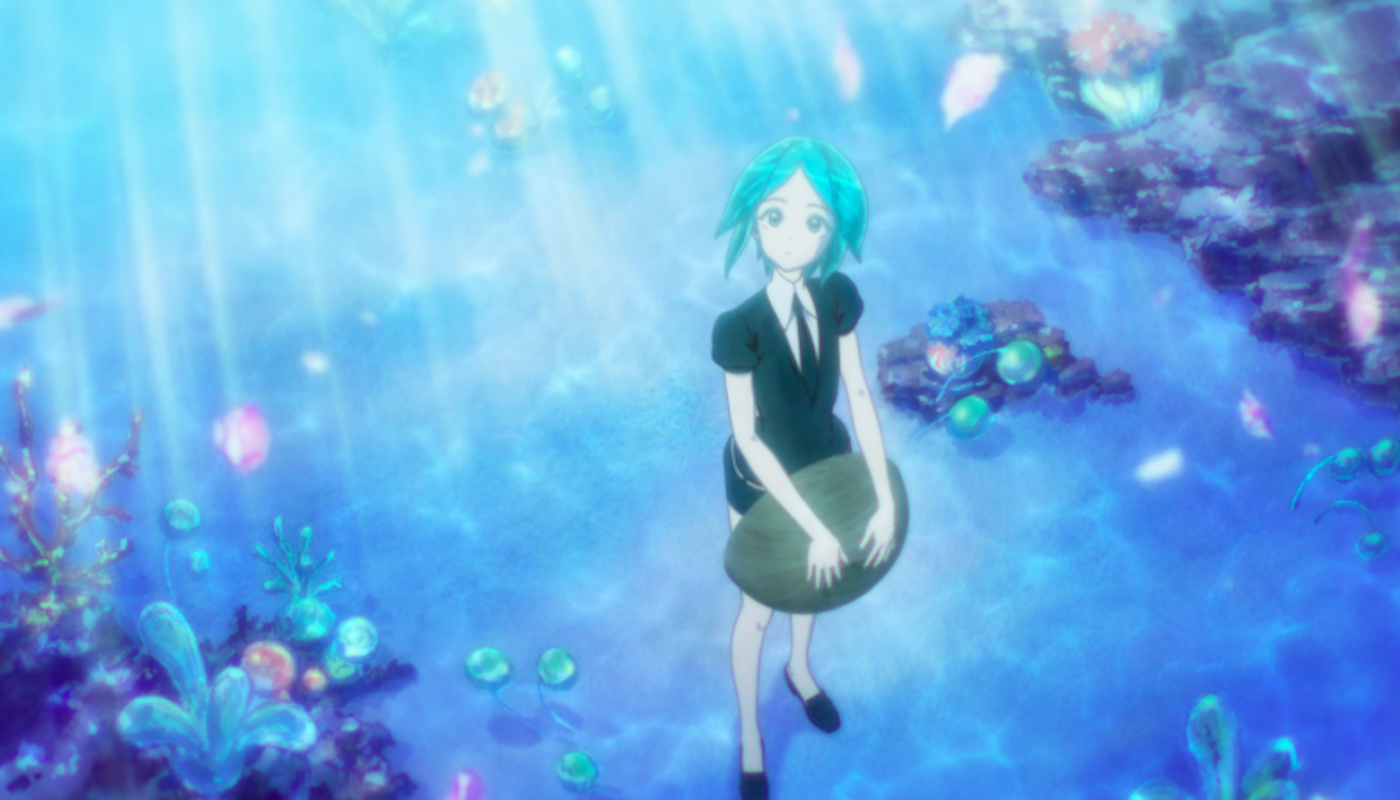
I made a concerted effort to embrace Land of the Lustrous. Visually, it is fantastic, polished to an exquisite sheen (the pun, perhaps, is intended). Its dedicated fanbase often speaks of it with glowy-eyed fondness. Land of the Lustrous features genderless protagonists and strikingly willowy character designs, leading some to perceive it as a more melancholic, introspective counterpoint to the joyful queerness of Steven Universe, with both series depicting shiny intergalactic rocks as sentient beings. The Lustrous are a race of anthropomorphic gems, perpetually struggling for survival against the invasive Lunarians, who seek to harvest their bodies for decorative purposes.
Despite its undeniable aesthetic appeal and thematic potential, I found myself unable to fully connect with the show. Part of this difficulty, I believe, stemmed from certain production choices that seemed to miss the mark regarding its stated premise of androgyny. While the Lustrous characters are explicitly established as agender and nonbinary, their visual presentation—with a cast composed entirely of female voice actors, slim torsos, long eyelashes, and, to be frank, distinct "booty" designs—felt consistently femme-presenting. This aesthetic limitation, for me, undermined some of the personal empowerment I might have otherwise felt in watching it, though I deeply appreciate that the story has resonated profoundly with many queer fans who have found solace and representation within its narrative. It raises important questions: what truly constitutes gender, or its absence, in a visual and auditory medium? Where do we draw the line between presentation and inherent identity? The observation that only alien beings are "allowed" to be nonbinary, and even then are often rendered as conventionally attractive, "pretty aliens," speaks to broader issues of representation. Yet, perhaps it is simply not the right form of representation for every individual.
Similarly, even among fervent admirers of Le Guin, not everyone holds her 1972 Hugo-winner, The Word for World Is Forest, in the same high regard as some of her other works. To be fair, any book positioned between the monumental The Left Hand of Darkness and The Dispossessed within the Hainish Cycle would have had exceedingly heavy boots to fill. However, what some critics, myself included, find somewhat lacking in Word for World is a degree of Le Guin’s characteristic subtlety. Le Guin explicitly stated she wrote the novel as a furious, direct response to the ongoing atrocities and ecological devastation of the Vietnam War. The plight of the Athsheans, a peaceful, dream-dwelling species native to a tropical world, besieged by Terran colonists seeking their valuable lumber, is tragically familiar territory. So too is the plight of the Lustrous, under constant assault and exploitation.

My intention is not to dismiss or belittle either story. Forced colonization, the exploitation of resources, and the myriad forms of violence it entails are invariably traumatic, profoundly unjust, and an enduring threat to the good things in all worlds, real or imagined. Rather, I mean to suggest that while both Land of the Lustrous and The Word for World Is Forest are essential narratives worthy of their acclaim, they largely follow storylines and thematic pathways that, regrettably, remain well-trodden throughout human history. The righteous fury at the deaths of innocents, the destruction of cultures, and the relentless march of exploitative "progress" is entirely justified, and it is profoundly unfortunate that stories such as these remain perpetually and tragically relevant. Both works compel us to confront the ethical dimensions of intervention, the consequences of cultural arrogance, and the inherent value of indigenous life and ecosystems.
For Fans of The Lathe of Heaven: Paprika
Confession: I have not yet had the privilege of reading The Lathe of Heaven. I operate under the assumption that I will, one day, which is precisely the same assumption I harbored for years regarding Satoshi Kon’s cinematic masterpiece, Paprika. I previously penned a separate piece about the years I spent adoring Satoshi Kon without ever fully immersing myself in his filmography, so this particular deferral feels entirely consistent with my personal history as a viewer.
In Le Guin’s The Lathe of Heaven, the central premise revolves around a man named George Orr, whose dreams possess the terrifying power to reshape reality itself. If Orr dreams of a world without pollution, he wakes to a world that has always been clean, with no memory of its prior state except for a faint, disturbing feeling. In Satoshi Kon’s Paprika, the narrative centers on Dr. Atsuko Chiba, a brilliant psychologist who, in her alter-ego as the vibrant dream detective Paprika, pursues a malevolent "dream terrorist" who leaves a trail of chaotic and sinister nightmares in their wake. While Orr’s involuntary dreams profoundly alter the past and present of the waking world, Chiba’s forays into dreamscapes are more overtly surreal, a kaleidoscope of whimsical, chaotic, and often profoundly unsettling imagery. Yet, the old adage that "dying in your dreams means dying in real life" resonates with a chilling prescience in both narratives. As the fragile barriers between waking consciousness and the subconscious blur and eventually threaten to collapse, the imminent threat to reality and sanity feels increasingly palpable.
While Le Guin masterfully employs her premise primarily as a vehicle for exploring profound philosophical themes of morality, responsibility, and the tenets of Taoism—questioning the ethics of intentionally altering reality and the dangers of attempting to achieve a "perfect" world—Kon’s film is more overtly colored by the anxieties and technological advancements of the early 2000s, an era when the internet was rapidly becoming a formative and ubiquitous factor in the trajectory of humankind. If Le Guin’s work is a philosophical thought experiment, then Kon’s is a breathtaking psychological thriller. Regardless of their differing tones and narrative structures, both stories provide an ample feast for thought, contemplation, and, indeed, a deep sense of dread regarding the human capacity to tamper with the fundamental fabric of existence. Both prompt us to consider the profound power of the mind and the ethical responsibilities that accompany any attempt to control or manipulate it.
For Fans of The Left Hand of Darkness: Kaiba
I stumbled upon Kaiba by pure accident, during an "Anime Grab Bag" feature I co-hosted with my fellow otaku, Bridget, where we spun a metaphorical wheel of chance to select our next viewing. Another Masaaki Yuasa arthouse masterpiece, animated in a distinctive avant-garde style that remarkably recalls the pioneering work of Osamu Tezuka, Kaiba is a veritable feast for both the eyes and the brain. The narrative begins with a nameless, heartless young man—literally, as there is a perfectly circular hole in his chest—who awakens in a peculiar, dystopian world devoid of any memories of his past identity. He pulls the audience along with him through a trippy, often unsettling universe where advanced technology allows people to transplant their minds into other bodies, and memories are stored as organic data on memory chips that resemble colorful toy blocks.

The young man, later given the name Warp, is initially aimless, propelled through the universe by the strange forces and harsh laws that surround him. In the absence of his own will, he is guided by the will of those who choose to protect him. As he gradually regains fragments of his memory, he becomes inextricably entangled in the troubles of a profoundly divided society, one where the impoverished masses struggle desperately to find suitable bodies to inhabit, while the wealthy elite traffic in memories and bodies for sport and pleasure.
I confess to a certain hesitation when drawing comparisons to The Left Hand of Darkness, precisely because it stands as such a singular and revolutionary work. However, it is also a novel fundamentally preoccupied with profound questions of what it means to be a person, whether the physical body plays an essential part in that definition, and whether anatomy ultimately matters in the least. If Warp is aimless and fragmented at the outset of Kaiba, so too is Genly Ai, the Terran envoy, when he first arrives on the planet Gethen and encounters Estraven, a native ambisexual. Both characters, through their respective journeys, become deeply engaged with their surroundings and are ultimately transformed and improved by their experiences, though they are perpetually plagued by uncertainty and profound ethical dilemmas. Both narratives powerfully argue that it is through the arduous work of understanding others, truly immersing oneself in their alien perspectives and experiences, that one can ultimately begin to understand oneself.
Kaiba mirrors The Left Hand of Darkness in its radical deconstruction of fundamental assumptions about identity, gender, and consciousness. Le Guin challenged the reader to imagine a society without fixed gender roles, forcing us to re-evaluate how much of our personality and societal structures are built upon biological sex. Kaiba takes this further, asking what happens when the very vessel of consciousness—the body—becomes a commodity, detachable and interchangeable. It explores how a society built on such premises creates new forms of inequality and existential angst. Both works compel us to look beyond superficial differences and delve into the core of what makes us sentient, feeling beings capable of love, loss, and profound connection, transcending the physical forms we inhabit.
Conclusion
Ursula K. Le Guin’s unparalleled influence on speculative fiction and her enduring relevance are testaments to the profound depth of her thought and the timeless nature of her inquiries. While the journey to find a direct anime adaptation that truly captures her spirit has been fraught with challenges, her thematic echoes resonate powerfully within the diverse and imaginative landscape of anime. From the introspective coming-of-age journeys and moral dilemmas of Vinland Saga to the ideological clashes of Terra E, the anti-colonial narratives of Land of the Lustrous, the dream-weaving psychological complexities of Paprika, and the radical explorations of identity in Kaiba, anime creators have, consciously or unconsciously, engaged with the very questions Le Guin pioneered.
These series demonstrate that even if direct adaptations falter, Le Guin’s spirit—her rigorous worldbuilding, her philosophical depth, her commitment to exploring ethical conundrums, and her unflinching examination of human nature and societal structures—lives on. Her legacy continues to inspire storytellers across mediums, proving that speculative fiction, in all its forms, possesses an extraordinary power to reflect, question, and ultimately enrich our understanding of ourselves and the myriad worlds we inhabit.

So, these are some suggestions from my own journey through Le Guin’s worlds and their anime parallels. I would love to hear your thoughts on other anime that might resonate with readers of Le Guin, whether they remind you of specific works or simply share some stylistic or thematic DNA with her many worlds. What anime do you feel truly captures the magic and complexity of Le Guin’s imagination?



Leave a Comment