
Modal Double-Faced Cards: The Unsung Heroes of Commander Deckbuilding
Introduction: The Foundation of Fluid Gameplay
In the dynamic and often unpredictable landscape of Magic: The Gathering’s Commander format, consistency is paramount. Players constantly seek innovative tools to mitigate the inherent variability of a 100-card singleton deck. Among the most impactful innovations in recent years are Modal Double-Faced Cards (MDFCs), a card type first introduced in Zendikar Rising. These ingenious designs offer a strategic duality: a non-land spell on one face and a land on the other. This seemingly simple concept has profound implications for deck construction and in-game decision-making, offering a vital layer of flexibility that smooths out draws, prevents mana screw, and provides outlets for mana flood.
MDFCs have quickly established themselves as an indispensable component of the Commander player’s arsenal. By effectively serving as both a land drop when needed and a functional spell when mana is abundant, they embody the "fiber" of a healthy Commander deck—facilitating smoother operations and reducing the number of frustrating "non-games" caused by an imbalanced mana base. While the spell sides are often perceived as "overcosted" compared to their single-faced counterparts, this perceived drawback is elegantly offset by their primary function: ensuring consistent access to mana. The true power of MDFCs lies not in raw efficiency, but in their unparalleled adaptability, allowing players to consistently advance their game plan, whether by hitting crucial land drops or deploying relevant spells. This article will delve into the mechanics, strategic implications, and optimal integration of MDFCs, championing their role as essential elements for any Commander enthusiast.
The Genesis of Flexibility: A Chronology of MDFCs
The introduction of Modal Double-Faced Cards in Zendikar Rising marked a significant evolutionary step in Magic: The Gathering card design. Prior to this, double-faced cards (DFCs) primarily featured transformative mechanics, where a permanent would flip from one state to another based on in-game conditions. MDFCs, however, presented a distinct paradigm: two entirely separate card types on a single piece of cardboard, with the player choosing which side to play from hand. This fundamental difference redefined how players approached card utility and resource management.
Zendikar Rising: The Dawn of Dual Utility
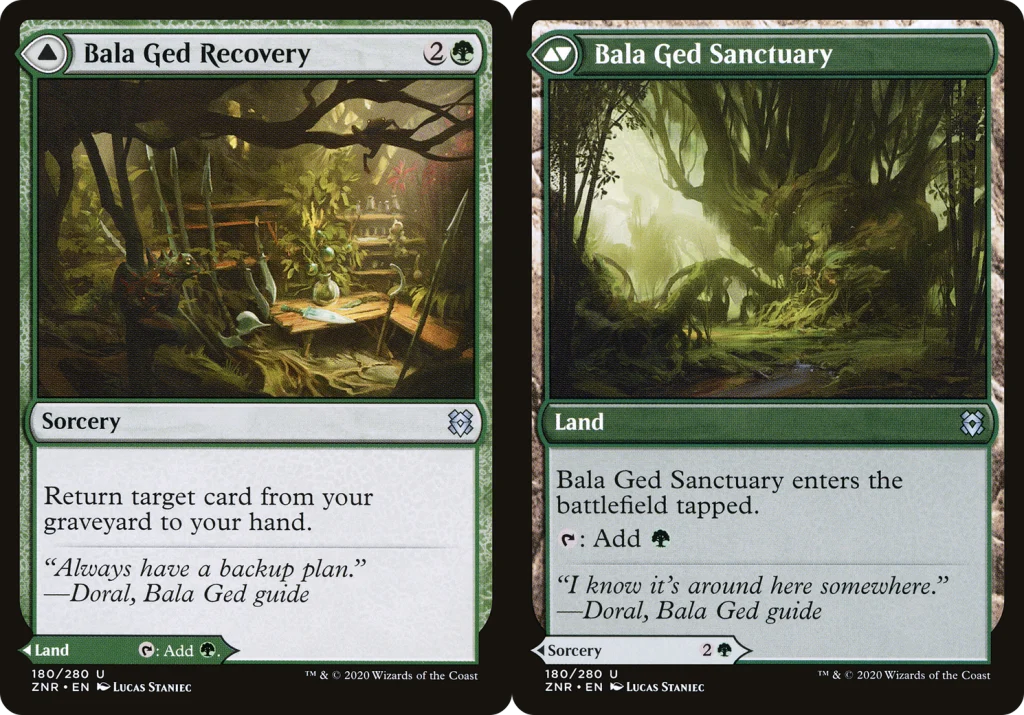
The initial batch of MDFCs in Zendikar Rising predominantly featured spell effects that were synergistic with the set’s themes of adventure and exploration, such as ramp, removal, or card advantage, paired with basic land types or non-basic lands that often entered the battlefield tapped. Examples like [[Bala Ged Recovery]] / [[Bala Ged Sanctuary]] or [[Sea Gate Restoration]] / [[Sea Gate, Reborn]] showcased the core design intent: offering a land when mana was scarce, and a spell to capitalize on mana surplus. The reception was overwhelmingly positive, as players immediately recognized the immense value of reducing variance in their Commander decks.
Kaldheim and Strixhaven: Expanding the Horizon
While Kaldheim introduced modal DFCs that were primarily spell/spell (e.g., [[Birgi, God of Story]] / [[Harnfel, Horn of Bounty]]) and Strixhaven: School of Mages brought in Lesson/Land MDFCs (e.g., [[Environmental Sciences]] / [[Environmental Sciences]]), the foundational spell/land MDFC design continued to see iterations. These subsequent sets reinforced the design philosophy of offering players meaningful choices, albeit with different modal applications. The spell/land MDFCs remained a distinct and highly valued category, celebrated for their direct impact on mana consistency.
Modern Horizons 3: Refinement and Power Creep
The release of Modern Horizons 3 further refined the MDFC landscape, particularly with the introduction of a cycle of powerful new options. This set provided each color with three options that could enter the battlefield untapped at the cost of 3 life, along with a cycle of tapped two-color MDFCs. These newer designs, such as [[Thoughtseize]]-esque effects or efficient removal, pushed the power level of the spell sides, making the choice between land and spell even more compelling. The presence of these potent, immediately usable options solidified MDFCs as a permanent and powerful fixture in Commander deckbuilding, demonstrating Wizards of the Coast’s commitment to this flexible card type.
Supporting Data: Rules, Ratios, and Strategic Nuances
The utility of MDFCs extends beyond their simple duality, intertwining with various rules interactions and statistical advantages that bolster their strategic value. Understanding these nuances is crucial for maximizing their impact in your Commander lists.
Rules Quirk: Playing Lands from Other Zones
One common misconception surrounding MDFCs is their interaction with effects that allow you to play lands from zones other than your hand, such as [[Crucible of Worlds]] or [[Courser of Kruphix]]. It is a vital rule that you can play the land side of an MDFC from your graveyard or the top of your library if such an effect is active. This is because, in any zone other than the stack or battlefield, an MDFC is considered to have the characteristics of its front face unless a rule or effect specifically states otherwise (like playing it as a land). When you play a land, you are given the option to choose the land side of an MDFC if it’s available. This interaction significantly enhances the value of MDFCs, allowing them to synergize with powerful recursion and card advantage engines, effectively increasing your "land density" for these specific strategies.
However, this flexibility does not extend to effects like [[Growth Spiral]], which instructs you to "put a land onto the battlefield." Since an MDFC is only considered a land when played as a land or once it’s on the battlefield as a land, it is treated as a non-land spell in your hand. Therefore, you cannot use Growth Spiral to put the land side of an MDFC directly into play from your hand. The distinction between "playing a land" (which involves making a choice) and "putting a land onto the battlefield" (which bypasses that choice) is critical.
Recursion and Card Types
The fact that MDFCs retain the card type of their front face in most zones opens up fascinating recursion possibilities. For instance, in a black deck, if you have a creature-fronted MDFC like [[Blackbloom Rogue]] / [[Blackbloom Bog]] in your graveyard, you can use creature recursion spells to return it to your hand. This effectively allows you to "recur a land" in situations where you might otherwise be unable to, adding an unexpected layer of resilience to your mana base. Similarly, retrieving [[Sea Gate Restoration]] / [[Sea Gate, Reborn]] with an [[Archaeomancer]] provides both a spell and a potential land drop, showcasing the profound utility of these dual-purpose cards.
The Ethos of Parallel vs. Orthogonal Play
Commander, particularly in non-competitive (non-cEDH) environments, often trends towards "parallel play." This involves each player building and executing their own game plan, drawing cards, making land drops, and deploying threats, akin to building sandcastles side-by-side. The player who does the most—makes the most land drops, draws the most cards, performs the greatest number of game actions—is typically in the strongest position. MDFCs are perfect facilitators for parallel play, as they ensure you’re always putting "something on the castle," whether it’s a land for mana or a spell to advance your board. They act as both mana and outlet, keeping your engine running smoothly.

However, MDFCs are also potent tools for "orthogonal play," which involves directly interacting with and disrupting opponents’ game plans. Many MDFCs feature interaction on their front sides, such as [[Fell the Profane]] (removal), [[Sink into Stupor]] (discard/draw), or [[Witch Enchanter]] (enchantment removal). These cards provide crucial answers to opponents who are pulling ahead, offering the flexibility to act as removal when needed, but gracefully transforming into a land drop if the immediate threat is absent. This dual functionality ensures that your deck is never truly dead-drawing, providing a valuable safety net while maintaining the capacity for decisive intervention.
Community Reception and Design Philosophy
Upon their debut, Modal Double-Faced Cards were met with widespread enthusiasm from the Magic community. Players, particularly those entrenched in the Commander format, immediately recognized the elegant solution they offered to long-standing deckbuilding dilemmas. The core problem MDFCs addressed was the tension between mana consistency and spell density. Traditional deckbuilding often forced a compromise: include enough lands to avoid mana screw, but at the cost of reducing the number of impactful spells, or pack in more spells and risk falling behind on mana. MDFCs provided a way to have both, albeit with the caveat of often "overcosted" spell effects.
Wizards of the Coast’s Intent
The design philosophy behind MDFCs, as articulated by Wizards of the Coast, aimed to:
- Reduce Non-Games: By offering a land on one side, MDFCs significantly reduce instances of mana screw, where a player draws too few lands to cast their spells. Conversely, the spell side provides an outlet for mana flood, where a player draws too many lands and lacks spells to utilize their mana. This leads to more engaging and interactive games.
- Increase Decision Points: MDFCs introduce a constant, low-stakes decision point: "Do I need a land now, or can I afford to wait for a spell later?" This choice, often made in the early turns, adds depth to gameplay without overly complicating the rules.
- Enhance Flexibility: The ability to pivot between a land and a spell based on the current game state provides players with more options and greater agency, allowing them to adapt to diverse board states and opponent strategies.
The community’s reception largely validated these design goals. While some purists initially expressed concern about the potential for "complexity creep" or the power level of certain spell sides, the overall consensus gravitated towards appreciation for the increased fluidity they brought to the game. MDFCs quickly became a staple, demonstrating that thoughtful innovation in card design can significantly enhance the play experience across various formats, especially Commander.
Implications: Deckbuilding Strategies and Optimal Integration
The strategic implications of integrating MDFCs into your Commander deck are multifaceted, influencing everything from your mana curve to your overall game plan. The decision of how to include them—whether replacing lands or non-lands—dictates their precise role and impact.
The "Replacement" Conundrum: Lands vs. Non-Lands
-
Replacing Non-Lands (Conservative Approach):
- Method: Swap out a traditional spell (e.g., [[Reclamation Sage]]) for an MDFC with a similar effect on its spell side (e.g., [[Witch Enchanter]]).
- Impact: This strategy effectively increases your relative land density. While the spell side of the MDFC might have a slightly higher mana cost, the statistical increase in your land count means you’re more likely to hit your land drops consistently. This, in turn, ensures you have the mana available to cast the slightly more expensive MDFC spell when needed. This approach is less "greedy" and generally leads to more stable mana.
- Recommendation: Ideal for decks that prioritize consistent mana development and want a safety net against mana screw, especially in 3+ color decks where mana fixing is already a concern. Aim for a total of 37-40 "land slots" (actual lands + MDFCs).
-
Replacing Lands (Aggressive Approach):
- Method: Swap out basic lands or less impactful utility lands for MDFCs.
- Impact: This approach aims to reduce the likelihood of mana flood by turning potential "dead draws" (excess lands) into actionable spells. By reducing your dedicated land count, you increase the density of spells that can also serve as lands. This strategy is more aggressive and requires a keen understanding of your deck’s mana requirements. While it can lead to more explosive plays and fewer late-game floods, it carries a slightly higher risk of early-game mana screw if you aggressively cast spell sides.
- Recommendation: Often favored in monocolor or two-color decks, where mana fixing is less strenuous, and the goal is to maximize utility from every card. Monocolor decks, in particular, benefit immensely from packing as much utility as possible into their mana base, transforming otherwise plain lands into flexible threats or answers. Aim for a total of 33-37 "land slots."
Optimal Ratios and Color Considerations
The "sweet spot" for lands in Commander is generally considered to be around 37. MDFCs allow you to maintain this consistency while adding flexibility.
-
3+ Color Decks: For these mana-hungry decks, consistency is key. I recommend a conservative approach, including 3-5 MDFCs, almost exclusively focusing on the untapped options that sacrifice life (from Modern Horizons 3 or other sets) or the most impactful spell effects. These decks cannot afford tapped lands in the early game. Consider MDFCs akin to utility lands like [[Otawara, Soaring City]], providing an untapped mana source with an optional, situational effect.
-
2-Color Decks: With slightly more stable mana bases, 2-color decks can afford more flexibility. Aim for 5-7 MDFCs, typically 4-5 untapped options and 1-2 of the better tapped 2-color MDFCs if their spell sides are highly relevant. The reduced pressure on mana fixing allows for more experimentation with the tapped dual MDFCs.
-
Monocolor Decks: This is where MDFCs truly shine. Monocolor decks often struggle with a lack of diverse utility lands and the inability to splash for powerful off-color spells. MDFCs become a primary method for injecting utility and flexibility. I advocate for jamming essentially every playable option, often 7-9+ MDFCs. This maximizes the utility derived from a restricted mana base, ensuring that every land drop contributes significantly to the game plan.
Top MDFC Selections (Illustrative Examples)
While specific choices depend on your deck’s strategy, some MDFCs stand out due to their sheer efficiency or unique utility.
-
White:
- [[Emeria’s Call]] / [[Emeria, Shattered Skyclave]]: A powerful late-game finisher or board presence on the spell side, and an untapped land that costs 3 life early.
- [[Valiant Endeavor]] / [[Valiant Keep]]: Removal for a problematic creature or artifact, combined with an untapped land.
- [[Sejiri Shelter]] / [[Sejiri Glacier]]: Crucial protection for a key creature, or a land.
-
Blue:
- [[Sea Gate Restoration]] / [[Sea Gate, Reborn]]: A massive draw spell in the late game, or an untapped land. Incredibly impactful.
- [[Glasspool Mimic]] / [[Glasspool Shore]]: A versatile clone effect or an untapped land.
- [[Jwari Disruption]] / [[Jwari Ruins]]: A conditional counterspell, or a tapped land. Good for budget or specific tempo strategies.
-
Black:
- [[Agadeem’s Awakening]] / [[Agadeem, the Undercrypt]]: A powerful reanimation spell scaling with mana, or an untapped land.
- [[Malakir Rebirth]] / [[Malakir Mire]]: Protection/recursion for a creature, or a tapped land. The effect is often worth the tapland.
- [[Fell the Profane]] / [[Fell the Quarry]]: Efficient removal or an untapped land. A strong option for any black deck.
-
Red:
- [[Shatterskull Smashing]] / [[Shatterskull, the Hammer Pass]]: Scalable removal for creatures/planeswalkers, or an untapped land.
- [[Spikefield Hazard]] / [[Spikefield Cave]]: Crucial early-game removal for small creatures, or a tapped land.
- [[Valakut Awakening]] / [[Valakut Stoneforge]]: A potent wheel effect for hand sculpting, or an untapped land.
-
Green:
- [[Kazandu Mammoth]] / [[Kazandu Valley]]: An early threat that grows, or a tapped land.
- [[Bala Ged Recovery]] / [[Bala Ged Sanctuary]]: Recursion for any card type, or a tapped land. Extremely flexible.
- [[Tangled Florahedron]] / [[Tangled Vale]]: A 2-mana vanilla mana dork or a tapped land. Its strength lies in providing consistent early-game choices, either ramping or making a land drop, crucial for commanders costing 4+ mana.
Two-Color MDFCs:
While generally less powerful than their monocolor counterparts, some two-color MDFCs offer excellent utility for their respective color pairs. Top contenders include [[Revitalizing Repast]] (Orzhov, life gain/draw or land), [[Waterlogged Teachings]] (Dimir, tutor or land), and [[Legion Leadership]] (Boros, anthem/tokens or land), offering impactful spell effects for their colors.
Conclusion: Embracing the Future of Flexibility
Modal Double-Faced Cards represent a paradigm shift in how Magic players approach deck construction and in-game strategy. By elegantly addressing the fundamental tension between mana consistency and spell density, they empower players to build more resilient, adaptable, and ultimately, more fun Commander decks. While they may not always be the flashiest cards in your collection, their quiet efficiency and profound flexibility make them unsung heroes that consistently smooth out the rough edges of a 100-card singleton format.
Incorporating MDFCs is not merely about slotting in powerful cards; it’s about embracing a philosophy of flexibility. Whether you choose to replace non-lands for increased safety or lands for enhanced utility, the strategic advantages are undeniable. They minimize the dreaded "non-games" where a player is hopelessly mana screwed or flooded, ensuring that every participant at the table has a meaningful opportunity to execute their strategy. By including a judicious number of MDFCs—typically 37-40 "land slots" in total, varying by deck color and archetype—you invest in a more consistent, engaging, and enjoyable Commander experience.
As Magic: The Gathering continues to evolve, the design principles embodied by MDFCs are likely to inspire future innovations in card flexibility. Their enduring impact on Commander is a testament to the power of offering players meaningful choices at every stage of the game. So, next time you’re refining your Commander list, consider the quiet strength of MDFCs. They might just be the most impactful "boring" cards you can include.
For those eager to push the boundaries of card utility even further, join us next week as we explore a deck that maximizes this flexibility to an extreme: the triumphant return of "60 to 99," where we convert the notoriously complex and surprisingly budget-friendly Pauper Oops! All Spells into an EDH masterpiece. Don’t miss it!
Have any questions or feedback? Drop us a note in the comments below or email us at [email protected]. Want articles like this linked in your inbox every Monday morning? Sign up for our newsletter. And don’t forget that you can support us on Patreon for backer rewards like early video content, Administratum access, an ad-free experience on our website, and subscriber-only content covering competitive Warhammer 40K!



Leave a Comment