
The Vigil of the Soul: Cinga Samson’s ‘Ukuphuthelwa’ and the Architecture of the Sublime
By [Your Name/Agency]
In the quiet, shadowed corridors of contemporary African art, few voices resonate with the same somber intensity as that of Cinga Samson. The South African artist, celebrated for his mastery of darkness and the metaphysical, has unveiled a new body of work titled Ukuphuthelwa. The exhibition, which serves as a profound meditation on the limits of representation and the heightened state of spiritual consciousness, is slated to remain on public view through April 18, 2026.
The title, an isiXhosa word from the artist’s native tongue, translates literally to being "unable to sleep." Yet, as Samson is quick to clarify, the term is a world away from the clinical, often negative connotations of the English word "insomnia." For Samson, Ukuphuthelwa is not a malady to be cured, but a sacred threshold—a state of "spiritual alertness" where the senses are sharpened by the absence of light, and the mind becomes a vessel for the vast, moving reality of the universe.
Main Facts: The Anatomy of a Night Vision
The exhibition represents a significant milestone in Samson’s career, further refining his "occluded palette"—a signature range of near-blacks, carbon, and deep Prussian blues that have come to define his aesthetic. These are not merely paintings of the night; they are paintings of the state of being awake within it.
The collection features a recurring cast of men-like figures, feral yet sentinel-like dogs, and the flora native to the South African landscape. However, these subjects are stripped of their quotidian identities. In a bold stylistic choice, Samson’s figures are depicted without pupils. By leaving the eyes unpainted, Samson allows the "light" of the background to circulate through the faces, rendering the human forms porous and inextricably linked to the atmosphere they inhabit.
The exhibition’s central thesis revolves around the "existential gravity" of the image. Samson grapples with the inherent failure of the artist to represent the "whole truth" of reality, acknowledging that he can only ever create symbols. Through these symbols, however, he attempts to bridge the gulf between the static painted sign and the fluid, infinite experience of life.
Chronology: The Evolution of a Spiritual Palette
The trajectory leading to Ukuphuthelwa reflects a long-standing preoccupation with the "true and honest painting." Samson’s earlier works established his interest in the vernacular of South African life, but this 2026 series marks a shift toward a more philosophical, almost monastic, rigor.
- Phase I: The Search for Honesty: Early in the development of this series, Samson questioned the authority of the image. He began to view the canvas not as a window, but as a barrier that he needed to dismantle.
- Phase II: The Mastery of the Occluded Palette: Throughout the production of these works, Samson experimented with the "magic trick" of light. By applying thin layers of glaze and subsequently wiping them back, he created a brooding chromatic density that gives the paintings a rhythmic, flickering quality.
- Phase III: The Linguistic Integration: As the series neared completion, Samson titled the works with enigmatic isiXhosa phrases—Imfihlo (Secret), Intsingiselo (Meaning), and Umlindo (Watcher). This decision was a conscious effort to highlight the "instability of interpretation," as the weight of these words in their original language exceeds their English translations.
Supporting Data: Technical Precision and Symbolism
To understand the impact of Ukuphuthelwa, one must look at the technical minutiae that Samson employs to destabilize the viewer’s perception.
The "Magic Trick" of Light
In works such as Isiganeko (2026), Samson’s technique is on full display. He leaves large sections of the under-drawing visible, creating moments of transparency that contrast with the heavy, glazed sections of the figure. This produces an "optical and psychical unsteadiness," forcing the viewer to engage in "slow, contemplative looking." The light does not strike the objects from a singular source; rather, it seems to emerge from within the darkness itself.
The Symbol of the Dog
The inclusion of dogs in Intsingiselo II (2026) provides a case study in the subjectivity of symbols. To a Western eye, the dog might represent domestic loyalty. However, within an amaXhosa framework, the dog is a signifier of the ancestors—a protective, guiding principle that bridges the world of the living and the spirit realm. Samson uses this duality to prove that the image is a relative symbol, never an equivalent to reality.
The Landscape of the Sublime
In Tshee (2026), Samson explores the affective register of the sublime. A vast field meets a murky sky, interrupted only by a "moonwashed cloud." The brilliance of the white against the cold, eerie atmosphere creates a sensation of "mute enormity." This oscillation between the approachable and the overwhelming is, for Samson, the same energy existing in different forms—the friendly sky and the scary void are one and the same.
Official Responses and Critical Context
Curators and art historians have noted that Samson’s work occupies a unique space in the contemporary landscape, one that refuses the "pretence of representation."
"Samson is not interested in individual transcendence through the subordination of nature," notes one contemporary critic. "Instead, he seeks a hypersensitivity to ordinary forms. His work suggests that the divine is not found in some distant ‘elsewhere’ but is present in the vernacular of all things—the foliage, the bird in flight, the dark sky."
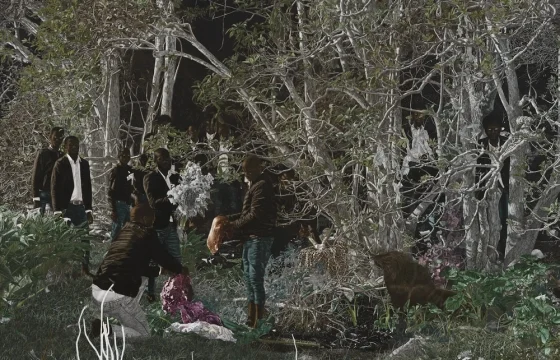
The artist himself describes his process as an attempt to capture a "vast reality that is continuously in motion." By focusing on ritual—as seen in Umlindo (Watcher)—Samson argues that the ritual itself is merely an opening. The figures gathered in the forest clearing with wildflower bouquets are not performing a specific, named ceremony; they are engaging in a "collective need for orientation" in the face of the unknown.
The use of isiXhosa is also a critical component of the exhibition’s reception. By leaning into the "interstice of two languages," Samson ensures that the meaning of the work remains somewhat elusive, protecting the "authority of the unnameable."
Implications: The Future of the Representational Image
The exhibition Ukuphuthelwa carries significant implications for the future of representational art, particularly from the Global South. Samson’s work suggests that the "limits of representation" are not a weakness to be hidden, but a tool to be harnessed.
- Redefining the Human Form: By removing pupils and creating "human forms enmeshed with the landscape," Samson challenges the anthropocentric view of art. His figures do not "look" at the world; they know the world from within. This suggests a move toward a more ecological and spiritual understanding of the human condition.
- The Ethics of Symbolism: Samson’s insistence on the "open-ended nature of symbols" serves as a critique of the desire for easy, consumable meaning in art. He posits that if an image could truly represent reality, it would cease to be art and become a mere document.
- Spiritual Alertness as a Cultural Value: At a time of global distraction, Samson’s elevation of "sleeplessness" to a state of spiritual alertness offers a counter-narrative to the modern obsession with productivity and "curing" the natural rhythms of the body.
In the final analysis, Cinga Samson’s Ukuphuthelwa is an invitation to embrace the dark. It is an acknowledgment that while we may never be able to paint the "whole truth," we can find a link to the divine—which Samson defines as "everything"—through the honest manipulation of light, shadow, and symbol. As the exhibition continues through 2026, it stands as a testament to the power of the unnameable and the enduring mystery of the ordinary.
Exhibition Details:
- Artist: Cinga Samson
- Ukuphuthelwa
- Duration: Through April 18, 2026
- Medium: Oil on canvas, various dimensions


Leave a Comment