
Navigating the Nine Worlds: A Definitive Guide to the Best Norse Mythology Books
Main Facts
The allure of Norse mythology, with its pantheon of enigmatic gods, valiant heroes, and dramatic sagas, has captivated imaginations for centuries. From the thunderous might of Thor to the cunning wit of Loki and the all-seeing wisdom of Odin, these ancient tales from Northern Europe have experienced a profound resurgence in contemporary popular culture. However, the sheer volume of available literature, ranging from casual retellings to rigorous academic analyses, can be an overwhelming landscape for both budding enthusiasts and seasoned scholars alike. To address this growing challenge, a comprehensive list of the "10 Best Books on Norse Mythology," last updated in April 2019, has been meticulously compiled to serve as an indispensable compass for navigating this rich literary realm. Curated to cater to a spectrum of learners, from novices seeking an accessible entry point to intermediate students eager to deepen their understanding, this guide meticulously ranks resources from the most beginner-friendly to the most advanced, ensuring a structured and rewarding exploration of the ancient myths and religion of the Norse and other Germanic peoples.
Chronology: From Ancient Echoes to Modern Resurgence

The genesis of Norse mythology lies deep within the pre-Christian oral traditions of Scandinavia and other Germanic lands, flourishing during the Viking Age (c. 793–1066 CE). These stories, imbued with the worldview of a seafaring, warrior culture, spoke of creation from primeval chaos, the cosmic struggle between order and destruction, and the ultimate fate of the gods at Ragnarök. Crucially, much of what we know today was preserved in written form during the medieval period in Iceland, particularly through the Poetic Edda and Prose Edda, compiled and written down centuries after the peak of Viking influence. These primary sources, however, were often complex, fragmented, and written for audiences already familiar with the underlying cultural context, making direct engagement challenging for modern readers.
Following the Christianization of Northern Europe, Norse mythology faded from mainstream consciousness for centuries, relegated largely to scholarly curiosity. A significant resurgence began during the Romantic era of the 18th and 19th centuries, fueled by a renewed interest in national histories, folklore, and indigenous spiritual traditions. This period saw figures like Richard Wagner draw heavily from Norse sagas for his epic Ring Cycle operas, reintroducing these narratives to a broader European audience, albeit often with significant artistic liberties. The 20th century further cemented this revival, with literary giants such as J.R.R. Tolkien openly acknowledging the profound influence of Norse mythology on his foundational works like The Lord of the Rings, which in turn inspired generations of fantasy writers and readers.
The turn of the 21st century has witnessed an unprecedented explosion of interest, largely driven by mainstream popular culture. Marvel Comics’ adaptations of Thor and other Norse deities, blockbuster films, popular television series, and video games like God of War have thrust these ancient narratives into the global spotlight. This widespread popularization, while exciting, has simultaneously created a landscape rife with interpretations, adaptations, and varying degrees of historical accuracy. Consequently, the need for authoritative yet accessible guides became paramount. The creation of curated lists, such as the one presented by Norse-Mythology.org, directly responds to this demand, offering a reliable pathway through the dense forest of available information, guiding readers toward resources that honor both scholarly rigor and narrative appeal. The list, first published and periodically updated, including its April 2019 revision, stands as a dynamic effort to maintain relevance in a rapidly evolving field of study and popular engagement.
Supporting Data: An In-Depth Look at the Top 10 Books
The curated list meticulously categorizes books to facilitate a progressive learning journey, moving from introductory retellings to essential primary sources and advanced reference materials.
H3: Tier 1: Foundational & Accessible Introductions
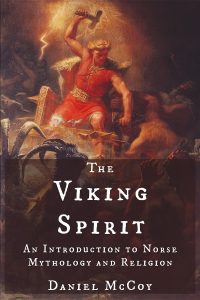
1. The Viking Spirit: An Introduction to Norse Mythology and Religion by Daniel McCoy
Authored by the creator of the prominent Norse-Mythology.org website, The Viking Spirit is presented as the quintessential starting point. Its declared intention is to offer an ideal introduction, blending scholarly accuracy with a clear, engaging narrative style. The book distinguishes itself by offering an impressive 34 retellings of epic Norse myths, a breadth unmatched by many other introductory texts. Beyond the stories, it provides a comprehensive overview of the historical Viking religion, delving into the gods and goddesses, the concept of fate, afterlife beliefs, moral codes, cosmic structure, religious practices, and the role of magic. This dual focus on both the mythical narratives and their underlying religious context makes it a robust resource for the 21st-century learner, bridging the gap between engaging storytelling and historical non-fiction.

2. Norse Mythology by Neil Gaiman
Acclaimed fiction writer Neil Gaiman brings his signature lyrical prose and storytelling mastery to this selection of Norse myths. Drawing from a wellspring of inspiration that has informed much of his earlier work, including the highly successful novel American Gods, Gaiman’s Norse Mythology excels in its ability to transform ancient tales into a captivating, novelistic experience. While it focuses on a select few, albeit crucial, myths—from creation to the cataclysm of Ragnarök—it fleshes out these narratives with remarkable depth and character development. The book’s strength lies in its ability to make these timeless stories resonate with a modern audience, turning them into a great modern novel in their own right. While less focused on the historical religious context, it is widely lauded for its literary brilliance and serves as an excellent gateway for those primarily interested in the compelling narratives. Many readers have noted its complementary nature when paired with more fact-driven works like The Viking Spirit.
3. The D’Aulaires’ Book of Norse Myths by Ingri and Edgar Parin d’Aulaire
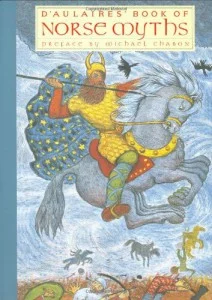
For parents seeking an introduction to Norse mythology for younger readers, The D’Aulaires’ Book of Norse Myths stands as an unrivaled classic. Specifically crafted for children aged 5-9 (kindergarten through fourth grade), this book offers lovingly and evocatively written retellings of the Norse tales, accompanied by vivid color illustrations. Its accessible language and engaging descriptions of the gods and their world are designed to ignite a child’s imagination and foster an early interest in the subject. Crucially, the d’Aulaires carefully curate the content, omitting the more lurid or violent elements of Norse mythology that might be deemed unsuitable for a young audience, ensuring a completely "family-friendly" experience. Its enduring popularity testifies to its success in making complex myths understandable and enjoyable for a new generation.
4. Gods and Myths of Northern Europe by H.R. Ellis Davidson
Hilda Roderick Ellis Davidson, a titan among 20th-century Norse mythology scholars, distinguished herself by making her profound knowledge accessible to a general audience. Gods and Myths of Northern Europe exemplifies this approach, offering a scholarly yet highly approachable examination of pre-Christian Norse and Germanic religion. Unlike books primarily focused on retelling myths, Davidson’s work delves into the historical religious practices, beliefs, and societal structures from which these tales emerged. Readers gain a thorough and nuanced understanding of the broader religious context, transcending mere storytelling. For decades, this book has been a cornerstone for those seeking a rigorous, academic perspective on the Viking Age without requiring specialized prior knowledge.

5. Myth and Religion of the North: The Religion of Ancient Scandinavia by E.O.G. Turville-Petre
Building upon the academic foundations laid by Ellis Davidson, E.O.G. Turville-Petre’s Myth and Religion of the North is a more advanced, yet equally essential, overview of ancient Scandinavian religion. Turville-Petre, a legendary Oxford Old Norse professor, offers unparalleled comprehensiveness and acuity of insight. While more academic in tone, its depth is astonishing, establishing it as a definitive reference book in universities worldwide. Often regarded as an "intellectual initiation," this work is considered indispensable for anyone serious about moving beyond introductory understanding into the deeper complexities of Norse mythology and religion. It is a testament to the rigorous scholarship required to fully grasp the nuances of this ancient belief system.
H3: Tier 2: Engaging with Primary Sources
6. The Poetic Edda translated by Jackson Crawford
Transitioning to the bedrock of Norse mythology, The Poetic Edda represents a collection of Old Norse mythical and heroic poems, composed by anonymous poets in Iceland or Scandinavia during the Viking Age and shortly thereafter. These poems constitute the single most important primary source for understanding Norse mythology and religion. Jackson Crawford’s translation is lauded for its remarkable clarity and accessibility, a rare feat given the inherent challenges of translating ancient poetry. While acknowledging that no translation can perfectly capture the full aesthetic and philosophical grandeur of the original Old Norse, Crawford’s version successfully preserves much of the original’s beauty while making it understandable to modern readers, striking a delicate balance often missed by other attempts.
7. The Prose Edda by Snorri Sturluson, translated by Jesse L. Byock
Written in the 13th century by the Icelandic scholar Snorri Sturluson, The Prose Edda is frequently regarded as the second most vital source for Norse mythology, complementing The Poetic Edda. Snorri’s original intent was to create a treatise explaining the mythology behind conventional Old Norse poetry, serving as a guide for poets and those seeking to comprehend older poetic works. His compilation provides a systematic summary of the narratives, deities, and cosmology of Norse mythology. While scholars continue to debate the exact accuracy of Snorri’s interpretations—acknowledging that his own embellishments or misunderstandings might be present—his Prose Edda remains an invaluable repository of facts that would otherwise have been lost to history. Jesse L. Byock’s translation is highly regarded for its precision and scholarly apparatus.

8. The Saga of the Volsungs translated by Jackson Crawford
Among the Icelandic sagas, which alongside the Eddas form the literary backbone of our knowledge of pre-Christian Germanic peoples, The Saga of the Volsungs stands out as perhaps the most popular and influential. This truly epic narrative recounts the larger-than-life deeds of the Volsung clan, detailing divine intervention in their fortunes and the legendary heroism of Sigurd, the dragon-slayer. The saga is rich with transformations, lost treasures, and profound insights into ancient Northern European gods, myths, and values. Its stories date back to the early centuries CE, widely circulating throughout the Germanic world, and significantly influenced works like the Poetic Edda and the medieval German Das Nibelungenlied. Crucially, this saga served as the direct inspiration for Richard Wagner’s monumental Ring Cycle operas and profoundly shaped J.R.R. Tolkien’s The Lord of the Rings. Jackson Crawford’s translation makes this foundational text accessible, with this particular edition also including The Saga of Ragnar Lothbrok.
9. The Sagas of Icelanders
The medieval Icelandic sagas are literary masterpieces characterized by their stark, matter-of-fact style and deep, unspoken implications. Beyond their literary merit, they are indispensable primary sources for understanding the pre-Christian mythology, religion, and culture of the Norse and other Germanic peoples. This substantial 740-page tome collects ten significant sagas, alongside numerous shorter tales, offering a comprehensive immersion into the genre. The collection’s centerpiece is Egil’s Saga, an account of the formidable warrior-poet and devotee of Odin, Egil Skallagrimsson. Egil’s Saga is celebrated for both its literary quality and the wealth of cultural insights it offers to the attentive reader. The translations within this volume are meticulously selected and of the highest caliber, making it the definitive introduction to the Icelandic sagas as a genre, and an exceptional value for its depth and breadth.
H3: Tier 3: Essential Reference
10. Norse Mythology: A Guide to the Gods, Heroes, Rituals, and Beliefs by John Lindow
John Lindow’s Norse Mythology functions as an indispensable reference tool rather than a standalone introductory text. Primarily structured as an alphabetical encyclopedia, it meticulously details the most important personages, cosmological locations, and key terms within Norse mythology. Its purpose is to serve as a companion volume, providing clarity and context for the potentially confusing profusion of proper nouns and concepts encountered when reading other books in the field. Much like the glossaries accompanying J.R.R. Tolkien’s works, Lindow’s guide makes complex readings more manageable, cementing its status as the perfect complementary resource for any student or enthusiast delving into the rich tapestry of Norse mythology.

Official Responses and Community Endorsement
The compilation of this "Top 10" list by Norse-Mythology.org reflects a significant community need for authoritative guidance amidst a burgeoning interest in Norse mythology. The inclusion of the site’s founder, Daniel McCoy’s, own work (The Viking Spirit) at the top is transparently acknowledged as biased, yet it also serves to underscore the deep expertise and pedagogical approach informing the entire selection. The widespread positive reception for books like Neil Gaiman’s Norse Mythology, often cited as complementing more academic texts, illustrates a strong reader-driven endorsement of the list’s balanced approach.
The very structure of the list, progressing from accessible retellings to rigorous academic analyses and primary source translations, implicitly responds to diverse learning styles and commitment levels. The enduring scholarly reverence for works by H.R. Ellis Davidson and E.O.G. Turville-Petre, highlighted in the list, signifies the continued importance of foundational academic texts in shaping a nuanced understanding of the subject. Furthermore, the emphasis on quality translations, particularly Jackson Crawford’s efforts with the Eddas and sagas, addresses a critical need for modern readers to engage directly with the original narratives without sacrificing clarity. The sustained engagement with the Norse-Mythology.org platform and the implicit endorsement through reader purchases via affiliate links further validate the list’s utility and the perceived value of its recommendations within the enthusiast community.

Implications: Deepening Engagement and Future Explorations
The existence and continued refinement of such a curated list have several profound implications for the study and popularization of Norse mythology. Firstly, it actively contributes to the democratization of knowledge, making a complex academic field accessible to a broader, non-specialist audience. By providing a clear roadmap, it lowers the barrier to entry for curious individuals, encouraging deeper engagement beyond superficial pop culture portrayals. This structured approach fosters a more informed and nuanced appreciation of the myths, moving readers from mere entertainment to genuine understanding of historical and cultural contexts.
Secondly, the list underscores the continuing relevance and enduring appeal of Norse mythology. Its themes of fate, heroism, sacrifice, cosmic cycles, and the intricate relationships between gods and mortals resonate powerfully with contemporary human experiences. The influence on modern literature, film, and gaming ensures that these ancient stories remain dynamic and subject to ongoing reinterpretation, yet a solid foundation in the primary sources and scholarly works ensures these interpretations are grounded.

Finally, this guide serves as a springboard for future intellectual exploration. By graduating readers from introductory texts to primary sources and advanced academic works, it prepares them for a lifetime of learning. The explicit mention of further resources, such as "The 10 Best Advanced Norse Mythology Books," and guides on related topics like Vikings, Celtic and Greek mythology, Runes, and the Old Norse language, signifies a comprehensive ecosystem for learners. This interconnectedness encourages enthusiasts to expand their horizons, delving into comparative mythology, historical linguistics, and archaeological studies. Ultimately, lists like these are vital tools in fostering a deeper, more rigorous, and more widely accessible appreciation for the timeless splendor and profound insights embedded within Norse mythology.



Leave a Comment