
The Architecture of Resilience: Ava Roth’s ‘Kintsu-Bee’ and the Intersection of Natural Engineering and Human Craft
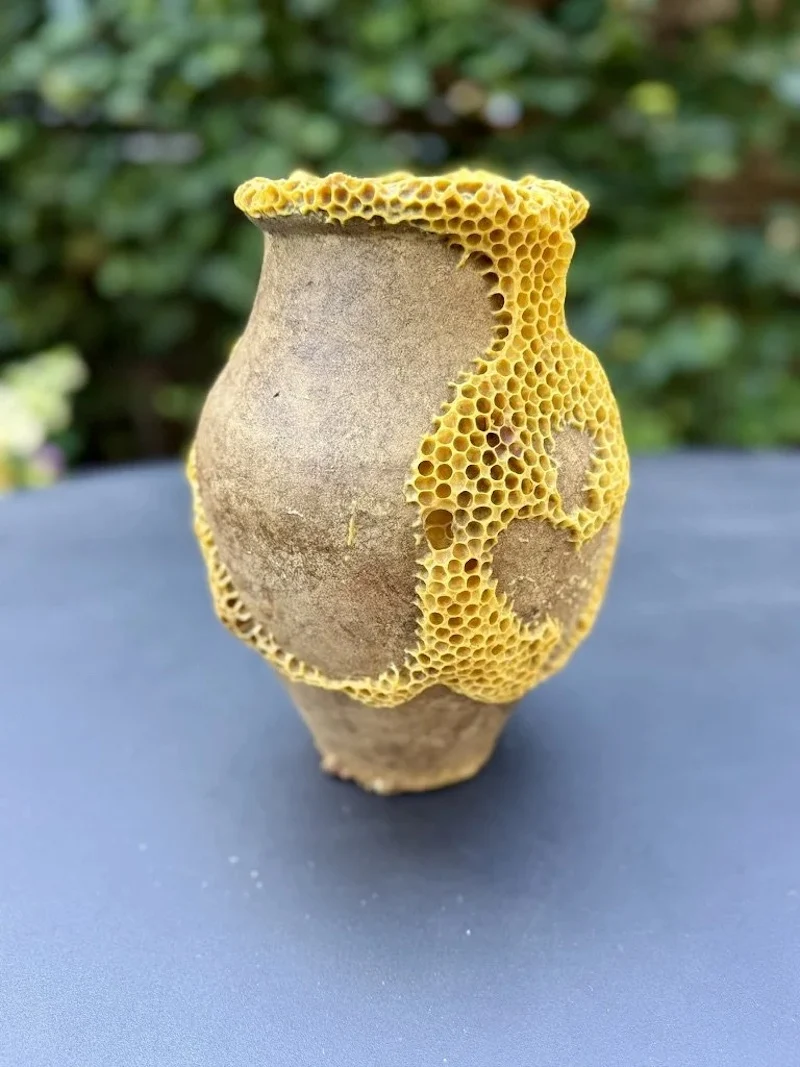
The ancient Japanese philosophy of kintsugi posits a radical view of damage: that a broken object, once mended with precious gold, possesses more beauty and narrative depth than it did in its original, pristine state. In this tradition, fractures are not flaws to be hidden but a vital record of an object’s history. Toronto-based artist Ava Roth has taken this centuries-old wisdom and introduced a startling new collaborator to the process: the honeybee.
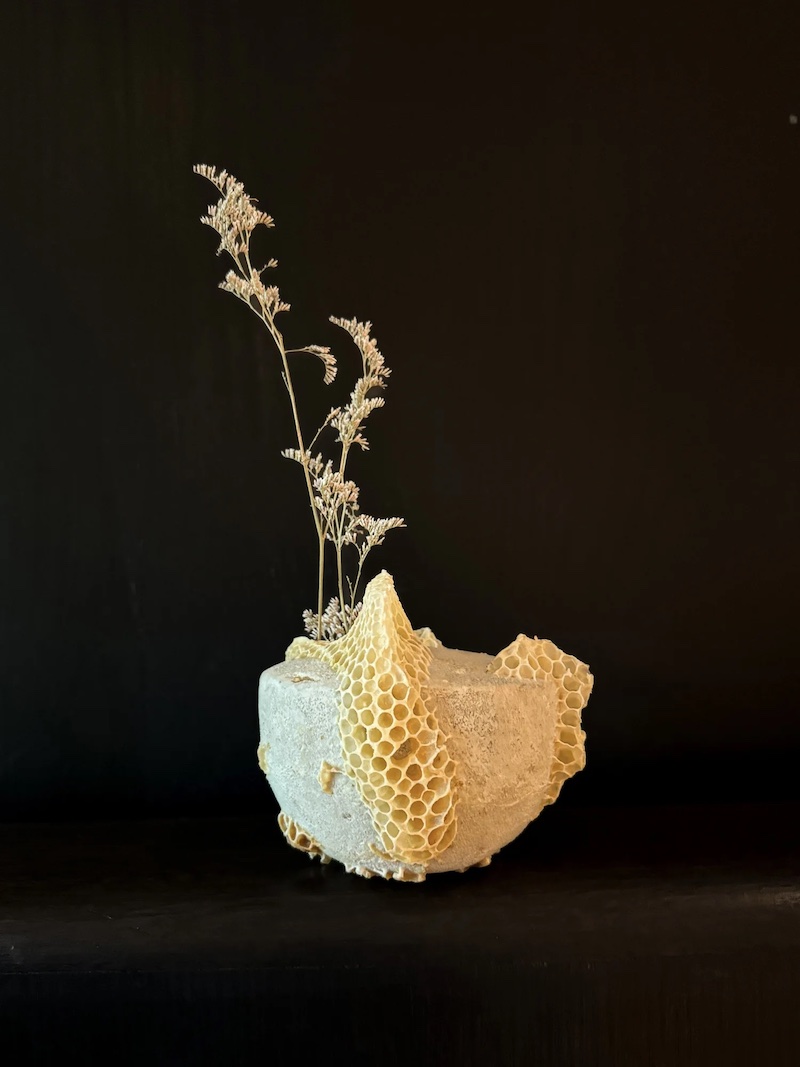
In her latest series, Kintsu-Bee, Roth bridges the gap between human artifice and biological instinct. By placing deliberately fractured ceramics—from chipped terracotta vases to cracked stoneware plates—into active beehives, she allows thousands of insects to perform the "repair." The result is a body of work that redefines the concept of repair, replacing the traditional gold-dusted lacquer of kintsugi with the glowing, hexagonal architecture of natural honeycomb.
Main Facts: The ‘Kintsu-Bee’ Series
The Kintsu-Bee project is a multidisciplinary exploration of bio-collaborative art. Ava Roth, an established encaustic painter and mixed-media artist, provides the "skeletons" of the work—broken pottery—and the bees provide the "flesh"—the wax structures that bridge the cracks and fill the voids.
The Collaborative Medium
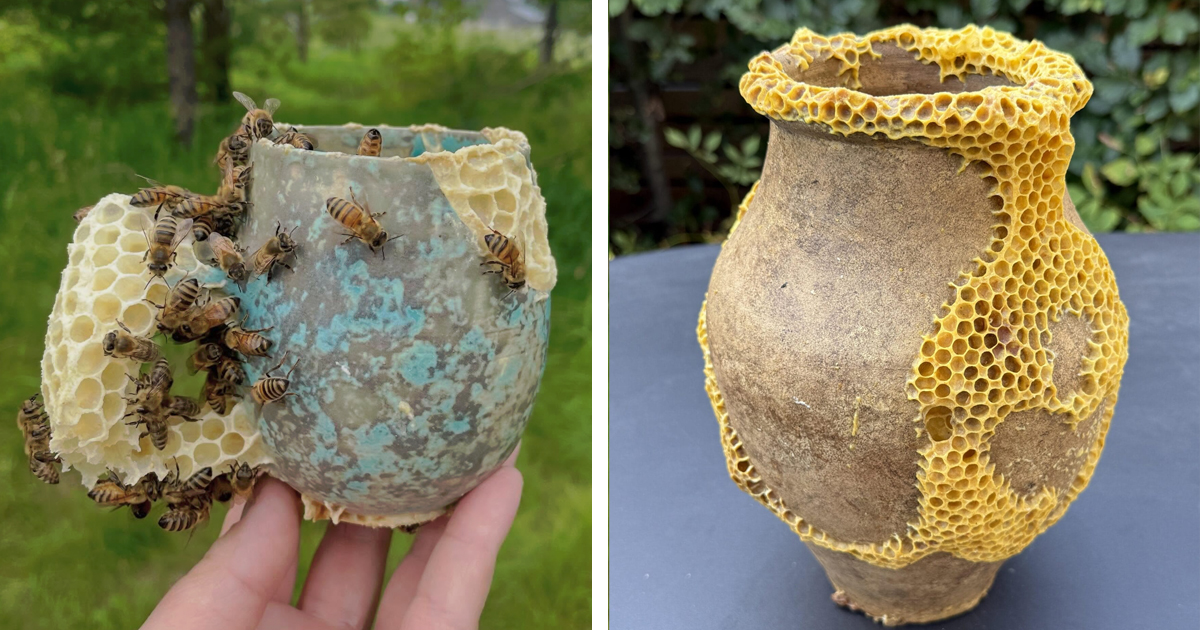
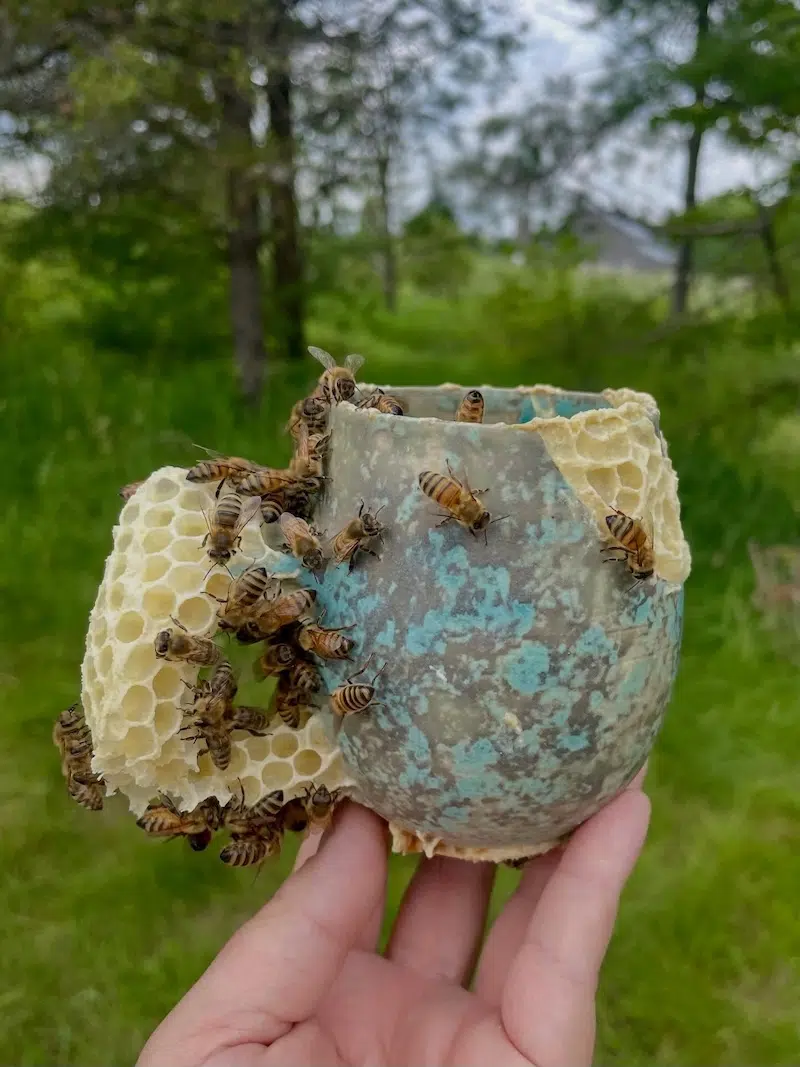
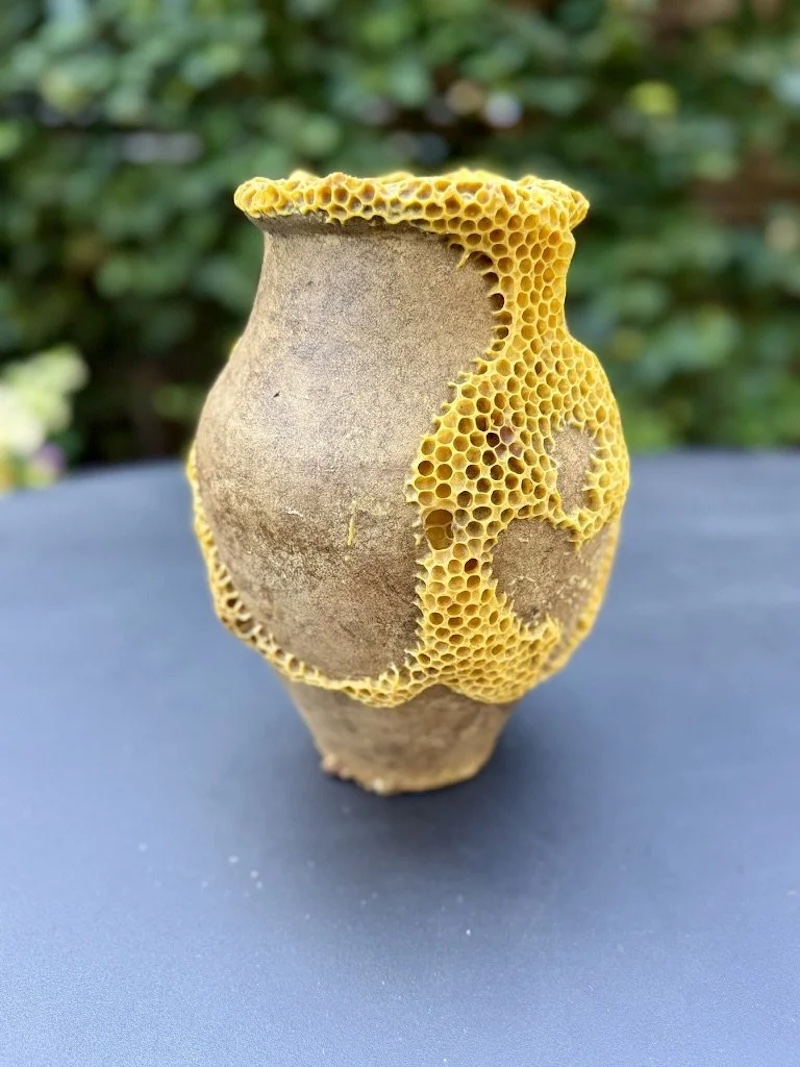
Unlike traditional sculpture, where the artist maintains absolute sovereignty over the final form, Roth’s work is a true partnership. She sources ceramics from various potters, including Makiko Hicher and Satoshi Yoshikawa, or uses vintage finds. These pieces are then intentionally broken or selected for their existing damage. Once placed within the hive, the honeybees (Apis mellifera) begin their work, building outward from the ceramic edges to fill gaps, replace missing handles, or veil fractures in delicate amber wax.
Visual and Material Contrast
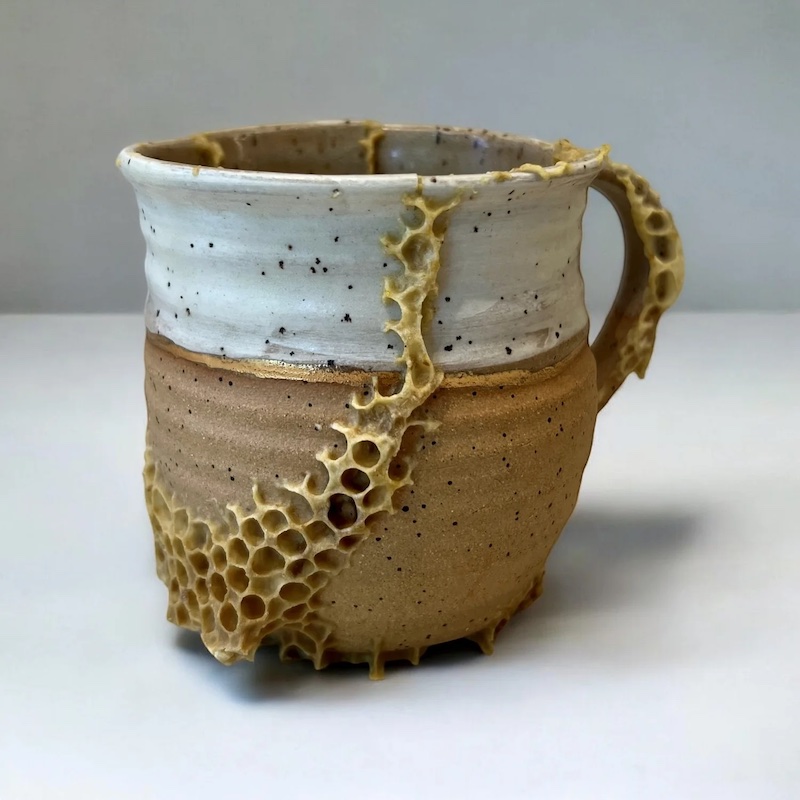
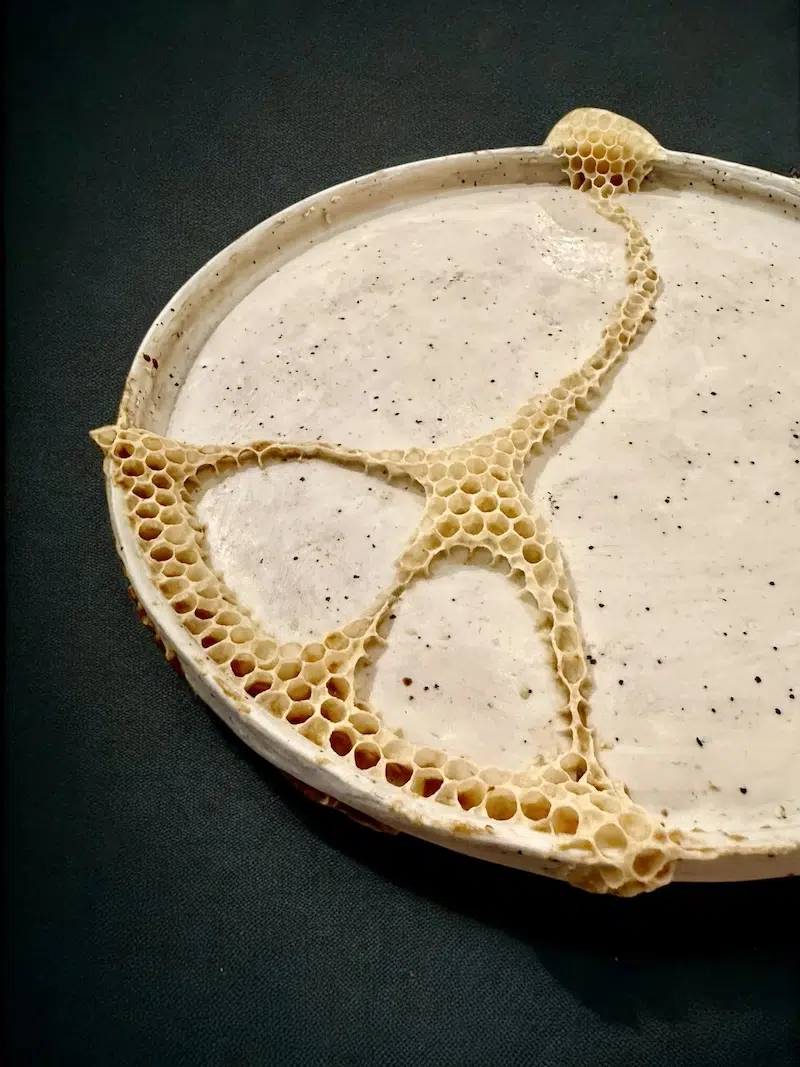
The aesthetic power of the series lies in its material tension. The ceramics represent the "human" element—fixed, fired, and brittle. The honeycomb represents the "natural" element—organic, fragrant, and geometrically perfect yet structurally fluid. The honeybees do not attempt to mimic the smooth glaze of a mug or the matte finish of terracotta; instead, they impose their own mathematical logic upon the human-made debris.
Key Artworks in the Series
Several standout pieces define the collection’s range:
- Green Mug #1: A ceramic piece by Makiko Hicher where the missing section of the rim is replaced by a thick, architectural swell of honeycomb, creating a functional-looking yet ethereal "organic handle."
- The White Plate #1: A collaboration with Satoshi Yoshikawa featuring a stark white ceramic plate where a central fracture is meticulously "stitched" together by a thin, precise line of wax cells.
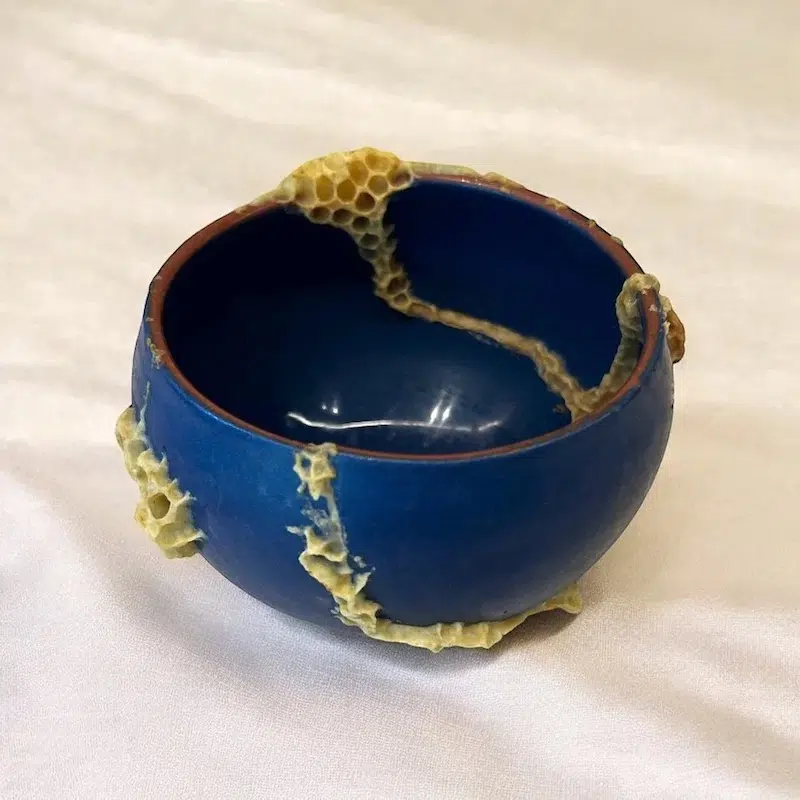
- The Blue Bowl: A deep cerulean vessel where the bees have ignored the exterior and focused on filling a large chip in the side, creating a golden "plug" of wax that glows against the blue glaze.
Chronology: A Decade of Interspecies Collaboration
Roth’s journey toward Kintsu-Bee was not a sudden departure but a natural evolution of her interest in encaustic art—a medium that utilizes heated beeswax mixed with pigment.
The Early Encaustic Years (2010–2014)
Roth began her career as a traditional encaustic painter. Her intimacy with the material—the smell, the texture, and the temperamental nature of wax—led her to wonder about the creatures that produced it. She began to view the wax not just as a medium, but as a biological byproduct of a complex social organism.
The ‘Honeycombed’ Series (2015–2022)
Before moving into three-dimensional ceramics, Roth spent years perfecting her collaboration with bees through two-dimensional works. In her Honeycombed series, she created mixed-media panels featuring embroidery, beadwork, and birch bark. These panels were fitted into custom frames and lowered into hives. The bees would then build their comb directly onto the thread and bark, creating a "dialogue" between human textile patterns and natural wax formations.
The Shift to Ceramics (2023–Present)
The transition to Kintsu-Bee represented a move toward the philosophical. By choosing ceramics, Roth tapped into the history of kintsugi and the concept of wabi-sabi—the appreciation of the imperfect and the transient. This shift required a more complex understanding of hive dynamics, as three-dimensional objects disrupt the bees’ internal traffic and airflow more significantly than flat panels.
Supporting Data: The Mechanics of the Hive
The success of Kintsu-Bee is rooted in a deep understanding of apiculture (beekeeping). Roth does not work alone; she collaborates closely with Master Beekeeper Mylee Nordin in Ontario, Canada.
The Role of the Beekeeper
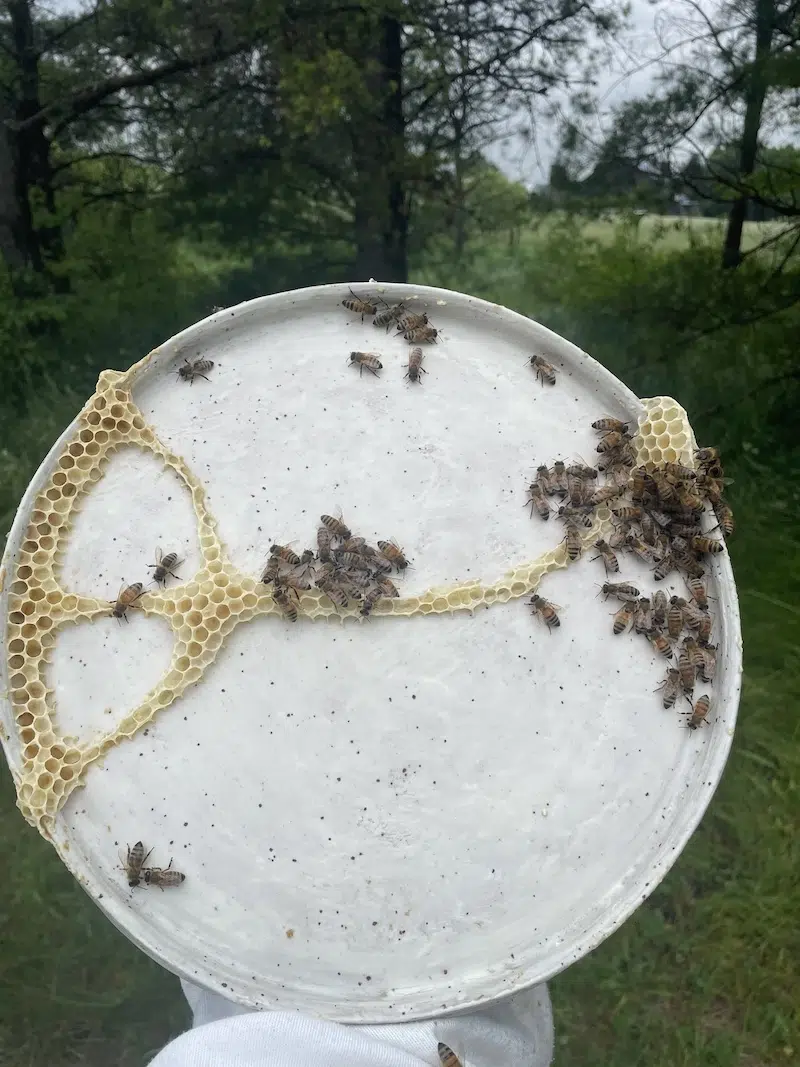
The process is seasonal and highly dependent on the "honey flow"—the period when nectar is abundant and bees are most active in building comb. Nordin manages the health of the hives, ensuring that the introduction of foreign objects (the ceramics) does not stress the colony or introduce pathogens. The ceramics must be carefully cleaned and, in some cases, "primed" with a thin layer of wax to encourage the bees to begin building in specific areas.
The Surrender of Control
One of the most significant data points in this project is the rate of "failure." Not every piece that enters a hive comes out as a work of art. The bees may choose to ignore a ceramic piece entirely, or they may entomb it completely in "burr comb"—the irregular wax bees use to bridge gaps larger than the "bee space" (roughly 6mm to 9mm).
Roth estimates that the "surrender" of her artistic ego is total once the hive is closed. The bees decide the density, the color (which varies based on the pollen source), and the extent of the repair. A piece may stay in a hive for anywhere from a few days to several weeks, depending on the strength of the colony and the weather conditions.
Material Safety
A primary concern in bio-art is the safety of the living participants. The ceramics used are lead-free and non-toxic. The process does not harm the bees; rather, it provides them with a substrate upon which to perform their natural building instincts. After the objects are removed, the bees continue their seasonal cycles, and the honey produced in these hives is often harvested separately.
Official Responses: The Artist’s Perspective on ‘Repair’
While there is no "official" government stance on the art, the critical reception and Roth’s own commentary provide a framework for understanding the project’s cultural value.
On the Philosophy of Kintsugi
Roth has stated that the series is a meditation on the beauty of the broken. "The honeycomb never attempts to imitate ceramic," she explains. "It remains unmistakably organic." By using bees to perform kintsugi, Roth suggests that nature is the ultimate healer. Where a human artist uses gold to fix a plate, the bee uses its own life force—the wax produced by its glands—to mend the world.
On the Concept of ‘Slow Art’
Curators have noted that Roth’s work is an antithesis to the "fast art" and "fast fashion" of the modern era. The timeline of a Kintsu-Bee sculpture is dictated by the seasons and the biological clock of the hive. This "slow" approach has garnered praise from environmental art critics who see it as a form of "quiet activism."
On Interspecies Dialogue
Roth views the bees not as "tools" but as "co-creators." In her artist statements, she emphasizes the humility required to let another species finish her work. This perspective aligns with contemporary art movements that seek to decenter the human experience and acknowledge the agency of non-human animals.
Implications: Ecology, Resilience, and the Future of Bio-Art
The Kintsu-Bee series arrives at a critical juncture in human history. As global bee populations face unprecedented threats from Colony Collapse Disorder (CCD), habitat loss, and pesticide use, Roth’s work carries a heavy ecological weight.
Reversing the Relationship
Traditionally, the relationship between humans and bees has been extractive; we take their honey and their wax for our consumption. Kintsu-Bee subtly reverses this. Humans bring their "brokenness"—symbolized by the fractured ceramics—to the bees for healing. It is a poetic reversal that highlights our dependence on these pollinators for the survival of our ecosystems.
The Metaphor of Resilience
In a post-pandemic world, the metaphor of kintsugi has become a cultural shorthand for resilience. Roth’s work makes this metaphor literal and biological. The sculptures serve as a reminder that resilience is not just a human trait but a fundamental principle of the natural world. If a hive can repair a shattered vessel, there is a suggestion that nature can, if allowed, repair the damage humans have inflicted upon the environment.
The Future of Bio-Collaborative Sculpture
Roth’s success with Kintsu-Bee opens the door for further exploration into "living" sculpture. As technology and art continue to merge with biology, works like these ask fundamental questions:
- Who owns the copyright to a work made by an insect?
- Can art be used to foster a deeper empathetic connection to endangered species?
- How can we design human environments that encourage, rather than discourage, this kind of biological "repair"?
Conclusion
Ava Roth’s Kintsu-Bee is more than a clever aesthetic exercise. It is a profound intersection of Japanese craft philosophy, ecological urgency, and contemporary sculpture. By handing the "gold" of the kintsugi process over to the bees, Roth has created a body of work that is as fragile as it is enduring. These objects—part clay, part wax, part human, part insect—stand as silent witnesses to the possibility of a world where human industry and natural instinct do not just coexist, but actively heal one another.
Through these quiet, honey-scented collaborations, Roth reminds us that the cracks in our world are not the end of the story, but merely the space where the most beautiful work begins.


Leave a Comment