
The Ethereal Architect of Wire: Remembering Alan Saret (1944–2024)
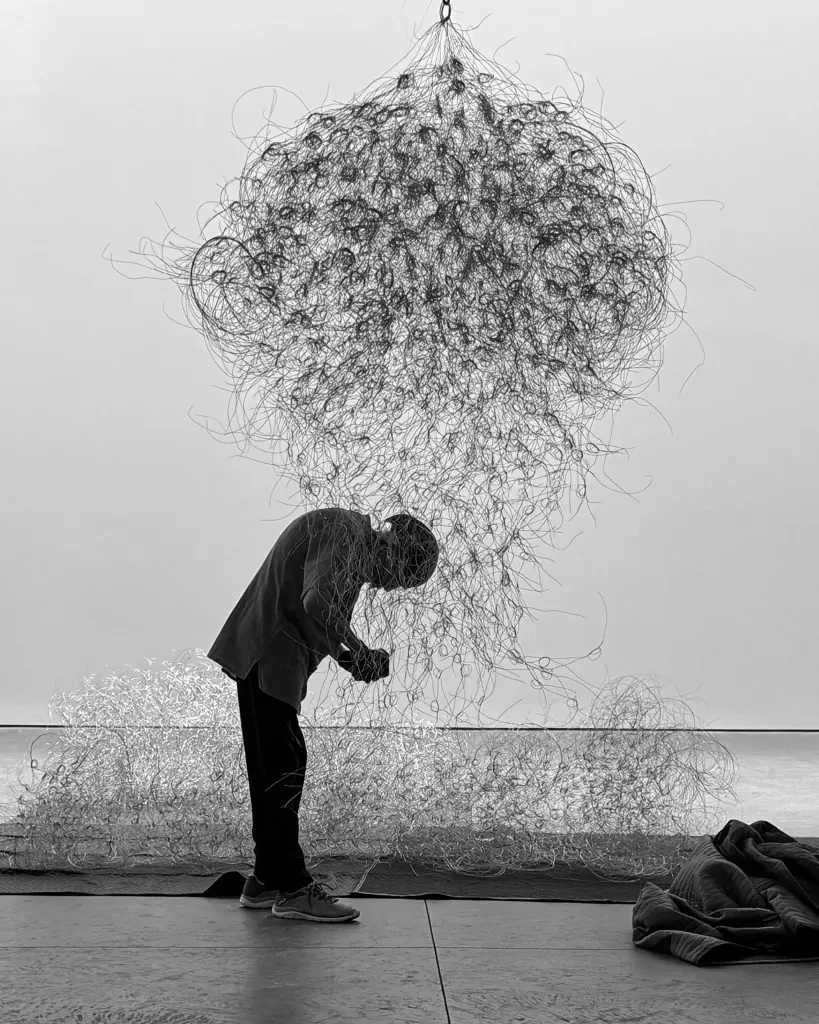
The art world mourns the loss of Alan Saret, a visionary sculptor whose pioneering work with industrial materials redefined the boundaries of Post-Minimalism. Saret, whose "anti-forms" and shimmering wire installations challenged the rigid geometries of his contemporaries, passed away on May 26 in Brooklyn at the age of 81. His death was confirmed by Karma, the gallery that represented him and spearheaded a significant late-career revival of his work.
Saret’s passing marks the end of a singular journey in American art—one that transitioned from the structured world of architecture to a spiritual, almost alchemical investigation into the properties of matter, space, and light.
Main Facts: The Aesthetic of the "Anti-Form"
Alan Saret rose to prominence in the late 1960s, a period of radical upheaval in the New York art scene. While the prevailing Minimalist movement sought clarity through industrial fabrication and geometric perfection, Saret sought something more elusive. He became a leading figure in "Process Art," a movement that emphasized the act of creation and the inherent properties of materials over the finished, static object.
His signature works were constructed from bundles of brass, copper, and stainless steel wire—materials usually associated with industrial utility. However, in Saret’s hands, these cold metals were transformed into "anti-forms": nebulous, cloud-like structures that seemed to pulse with organic life. These sculptures did not sit heavily on pedestals; they hung from ceilings like gathering storms, clung to walls like metallic moss, or rested on the floor like tumbleweeds of light.
Saret’s approach was defined by a rejection of traditional sculptural permanence. His works were often "unfixed," meaning they could be compressed for travel and reshaped for installation, allowing the environment of the gallery to dictate the final form of the piece. This flexibility was not merely a logistical convenience but a philosophical statement on the fluidity of existence.
Chronology: From Cornell to the Streets of SoHo and the Temples of India
Formative Years and Architectural Roots
Alan Saret was born on Christmas Day, 1944, in New York City. His early intellectual life was shaped by the rigors of architecture. He attended Cornell University, earning a Bachelor of Architecture, a degree that provided him with a profound understanding of structural integrity and spatial dynamics. However, the rigid constraints of functional building could not contain his artistic impulses.

In 1961, a summer spent assisting the visionary Italian architect Paolo Soleri proved foundational. Soleri’s concepts of "arcology"—the fusion of architecture and ecology—deeply influenced Saret’s later desire to harmonize industrial materials with natural, organic forms.
The Hunter College Influence and the Rise of Process Art
After Cornell, Saret moved back to New York to study at Hunter College. It was here that he encountered Robert Morris, a titan of the Minimalist movement whose 1968 essay "Anti-Form" became a manifesto for Saret’s generation. Morris argued that the "process" of making—gravity, stacking, hanging, and folding—should be the primary focus of the artist.
Saret took these lessons to heart but added a humanistic, almost mystical layer that Morris lacked. By the late 1960s, Saret was a rising star. In 1969, he was included in Harald Szeemann’s seminal exhibition, "When Attitudes Become Form," at the Kunsthalle Bern. This show is now regarded as one of the most important exhibitions of the 20th century, cementing Saret’s place among the avant-garde elite alongside figures like Richard Serra and Eva Hesse.
The Indian Pilgrimage (1971–1974)
At the height of his early success, Saret felt a profound spiritual dissatisfaction. He famously remarked that art had taken him to a "portal" but could not reveal what lay beyond. In 1971, under the aegis of an invitation from the Museum of Modern Art to participate in an exhibition in New Delhi, Saret traveled to India.
What was intended as a brief visit turned into a three-year residency. During this time, Saret distanced himself from the New York market. He became fascinated with Vedic philosophy, sacred geometry, and the symbolic power of numbers. When he returned to the United States in 1974, his work had evolved. He abandoned connective techniques like welding and soldering, which he viewed as "violent" interventions, in favor of knotting and twisting wire by hand—a low-tech, meditative process he termed "Network Sculpture."
The Later Decades and the Karma Revival
The 1980s and 90s saw Saret move in and out of the public eye. While he received major commissions—such as a permanent aperture carved into the wall at MoMA PS1 and the massive Ghosthouse (1975) at Artpark—he remained vocally disinterested in the commercial machinery of the art world. This led to long periods of relative obscurity, including a decade-long stretch where he exhibited no new work.

His "Gang Drawings," created by dragging bundles of pencils across paper to mimic the density of his wire sculptures, received critical acclaim during a solo show at The Drawing Center in 2007. However, it was his 2022 partnership with Karma gallery that finally re-centered Saret in the contemporary dialogue. The gallery’s dedicated stewardship resulted in three major exhibitions that introduced his ethereal vision to a new generation of collectors and critics.
Supporting Data: Materials and Methodology
Saret’s work was a masterclass in the economy of means. By using common "chicken wire" or industrial spools, he democratized the materials of sculpture.
- The "Anti-Form" Technique: Unlike traditional bronze casting, Saret’s wire works were defined by their transparency. He often described his sculptures as what a painting would look like "if the space between the threads of the canvas were expanded." This allowed the viewer to see through the work, making the air and light surrounding the sculpture as much a part of the piece as the metal itself.
- The Gang Drawings: These were not preparatory sketches but autonomous works of art. By binding dozens of colored pencils together into a "gang," Saret could create hundreds of lines with a single gesture. This method captured the "moment of creation" and translated the three-dimensional chaos of his wire works into a two-dimensional plane.
- Mathematical Precision: Post-India, Saret’s work relied heavily on prime numbers and specific ratios. He would knot strands in groups of three, seven, or nine, believing that these numerical vibrations imbued the work with a cosmic order.
Official Responses and Critical Legacy
Upon the announcement of his death, the art community was quick to reflect on Saret’s uncompromising integrity.
A spokesperson for Karma stated: "Alan Saret was a poet of space. He understood that the most powerful structures are often the most delicate. His commitment to the spiritual and the elemental stayed firm throughout his life, regardless of the trends of the day."
In a famous 1982 essay, the influential critic Klaus Kertess captured the duality of Saret’s work: "His procedures are clear and transparent, but are further transformed and layered in meshes of metaphor and ambiguities of space and form that make vision a veil for the visionary."
Critics often noted that Saret was "the artist’s artist." While he may not have achieved the household-name status of a Donald Judd or a Richard Serra during his lifetime, his influence on contemporary installation art and the use of flexible materials is immeasurable.

Implications: The Future of the Ephemeral
The death of Alan Saret poses unique challenges for the institutions that hold his work. Because many of his sculptures are intended to be "re-configured" each time they are installed, curators must grapple with the artist’s intent in his absence. How does one "shape" a Saret cloud without Saret’s hands?
However, the sheer volume of his presence in public collections ensures that his legacy is secure. His work is currently held by nearly every major American art institution, including:
- The Metropolitan Museum of Art, New York
- The Museum of Modern Art (MoMA), New York
- The Whitney Museum of American Art, New York
- The Art Institute of Chicago
- The National Gallery of Art, Washington, D.C.
- The Hammer Museum, Los Angeles
Saret’s life and work serve as a reminder that industrial materials do not have to be cold, and that art can be both mathematically rigorous and spiritually profound. As the art world increasingly moves toward digital and permanent monumentalism, Saret’s fragile, hand-knotted galaxies offer a necessary counterpoint—a celebration of the hand, the process, and the beauty of the temporary.
In the end, Alan Saret did more than just bend wire; he taught us how to see the vibrations of the air itself. His "living breathing worlds" will continue to pulse in the galleries of the world’s greatest museums, a testament to an artist who found the infinite within a simple spool of steel.


Leave a Comment