
Beyond the Horizon: How ‘For All Mankind’ Season 5 Redefines the Final Frontier
The Apple TV+ flagship series For All Mankind has long been celebrated for its meticulous blending of historical "what-if" scenarios with the rigorous physics of aerospace engineering. However, the Season 5 finale, titled with the weight of a world-changing revelation, has officially propelled the series into a new era. By confirming the existence of extraterrestrial life on Saturn’s moon, Titan, the showrunners have not only fulfilled a decade-long narrative promise but have also raised a fundamental question: Is this grounded alternate history finally evolving into a "Full Star Trek" space opera?
As the series prepares for its sixth and final season, the discovery of methane-based microbial life marks the definitive crossing of a threshold. What began in 1969 with a Soviet cosmonaut beating Neil Armstrong to the moon has culminated in a 21st-century realization that humanity is not alone in the universe.
The Titan Revelation: Main Facts and Narrative Pivot
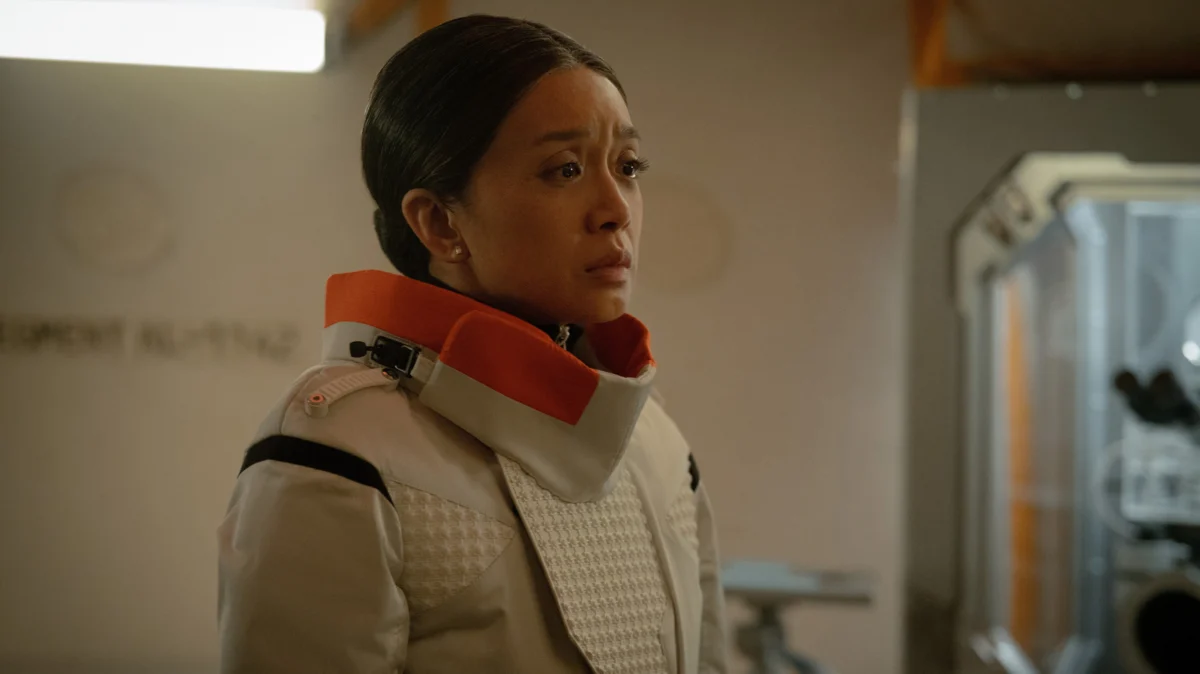
The Season 5 finale of For All Mankind serves as a dual-climax, balancing the geopolitical turmoil of a Martian war for independence with the quiet, profound biological discovery on Titan. The central figure of this breakthrough is Kelly Baldwin (Cynthy Wu), whose lifelong obsession with finding life beyond Earth finally bears fruit under the most harrowing circumstances.
The discovery occurs in two stages. First, Kelly identifies living microorganisms—methane-based life forms that exist outside the oxygen-carbon paradigm of Earth. This fulfills the scientific "Quest for Life" arc that has dominated the season. However, it is the episode’s closing moments that provide the emotional and visual spectacle. Facing a lethal oxygen shortage, Kelly volunteers to remain on Titan to ensure her crewmates can return to Mars.
In her presumed final moments, overlooking a vast methane lake, she witnesses a stunning display of bioluminescence. As she steps onto the liquid surface, the microbes react to her movement, glowing in a rhythmic response. This confirms that Titan isn’t just home to a few stray cells; it is a moon teeming with a complex, reactive ecosystem.
![Will For All Mankind Season 6 Go Full Star Trek? The Showrunner Tells Us [Exclusive]](https://www.slashfilm.com/img/gallery/will-for-all-mankind-season-6-go-full-star-trek-the-showrunner-tells-all-exclusive/l-intro-1780070597.jpg)
A Chronology of Escalation: From Apollo to Titan
To understand the magnitude of the Season 5 finale, one must look at the chronological trajectory of the series. For All Mankind has utilized decade-spanning time jumps to show the compounding interest of a space race that never ended.
- Season 1 (The 1970s): The focus was on lunar base construction and the "Moon Race." The technology was grounded in the Apollo-era designs, albeit accelerated.
- Season 2 (The 1980s): The militarization of the Moon and the introduction of nuclear-powered shuttles. The stakes were terrestrial—preventing World War III on Earth.
- Season 3 (The 1990s): The race to Mars. This marked the first major shift toward speculative technology, introducing private space travel (Helios) and the first permanent Martian colony.
- Season 4 (The 2000s): The "Asteroid Gold Rush." The focus shifted to economics and the "Happy Valley" strike, exploring the labor politics of a multi-planetary species.
- Season 5 (The 2010s): The expansion to the Jovian and Saturnian systems. The "War of Independence" on Mars mirrored Earth’s colonial histories, while the Titan mission sought the ultimate scientific prize.
This progression shows a deliberate "ladder" of discovery. By the time Kelly Baldwin reaches Titan, the show has "earned" its sci-fi elements through forty years of in-universe technological evolution.
Supporting Data: The Science of Methane-Based Life
One of the hallmarks of For All Mankind is its commitment to scientific plausibility. While the show has introduced alien life, it has avoided the tropes of "little green men" or flying saucers. Instead, it focuses on the theoretical possibilities of Titan’s environment.
Titan is the only moon in the solar system with a dense atmosphere and stable bodies of surface liquid. However, unlike Earth’s water-based cycle, Titan has a methane cycle. Showrunners Ben Nedivi and Matt Wolpert worked closely with scientific consultants to ensure that the "alien" reveal felt like a natural extension of organic chemistry.
The bioluminescence seen in the finale is modeled after terrestrial phenomena, such as dinoflagellates in Earth’s oceans. By grounding the alien life in microbial and chemical reality, the show maintains its "Hard Sci-Fi" reputation. The microbes aren’t a threat or a message; they are simply a biological fact, which makes their discovery feel more profound and less like a Hollywood gimmick.
![Will For All Mankind Season 6 Go Full Star Trek? The Showrunner Tells Us [Exclusive]](https://www.slashfilm.com/img/gallery/will-for-all-mankind-season-6-go-full-star-trek-the-showrunner-tells-all-exclusive/intro-1780070597.jpg)
Official Responses: Insights from the Showrunners
In an exclusive interview with /Film, showrunners Ben Nedivi and Matt Wolpert addressed the creative risks of introducing extraterrestrial life into a series that prides itself on realism.
"We always knew we were going to get here, but we knew this was kind of the final discovery," Nedivi explained. He emphasized that the discovery needed to be "earned" through the sacrifices of the characters. For Kelly Baldwin, finding life wasn’t just a professional goal; it was a legacy-defining moment that cost her the chance to return home.
When asked about the "Star Trek" comparison, Nedivi remained cautious. While the show is creeping closer to the utopian, multi-planetary future envisioned by Gene Roddenberry, the creators are determined to keep the "physics making sense."
"I think we as humans have been talking about… are we alone?" Nedivi continued. "It’s been a question central not only to science fiction but to all of us." The showrunners suggest that while the discovery of life is monumental, the reaction of humanity—politics, religion, and greed—will remain the show’s primary focus.
The 2020 Cliffhanger and the Implications for Season 6
As is tradition, the season ended with a significant time jump, this time landing in the year 2020. The final scene depicts a relic of the past: a Russian Mars-94 ship, which had been lost or drifting, now orbiting a ringed planet—presumably Saturn, given the proximity to Titan.
![Will For All Mankind Season 6 Go Full Star Trek? The Showrunner Tells Us [Exclusive]](https://www.slashfilm.com/img/gallery/will-for-all-mankind-season-6-go-full-star-trek-the-showrunner-tells-all-exclusive/a-discovery-for-all-mankind-1780070600.jpg)
The ship’s computers are shown detecting "gravitational wells." In the lexicon of science fiction, gravitational wells are often associated with advanced propulsion or the manipulation of spacetime. This suggests that Season 6 will move beyond chemical rockets and toward the next frontier: interstellar travel or, at the very least, sophisticated deep-space navigation.
The Potential for "First Contact"
While the showrunners have ruled out a sudden shift into a "War of the Worlds" scenario, the presence of life on Titan changes the geopolitical (or "galactopolitical") landscape. Season 6 will likely explore:
- The Colonization of Titan: If there is life, there is a reason for humanity to stay. Titan could become the new Mars—a hub for scientific and corporate interest.
- The Evolution of Technology: The mention of gravitational wells hints that the 2020s in the For All Mankind timeline will look nothing like our own. We may see the birth of the first truly "interstellar" vessels.
- The End of the Journey: With Season 6 confirmed as the series finale, the show is expected to provide a "Full Circle" moment. If Season 1 was about reaching the Moon, Season 6 may be about leaving the Solar System entirely.
Conclusion: A Masterclass in Narrative Patience
For All Mankind has pulled off a rare feat in modern television: a slow-burn reveal that spans five years of real-time broadcasting. By waiting until the penultimate season to introduce alien life, the creators ensured that the discovery felt like a monumental achievement for the characters rather than a plot device to save a flagging ratings cycle.
As the series enters its final chapter, it stands as a bridge between the gritty realism of the 20th-century space race and the aspirational futurism of Star Trek. Whether or not the show goes "full sci-fi," it has already secured its place in the pantheon of great speculative fiction by reminding us that the greatest discovery is not just what is out there, but how we change when we finally find it. The bioluminescent lakes of Titan are not just a new setting; they are a mirror reflecting the relentless, often self-destructive, but ultimately noble ambition of mankind.




Leave a Comment