A Decade in the Making: ‘The Treasury of Folklore’ Unveils Grand Compilation, Revealing Humanity’s Shared Myths
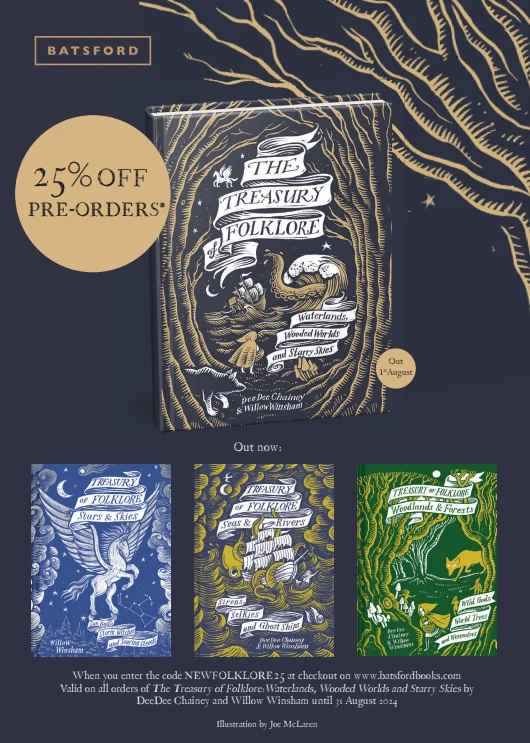
London, UK – July 22, 2024 – The highly anticipated compilation, The Treasury of Folklore: Waterlands, Wooded Worlds and Starry Skies, is set to launch on August 1, 2024, marking a significant milestone for folklore enthusiasts and scholars alike. This single, beautifully bound volume brings together a curated selection of cherished tales and insights from the acclaimed Treasury of Folklore series, originally conceived as a trilogy exploring human beliefs across diverse landscapes. Authored by esteemed folklorists Dee Dee Chainey and Willow Winsham, this compendium fulfils their initial ambition to encapsulate the rich tapestry of global folklore within one comprehensive work.
More than just a collection of stories, this "hefty tome" – as affectionately described by its creators – serves as a profound exploration of shared human experience. It delves into how communities worldwide craft customs, beliefs, and narratives around their environments, ultimately revealing a fundamental truth: despite geographical and cultural variations, humanity is united by primal fears, universal dreams, and an innate wonder at the world. From the dread of the unknown lurking in shadowed forests to the awe inspired by ancient stars, The Treasury of Folklore underscores our inherent interconnectedness through the enduring power of myth.
Chronology: A Decade-Long Journey into Myth
The genesis of The Treasury of Folklore series began nearly a decade ago, sparked by an overwhelming outpouring of interest and engagement on social media, particularly through the vibrant #FolkloreThursday hashtag. This digital phenomenon highlighted a global appetite for traditional tales and a yearning for understanding their cultural significance. Inspired by this unifying universality, the authors embarked on a mission to create something meaningful and lasting.
Their initial vision was ambitious: a single, expansive volume that would encompass folklore from every physical landscape inhabited by humans across the globe. However, the sheer volume and depth of material uncovered during their extensive research quickly surpassed what could be contained within a solitary book. This wealth of discovery led to the strategic decision to divide the project into a compelling trilogy, allowing for a more focused and detailed exploration of specific environments.
The resulting three original books – Seas and Rivers, Trees and Woodlands, and Stars and Skies – were met with surprising and heartwarming popularity. Each volume offered readers a deep dive into the myths, legends, and customs associated with water, land, and sky, respectively, garnering a dedicated readership. The success of these individual titles laid the groundwork for the ultimate realization of the authors’ initial dream. When the opportunity arose to create a compendium, the decision was instantaneous: to finally compile this rich material into the single, special volume originally envisaged. This journey, spanning almost ten years, from a single ambitious concept to a successful trilogy and now to a comprehensive compilation, truly reflects the enduring and evolving nature of folklore itself.
Supporting Data: Unearthing Universal Truths and Ancient Wonders
At the heart of The Treasury of Folklore lies the powerful assertion that folklore, despite its myriad forms, speaks a universal language. The authors’ extensive research underscores how humans, irrespective of their locale, attire, or the names they assign to mythical beings, grapple with shared existential questions. We all harbour primal fears – of the dark, the unknown, the untamed wilderness – and universal dreams – of discovery, connection, and understanding our place in the cosmos. This shared emotional landscape forms the bedrock upon which diverse cultural narratives are built, providing a sense of collective human identity that transcends borders. The stories gathered within this treasury are not mere quaint tales; they are echoes of our deepest anxieties and highest aspirations, woven into the fabric of human history. They offer a unique lens through which to understand humanity’s psychological journey, reflecting common archetypes and narrative structures that resonate across continents and centuries.

Perilous Depths: The Enigma of Water Horses
The compendium opens a window into the watery realms, presenting creatures as captivating as they are terrifying, none more so than the infamous water horses. These majestic yet malevolent beings, found lurking beneath lakes and waterways across various cultures, embody humanity’s age-old fascination and fear of the aquatic unknown.
Scotland’s folklore is famously rich with such entities, notably the Kelpie and the Each-Uisge. While often conflated, the authors meticulously distinguish between them: the Kelpie, a river dweller, lures victims with its seemingly tame appearance before dragging them to their demise. The Each-Uisge, conversely, haunts the deeper, darker lochs, a more sinister cousin whose grip on its rider is unbreakable once mounted. Tales of escaping these creatures, often through a blessed bridle or by using the potent force of red-hot iron, speak to humanity’s desire to exert control over untamed nature, however fleetingly. The enduring cultural impact of the Kelpie is strikingly visible in the monumental 30-metre-tall sculptures near Falkirk, a modern testament to an ancient legend, further cemented by its appearances in contemporary literature by authors like Lari Don and J.K. Rowling’s Fantastic Beasts and Where to Find Them.
Curiously, this specific aquatic equine menace appears to bypass England, yet resurfaces with vivid intensity in Wales. Here, the Ceffyl Dwr (Water Horse) was a prevalent belief well into the 19th century. In northern Wales, it was a shapeshifting spirit, often violent, while in the south, it consistently took the form of an enchanting, small horse. Its incredible speed was legendary, luring unsuspecting riders to their doom, though a peculiar exception granted safe passage to clergymen of any denomination, highlighting an intriguing intersection of pagan belief and religious influence.
Scandinavia contributes its own formidable water horse, the Bäckahäst or ‘brook horse’. Often appearing in the misty twilight, this luminous and majestic creature entices riders, frequently children, before plunging back into the water to drown them. However, many Bäckahäst tales surprisingly conclude with the riders surviving, often due to a clever trick or, in one notable instance, the accidental invocation of a holy name, revealing a common folkloric vulnerability to sacred words. Like the Kelpie, the Bäckahäst could also be put to work, if tricked, showcasing the complex relationship between humans and these powerful elemental spirits. These narratives collectively serve as cautionary tales, warning against recklessness and disrespect for the formidable powers of natural environments.
Guardians of the Green: The Lords of the Wild
Leaving the depths, the compendium guides us into the verdant heart of the forest, the domain of the Lords of the Wild. These powerful spirits and creatures, found in woodlands and jungles globally, embody the untamed essence of nature – sometimes benevolent protectors, sometimes malevolent forces of chaos. Their stories reflect humanity’s reverence, fear, and deep connection to the arboreal world.
From Finland emerges Tapio, also known as Metsähine or Hiisi, the venerable king of the forest realm. Depicted as tall and thin, adorned in ermine fur or moss, with a great beard and a gnarled tree-like back, he is both the personification and fierce protector of the forest. Hunters traditionally sought his blessing, pledging respect for the wilderness in return for a bountiful chase. Tapio’s control over all forest creatures meant he could grant success or curse a hunter to return empty-handed, underscoring the ancient pact between humans and nature. His family, including his benevolent wife Mielikki (or Kuurikki when angered) and their children Nyrikki and Tulikki who aid hunters, paints a complex picture of a divine household intricately linked to the forest’s lifeblood.

Slavic folklore introduces the Leshy (or leshii, lyeshy), a tutelary spirit and protector of the woods, often associated with wolves or bears. A master shapeshifter, the Leshy can alter its size and form at will, appearing as anything from a blade of grass to a towering tree, or even a familiar human, animal, or plant. Its human guise, however, is always subtly distorted: missing eyelashes or brows, shoes worn on the wrong feet; in Yaroslavl Province in Russia, they might wear their skirt or kaftan wrapped in the opposite way to the local fashion. These subtle cues serve as warnings, highlighting the deceptive nature of the wilderness.
The Leshy’s temperament is as unpredictable as the forest itself. Its bellowing whips up winds, and its shrieking laughter or howls are meant to deter intruders. Those who ignore these warnings risk becoming lost, confused, and sometimes even tickled to death. They are known for abducting women and children, cursing farms, and are notorious gamblers, often using squirrels as stakes. Despite their fearsome reputation, there are specific rituals for safety: turning clothes inside out, reversing shoes, or swearing profusely are believed to amuse the Leshy and guide lost travellers back. Conversely, summoning a Leshy involves a specific ritual with young birch trees, underscoring the delicate balance between reverence and interaction with these powerful entities. The Leshy, like other fae folk, represents the unpredictable, sacred, and dangerous aspects of nature, demanding respect and caution from those who enter its domain.
Celestial Echoes: The Hare in the Moon
Finally, the compendium lifts our gaze to the heavens, exploring humanity’s enduring fascination with the moon and the myriad faces seen upon its surface. Among the most widespread motifs is the Hare in the Moon, a figure appearing in diverse cultures, with the Sea of Tranquillity often perceived as its head, and the Seas of Fertility and Nectar forming its ears. This phenomenon of pareidolia, where patterns are perceived in random stimuli, reveals a universal human tendency to imbue the cosmos with narrative and meaning.
Buddhist tradition, particularly the Sasa-Jātaka, offers a poignant origin story. Here, a virtuous hare, in an act of profound self-sacrifice, offers itself as food to the deity Sakka, disguised as a beggar. For this unparalleled faithfulness, Sakka immortalises the hare by placing its image on the moon for all eternity. Similar tales of self-sacrifice echo across Asia: in Sri Lanka, the hare offers itself to a hungry Buddha, who then transports it to the moon; in Japan, the Tsuki no Usagi (Moon Rabbit) makes a similar offering to a disguised Man in the Moon. These narratives, often shared with children during the Harvest Moon and Mid-Autumn Festival, underscore themes of compassion, altruism, and divine recognition.
A starkly contrasting narrative emerges from South Africa, where the hare takes on a more ambivalent, even mischievous, role. In this tale, the Moon dispatches Hare to deliver a message of cyclical mortality to humankind – that humans, like the moon, would die and be reborn. However, the flighty Hare misdelivers the message, proclaiming only death. Enraged, the Moon attacks Hare, splitting its lip, while Hare, in retaliation, scars the Moon’s face, explaining the dark markings seen today. This version portrays the hare not as a symbol of selfless devotion, but as a trickster figure whose carelessness has profound, irreversible consequences for humanity, highlighting the dualistic nature of mythological figures and the diverse interpretations cultures project onto celestial bodies.
The Artistry of Folklore: Joe McLaren’s Illustrations
Adding another layer of richness to this compilation are the evocative original illustrations by Joe McLaren. His intricate black and white engravings breathe life into these ancient narratives, capturing the majesty of water horses, the elusive nature of forest spirits, and the serene wonder of the celestial hare. McLaren’s artistry serves not just as accompaniment but as an integral part of the storytelling, guiding the reader’s imagination and grounding these fantastical tales in a visually compelling reality.

Official Responses: A Collective Triumph
The creation of The Treasury of Folklore: Waterlands, Wooded Worlds and Starry Skies has been met with palpable excitement from its authors and publisher. Dee Dee Chainey and Willow Winsham have openly expressed their immense delight and gratitude for the journey this series has taken them on. Their initial surprise at the trilogy’s popularity has evolved into profound heartwarming appreciation for every reader who has embraced these stories. The opportunity to finally bring the entire collection together in one volume, fulfilling their decade-old vision, is described as nothing short of thrilling.
Behind the scenes, the process involved a meticulous re-engagement with material the authors knew intimately. Reading through their own words "with fresh eyes" was crucial for curating the best possible selection, ensuring the compilation flowed cohesively and captured the essence of each original book while spanning shared landscapes across time and place. The end result, a "beautifully bound volume" with its ideal size, striking cover, and luxurious cream paper, has exceeded even their own high expectations. It stands as a testament to their dedication and the shared vision with Batsford Books, the publisher, who recognized the immense value in consolidating these beloved tales into a definitive edition. This collaborative effort has not only celebrated the success of the individual books but also cemented the legacy of the entire Treasury of Folklore series.
Implications: A Bridge to Our Shared Human Heritage
The release of The Treasury of Folklore: Waterlands, Wooded Worlds and Starry Skies carries significant implications, both for individual readers and for the broader understanding of cultural heritage. For the casual reader, it offers an unparalleled single-volume journey into the heart of global myth, serving as an ideal introduction or a cherished reference. Its aesthetic appeal – a "hefty tome" designed to grace any bookshelf or coffee table – ensures it will be a constant invitation for discovery and a natural conversation starter, fostering connection through shared stories.
Beyond personal enjoyment, this compilation underscores the critical importance of folklore in preserving cultural identity and understanding our collective past. In an increasingly globalised world, such works act as vital anchors, reminding us of the unique traditions that define different communities while simultaneously highlighting the threads of commonality that bind us all. The book’s structure, divided into three sections with extracts from each original volume, allows for thematic exploration, encouraging readers to draw parallels between seemingly disparate cultures and their responses to the natural world.
For the field of folklore studies, this compendium represents a powerful popularisation of academic research, making complex cultural insights accessible to a wide audience. It champions the enduring relevance of oral traditions and ancient beliefs in shaping contemporary thought and inspiring new forms of creative expression, as evidenced by the modern literary and artistic tributes to figures like the Kelpie. By presenting these stories as living, breathing narratives, The Treasury of Folklore not only enriches individual lives but also contributes to the ongoing dialogue about what it means to be human, fostering