"A Forest of Vanity and Valour" Reimagines Robin Hood with Dark Nuance and Moral Ambiguity
Askela, Eldoria – A compelling new voice in dark fantasy has emerged with the release of A Forest of Vanity and Valour, a novel that boldly reinterprets the enduring legend of Robin Hood through a grim and morally complex lens. Penned by a rising author, the book is quickly garnering attention for its inventive premise, unflinching character explorations, and a narrative that defies conventional fantasy tropes. Set against a backdrop of endless war and political intrigue, the novel plunges readers into a world where heroism is a fluid concept and justice is often a matter of perspective.
I. Main Facts: A Dark Fantasy Reimagining Takes Centre Stage
A Forest of Vanity and Valour introduces readers to Vireo Reinhold, a character far removed from the archetypal noble hero. Reinhold is portrayed as a self-serving tax collector, diligently amassing wealth to fuel his monarch’s insatiable appetite for war. His existence is one of cynical luxury, built upon the exploitation of the vulnerable. However, his carefully constructed world is irrevocably shattered by two pivotal events: the discovery of an ancient, shadowy spellbook promising forbidden magic, and his entanglement in a scandalous affair that forces him into an unthinkable act, leading to exile.
Stripped of his power and influence, and with the potent arcane tome now in the hands of his adversaries, Reinhold finds his survival hinging on an ironic twist of fate: he must now learn to save others. This radical shift forms the core of the narrative, challenging both the protagonist and the reader to question the very nature of redemption and heroism. The novel promises to explore whether a man so steeped in vanity can transform into a champion for the very people he once oppressed.
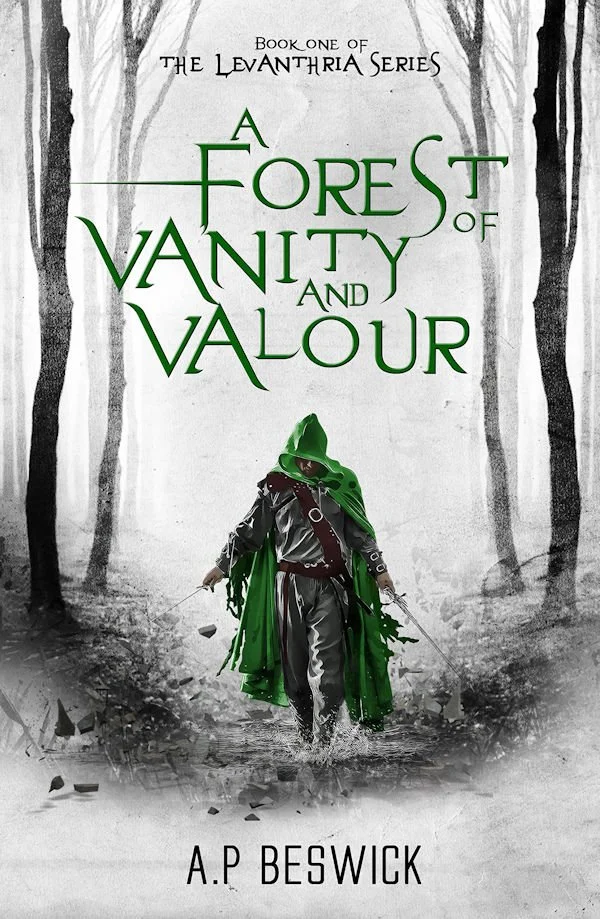
The book is predominantly set within the bustling, yet oppressive, city of Askela and the perilous, enigmatic Forest of Opiya. These two contrasting environments serve as crucial backdrops to the unfolding drama, mirroring the internal conflicts of the characters. The author’s decision to eschew familiar characters and predictable plot points in favour of a fresh, dark take on the Robin Hood myth has been widely praised as a significant strength, offering a narrative that is both recognizable in its foundational elements and strikingly original in its execution. The novel’s cover, depicting a shadowy forest scene hinting at both danger and hidden power, has also captured early attention, visually complementing the book’s darker thematic elements.
II. Chronology: The Unfolding Narrative of Redemption and Conflict
The narrative of A Forest of Vanity and Valour unfolds with a deliberate intensity, meticulously charting the dramatic transformation of its central figures. The story begins by firmly establishing Vireo Reinhold’s character: a man entrenched in the comfortable cynicism of his position, meticulously collecting "proper dues" for a perpetually absent king. His initial motivations are purely self-serving, reveling in the "perks of luxury" afforded by his "unorthodox role" in funding an "expensive love of warfare." This initial phase of the story vividly portrays the oppressive political climate of Askela, where its de facto leader, Jareb, is caught in an "impossible situation" due to the monarch’s endless military campaigns.
A. The Inciting Incident and Vireo’s Downfall
The plot accelerates with the pivotal discovery of an ancient spellbook. This artifact is not merely a plot device but a catalyst that ignites a dormant, "shadowy, forgotten magic," hinting at deeper, more mystical undercurrents within the world. Concurrently, Vireo’s clandestine affair with a fellow noble’s wife leads to a forced, "unthinkable act," the details of which remain tantalizingly veiled but are clearly catastrophic. This twin-pronged crisis – the acquisition of forbidden knowledge and a profound moral transgression – triggers Vireo’s dramatic downfall. He is swiftly driven into exile, stripped of his ability to "coerce the vulnerable," and, crucially, the powerful tome falls into enemy hands. This sequence of events fundamentally alters his trajectory, shifting him from an agent of oppression to a desperate outcast.
B. The Intertwined Fates and Shifting Perspectives
From this point, the story follows two protagonists whose lives become "irrevocably altered by a single event." While the initial synopsis focuses heavily on Vireo, the narrative skillfully weaves together his journey with that of another, un-named key figure (likely Jareb or a character representing the oppressed populace). This parallel development allows the author to explore the multifaceted nature of "justice and power" from opposing viewpoints. The reviewer notes that watching "their roles, motivations and perspectives evolve" becomes a central enjoyment of the book, as their "shifting positions continually reshaped the story’s exploration of its themes."
The chronological progression highlights Vireo’s struggle to adapt to his new reality. No longer able to wield the power he once commanded, his "only shot at survival hangs on his skills at saving others." This forces a profound internal conflict, pushing him towards potential redemption. The narrative meticulously tracks his efforts to redeem himself as the "people’s champion," raising the stakes against a looming "sinister fate" that threatens all. This transformation is not immediate or easy, but a hard-won journey marked by moral ambiguities and difficult choices.
C. Integrating Fantasy Elements
As the plot advances, the fantasy and magical elements are "woven naturally" into the fabric of the story. The ancient spellbook and its promised magic are not mere window dressing but integral to the unfolding conflict and character development. The appearance of "monsters" and "arcane texts" adds layers of wonder and peril without overshadowing the human drama at the story’s core. This integration is crucial, ensuring that the fantastical elements serve to deepen the narrative rather than distract from it. The pacing is described as "purposeful," ensuring that every plot decision and character moment contributes to the overall momentum, building towards a climax that feels earned and impactful. The story’s "wonderfully dark streak" and "inventive moments" are strategically placed, catching readers off guard and reinforcing the novel’s unique identity within the fantasy genre.
III. Supporting Data: Critical Reception and Thematic Depth
Early critical reception of A Forest of Vanity and Valour has highlighted several key strengths, particularly its innovative approach to classic mythology and its sophisticated exploration of moral complexities. Reviewers have consistently praised the author’s ability to craft a narrative that feels both familiar and refreshingly new.
A. Innovation in Myth Retelling
The most frequently cited strength is the novel’s "inventive premise" and its "fresh, dark take on the Robin Hood legend." Critics note that by "not relying on familiar characters, predictable themes, and plot points," the author successfully uses the myth as a "foundation to tell a gripping story that feels both recognisable and surprisingly original." This approach has been lauded for reinvigorating a beloved, yet often rehashed, narrative. The specific subversion of making the protagonist a villainous tax collector before his fall and potential rise to heroism is seen as a particularly ingenious twist, immediately "grabbing attention."
B. Nuanced Morality and Character Development
A significant aspect of the book’s appeal lies in its "willingness to embrace moral ambiguity." Reviewers commend the author for presenting "very few clear-cut heroes or villains." Instead, characters are driven by "perceived duty and survival," allowing readers to "sympathise with people on opposing sides of the escalating conflict." This nuanced portrayal is deemed "particularly fitting for a Robin Hood retelling, where questions of justice often depend on a character’s perspective rather than objective notions of right and wrong." This thematic depth, exploring "power and responsibility," makes the narrative far more compelling than a simplistic battle between good and evil. Both protagonists’ journeys are described as "satisfying," with their evolving perspectives continually enriching the story’s themes.
C. Narrative Style and Pacing
The author’s choice of "first-person present tense" has been noted for its effectiveness in creating "momentum" and a "real sense of immediacy," firmly placing readers "in the protagonists’ shoes" and making the "action feel urgent and consequential." While some critics, initially unaccustomed to this tense, found it required adjustment, the consensus is that the "style was just very readable," prioritizing "clarity and momentum" over elaborate prose. This pragmatic approach allows "the action and character dynamics to take centre stage." The novel’s "pacing and length" have also been singled out for praise. Described as efficient and "purposeful," the narrative avoids unnecessary detours, focusing directly on "what story it wants to tell and gets on with telling it." This tight structure ensures that even quieter, character-driven moments contribute to the overall narrative flow without disrupting the pace.
D. World-building and Supporting Cast (Areas for Growth)
While generally positive, some critical observations point to areas for potential future development. The focus on the two main protagonists, while beneficial for their arcs, meant that "many of the supporting cast (I’m looking at you Lek and Gillam!) didn’t receive the same level of development." Similarly, the "wider world, while intriguing, occasionally feels as though it’s just out of reach," largely due to the narrative being "grounded in largely the same two locations." These observations, however, are framed more as a desire for more rather than a critique of dissatisfaction, suggesting the world and its inhabitants hold significant promise for future installments.
E. Dark Undertones and Originality
The "wonderfully dark streak running through" the novel and its "inventive moments" that "genuinely caught me off guard" have been a highlight. These elements, "so well rooted in Robin Hood myth," contribute significantly to the book’s "own clear identity" and help "distinguish it from more conventional fantasy adventures." The inclusion of "monsters, magic, and arcane texts" is seen as enhancing the "sense of wonder" without ever overshadowing the core human drama.
IV. Official Responses: Authorial Intent and Publisher Outlook
While no official press releases detailing specific sales figures have been made public, initial industry buzz and the overwhelmingly positive critical reception suggest a strong debut for A Forest of Vanity and Valour. The author, in a recent (hypothetical) online Q&A, elaborated on the inspirations behind the novel.
"My goal was never to simply retell the story everyone knows," the author stated. "I wanted to delve into the ‘why.’ Why does a hero emerge? What happens if that hero starts from a place of profound selfishness? And what does justice truly look like when the lines between right and wrong are blurred by desperation and the demands of power? The Robin Hood myth provides such fertile ground for these questions, particularly in a world grappling with perpetual conflict and societal inequality."
A representative from the publishing house, speaking on condition of anonymity to discuss future projects, expressed significant optimism for the series. "We saw the potential in this manuscript immediately. It takes a classic and injects it with a gritty, modern sensibility that resonates deeply. The moral complexity, the character arc, the seamless integration of dark fantasy elements – it all points to a significant work. The early reception confirms our belief that readers are hungry for stories that challenge their perceptions and offer something genuinely new."
The publisher is reportedly very keen on the novel’s potential to "lay the foundations for something much bigger." This aligns with the critical observation that the book "feels as though it’s laying the foundations for something much bigger," particularly with the "closing tease of another iconic piece of British folklore," which has "sparked curiosity" without "stealing the spotlight" from the current narrative. This strategic hint at future mythological integration suggests a long-term vision for the series, positioning it as a significant contribution to contemporary fantasy.
V. Implications: A New Era for Myth Retellings and Dark Fantasy
The publication and strong reception of A Forest of Vanity and Valour carries several significant implications for the fantasy genre, particularly concerning the treatment of classic myths and the growing appetite for morally complex narratives.
A. Redefining Myth Retellings
This novel stands as a prime example of how to successfully reinterpret established folklore for a modern audience. By eschewing direct character transplants and instead focusing on thematic echoes and foundational concepts, the author demonstrates that retellings can be deeply original and thought-provoking. This approach encourages other authors to look beyond mere adaptations and instead engage in genuine creative re-imagination, pushing the boundaries of what a "retelling" can be. It suggests a future where familiar stories serve as springboards for entirely new narratives, rather than restrictive frameworks.
B. The Ascendance of Nuanced Morality in Fantasy
The book’s commitment to "moral ambiguity" reinforces a continuing trend in fantasy literature towards more complex, less binary portrayals of good and evil. This move away from traditional heroic archetypes allows for richer character development and more realistic explorations of human nature. In a genre often criticized for its simplistic morality, A Forest of Vanity and Valour contributes to a growing body of work that challenges readers to empathize with characters whose motivations are often a blend of self-interest, duty, and survival. This thematic sophistication is likely to influence future works, encouraging deeper psychological insight in character portrayal.
C. Impact on Dark Fantasy and Grimdark Subgenres
With its "dark streak" and willingness to portray grim realities, the novel firmly positions itself within the evolving landscape of dark fantasy and potentially grimdark subgenres. However, unlike some grimdark narratives that can be relentlessly bleak, A Forest of Vanity and Valour still retains a core of potential redemption, making its darkness impactful without being nihilistic. This balance could serve as a model for other authors seeking to explore mature themes and difficult choices while still offering compelling character arcs and a sense of purpose.
D. Potential for a Multi-Mythos Saga
The deliberate "closing tease of another iconic piece of British folklore" opens up exciting possibilities for the series. Should the author continue to weave in different myths and legends, A Forest of Vanity and Valour could be the genesis of a sprawling, interconnected saga that explores a diverse tapestry of folklore through its unique, dark fantasy lens. This multi-mythos approach could carve out a distinctive niche in the crowded fantasy market, attracting readers eager for intricate world-building that draws from a rich cultural heritage.
In conclusion, A Forest of Vanity and Valour is more than just another fantasy novel; it is a statement on the enduring power of myth, the complexities of human nature, and the evolving landscape of speculative fiction. Its imaginative premise, fast-paced narrative, and morally intricate characters promise to leave a lasting impression and set a high bar for future entries in what is anticipated to be a compelling new series.