
A Primal Collision of Icons: Unearthing Superman/Tarzan: Sons of the Jungle
In the vast and ever-expanding multiverse of comic books, few concepts capture the imagination quite like the crossover event. The unlikely fusion of disparate mythologies, the "what if" scenarios that challenge foundational lore, often yield some of the most memorable and thought-provoking narratives. Among these, the 2001 three-issue miniseries Superman/Tarzan: Sons of the Jungle, a collaborative effort between Dark Horse Comics and DC Comics, stands as a particularly intriguing entry. This series dared to fundamentally alter the origin stories of two of pop culture’s most enduring figures, crafting a tale that explores themes of fate, identity, and heroism within an alternate reality.
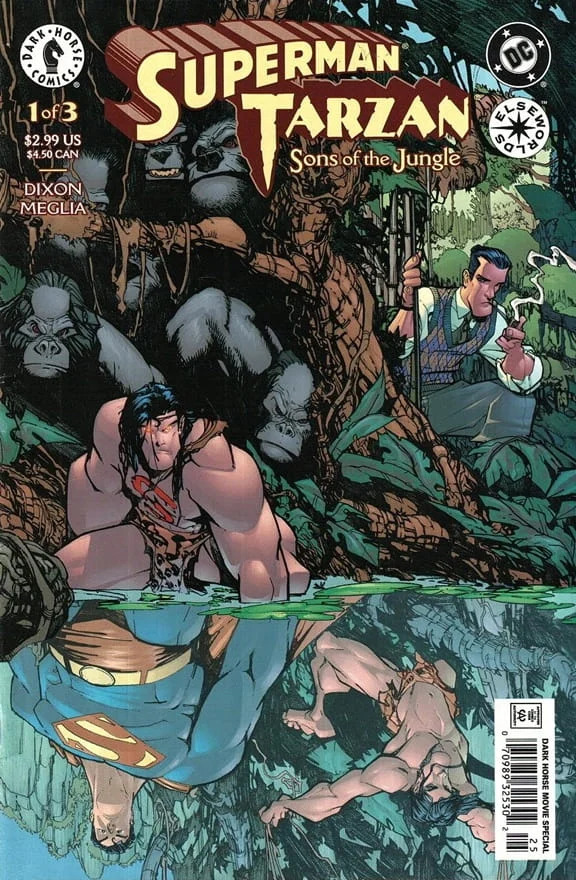
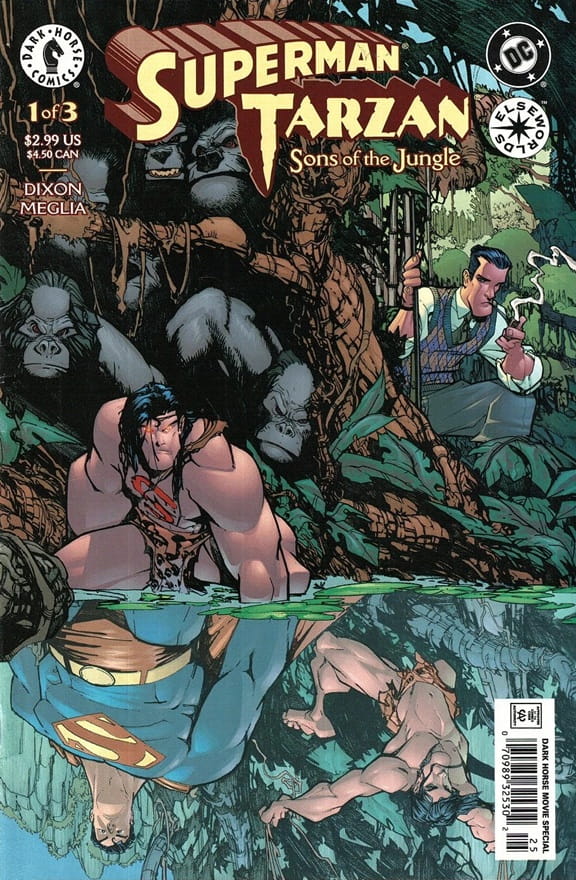
Penned by the prolific Chuck Dixon, with dynamic interior art by Carlos Meglia and striking covers by Humberto Ramos, Superman/Tarzan: Sons of the Jungle offered readers a radical reinterpretation of what it means to be a hero raised in the wild. Instead of the familiar narrative arcs, the series presented a world where the Man of Steel grew up among apes in the African jungle, while the Lord of the Apes experienced a privileged, if unfulfilled, life in civilized Britain. This ambitious premise promised a fresh perspective on characters whose stories are deeply ingrained in the collective consciousness, inviting a re-evaluation of the forces that shape their destinies.
The Genesis of a Crossover Dream
The early 2000s were a fertile period for comic book crossovers, particularly those involving DC Comics lending its iconic characters to other publishers for unique takes. Dark Horse Comics, known for its diverse catalogue and willingness to experiment, proved an ideal partner for such an endeavor. The idea of bringing Superman and Tarzan together was not entirely new, as both characters, in their own rights, represent archetypal heroes — one a beacon of hope from another world, the other a noble savage embodying humanity’s connection to nature. However, Sons of the Jungle pushed beyond a simple team-up, opting instead for a profound switch of origins.
Chuck Dixon, a writer celebrated for his meticulous plotting, strong characterization, and extensive work on titles like Batman and Birds of Prey, was a natural fit for navigating the complex narrative demands of such a concept. His ability to blend action with character-driven storytelling was crucial in grounding the fantastical elements of the premise. Carlos Meglia’s distinctive art style, characterized by its energetic lines and expressive figures, promised a visual dynamism that would differentiate this series from more traditional interpretations of either character. Meanwhile, Humberto Ramos, already a fan-favorite for his work on titles like Impulse and The Amazing Spider-Man, brought his signature kineticism and vibrant aesthetic to the covers, ensuring the series immediately caught the eye of readers.
Unraveling the Core Premise
At its heart, Superman/Tarzan: Sons of the Jungle is an "Elseworlds" or "What If" story, a popular subgenre that allows creators to explore alternate realities without disturbing the main continuity of established characters. The central conceit is elegantly simple yet profoundly impactful: what if the events that led to Tarzan’s birth and upbringing in the jungle were altered, and instead, the infant Kal-El landed in his place? This single point of divergence creates a cascade of altered destinies, setting the stage for a narrative rich with potential for irony, drama, and unexpected character development.
The series directly references Edgar Rice Burroughs’ seminal 1912/1914 serial/novel Tarzan of the Apes, taking its initial setup—the mutiny aboard The Fuwalda—as the jumping-off point. This grounding in the original source material provides a familiar foundation before the narrative dramatically veers into uncharted territory. The brilliance of the premise lies in its ability to immediately highlight the core attributes of both heroes, suggesting that while circumstances may change, certain heroic qualities or inherent destinies might persist.
Rewriting Destiny: A Chronological Journey Through the Jungle and Metropolis
The three issues of Superman/Tarzan: Sons of the Jungle meticulously unfold this altered reality, tracing the parallel lives of John Clayton and Kal-El as they are shaped by their new, unexpected environments. The narrative serves as a fascinating exercise in exploring the nature versus nurture debate through the lens of iconic heroism.
Issue #1: The Fateful Divergence
The story begins with a familiar scene: John Clayton and his pregnant wife, Alice, are aboard The Fuwalda, destined for marooning on the African coast. This is the precise moment where Burroughs’ classic tale of Tarzan’s origins begins. However, in this alternate reality, fate intervenes with a spectacular twist. Just as the mutinous crew prepares to abandon the Claytons, a flaming meteor streaks across the sky and crashes precisely at their intended landing site. Interpreting this celestial event as a dire omen, the superstitious crew diverts course, returning to Cape Town to drop off the Claytons instead.
This pivotal moment irrevocably alters history. The infant who would have become Tarzan is thus born and raised by his loving parents in the comforts of civilized Britain, rather than by Kala and the great apes in the heart of the jungle. This immediate shift establishes John Clayton as a man of privilege and education, seemingly far removed from his wild counterpart.
Crucially, the meteor that crashed was not merely a random space rock, but the very vessel carrying the infant Kal-El from the dying planet Krypton to Earth. Instead of landing in rural Kansas, the Kryptonian infant’s escape pod now lies amidst the African wilderness. It is here that Kala, the she-ape, discovers the extraordinary child. With her own infant tragically lost, Kala adopts the alien baby, bestowing upon him the name "Argo-zan," meaning "fire-skin," a direct reference to the fiery arrival of his ship. This sets up a Superman whose formative years are spent learning the ways of the jungle, without the guidance of Jonathan and Martha Kent, and crucially, without the immediate understanding of his alien heritage or the full extent of his powers. The series largely skips over Argo-zan’s earliest childhood, a point of critique for some, but establishes the profound impact of this wild upbringing on his character.
Issue #2: Paths Converge
Years later, the narrative introduces us to the adult John Clayton. Despite his upbringing in British society, Clayton is depicted as profoundly restless and "unsatisfied" with his civilized existence. He feels an inexplicable void, a deep-seated longing for something more primal and untamed, hinting at the ingrained "call of the wild" that even a changed destiny cannot fully extinguish. This internal struggle leads him to Africa, drawn by an almost instinctual pull to the continent that should have been his birthplace and kingdom.
Accompanying John Clayton on his African expedition are two iconic figures from the respective mythologies: Jane Porter, the classic love interest of Tarzan, and Lois Lane, the intrepid reporter traditionally associated with Superman. Their presence underscores the theme that certain connections and relationships are fated to occur, regardless of how individual lives are reshaped. Their journey to Africa becomes a catalyst, setting the stage for the inevitable confrontation and collaboration between the two "sons of the jungle" – one who was meant to be, and one who became.
Meanwhile, Argo-zan has grown into a powerful, albeit different, version of Superman. This incarnation of Kal-El is not yet fully superpowered in the traditional sense; he cannot fly, for instance. However, he possesses immense strength far beyond any human and is virtually impervious to physical harm, indicating that his Kryptonian physiology still grants him significant abilities, even if his powers haven’t fully manifested or been explored. His life among the apes has honed his senses, agility, and connection to the natural world, shaping him into a formidable guardian of the jungle.
Issue #3: Confrontation and Consequence
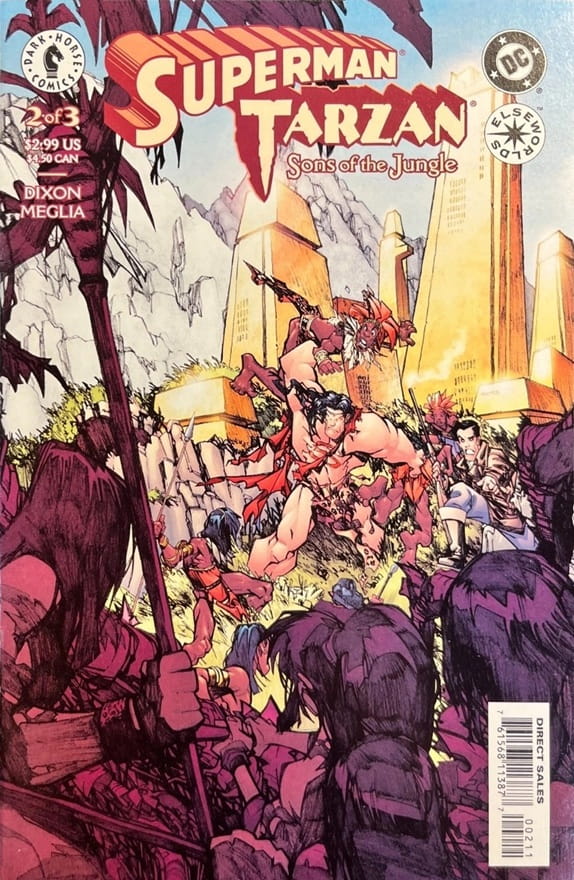
The climax of the miniseries brings the two protagonists and their companions into direct conflict with a formidable adversary: La of Opar. This classic Tarzan villain, a high priestess and queen of a lost city, is presented here with an enhanced threat, having discovered a potent weapon against the jungle’s new protector: Kryptonite. Her nefarious plan involves using this alien element to control Argo-zan, exploiting his vulnerability to harness his incredible strength for her own ambitions.
The final issue orchestrates the dramatic confrontation, forcing John Clayton and Argo-zan to cross paths and, ultimately, to recognize a shared destiny. The narrative builds to a resolution where the characters, through their trials and tribulations, find themselves drawn back to the roles and locations that, in their original mythologies, were destined for them. This cyclical nature of fate, the idea that certain powerful destinies cannot be entirely escaped, forms the core thematic conclusion of the series. The interplay between the "true" Tarzan (Clayton, fulfilling his destiny to return to the wild) and the "true" Superman (Argo-zan, an alien protector) offers a compelling resolution to the "what if" premise, leaving readers to ponder the profound implications of such an intertwined fate. The collected edition, released in September 2002, allowed fans to experience this complete, albeit condensed, saga.
Deeper Layers: Creative Choices and Thematic Resonance
Beyond the compelling plot, Superman/Tarzan: Sons of the Jungle is a rich tapestry woven from deliberate creative choices and profound thematic explorations. The series stands as a testament to the versatility of its iconic characters and the power of alternate history storytelling.
Crafting the Narrative: Chuck Dixon’s Vision
Chuck Dixon’s writing is a cornerstone of the series’ success. His narrative for Sons of the Jungle is praised for its smoothness and efficiency, especially given the monumental task of re-writing two legendary origins within a mere three issues. Dixon demonstrates a keen understanding of both Superman and Tarzan’s core appeal, skillfully integrating elements from their established mythologies while forging a new, cohesive narrative. He manages to convey John Clayton’s deep-seated unease with his "civilized" life and Argo-zan’s innate heroism, even without the traditional trappings of a cape or a city to protect.
However, the brevity of the series is also its primary limitation. As noted in contemporary analysis, there was significantly "more story here than could adequately be told in 3 comic book issues." The richness of the premise, the intricate details of two alternate upbringings, and the dramatic convergence of their paths, arguably deserved a more expansive canvas. Key developmental periods, such as Argo-zan’s early childhood among the apes and his discovery of his burgeoning powers, or John Clayton’s struggles with his identity and his journey back to Africa, are largely summarized rather than fully explored. While Dixon’s writing is adept at implying these deeper narratives, readers are left to imagine many compelling scenes and character moments that could have further enriched the tale. This inherent constraint, often a reality in comic miniseries, meant that the plot moved swiftly, prioritizing the overarching "what if" concept over granular character studies.
The Visual Tapestry: Artistry by Carlos Meglia and Humberto Ramos
The visual identity of Superman/Tarzan: Sons of the Jungle is defined by the distinctive styles of its interior artist, Carlos Meglia, and cover artist, Humberto Ramos. Meglia’s interior art is characterized by its dynamic energy and exaggerated forms. His jungle backgrounds are often lauded for their lushness and atmosphere, effectively conveying the wild, untamed environment that shapes Argo-zan. However, his portrayal of human figures, particularly their faces, often leans into caricature. This stylistic choice, which results in "hugely exaggerated" characters, was a point of contention for some viewers. While some found it refreshing and expressive, others perceived it as detracting from the realism or gravitas typically associated with these characters. Meglia’s style, known for its animated quality, often imbues characters with a sense of motion and intense emotion, which can be both captivating and polarizing.
Humberto Ramos’s cover art for the series similarly employs a highly stylized and energetic approach. His Superman, for instance, is depicted with a powerfully built physique and intense facial features, sometimes to the point of appearing "like he has acromegaly" – a comment highlighting the extreme exaggeration. Yet, Ramos’s covers are undeniably eye-catching and successful in conveying the primal power and raw emotion inherent in the concept. His use of vibrant colors and dynamic compositions effectively draws readers into the world of Sons of the Jungle, hinting at the epic clash within. The cover of issue #1, with its evocative "pool reflection," stands out as a particularly well-executed piece, blending symbolism with visual appeal. Ultimately, the artistic choices by both Meglia and Ramos, while distinct and perhaps not universally appealing, contribute significantly to the series’ unique identity and set it apart from more conventional superhero or adventure comics.
Exploring Fate, Identity, and Heroism
Thematically, Superman/Tarzan: Sons of the Jungle delves deep into the interplay of fate versus free will. The narrative consistently suggests that despite the radical alterations to their origins, John Clayton and Kal-El are still fundamentally drawn to their heroic destinies. Clayton, raised in luxury, feels an unshakeable pull towards the wild, while Argo-zan, the Kryptonian raised by apes, instinctively becomes a protector. This raises profound questions about what truly defines a hero: is it circumstance, inherent nature, or a predetermined path?
The series also explores the concept of identity. How does growing up in a vastly different environment shape who these characters become? Argo-zan, without the moral compass of the Kents or the understanding of Kryptonian science, develops a primal sense of justice rooted in the laws of the jungle. John Clayton, despite his education, struggles with an internal wildness, hinting that the "Lord of the Apes" spirit is more than just a title – it’s an intrinsic part of his being. The presence of Jane Porter and Lois Lane further reinforces the idea that certain connections are foundational to their narratives, transcending alternate realities.
Critical Reception and Authorial Intent
While specific widespread "official responses" from the time of its release might be difficult to unearth two decades later, the initial critical assessment within the provided article offers valuable insights into the series’ reception and highlights areas where authorial intent might have clashed with practical constraints.
Pacing and Narrative Scope: A Three-Issue Conundrum
The primary criticism leveled against Superman/Tarzan: Sons of the Jungle concerns its ambitious scope being constrained by a limited page count. The reviewer articulated that "there’s a lot more story here than could adequately be told in 3 comic book issues." This is a common challenge for miniseries attempting to re-imagine fundamental aspects of established characters. Dixon’s narrative, while "smooth" and "generally well done," had to condense potentially rich developmental arcs into mere glimpses.
For instance, the formative years of Argo-zan, including his discovery of his powers, his interactions with the African wildlife, and his integration into the ape community, are largely absent. Similarly, John Clayton’s internal struggle with his "unsatisfied" civilized life and the gradual realization of his inherent wildness are presented more as established facts than as developed narrative threads. A longer series, perhaps 6 or 12 issues, could have allowed for a more gradual build-up, deeper character exploration, and the inclusion of numerous "scenes I’d have enjoyed getting a look at," as the reviewer notes. This limitation likely stemmed from editorial decisions regarding market viability, rather than a lack of vision from the creative team, demonstrating the perpetual tension between artistic ambition and commercial realities in the comic book industry.
The Distinctive Art Style: A Matter of Preference
The artistic direction, particularly the "hugely exaggerated" character designs by Carlos Meglia for the interiors and Humberto Ramos for the covers, also elicited a mixed response. While acknowledging the immense talent of both artists, the reviewer expressed a personal preference against the caricatured faces and forms, stating, "I didn’t personally like many of the human images presented here." The description of Superman looking like he has "acromegaly on the covers" underscores the extreme nature of these stylistic choices.
It’s plausible that this exaggerated style was a deliberate choice, intended to lend a heightened, almost mythical quality to the characters, or to emphasize the raw, untamed nature of their altered origins. Meglia’s art often has a kinetic, almost animated feel, which can be very effective for action sequences and conveying strong emotions. Ramos’s covers, with their bold lines and dynamic poses, are designed to grab attention and symbolize the primal power of the crossover. Artistic preference is, by its nature, subjective, and what one reader perceives as "caricatures" another might see as expressive and stylized interpretations that breathe fresh life into familiar figures. The series’ art style, therefore, became a defining characteristic, polarizing some but undoubtedly contributing to its unique aesthetic.
The Enduring Legacy of an "Elseworlds" Tale
Despite its brevity and the subjective nature of its artistic style, Superman/Tarzan: Sons of the Jungle holds a notable place within the pantheon of comic book crossovers and "what if" narratives. It represents a bold experiment, pushing the boundaries of how established characters can be re-imagined.
A Unique Contribution to Crossover Lore
This miniseries is not just another team-up; it’s a fundamental re-wiring of two legendary origins. By swapping the core elements of Superman and Tarzan’s beginnings, Dark Horse and DC created a story that is genuinely unique, even within the crowded field of crossover events. It highlights the enduring flexibility of these characters’ mythologies and their ability to resonate even when stripped of their most familiar trappings. The series demonstrated that the essence of Superman’s heroism and Tarzan’s connection to nature could persist, regardless of the precise circumstances of their upbringing. This kind of deep narrative alteration stands apart from simple team-ups, offering a more profound exploration of character identity.
Reflecting on the "What If" Paradigm
Superman/Tarzan: Sons of the Jungle serves as an excellent example of the "Elseworlds" or "What If" paradigm at its best. It uses an alternate reality to explore foundational questions about character, destiny, and the forces that shape heroes. It challenges readers to consider what makes Superman "Superman" and Tarzan "Tarzan," suggesting that while external circumstances play a role, there is an inherent core to these characters that transcends their specific origins. The series posits that certain destinies, or at least inclinations towards heroism, are so strong they will manifest even through radically different paths.
Final Thoughts: A Worthy, If Flawed, Experiment
Ultimately, Superman/Tarzan: Sons of the Jungle is a commendable and imaginative endeavor. Chuck Dixon delivered a clever and engaging narrative, effectively executing a high-concept premise. While the limited issue count undoubtedly compressed what could have been an even richer story, and the art style might not appeal to all, the series succeeded in its primary goal: to offer a fresh, thought-provoking, and entertaining twist on two timeless legends. It stands as a testament to the creative risks that can yield fascinating results, proving that even the most iconic characters can be re-interpreted in ways that surprise, challenge, and delight readers. For fans of either character, or those simply interested in inventive alternate history storytelling, this miniseries remains a compelling, albeit condensed, journey into a world where destinies are swapped and heroes are forged anew.

Leave a Comment