
A Retrospective Journey Through the Golden Age: Unpacking DAW Books’ The Year’s Best Fantasy Stories
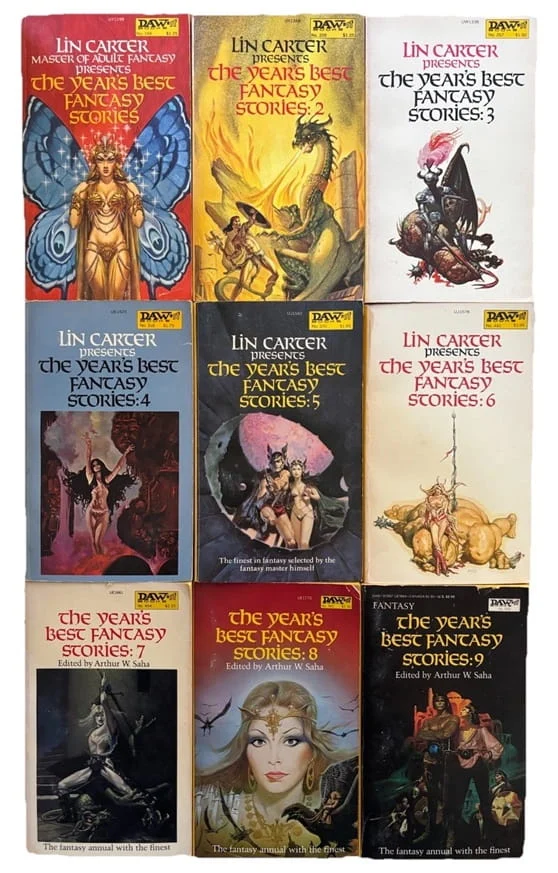
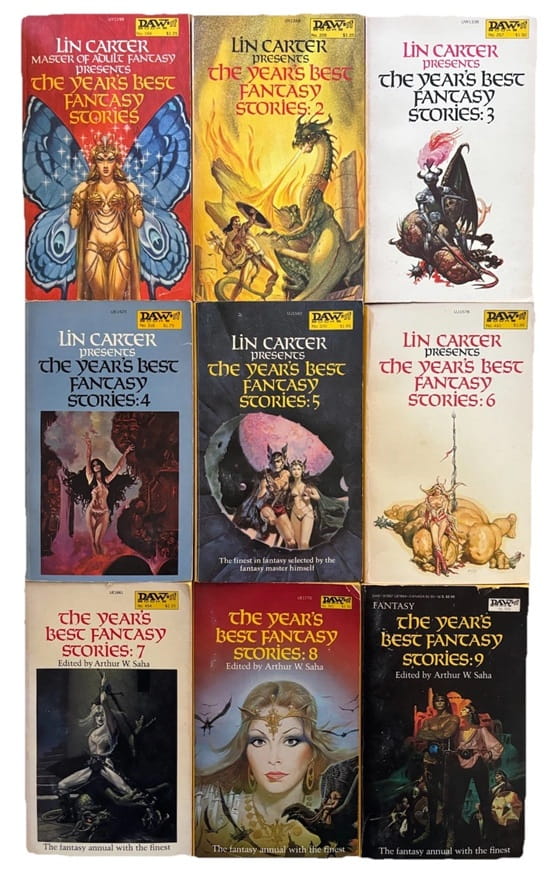
NEW YORK, NY – From the mid-1970s through the late 1980s, DAW Books offered fantasy enthusiasts a vital annual compass to the genre’s evolving landscape: The Year’s Best Fantasy Stories. This anthology series, initially helmed by the indefatigable Lin Carter and later by Arthur W. Saha, became a cornerstone for many readers, introducing them to both established masters and burgeoning talents in fantasy literature. Spanning nine volumes under Carter and Saha, these collections provided a crucial snapshot of the genre’s dynamic shifts, its enduring traditions, and even its occasional controversies.
While Lin Carter’s personal writing style often drew mixed critical reactions, his immense influence as an editor and fervent advocate for the fantasy field remains largely undisputed. He possessed an uncanny knack for unearthing forgotten gems, championing new voices, and consistently curating a diverse diet of works that resonated deeply with the genre’s burgeoning readership. This retrospective delves into the chronological unfolding of this seminal series, examining its contents, editorial philosophies, and lasting implications for fantasy literature.
The Dawn of a Series: Lin Carter’s Vision Takes Hold (1975-1980)
The launch of The Year’s Best Fantasy Stories in 1975 by DAW Books marked a significant moment for the genre. At a time when fantasy was gaining broader mainstream appeal but still finding its definitive voice beyond the shadow of Tolkien, these anthologies served as essential guides. Lin Carter, already a celebrated figure for his work on the Ballantine Adult Fantasy series and his own Sword & Sorcery novels, was the natural choice to curate the initial volumes. His editorial mandate appeared clear: to celebrate the heroic, the mythical, and the imaginative.
The Year’s Best Fantasy Stories 1 (October 1975)
The inaugural volume, featuring a striking cover by George Barr, immediately established Carter’s eclectic yet focused approach. It opened with a powerful offering from Robert E. Howard, "The Temple of Abomination," a Cormac Mac Art story that anchored the collection in classic Sword & Sorcery. This inclusion underscored Carter’s dedication to the foundational authors of heroic fantasy.
Beyond Howard, the anthology presented a fascinating cross-section of the genre. Marion Zimmer Bradley, a prominent voice in both fantasy and science fiction, contributed alongside Lloyd Alexander, whose work often bridged the gap between young adult and adult fantasy. Clark Ashton Smith, another pulp-era titan, was represented by a fragment completed by Carter himself—a practice that, while sometimes debated, highlighted Carter’s commitment to preserving and presenting the work of foundational authors.
Fritz Leiber, with a Fafhrd and the Gray Mouser tale, showcased the enduring popularity of his iconic duo, while Carter himself included a Thongor story, a common practice for him in these anthologies. Other notable contributors included Hannes Bok, L. Sprague de Camp (whose often tongue-in-cheek style was noted as not universally appealing), Pat McIntosh, and Jack Vance, representing his distinct Dying Earth subgenre.
Perhaps one of the most significant inclusions was Charles R. Saunders’ "The Price of the Dream," later titled "Dominu." This Imaro story was reportedly Saunders’ first published work, showcasing immense power and promise despite its nascent nature. Its presence was a groundbreaking moment, introducing a powerful new voice and an important perspective to the heroic fantasy canon. The inclusion of an editor’s own work in a "Best of" anthology, while now often considered a faux pas, was a more accepted practice at the time, likely driven by Carter’s established popularity and perceived sales draw.
The Year’s Best Fantasy Stories 2 (August 1976)
The second volume, also adorned with George Barr’s artwork, continued Carter’s established pattern, beginning with his customary "The Year in Fantasy" essay. This essay served as a valuable yearly overview, contextualizing the genre’s developments and notable publications.
This collection featured "The Demoness" by Tanith Lee, a story praised for its beautiful prose and regarded by some as a highlight of the collection, cementing Lee’s rising status as a unique and influential voice in fantasy. Thomas Burnett Swann contributed "The Night of the Unicorn," a short piece leaning into magical realism, demonstrating the series’ openness to varied subgenres.
Fritz Leiber’s Fafhrd and the Gray Mouser reappeared with "Under the Thumbs of the Gods," reaffirming the duo’s consistent quality. Lovecraftian horror found a place with Gary Myers’ "Xiurhn" and Walter C. DeBill, Jr.’s "In ‘Ygiroth’," showcasing the genre’s enduring connection to cosmic dread. Carter again included his own work, "The City in the Jewel," a substantial Thongor story, and collaborated with Clark Ashton Smith on "The Scroll of Morloc." While some collaborations were successful, this particular piece was noted as not being "terribly well done." The volume also featured a werewolf tale by Pat McIntosh, "Cry Wolf," and "The Lamp from Atlantis" by L. Sprague de Camp, which, while interesting, was perceived as overly long.
The Year’s Best Fantasy Stories 3 (November 1977)
Though this particular volume was not personally read by the original reviewer, its table of contents reveals continued editorial consistency and prescience. Josh Kirby provided the cover art. Carter’s "The Year in Fantasy" essay remained a staple.
This collection showcased George R. R. Martin’s "The Lonely Songs of Laren Dorr," an early work from an author who would later achieve global renown, highlighting Carter’s ability to spot burgeoning talent. Karl Edward Wagner contributed a Kane story, "Two Suns Setting," offering a taste of the darker, more morally ambiguous side of fantasy that Wagner expertly crafted. C. J. Cherryh, another future luminary, was also featured with "The Dark King." The presence of these authors underscores the anthology’s role as a vital platform for emerging stars. Further contributions included L. Sprague de Camp’s "Eudoric’s Unicorn," Gardner F. Fox’s "Shadow of a Demon" (featuring Niall of the Far Travels), Pat McIntosh’s "Ring of Black Stone," and Charles Saunders’ "The Pool of the Moon," marking his continued presence in the series. Lin Carter also included "Black Moonlight" under his own name, and another collaboration with Clark Ashton Smith, "The Stairs in the Crypt."
The Year’s Best Fantasy Stories 4 (December 1978)
Esteban Maroto’s distinctive artwork graced the cover of the fourth volume. Robert E. Howard made another appearance with "Nekht Semerkeht," a partial story expertly completed by Andrew Offutt. This practice of completing fragments of revered authors was a hallmark of Carter’s editorial philosophy, aiming to bring as much of these foundational works to light as possible.
Beyond Howard, the volume featured two particularly strong tales: Poul Anderson’s "The Tale of Hauk," celebrated for its blend of myth and compelling narrative, and a story by Ramsey Campbell, which had previously appeared in Swords Against Darkness, showcasing the cross-pollination between heroic fantasy and dark fantasy/horror. Avram Davidson’s "Hark! Was that the Squeal of an Angry Thoat?" offered a humorous pastiche of Edgar Rice Burroughs’ Barsoom, demonstrating the series’ willingness to include playful homages. Clark Ashton Smith’s "Lok the Depressor" was present, described as good but not outstanding. Other contributors included Grail Undwin, Lin Carter, Phyllis Eisenstein, Tanith Lee, Pat McIntosh, and Philip Coakley.
The Year’s Best Fantasy Stories 5 (January 1980)
The fifth volume, with cover art by Penalva, again featured Robert E. Howard, this time with "Lord of the Dead." This story, primarily a crime narrative with fantastic elements, highlighted Howard’s versatility beyond the confines of pure Sword & Sorcery, demonstrating his ability to infuse various genres with his signature dark flair.
A Conan pastiche, co-written by L. Sprague de Camp and Lin Carter, was also included, continuing the tradition of extending the lives of iconic characters through new tales. The anthology showcased a blend of established and newer talents: T. H. White, known for his Arthurian epic The Once and Future King, Tanith Lee, Pat McIntosh, Craig Shaw Gardner, and Adrian Cole. Cole’s "Astral Stray" was singled out as a standout, reflecting his unique and often atmospheric style. Janet Fox, David Malory, Grail Undwin, Marvin Kaye, and Evangeline Walton, celebrated for her Mabinogion retellings, completed the lineup.
The Year’s Best Fantasy Stories 6 (November 1980)
The sixth volume, featuring a vibrant Josh Kirby cover, marked a notable departure: it did not contain a Robert E. Howard story. Despite this, it was lauded as a particularly strong collection, opening with Carter’s annual "The Year in Fantasy" essay.
Roger Zelazny contributed a Dilvish story, "Garden of Blood," showcasing his mastery of imaginative prose and complex worlds. John Brunner, typically associated with science fiction, offered "The Things That Are Gods," illustrating the porous boundaries between genres. Tanith Lee made multiple appearances with "Perfidious Amber" and "Red as Blood," further solidifying her consistent presence and quality within the series. Fritz Leiber’s Fafhrd and the Gray Mouser also returned with "The Mer She."
Lin Carter included another Thongor tale, "Demon of the Snows," maintaining his dual role. Other contributors included Paul H. Cook, Jayge Carr, and Brian Lumley, known for his horror and Cthulhu Mythos-inspired works. However, the true gem of this collection, and a story frequently cited as worth the price of admission alone, was Orson Scott Card’s "Sandmagic." This powerful and imaginative tale demonstrated Carter’s continued ability to identify stories that would resonate deeply with readers and stand the test of time.
The Grail Undwin Enigma: A Journalistic Inquiry
A fascinating and ethically complex revelation concerning Lin Carter’s editorial practices emerged around the same period. The name "Grail Undwin" appears in several of the Carter-edited Year’s Best Fantasy Stories collections (volumes 4, 5, and 6), often with stories that, while present, did not leave a particularly strong impression on the reviewer. This consistent appearance, coupled with the eventual unmasking, calls into question the fundamental integrity of a "Best of" anthology.
It has been widely reported, notably by G. W. Thomas, that "Grail Undwin" was a secret pseudonym of Lin Carter himself. If true, this implies that Carter not only included one of his own stories under his acknowledged name in virtually every anthology but also managed to insert a second, pseudonymous piece. The motivations behind such a practice could be manifold: financial gain (being paid for two stories instead of one), a perceived scarcity of suitable high-quality submissions, or perhaps an editor’s ego, believing his work was indeed among the "best."
This revelation undoubtedly casts a shadow on Carter’s otherwise esteemed reputation as an editor. While his dedication to the genre was undeniable, the use of a pseudonym to effectively double-dip in a "Best of" compilation raises serious ethical questions about impartiality and the objective selection process inherent in such anthologies. It challenges the very premise of "best," suggesting that editorial self-interest might have occasionally superseded meritocratic selection. DAW Books, the publisher, seemingly remained unaware or unconcerned by this practice, or at least no public statement or ‘official response’ ever addressed it, further muddying the waters of this peculiar episode in fantasy publishing history.
A Shifting Landscape: Arthur W. Saha Takes the Helm (1981-1988)
The editorial reins of The Year’s Best Fantasy Stories passed from Lin Carter to Arthur W. Saha following the sixth volume. The exact reasons for this transition were not officially stated at the time, but speculation, including observations by the original reviewer, often pointed to Carter’s declining health. Lin Carter, a prolific writer and editor, tragically passed away in 1988, underscoring the potential validity of this theory.
Arthur W. Saha brought a distinctly different editorial philosophy to the series, marking a significant shift in its direction and content. His tenure saw the series continue for several more volumes, extending through volume 14 in 1988.
The Year’s Best Fantasy Stories 9 (October 1983)
One of Saha’s volumes, The Year’s Best Fantasy Stories 9, with a cover by Sanjulian, exemplifies this new direction. The roster of authors included John Kessel, R. A. Lafferty, Michael Shea, Harlan Ellison, Richard Christian Matheson, Parke Godwin, Jor Jennings, Jane Yolen, Suzette Haden Elgin, and Tanith Lee.
This lineup immediately signals a move towards a broader, more literary, and often more experimental definition of "fantasy" than Carter’s predominantly heroic and traditional selections. Saha’s anthologies embraced a wider spectrum of the fantastic, often featuring stories set in more modern milieus and tending towards the humorous, the satirical, or the psychologically complex, rather than the epic adventures that characterized many of Carter’s choices.
For readers accustomed to Carter’s focus on Sword & Sorcery, epic fantasy, and mythic adventures, Saha’s collections presented a drastic change. While objectively, many of these stories were undoubtedly well-crafted and significant contributions to the genre, they catered to a different sensibility. The shift away from pure adventure and towards more contemporary settings and diverse narrative styles alienated some readers, including the original reviewer, who opted not to continue collecting Saha’s subsequent volumes. This divergence highlights the growing fragmentation and diversification of the fantasy genre itself during the 1980s, where "fantasy" began to encompass a much wider array of themes and styles beyond its traditional heroic roots.
Legacy and Implications: A Genre in Flux
The Year’s Best Fantasy Stories series, under both Lin Carter and Arthur W. Saha, remains a crucial artifact of fantasy literature. Carter’s initial volumes, particularly, served as an essential gateway for countless readers into the genre, consolidating its foundations and spotlighting both its established masters and its most promising new talents. His dedication to authors like Robert E. Howard, Clark Ashton Smith, and Fritz Leiber ensured their continued relevance, while his early championing of authors like Charles R. Saunders, George R. R. Martin, and Tanith Lee demonstrated his prescience. The "Grail Undwin" controversy, while tarnishing his editorial impartiality, does not erase the broader positive impact of his curatorial work.
Arthur W. Saha’s tenure, while perhaps less universally embraced by fans of the earlier heroic fantasy focus, was equally significant in reflecting the genre’s evolution. His broader definition of fantasy, encompassing more literary, modern, and diverse forms, foreshadowed the genre’s later explosion into myriad subgenres. The series, therefore, serves as a chronological record of fantasy’s journey from its pulp roots to its more experimental and mainstream manifestations.
These "Year’s Best" anthologies, in general, play a critical role in genre literature. They offer a curated overview, acting as both historical documents and predictive indicators of future trends. The DAW series, despite its editorial shifts and internal quirks, fulfilled this role admirably. It provided a yearly benchmark, sparked discussions, and, most importantly, brought countless hours of imaginative escape to a generation of fantasy readers. Its enduring value lies not just in the individual stories it contained, but in its collective testimony to the vibrant, dynamic, and ever-expanding world of fantasy fiction during a pivotal era. The series’ run from 1975 to 1988 encapsulates a period of profound growth and redefinition for the genre, leaving behind a rich legacy for future generations to explore and appreciate.


Leave a Comment