Cinga Samson’s "Ukuphuthelwa": A Profound Exploration of Sleeplessness, Representation, and the Sublime
Cape Town, South Africa – Renowned South African artist Cinga Samson unveils his latest exhibition, "Ukuphuthelwa," a deeply resonant collection of new oil paintings that delve into the multifaceted nature of sleeplessness, the inherent limitations of artistic representation, and the awe-inspiring power of the sublime. The exhibition, which opened to critical acclaim, will be on view through April 18, 2026, offering a prolonged opportunity for contemplation and engagement with Samson’s profound visual language.
The Unsettling Gift of Sleeplessness: "Ukuphuthelwa" Reimagined
The exhibition’s title, "Ukuphuthelwa," is derived from an isiXhosa word that translates to "unable to sleep." Crucially, unlike its English counterpart, "insomnia," the isiXhosa term carries no negative connotations. For Samson, this state is not a malady to be cured but rather a heightened spiritual alertness, a profound sensitivity that blossoms in the darkness. This nuanced understanding forms the bedrock of his new body of work, where the nocturnal hours become a fertile ground for deeper perception and existential inquiry.
Samson’s signature artistic style is immediately apparent in "Ukuphuthelwa." He employs an occluded palette dominated by near-blacks, carbon, and deep Prussian blues, creating an atmosphere of profound depth and introspection. Within these nocturnal landscapes, the artist renders enigmatic figures that are distinctly human-like, alongside dogs that inhabit overgrown fields and intimate portraits of South Africa’s native flora. These elements, rendered with painstaking detail and masterful brushwork, coalesce to evoke a palpable sense of existential gravity. The paintings invite a slow, contemplative gaze, pushing viewers to confront a vast reality that is perpetually in flux. At the heart of this exploration lies Samson’s own profound quandary: how to create a "true and honest painting."
The Unbridgeable Gulf: The Artist’s Struggle with Representation
"Ukuphuthelwa" is a direct confrontation with Samson’s role as an artist grappling with the inherent limitations of his medium. He acknowledges the impossibility of representing the entirety of truth and the fact that his creations are ultimately symbols, mere gestures towards a reality that often eludes definitive capture. Samson posits that a fundamental gulf exists between the static, painted sign and the fluid, lived experience it attempts to convey – a chasm that no single image can fully bridge.
While the technical mastery and convincing realism evident in these paintings might seem to invite straightforward interpretation, Samson asserts that his work intentionally highlights the very dilemma of representation. He contends that an image can only ever be a relative symbol of its subject, never its true equivalent. This acknowledgement of the open-ended nature of symbols and their subjective interpretation is central to the exhibition.
To illustrate this point, Samson frequently employs the figure of the dog. In "Intsingiselo II" (2026), for instance, a viewer might readily perceive the conventional symbolism of loyalty associated with dogs. However, an amaXhosa cultural lens offers a richer interpretation, where the dog can signify the guiding and protective principles of ancestors. This duality underscores Samson’s central thesis: that meaning is not inherent but is fluid, shaped by individual experience, cultural context, and the inherent ambiguity of symbols themselves. Instead of disguising the limits of representation, Samson’s paintings aspire to harness his artistic skills to point towards that which lies beyond the representable, seeking the authority of the unnameable and the profound territory of the sublime.
Ritual, Language, and the Unseen: Unlocking Deeper Meaning
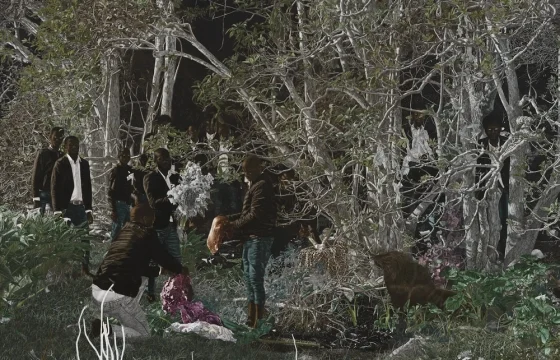
Samson’s larger compositions possess a palpable sense of reverence and ceremony. In "Umlindo" (Watcher) (2026), figures are depicted in a forest clearing, adorned with wildflower bouquets and lengths of fabric. This scene, rich in the visual grammar of ritual, deliberately avoids specifying the object or terms of the ceremony. For Samson, however, the ritual itself is not the ultimate concern; rather, it serves as "an opening to what exists beyond."
Through the aesthetics of ritual, Samson’s paintings speak to a collective human need for orientation and the profound capacity of ritual to mediate encounters with the vast and often overwhelming unknown. The exhibition’s titles, often featuring enigmatic isiXhosa words and phrases such as "Imfihlo" (Secret) and "Intsingiselo" (Meaning) (both 2026), further reinforce the central theme of interpretation’s instability, particularly concerning the knowable and the unknowable. Each word carries a weight and resonance in isiXhosa that its English translation can only approximate. Just as meaning slips between the painted sign and the living referent, it also navigates the interstitial spaces between languages, highlighting the inherent complexities of translation and understanding.
The Sublime in the Mundane: Oscillations of Awe and Intimidation
The objects, people, and settings that recur throughout Samson’s oeuvre are deliberately recognizable and quotidian. Yet, in each instance, he imbues them with an inexplicable mystery. In "Tshee" (2026), a vast field stretches towards a murky sky, punctuated by silhouetted trees. The nocturnal void is dramatically interrupted by a moonlit cloud, its brilliant white light destabilizing the eerie, cold atmosphere with an undeniable majesty.
"The sky can be so friendly, but sometimes so heavy, dark, so scary," Samson observes. "It’s the same energy, but it exists in different forms." This oscillation between the approachable and the overwhelming, the comforting and the terrifying, directly evokes the affective register of the sublime. "Sithini ngelilitye" (2026) distills this same sensation: a rocky crag, rendered with forensic detail, emerges from arid undergrowth against a sky of barely-there wash. The scene is charged with a quality of mute enormity, a silent testament to forces beyond human comprehension.
The Art of Revealing and Concealing: Light, Line, and the Porous Figure
Samson masterfully manipulates light "like a magic trick," imbuing his paintings with a unique rhythm. This flickering quality, which emerges and disperses across the picture plane, grants varying degrees of visibility to the predominantly dark, nighttime scenes. This technique creates an unsteadiness that is both optical and psychical, drawing the viewer into a more active engagement with the artwork.
The artist strategically leaves large sections of the under-drawing visible, lending moments of transparency to the work and revealing the process of its creation. In "Isiganeko" (2026), for example, thin layers of glaze are applied and then wiped back in Samson’s characteristic style. This method of building color lends the figures a brooding chromatic density, while elsewhere, in the undergrowth and a bird caught mid-flight, the under-drawing remains entirely exposed.
Perhaps the most striking element in Samson’s figures is the deliberate omission of pupils in their eyes. This artistic choice allows "light" to circulate more freely, rendering the figures porous and suggesting they are "completely one with the whole painting." Without pupils, these figures transcend individual personification; they become "human" forms deeply enmeshed with the painting’s landscape and atmosphere, where no single element holds absolute mastery over another.
Beyond Representation: Towards the Immanent Magic of Existence
Where the "trick" of painting reveals itself, it signifies Samson’s deliberate move away from the pretense or promise of definitive representation. "Ukuphuthelwa" does not aim for individual transcendence through subordination. Instead, it seeks to unearth the profound mystery embedded within ordinary forms, revealing an immanent magic that is accessible to those who are sensitive to its presence.
This exhibition ultimately describes a condition of hypersensitivity, not an absence or deficit. It is a state that affords everything in existence an equal potential for eliciting wonder or fear. Samson’s pupilless figures do not "look" outward in a conventional sense because their knowing emanates from within the world they inhabit. This shared knowledge exists in communion with the bowing foliage, the vigilant dog, the bird in flight, and the foreboding night sky that envelops them all. In Samson’s masterful hands, each optical device and representational motif serves to pry apart that which cannot be fully contained, ultimately in service of painting "a thing that links us to God – by God, I mean everything."
The enduring power of "Ukuphuthelwa" lies in its capacity to transcend mere visual representation. It invites viewers to engage with a deeper understanding of existence, to embrace the ambiguity of meaning, and to find the sublime not in the distant or the divine, but in the very fabric of the ordinary, illuminated by the profound sensitivity of sleeplessness.
Exhibition Details:
- Ukuphuthelwa
- Artist: Cinga Samson
- On View Through: April 18, 2026
- Location: [Insert Gallery Name and Location Here]