Allen Stroud’s "Anti-State" Ignites Debate with Stark Portrayal of Martian Rebellion and Authority
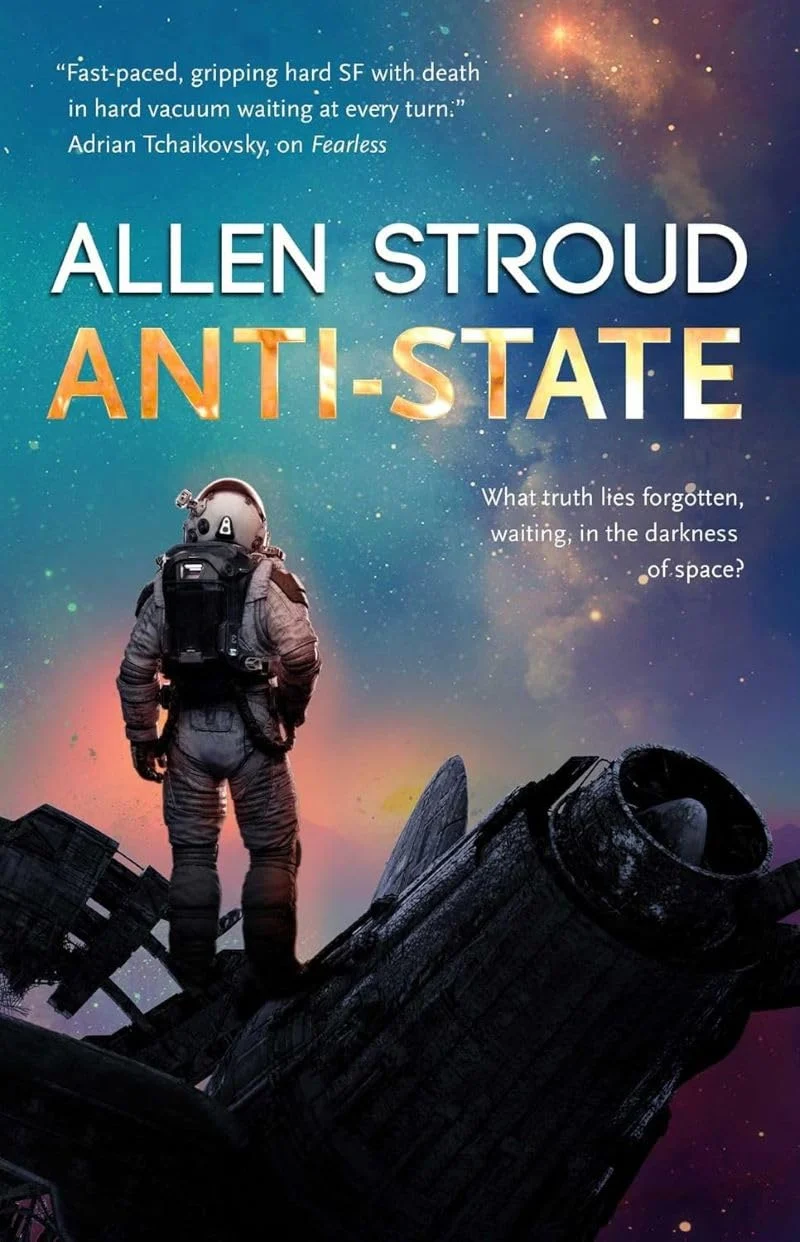
London, UK – The latest addition to author Allen Stroud’s acclaimed "Fractal" series universe, Anti-State, has been released, plunging readers into a gritty 22nd-century Martian colony gripped by a corporate-fueled worker uprising. Marketed as a standalone narrative, the novel explores the complex ethical and political dimensions of rebellion, corporate manipulation, and the very nature of authority, prompting robust discussion among literary critics and science fiction enthusiasts alike. While praised for its intricate world-building and ambitious premise, early reviews suggest Anti-State delivers a deliberately challenging and, for some, unsettling take on its core themes, leaving an impression of profound, perhaps even uncomfortable, resolution.
The novel transports readers to a future where humanity has begun the arduous task of colonizing the solar system, a backdrop extensively detailed in Stroud’s ongoing "Fractal" series. Anti-State specifically zeroes in on the Jezero crater colony on Mars, a corporate-controlled entity where the promise of prosperity has devolved into a system of indentured labor, explicitly equated to slavery within the narrative. It is against this oppressive backdrop that a worker uprising erupts, a rebellion whose initial idealism is gradually complicated by revelations of deeper manipulation.
Initial critical reception highlights the novel’s compelling setup, presenting a multifaceted conflict through the eyes of four distinct protagonists, each embodying a different philosophical stance on authority and justice. However, a recurring observation from reviewers points to a perceived lack of dynamic character development and an eventual thematic conclusion that some find "simplistic" or "artificial," raising questions about the author’s ultimate message regarding societal control and individual agency.
Chronology: From Galactic Ambitions to Martian Rebellion
The Genesis of the Fractal Series
Allen Stroud’s "Fractal" series has established itself as a significant voice in contemporary science fiction, building an extensive and interconnected universe charting humanity’s ventures beyond Earth. This collection of novels and novellas is known for its detailed exploration of interplanetary colonization, the socio-political challenges of expansion, and the ethical quandaries that arise when new societies are forged under extreme conditions. Anti-State positions itself within this grand narrative, offering a concentrated look at a pivotal moment in Martian history without requiring prior knowledge of the broader series. This strategic positioning allows new readers an entry point while providing established fans with deeper lore and context for the wider "Fractal" universe.
The series typically delves into the intricate power structures that emerge in off-world settlements, from nascent democratic efforts to entrenched corporate hegemonies. Anti-State appears to distill many of these overarching themes into a singular, intense conflict, focusing on the immediate ramifications of unchecked corporate power and the desperate measures taken by an oppressed populace.
The Narrative Arc of Anti-State
The narrative of Anti-State is constructed around four converging storylines, each introducing a character whose initial worldview is sharply defined, setting the stage for ideological clashes.
-
Magnus Sirocco: Introduced in a cafe in Naples, Italy, Magnus is a former soldier turned corporate mercenary, a figure steeped in pragmatic nihilism. His backstory reveals a profound disillusionment with idealistic rhetoric and institutional authority, leading to a dishonorable discharge from an unnamed military. A pivotal early scene sees Magnus intervening to protect a couple from attackers, not out of duty or personal vendetta, but from a clear-eyed assessment that official authorities (police drones) are absent or unwilling to act. This act of self-reliance, born from a rejection of external control but guided by a personal sense of justice, draws the attention of the mysterious Icono Group. They recruit him for a mission on Mars: to contact Antonio Sammatri, a revolutionary leader, and deliver encrypted data vital to an unfolding rebellion. Magnus accepts, despite his inherent distrust of corporate objectives, driven by a cynical acceptance of his role in a world devoid of genuine authority.
-
Peter Iskander: In stark contrast to Magnus, Peter Iskander serves "The Temple," a religious organization on the same Jezero colony. His narrative opens as he and fellow Temple followers commandeer the Asthoreth, a damaged battleship being salvaged by the Martian government. Peter’s leadership is characterized by an unwavering allegiance to a higher authority, his Temple perceiving itself as an amalgamation of all human religions, united by a belief in a "higher purpose." His reluctance to execute a corporate overseer, Weaver, hinges solely on Weaver’s potential conversion to any form of religious authority, highlighting Peter’s conviction that faith in a higher power is synonymous with trustworthiness and moral rectitude. This establishes Peter as a devout follower of structured belief, directly opposing Magnus’s skepticism.
-
Ellisa Shann and Avril Johansson: Representing a middle ground between Magnus’s radical individualism and Peter’s dogmatic faith are Ellisa Shann and Avril Johansson, both dedicated soldiers of Earth’s Fleet. Shann, an officer returning from deep space, receives orders to intercept Peter’s hijacked Asthoreth. Her story embodies institutional loyalty and a commitment to maintaining order. Johansson, a Fleet liaison on Mars, is tasked by Shann with investigating Peter Iskander and his group. Assisted by her wife, Chiu, Johansson’s mission provides a crucial on-the-ground perspective of the Martian totalitarian society, exposing the brutal realities of the indentured labor system and the simmering discontent among the populace. Their narratives intertwine the macro-level geopolitical conflicts with the micro-level human cost of corporate exploitation.
As these four distinct narratives converge, Stroud meticulously weaves an "intricate narrative" that promises a rich exploration of contrasting philosophies. Magnus makes contact with Sammatri, discovering the rebellion’s true, unsettling nature: it is not a genuine grassroots movement but a meticulously orchestrated event by the Icono Group, leveraging an artificial intelligence known as "the Machine" to manipulate public opinion and seize control. The encrypted data Magnus carries are codes for this AI, designed to ensure the rebellion serves its corporate creators, merely replacing one form of control with another. This revelation transforms the uprising from a fight for freedom into a cynical power play, forcing characters to confront the blurred lines between liberation and manipulation.
Supporting Data: Thematic Intricacies and Narrative Execution
A Universe of Indentured Labor and Corporate Hegemony
Anti-State paints a chilling picture of a future where corporate power has superseded governmental oversight on newly colonized worlds. The Martian colony’s system of indentured labor, where Earth residents are lured with false promises and then trapped in a cycle of debt and servitude, serves as the novel’s central injustice. This portrayal resonates with historical precedents of forced labor and modern critiques of global capitalism, presenting a plausible, albeit grim, trajectory for humanity’s expansion into space. The Icono Group, as the architect of both the oppression and the "rebellion," embodies the insidious nature of corporate control, where even dissent can be co-opted and weaponized for profit and power consolidation. The introduction of "the Machine" further amplifies this, depicting an AI not as a liberator but as an advanced tool of subliminal manipulation, controlling media and public perception to serve its corporate masters.
Character Arcs: A Study in Stasis or Dynamic Evolution?
A significant point of discussion among critics centers on the development, or perceived lack thereof, of the novel’s protagonists. Magnus Sirocco, in particular, draws scrutiny. His initial introduction establishes him as profoundly distrustful of manipulation, having abandoned a military career precisely because he felt "manipulated by others." As he reflects on his past, the text reads:
"What was a vocation becomes a job. The morals and ethics start to blur and fade. What’s left is jaded repetition and familiarity. You get frightened about leaving the world that is slowly murdering you because you don’t know anything else. You wonder if anything you’ve been taught is worthwhile and worry that the only things people will value are your propensity for violence. And you learn to hate the people who decide who you’re supposed to be fighting."
Given this foundation, reviewers express surprise and frustration when Magnus, upon discovering the fraudulent nature of Sammatri’s rebellion and the Machine’s manipulative role, not only accepts it but volunteers to serve its cause. He proceeds to carry out increasingly brutal and seemingly senseless assassinations at the Machine’s behest, including the murder of an innocent revolutionary and a group of scientists, without any discernible internal conflict or reflection. Critics argue this transformation strains believability, suggesting that Magnus’s anti-authoritarian stance, initially rooted in a moral conviction against harm, inexplicably gives way to blind obedience to a new, equally manipulative authority. The novel, in this reading, implies that a rejection of any central authority leaves one vulnerable to control.
Conversely, Peter Iskander’s unwavering adherence to authority is seemingly rewarded. Throughout his journey on the Asthoreth, Peter contemplates revealing his mission’s true, dangerous objective to his crew but ultimately maintains his secrecy and faith. His eventual alliance with Ellisa Shann’s Fleet, driven by a shared belief in structured authority (his Temple, her Fleet), is depicted as a path to survival. This narrative choice leads some to infer that the novel subtly champions obedience, suggesting that dedication to a higher power, regardless of its nature, provides protection and moral clarity, contrasting sharply with Magnus’s fate.
Shann and Johansson, while providing crucial narrative perspective, are also noted for their consistent adherence to their institutional loyalties. Their individual sequences are lauded for their tension and skillful writing, yet reviewers point out that these moments rarely compel them to genuinely question the underlying themes of authoritarianism or the ethical implications of their service. They navigate danger and uncover truths, but their core convictions remain largely unchallenged.
The Depiction of Revolution
The portrayal of the Martian revolution itself also forms a significant part of the critical discussion. While the novel establishes the urgent necessity of overthrowing the "slavery" of indentured labor, the rebellion, as witnessed through Johansson’s eyes and other perspectives, is primarily depicted as a "disorganized mass of enraged people running around in the streets with the aim of indiscriminately destroying things." Johansson’s narration explicitly frames the uprising as dangerous not due to its specific ideology or the actions of its participants, but because its very aim is to defy any authority. She observes:
"There’s no one outside the apartment block as we leave. That’s a good sign. Sooner or later, the mobs are going to engage with all symbols of authority. If they aren’t thinking about us right now, we’re less likely to be observed, although I’m pretty sure the computer system will have monitored our exit through security cameras and that information will be with whoever is hacking everything to manage the riot."
This perspective implies that, in the absence of governmental control—even a totalitarian one—society will naturally descend into violent chaos. Critics note the absence of any visible underlying organizational structure within the rebellion, beyond vague references to Sammatri’s contacts. This depiction, coupled with Magnus’s transformation, contributes to the overall impression that Anti-State posits anti-authoritarianism as inherently perilous and ultimately self-destructive.
Official Responses: Publisher’s Intent vs. Critical Interpretation
Publisher’s Positioning
The novel’s publisher has consistently positioned Anti-State as a "standalone story set in the same universe as the author’s ongoing Fractal series." This marketing strategy aims to draw in both loyal fans of Stroud’s broader work and new readers intrigued by the premise of a Martian uprising. The implication is that while the novel contributes to the rich tapestry of the "Fractal" universe, its narrative is self-contained and offers a complete experience. This framing manages reader expectations, suggesting a resolved plot within its covers.
Divergent Readings from the Literary Community
However, the initial critical reception from segments of the literary community presents a nuanced counter-narrative to the publisher’s "standalone" and "complete" assertions. Many reviewers, while acknowledging the novel’s intricate setup and individual "skillfully written" sequences, express a feeling that the book ultimately feels "incomplete." The recurring sentiment is that despite the ambitious premise and complex ethical dilemmas introduced, the characters "fail to engage with the dilemmas and challenges that emerge around them."
Instead of dynamic evolution, characters are perceived as "unchanging figureheads for the abstract ideologies and philosophies they have been asserted to represent." This leads to an "artificial resolution" at the book’s conclusion, one that "is very clearly not supported by the events that have preceded it." The strong critique suggests a significant disconnect between the promise of the narrative and its execution, particularly concerning the development of its thematic underpinnings. The critical consensus seems to be that the novel, despite its journey, ends precisely where it began thematically, without meaningful character growth or resolution of its central philosophical conflicts.
The Author’s Vision (Inferred)
While Allen Stroud has not publicly responded to specific critical interpretations, the choices made within Anti-State can be inferred as a deliberate artistic statement. The consistent portrayal of characters adhering to their initial philosophical stances, the seemingly simplistic downfall of Magnus, and the rewarded obedience of Peter and Shann, suggest a potential commentary on the inherent dangers of unchecked individualism versus the perceived necessity of structured authority. Stroud may be challenging readers to confront uncomfortable truths about human nature, the fragility of rebellion, and the enduring power of manipulation, even when freedom is the stated goal. The novel could be interpreted as a cautionary tale, deliberately designed to provoke thought rather than offer easy answers or conventional heroic arcs. It forces readers to grapple with the idea that even the most well-intentioned movements can be corrupted, and that the rejection of all authority might, paradoxically, lead to a different, equally oppressive form of control.
Implications: A Provocative Contribution to Sci-Fi Discourse
Debating Authority in Dystopian Futures
Anti-State makes a provocative contribution to the enduring debate within science fiction regarding anarchism, authoritarianism, and the ethics of resistance. By framing anti-authoritarian convictions as inherently susceptible to manipulation and ultimately dangerous (as seen with Magnus), while seemingly validating loyalty to structured systems (Peter, Shann), the novel challenges conventional narratives of rebellion. This approach is likely to spark further discussion among readers and critics about the author’s intent and the broader implications of such a stance in a genre often lauded for its exploration of liberating futures. It prompts a critical examination of whether freedom without structure is merely a prelude to chaos or another form of subjugation.
The Future of the Fractal Series
The reception of Anti-State could significantly influence the trajectory of Allen Stroud’s "Fractal" series. If the novel’s thematic conclusions represent a deliberate philosophical statement, it might set a precedent for future entries, continuing to explore the complexities of governance and individual morality in challenging ways. Conversely, if the criticisms regarding character development and thematic resolution gain broader traction, it might prompt the author to refine his approach in subsequent works, ensuring that the intricate plots are matched by equally dynamic character journeys. Regardless, Anti-State solidifies Stroud’s reputation as a writer unafraid to tackle difficult questions, even if the answers he presents are not always palatable.
Broader Genre Resonance
In a landscape rich with dystopian narratives and tales of corporate overreach—from the sprawling political intrigue of The Expanse to the cyberpunk aesthetic of a future dominated by megacorporations—Anti-State carves out its own niche. It stands as a testament to science fiction’s enduring capacity to dissect and comment on contemporary societal anxieties, particularly those concerning power, control, and the elusive nature of freedom. The novel encourages readers to look beyond simplistic heroes and villains, instead presenting a nuanced, albeit stark, portrayal of a future where the lines between oppressor and liberator, order and chaos, are dangerously blurred. Its unflinching gaze at the potential pitfalls of both absolute authority and absolute rejection of it ensures its place as a memorable, if contentious, work in the genre.