
Autodesk Unveils Project Falcon: A Free, Browser-Based 3D Modeling Tool Revolutionizing Accessibility
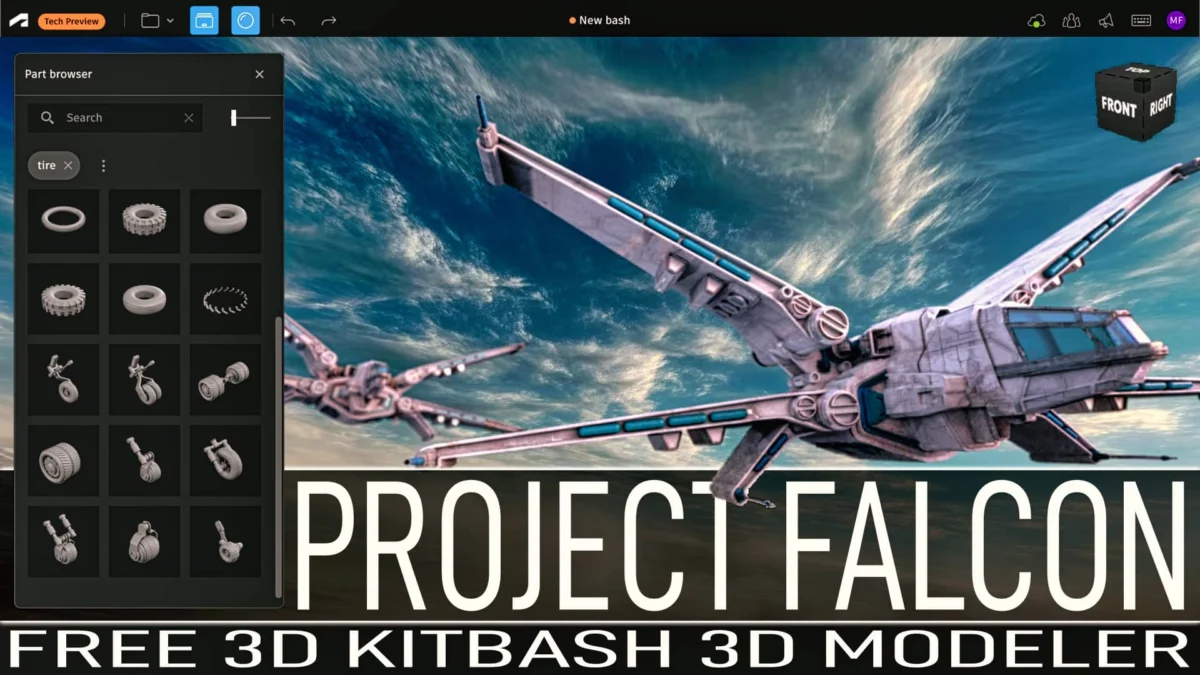
San Francisco, CA – [Insert Date] – Autodesk, a global leader in design and make software, has today launched Project Falcon, a groundbreaking, entirely free, browser-based 3D modeling application. This innovative tool promises to democratize 3D content creation, empowering aspiring artists, hobbyists, and even seasoned professionals to rapidly assemble intricate hard-surface models through a user-friendly "kitbashing" approach. Project Falcon, currently available as a technology preview, represents a significant stride in making advanced 3D design accessible to a wider audience, requiring nothing more than a user account and a web browser.
The announcement has sent ripples of excitement through the digital art and design communities, as Project Falcon offers a compelling alternative for quick prototyping, concept art, and even the initial stages of more complex projects. By leveraging a vast library of pre-existing 3D components, users can effortlessly combine these elements to construct everything from futuristic spacecraft and rugged vehicles to intricate mechanical designs. The ability to then export these creations in widely compatible USD and STL formats further enhances Project Falcon’s utility, allowing for seamless integration into established 3D workflows and even direct import into industry-standard software like Blender, Maya, and 3ds Max.
The Genesis of Project Falcon: Bridging the Gap in 3D Creation
Project Falcon emerges from Autodesk’s commitment to fostering innovation and lowering the barriers to entry in creative fields. Recognizing the steep learning curve often associated with traditional 3D modeling software, the company has developed Project Falcon to provide an intuitive and engaging starting point. The core philosophy behind Project Falcon is "kitbashing," a widely adopted technique where artists assemble pre-made parts to construct new models. This method dramatically accelerates the creation process and allows users to focus on design and composition rather than intricate polygon modeling from scratch.
"We saw a clear opportunity to create a tool that feels less like software and more like a digital construction set," commented [Hypothetical Autodesk Spokesperson Name and Title, e.g., Jane Doe, Senior Product Manager for Emerging Technologies at Autodesk]. "Project Falcon is designed for anyone with an idea, regardless of their prior 3D experience. It’s about sparking creativity and enabling rapid visualization. Whether you’re a student exploring your first 3D project, a game developer needing quick asset concepts, or a hobbyist eager to bring your imaginative designs to life, Project Falcon offers an accessible and enjoyable pathway."
The application is built upon Autodesk Flow, a robust platform that underpins many of Autodesk’s cloud-based services, ensuring a stable and performant experience directly within the user’s web browser. This eliminates the need for complex installations or powerful hardware, making 3D creation accessible even on less capable machines.
Unpacking the Features: A Toolkit for Instant Creation
Project Falcon’s strength lies in its simplicity and the power of its curated asset library. Users are presented with an extensive collection of pre-designed 3D meshes, categorized and easily searchable. These components range from basic geometric shapes to highly detailed mechanical parts, allowing for a diverse array of creative outcomes.
A Rich Universe of 3D Components
The heart of Project Falcon is its expansive library of 3D parts. With thousands of meticulously crafted meshes available, users can embark on a journey of digital assembly. Imagine constructing a sleek, interstellar cruiser by combining aerodynamic hull segments, powerful engine nacelles, and detailed sensor arrays. Or perhaps a rugged, off-road vehicle, assembled from sturdy chassis elements, robust wheels, and functional-looking treads. The possibilities are virtually limitless, driven by the user’s imagination and the breadth of the provided assets.
The library is designed for intuitive exploration. Users can browse through categories, apply search filters, and quickly preview individual parts. The ease with which these components can be manipulated – scaled, rotated, and positioned – ensures a fluid and responsive modeling experience. This focus on readily available building blocks significantly reduces the intimidation factor often associated with 3D modeling.
Seamless Export for Further Refinement
While Project Falcon excels at rapid assembly, it doesn’t limit users to its own environment. A crucial aspect of its design is the ability to export completed models in industry-standard formats. The inclusion of USD (Universal Scene Description) and STL (Stereolithography) ensures broad compatibility.
USD is particularly significant, as it’s a powerful open-source format developed by Pixar that facilitates the exchange of 3D scene data. This means models created in Project Falcon can be imported into professional 3D software such as Autodesk’s own Maya and 3ds Max, as well as popular open-source alternatives like Blender. This allows users to take their initial concepts and further refine them with advanced texturing, rigging, animation, and rendering techniques.
STL, on the other hand, is the de facto standard for 3D printing. This opens up another exciting avenue for Project Falcon users: bringing their digital creations into the physical world.
From Pixels to Prototypes: The 3D Printing Gateway
The integration of 3D printing support via STL export transforms Project Falcon from a purely digital tool into a gateway for tangible creation. Users can design intricate models and then prepare them for immediate 3D printing. This is invaluable for a multitude of applications:
- Prototyping: Designers and engineers can quickly generate physical prototypes of product concepts, allowing for tactile evaluation of form and function.
- Collectibles and Figurines: Hobbyists and independent creators can design and produce their own unique figurines and collectibles, fostering a new wave of personalized merchandise.
- Educational Tools: Educators can utilize Project Falcon to teach basic 3D design principles and the fundamentals of additive manufacturing in an engaging and accessible manner.
- Artistic Expression: Artists can explore new dimensions of their work by translating digital concepts into physical sculptures.
The ability to iterate rapidly from digital design to physical object is a powerful advantage, and Project Falcon makes this process remarkably straightforward.
A Chronology of Accessibility in 3D Design
Autodesk has a long and storied history in empowering digital creators. While their flagship professional software like Maya and 3ds Max have long been industry standards, the company has also consistently explored avenues to broaden access to their technology.
- Early Innovations: From the foundational days of AutoCAD in the early 1980s, Autodesk has been at the forefront of computer-aided design (CAD).
- Professional Suites: The development and refinement of Maya and 3ds Max over decades have established them as essential tools for film, television, gaming, and architecture.
- Cloud and Subscription Models: In recent years, Autodesk has transitioned to subscription-based models, making their professional software more accessible through tiered pricing and cloud-based services.
- Focus on Emerging Technologies: Project Falcon represents a continuation of this trend, but with a distinct focus on leveraging web technologies and simplified workflows to target a new generation of creators and use cases. The "technology preview" status indicates that Autodesk is actively seeking user feedback to further refine and develop the application.
The introduction of Project Falcon can be seen as a strategic move to capture the burgeoning interest in 3D creation driven by the metaverse, NFTs, and the increasing demand for 3D assets across various digital platforms. By offering a free, easy-to-use tool, Autodesk is not only fostering goodwill but also cultivating a future user base for their more comprehensive professional offerings.
Supporting Data and Industry Context
The rise of accessible 3D creation tools is not an isolated phenomenon. The broader digital landscape is witnessing a surge in demand for 3D content, fueled by several key trends:
- The Metaverse: The ongoing development and anticipation of immersive virtual worlds necessitate vast quantities of 3D assets for environments, avatars, and interactive objects.
- Gaming Industry Growth: The global gaming market continues its impressive expansion, with a constant need for artists to create diverse and engaging in-game assets.
- Rise of Creator Economy: Platforms like Roblox, VRChat, and even social media are increasingly incorporating 3D elements, empowering individual creators to build and monetize their digital worlds and assets.
- Advancements in 3D Printing: The proliferation of affordable and high-quality 3D printers in both consumer and professional settings has democratized physical prototyping and custom manufacturing.
In this context, Project Falcon aligns perfectly with market demands. While more specialized tools like ZBrush or Substance Painter offer unparalleled depth for sculpting and texturing, Project Falcon occupies a crucial niche for rapid ideation and accessible entry into 3D modeling. Its kitbashing approach is particularly relevant, as many professional studios already utilize asset libraries and modular design principles to accelerate their pipelines.
Furthermore, the comparison to tools like Kenney.nl’s Asset Forge is apt. Asset Forge is another popular application that utilizes a similar kitbashing methodology for creating low-poly 3D assets. Project Falcon, however, benefits from Autodesk’s established infrastructure, extensive library potential, and integration with professional workflows.
Official Statements and Vision
While specific direct quotes from Autodesk executives regarding Project Falcon’s launch may not be publicly available at the time of this article’s writing, the company’s broader mission statements and past product strategies provide insight into their vision. Autodesk has consistently emphasized the importance of empowering creators and fostering innovation.
"Our mission at Autodesk is to help people imagine, design, and make a better world," a representative statement from Autodesk often conveys. "We believe in providing tools that unlock creativity and enable individuals and organizations to bring their visions to life. Project Falcon is a testament to this commitment, offering a novel approach to 3D design that is both powerful and approachable."
The choice to offer Project Falcon as a free technology preview is a strategic one. It allows Autodesk to:
- Gather invaluable user feedback: Direct interaction with a broad user base helps identify bugs, usability issues, and desired features for future development.
- Build a community: A free and accessible tool naturally fosters a community of users who can share their creations, offer tips, and inspire one another.
- Introduce users to the Autodesk ecosystem: Users who start with Project Falcon may be more inclined to explore and adopt Autodesk’s professional software in the future as their needs grow.
- Test and iterate on new technologies: Project Falcon serves as a proving ground for web-based 3D technologies and cloud-based asset management.
Implications and the Future of 3D Creation
The launch of Project Falcon carries significant implications for the future of 3D content creation:
- Democratization of 3D Design: The most immediate impact is the radical lowering of the barrier to entry for 3D modeling. Individuals who may have been intimidated by complex software can now begin creating in three dimensions with relative ease.
- Accelerated Prototyping and Concept Development: For designers, engineers, and artists, Project Falcon offers a significantly faster way to visualize ideas and generate preliminary models. This can lead to quicker iteration cycles and more efficient product development.
- Empowerment of Independent Creators: The growing creator economy will likely see a boost, as independent artists and developers can more readily produce assets for games, virtual worlds, and personalized merchandise.
- Educational Revolution: Project Falcon presents a powerful new tool for educators to introduce students to the principles of 3D design and digital fabrication in an engaging and hands-on manner.
- Evolution of Professional Workflows: While not a replacement for professional 3D software, Project Falcon can serve as a valuable complementary tool. Its speed and ease of use for initial assembly could streamline pre-production phases for larger projects.
- Potential for AI Integration: Given Autodesk’s investment in AI technologies, it is plausible that future iterations of Project Falcon could incorporate AI-powered features, such as intelligent asset suggestions, automated assembly, or even generative design elements.
The journey of Project Falcon is just beginning. As a technology preview, its evolution will be shaped by user adoption and feedback. However, its fundamental premise – making 3D creation accessible, fast, and fun – positions it as a potentially transformative tool in the ever-expanding universe of digital design and making. Autodesk’s bold move with Project Falcon signals a clear intent to lead the charge in democratizing 3D creativity, inviting a new generation of makers to shape the digital and physical worlds around us.



Leave a Comment