Beyond the Black Mirror: How Infinidream.ai is Resurrecting the Idle Screen
In the modern household and office, the glowing rectangle is the undisputed centerpiece of the environment. Yet, for a significant portion of the day, these high-resolution displays—costing hundreds or thousands of dollars—sit in a state of digital rigor mortis. When not in active use, they revert to a "dead screen": a black void or, at best, a sterile digital clock. Scott Draves, a pioneer in the world of algorithmic art, views this as a profound aesthetic failure.
His solution is Infinidream.ai, a newly launched application for Mac and Windows that seeks to transform idle monitors into "living" AI paintings. Unlike traditional screensavers that rely on static images or repetitive video loops, Infinidream utilizes generative artificial intelligence to create a continuous, evolving stream of art. The result is a digital canvas that breathes, shifts, and morphs in real-time, ensuring that a screen never looks the same way twice.
I. Main Facts: The Concept of "Living Art"
Infinidream.ai is not merely a utility; it is an ambient art platform. Available as a desktop application, it functions in two primary modes: as a traditional screensaver that activates during periods of inactivity, or as a dedicated fullscreen display designed to set the mood of a room.
The Generative Difference
The core innovation of Infinidream lies in its departure from the "loop." Traditional digital art displays typically cycle through a gallery of photographs or play a high-definition video file. These eventually become predictable, leading to a psychological phenomenon known as "habituation," where the viewer stops noticing the art because the brain has fully mapped its patterns.
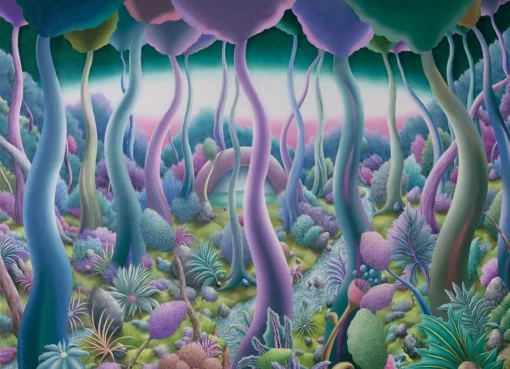
Infinidream utilizes generative AI models to ensure that the art is "thinking." By drawing on the work of dozens of curated AI artists, the software generates transitions and evolutions that are fluid and non-deterministic. As the software runs, the imagery drifts between states—abstract shapes might dissolve into moody landscapes, which then melt into hypnotic patterns.
User Customization and Interface
The application is designed to be "zero-friction." Users can select from various "moods" and adjust the tempo of the evolution. A user seeking a meditative environment might set the speed to a glacial crawl, where changes occur so slowly they are almost imperceptible. Conversely, for a social gathering or a high-energy workspace, the tempo can be increased to a "burning fire" setting, creating a more dynamic visual presence.
Importantly, Infinidream is built to be unobtrusive. When in fullscreen mode, there are no notifications, no menus, and no interface elements to clutter the visual field. It is designed to function as "digital furniture," contributing to the atmosphere of a space without demanding the user’s direct attention.
II. Chronology: From Distributed Fractals to Neural Networks
To understand the significance of Infinidream.ai, one must look at the career of its creator, Scott Draves. A New York-based artist and engineer, Draves has spent over three decades exploring the intersection of code and creativity.
1999: The Birth of Electric Sheep
Long before "AI" was a household term, Draves launched Electric Sheep in 1999. This was a groundbreaking distributed computing project that functioned as a collective intelligence. It linked over 450,000 computers worldwide into a networked supercomputer. While these computers were idle, they would render "fractal flames"—complex mathematical animations.
Users could vote on their favorite "sheep," and the system’s genetic algorithm would ensure that the most popular designs "reproduced," passing their mathematical traits to the next generation of animations. Electric Sheep was more than a screensaver; it was a decades-long experiment in digital evolution that eventually found its way into prestigious institutions like the Museum of Modern Art (MoMA) and the Los Angeles County Museum of Art (LACMA).
2020–2023: The Generative AI Revolution
As large language models and diffusion-based image generators (like Midjourney and Stable Diffusion) began to dominate the tech landscape, the tools available for generative art underwent a seismic shift. Draves recognized that the "evolutionary" spirit of Electric Sheep could be supercharged by the creative depth of modern AI.
2024: The Launch of Infinidream.ai
Infinidream represents the culmination of this journey. It moves away from the purely mathematical nature of fractals and into the realm of high-concept digital painting. By collaborating with a diverse group of AI artists, Draves has transitioned from a solo experimenter to a curator of a new digital movement. The app was officially released to the public this year, offering a "freemium" model that allows users to experience the ambient energy of the platform before committing to a full account.
III. Supporting Data: The Technical and Aesthetic Framework
The "dead screen problem" is more than an aesthetic grievance; it is a missed opportunity for "ambient computing." Research into environmental psychology suggests that the visual characteristics of a room significantly impact stress levels and productivity.

The Psychology of Ambience
Static screens or high-contrast clocks can create a "staccato" environment, where the eye is constantly drawn to the harshness of the display. In contrast, "soft fascination"—a term coined by environmental psychologists—refers to visual stimuli that hold attention without requiring effort, such as watching clouds or a flickering fire. Infinidream’s slow-moving, generative art is designed to trigger this state of soft fascination, potentially reducing cognitive load and providing a restorative background for the viewer.
Technical Architecture
While the specific neural weights and proprietary algorithms of Infinidream remain under wraps, the system operates on a "client-side" rendering philosophy. Unlike video streaming services that consume massive amounts of bandwidth to play 4K video, generative art can often be "seeded" and then evolved locally, making it an efficient use of hardware resources.
The diversity of the art is another data point of interest. Rather than relying on a single AI style, Infinidream incorporates:
- Abstract Expressionism: Focus on color and form.
- Surrealist Landscapes: Dreamlike environments that shift perspectives.
- Kinetic Minimalism: Subtle movements of lines and geometric shapes.
- Bio-Organic Forms: Imagery that mimics cellular or botanical growth.
IV. Official Responses: The Visionary’s Perspective
Scott Draves has been vocal about his philosophy regarding the "living" nature of digital art. In statements regarding the launch of Infinidream, he emphasizes that the app is meant to be felt as much as seen.
"There’s a moment every few hours when your computer just sits there," Draves explains. "Screen dark, or worse: showing the time in giant white numerals against a black void, quietly announcing that nothing interesting is happening. That moment is wasted."
Draves often uses the analogy of a Calder mobile—the famous kinetic sculptures that move with the air currents of a room. "Think of a kinetic sculpture that shifts with the air. Art that is never quite the same twice, that has duration as well as form. Infinidream is that, but on your screen."
The artists contributing to the platform also highlight the collaborative nature of the project. By providing their curated "seeds" and artistic styles to the Infinidream engine, they are moving away from the "single image" output of traditional AI art and toward a "performative" output where the AI acts as a continuous brush.
V. Implications: The Future of the Domestic Digital Space
The release of Infinidream.ai signals a broader shift in how we perceive our relationship with technology in the home. It suggests that the future of AI is not just in "chatbots" and "productivity tools," but in the very fabric of our living spaces.
AI as Interior Design
As televisions become larger and thinner, they are increasingly being treated as architectural elements. Products like Samsung’s "The Frame" have already popularized the idea of a TV that looks like a painting. However, Infinidream takes this a step further by removing the static nature of the "frame." If the 2010s were the decade of the digital photograph, the 2020s are becoming the decade of the "living digital asset."
The "Always-On" Economy
There are also implications for energy consumption and hardware longevity. Critics of "always-on" displays point to power usage; however, Draves and his team argue that if a screen is going to be on—as many are in modern offices and smart homes—it should provide a net benefit to the atmosphere of the room. Furthermore, the slow, shifting nature of generative art is actually a functional defense against "screen burn-in," a problem that plagued early plasma and OLED displays when left on static images for too long.
Redefining the "Artist"
Infinidream also poses interesting questions about authorship. Who is the artist? Is it Scott Draves, the engineer? Is it the AI artist who provided the initial style? Or is it the AI itself, which is making the real-time decisions on how to morph from one frame to the next? The project suggests a future where "art" is a collaborative, ongoing process between human intent and machine execution.
Conclusion: A Beautiful Utility
Infinidream.ai arrives at a time when digital fatigue is at an all-time high. By turning the very tools of our labor—our Macs and PCs—into sources of passive, restorative beauty, the app offers a rare example of technology that asks for nothing back.
As the app becomes available for wider use, it challenges the status quo of the "dead screen." In a world where we are surrounded by screens, Infinidream suggests that they don’t have to be voids or billboards. They can be windows into an infinite, evolving dream. As the project’s tagline succinctly puts it: "Your screen is on anyway. It might as well be beautiful."