Canon’s Mixed-Reality Paradox: A Hands-On Journey from Miniature Prototypes to $20,000 Enterprise Ecosystems
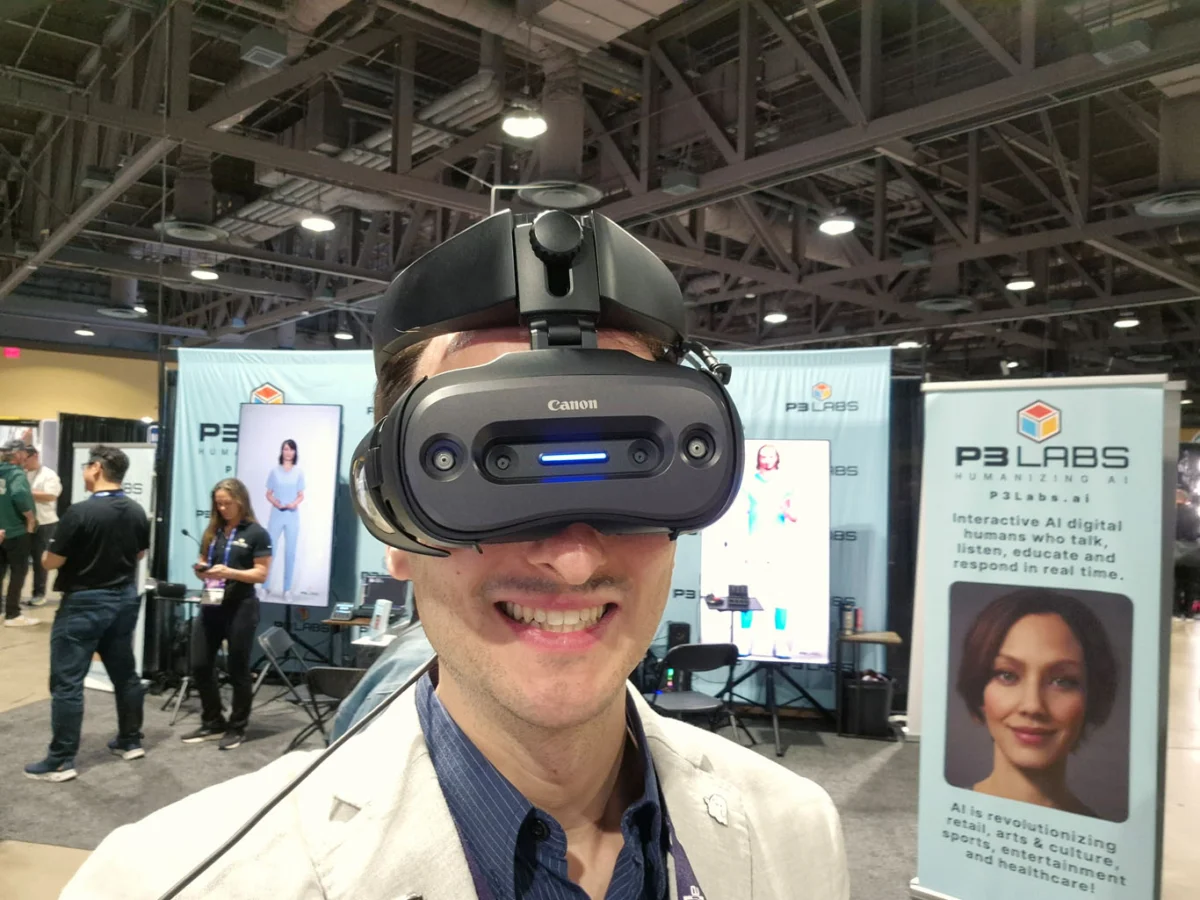
At the most recent Augmented World Expo (AWE), the floor was crowded with the usual suspects of the XR (Extended Reality) world. However, one of the most enigmatic presences was undoubtedly Canon. Known globally for their world-class camera optics and imaging sensors, Canon’s foray into the mixed-reality (MR) space has always been characterized by a distinct "enterprise-first" philosophy.
This year, the company showcased a striking contrast in hardware: a handheld prototype so small it could fit in a jacket pocket, and the MREAL X1, a tethered enterprise powerhouse with a staggering $20,000 price tag. After a series of exclusive hands-on sessions, the experience left behind a complex narrative of brilliant industrial design clashing with aging technical specifications and a perplexing value proposition.
Main Facts: The Two Faces of Canon MR
Canon’s strategy in the MR sector appears to be splitting into two distinct directions. On one hand, they are exploring ultra-portable, low-friction devices for public-facing sectors like museums and galleries. On the other, they are maintaining their foothold in high-end industrial design and manufacturing with the MREAL line.

The Handheld "Smol" Prototype
This device represents a radical departure from the traditional "head-mounted display" (HMD) paradigm. It is essentially a stripped-down optical module with a handle.
- Form Factor: Handheld, no head strap, tethered to a PC.
- Purpose: Short-duration "look-through" experiences (e.g., museum exhibits).
- Core Specs: Full HD resolution, ~50-degree Field of View (FOV).
- Tracking: Currently limited to marker-based (QR-style) tracking.
The Canon MREAL X1
The X1 is the commercial successor to the even more expensive MREAL S1 ($38,500). While "cheaper" than its predecessor, the X1 remains one of the most expensive headsets on the market.
- Price: Approximately $20,000 (includes headset, proprietary link box, and PC).
- Display: 1920 x 2160 per eye.
- FOV: 58° horizontal by 60° vertical.
- Design: Open periphery "Lynx-style" design with optional blinders.
Chronology: Navigating the Canon Booth Experience
1. The Miniature Prototype: Convenience Over Immersion
The first session involved a device that looked more like a futuristic magnifying glass than a VR headset. Canon’s representative explained that this device is designed for the "uninitiated." In public spaces like museums, the friction of putting on a headset—adjusting straps, cleaning lenses, and managing hair—often discourages users.

Upon picking up the device, the ergonomics were immediately impressive. It was lightweight and the handle felt natural. However, the experience inside the lenses was a trip back in time. The 50-degree FOV created a "tunnel vision" effect that made it difficult to maintain the illusion of mixed reality. The demo required holding a physical wand covered in QR-code-style markers. When viewed through the device, a high-fidelity 3D model of a Canon camera appeared atop the wand. While the 3D model itself was crisp—showcasing Canon’s rendering prowess—the reliance on marker-based tracking in 2024 (and looking toward 2026) felt significantly behind the industry standard of Inside-Out SLAM (Simultaneous Localization and Mapping) tracking.
2. The $20,000 MREAL X1: High Stakes, High Latency
Transitioning to the MREAL X1, the expectations were naturally higher. For the price of a mid-sized sedan, one expects a "Retina-level" passthrough and flawless stability.
The headset utilizes a halo strap system, which should theoretically provide comfort. However, during the demo, the unit felt surprisingly unstable. The "premium" price did not seem to translate to the materials of the peripherals; the lateral blinders were made of thin, flexible plastic that felt out of place on a five-figure device.

The most jarring part of the chronology was the setup. The headset does not plug directly into a laptop. It requires a bulky "Link Box" that acts as an intermediary. During the simulation—a high-detail CAD model of a car—the tracking struggled. There was a noticeable jitter and a slight but perceptible lag in the passthrough. When moving my head rapidly to inspect the car’s interior, motion blur became a significant issue, breaking the immersion and causing the "virtual" car to appear as if it were swimming through the air rather than sitting on the floor.
Supporting Data: Technical Analysis and Market Comparisons
To understand why these devices are controversial, one must look at the technical data relative to the current market.
The FOV Deficit
The most critical metric in MR is the Field of View. The MREAL X1 offers a diagonal FOV of roughly 85 degrees (58°H / 60°V). In comparison:

- Meta Quest 3 ($500): ~110° Horizontal.
- Apple Vision Pro ($3,500): ~100°+ Horizontal.
- Varjo XR-4 ($3,990+): 120° x 105°.
For an enterprise user trying to visualize a full-scale engine or architectural layout, a 58-degree horizontal FOV is a severe limitation. It requires constant head movement to see the "whole" of a medium-sized object.
Resolution and Pixel Density
Where Canon attempts to win is in angular resolution (Pixels Per Degree). Because they cram 1920 x 2160 pixels into a very small FOV, the PPD is high, making text and fine mechanical details look very sharp. However, this advantage is negated by the passthrough quality. In 2026, the industry has moved toward 4K-per-eye systems. The MREAL X1, which originally launched in 2022, is now being outperformed by consumer hardware costing 1/40th of the price.
Tracking Stability
The MREAL X1 demo still relied on a floor marker to "anchor" the experience. While the tracking persisted when the marker was out of view, the lack of stability (shaking models) suggests that Canon’s software stack for spatial computing has not kept pace with the AI-driven tracking improvements seen in the Meta or Apple ecosystems.

Official Responses: Canon’s Enterprise Philosophy
When questioned about the specs and the reliance on tethered boxes, Canon representatives were clear: their focus is not on the mass market.
Canon views these devices as "optical instruments" rather than "consumer electronics." Their primary clients are in the automotive and manufacturing sectors in Japan and North America, where the hardware is often integrated into much larger, multi-million dollar software contracts.
Regarding the handheld prototype, Canon confirmed it is still in the developmental phase. They are using these "hands-on" sessions at expos like AWE to gauge interest in specific form factors. They emphasized that the "optical module" is the core product, and they are considering licensing this module to other manufacturers or using it as a basis for a wider range of AR/VR headsets in the future. Their defense of the small FOV in the prototype was centered on portability and the specific use case of "glanceable" information rather than deep immersion.

Implications: The Reality of Enterprise MR in 2026
The Canon experience highlights a growing "Enterprise Gap" in the XR industry. For years, companies like Canon and Varjo could command astronomical prices because consumer hardware was simply not capable of high-fidelity passthrough.
The "Prosumer" Threat
With the release of the Apple Vision Pro and the Meta Quest 3, the baseline for "good enough" MR has shifted. An engineer can now buy a Quest 3 and, using third-party software, achieve a more stable and wider-FOV experience than what the MREAL X1 provides for $20,000.
The Niche Survival
However, Canon’s survival in this space likely depends on two things:

- Optics Heritage: Canon’s ability to minimize chromatic aberration and distortion is still top-tier.
- Specific Use Cases: The handheld prototype is a genuine innovation. For museums, trade shows, and retail, a "no-wear" MR device solves the hygiene and throughput bottlenecks that currently plague the industry.
The Verdict for Canon
The MREAL X1 feels like a relic of a previous era—a 2022 device trying to survive in a 2026 world. If Canon wishes to remain relevant in the high-end sector, they must move away from proprietary link boxes and marker-based crutches. They need to leverage their world-class sensor technology to create a passthrough experience that justifies its price tag.
As for the "smol" prototype, it is the most exciting thing Canon has produced in years. It acknowledges that not everyone wants to wear a computer on their face. If they can bump the FOV to at least 70 degrees and integrate modern SLAM tracking, they might just carve out a new category of "Casual MR" that the industry didn’t know it needed.
Conclusion
Canon remains a titan of imaging, but in the realm of Mixed Reality, they are currently a study in contradictions. They offer the most portable concept and the most expensive legacy hardware simultaneously. For the enterprise buyer, the message is clear: proceed with caution. For the rest of us, Canon’s experiments serve as a fascinating, if flawed, glimpse into a future where MR might be as simple as picking up a handle and looking through a lens.