
Chaos in the Cockpit: An In-Depth Analysis of FlatOut 4: Total Insanity VR’s Early Access Debut
The virtual reality landscape has long been divided between ultra-realistic simulations and high-concept experimental titles. However, the arrival of FlatOut 4: Total Insanity VR in SteamVR Early Access marks a significant shift toward the visceral, unrefined joy of arcade-style demolition. Released on May 7, 2026, by publisher Impact Inked and developed through a collaboration between Flat2VR Spark and Mutar, this title brings the storied franchise’s signature brand of "mutually assured destruction" to a medium where every impact is felt with newfound intensity.
At a competitive entry price of $19.99, the title seeks to redefine what players expect from VR racing—prioritizing the "charm of the wreck" over the precision of the perfect lap.
Executive Summary and Key Facts
FlatOut 4: Total Insanity VR is not merely a port; it is a reconstruction of the high-octane, destructive racing experience specifically tailored for the immersive capabilities of modern PC VR hardware. The game emphasizes environmental interactivity, vehicle deformation, and a variety of unconventional game modes that challenge the player’s reflexes and stomach for high-speed impact.
Core Specifications:
- FlatOut 4: Total Insanity VR
- Developer: Flat2VR Spark, Mutar
- Publisher: Impact Inked
- Release Date: May 7, 2026 (Early Access)
- Platform: PC VR (SteamVR compatible)
- Price: $19.99 USD
- Primary Features: Multiplayer destructive racing, Stunt Mode, Carnage Mode, Beat The Bomb, and Battle Arena.
The game utilizes a progression-based unlock system, requiring players to earn points through participation to access higher-tier vehicles and more complex tracks. While the initial offering is lean, the core gameplay loop is designed for high replayability, driven by a "just one more try" philosophy.
A Chronology of Destruction: From Flat Screen to VR
The FlatOut franchise has historically occupied a unique niche in the racing genre, standing as a grittier, more chaotic alternative to the Burnout series. The journey to the 2026 VR release began with the original FlatOut 4: Total Insanity, which sought to return the series to its roots of physics-based mayhem.
In late 2024, rumors began to circulate regarding a dedicated VR adaptation. The project gained momentum when Flat2VR Spark—a studio renowned for bringing traditional "flat" gaming experiences into the 360-degree space—partnered with Mutar. Their goal was to translate the chaotic physics engine of FlatOut into a stable, yet thrilling, VR experience.
The development timeline faced several hurdles, particularly in optimizing the game’s "destruction physics" for VR, where high frame rates are essential to prevent motion sickness. Following a series of closed alpha tests in early 2026, the game officially entered SteamVR Early Access on May 7. This phase is intended to serve as a collaborative period where developer Mutar can refine the user interface, address technical glitches, and balance the multiplayer ecosystem based on real-world player data.
Deep Dive: Gameplay Mechanics and Mode Analysis
The "Total Insanity" subtitle is earned through a diverse array of game modes that deviate from traditional circuit racing.
The Stunt Mode: A Physics Playground
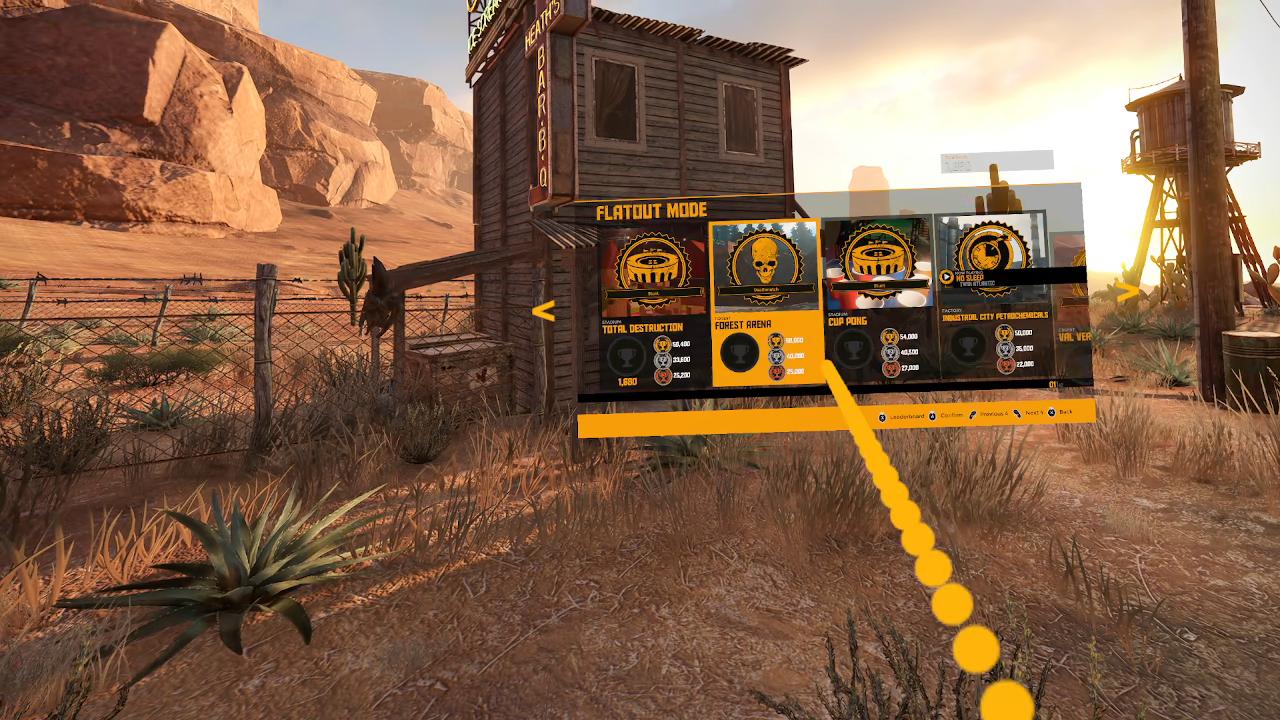
Perhaps the most iconic element of the FlatOut series is the Stunt Mode. In VR, this mode takes on a surreal, almost terrifying quality. Players accelerate down a massive ramp before intentionally ejecting their driver through the windshield. The objective varies: some stages resemble a gargantuan game of "cup pong," while others require the player to use their driver as a projectile to topple block towers in a style reminiscent of Angry Birds. The short duration of these rounds—often under two minutes—makes them an ideal entry point for quick sessions.
Beat The Bomb and Battle Arena
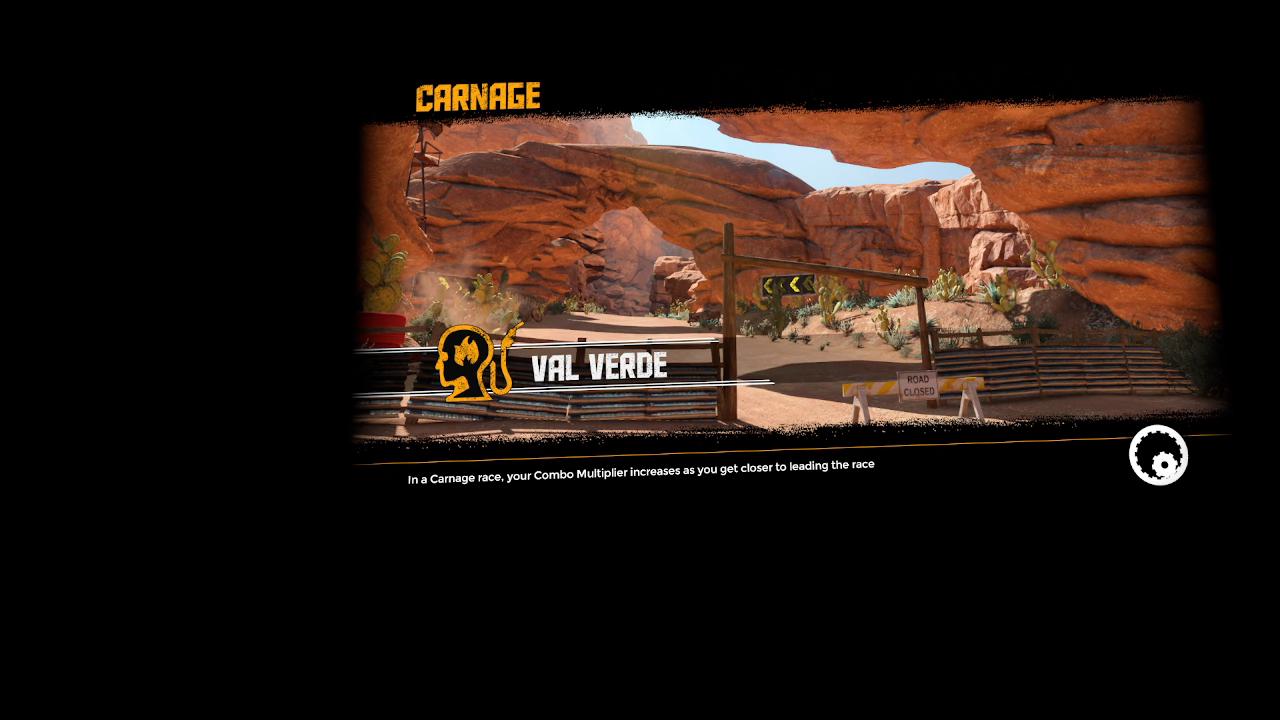
"Beat The Bomb" introduces a high-stakes time-trial mechanic where players must reach successive checkpoints within 10 to 30 seconds to prevent a catastrophic explosion. This mode emphasizes the game’s responsive analog handling. Conversely, the "Battle Arena" and "Carnage" races are longer affairs, focusing on vehicular combat and environmental destruction. Here, the game’s AI shines, frequently sideswiping players and forcing them into off-road hazards.
Progression and Grinding
The game employs a traditional points-based progression system. Early-game players may find the selection of vehicles and tracks somewhat limited, particularly in Stunt Mode. However, the developers have balanced the point distribution so that even mid-pack finishes contribute significantly toward unlocks. This mitigates the feeling of a "grind" by rewarding the spectacle of the race rather than just the podium finish.
Technical Specifications and Performance Metrics
To achieve the "Ultra" graphical fidelity required for a truly immersive experience, the game demands robust hardware. During the review period, the software was tested on a high-end enthusiast rig to push the limits of the engine.
Testing Configuration:
- CPU: Ryzen 7 9850X3D
- RAM: 32GB DDR5
- GPU: NVIDIA RTX 5070 Ti
- Headset: Meta Quest 3 (via Virtual Desktop)
- Preset: Ultra (including maxed shadows, SSAO, textures, and particles)
Visual and Audio Fidelity
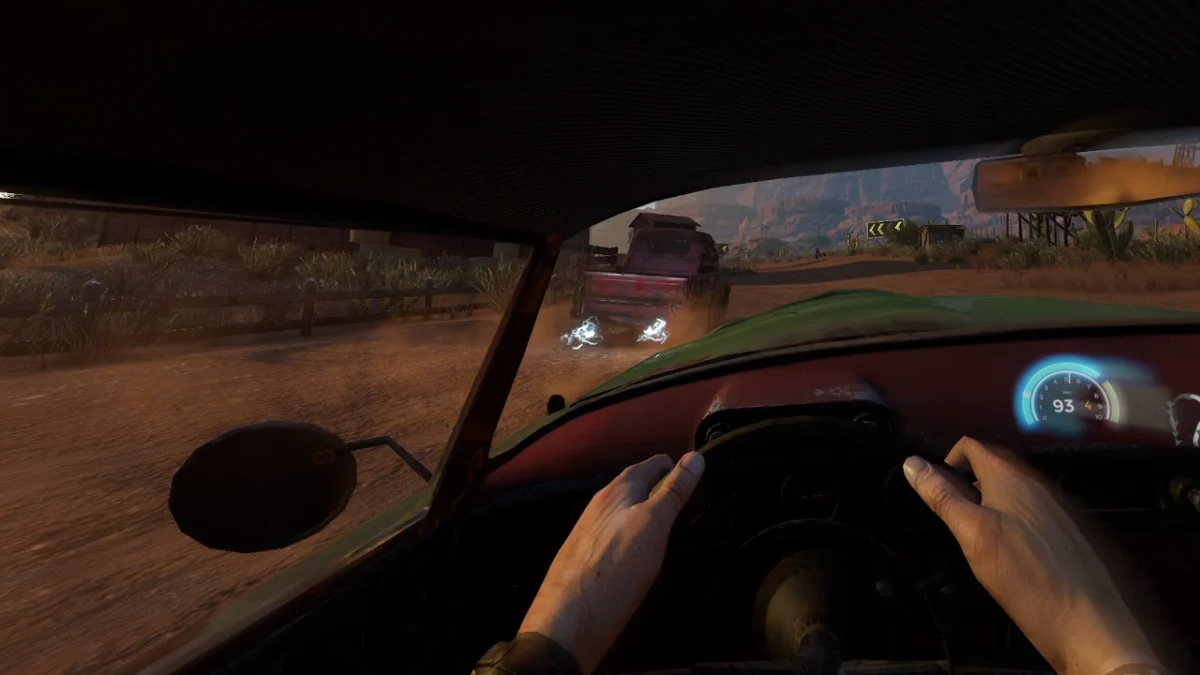
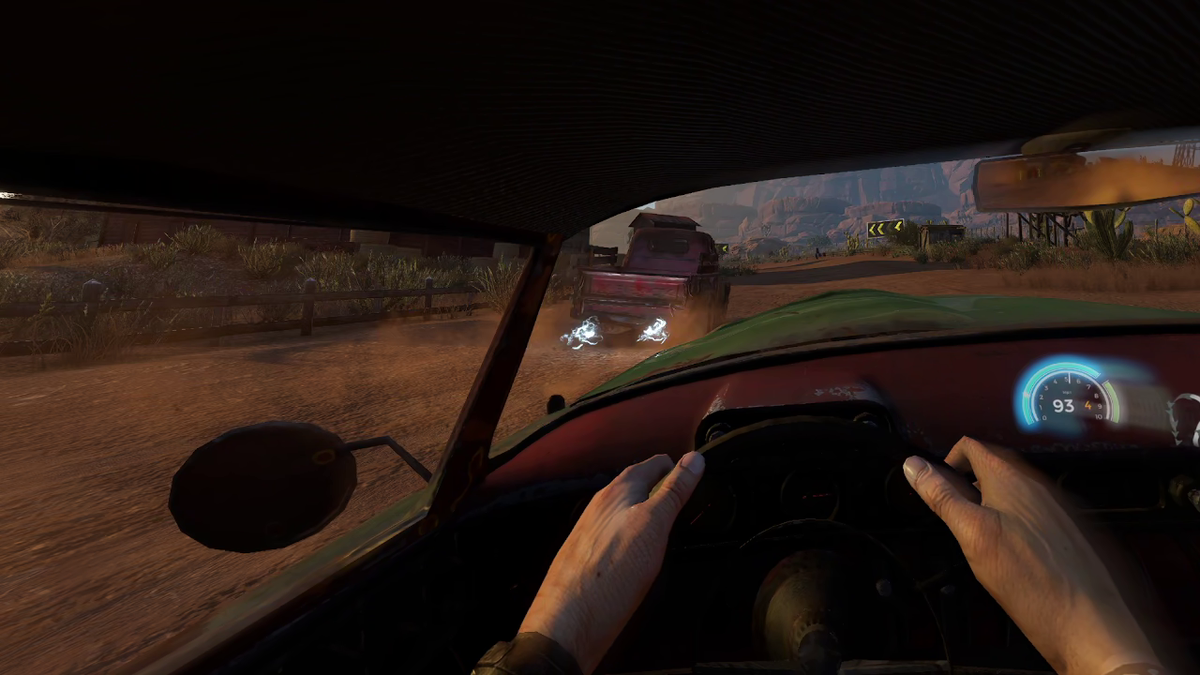
Visually, the game adopts a "grungy grit" aesthetic. While the textures and models are high-quality, the sheer speed of the gameplay often masks minor graphical compromises. There are reports of occasional clipping and artifacting during high-speed, tight turns on larger maps. However, the level of detail in the cockpit is commendable; speedometers and rearview mirrors are fully functional, providing a sense of "presence" that is often missing in VR ports.
The audio design is a mixture of triumphs and minor setbacks. The soundtrack is a standout feature, evoking the high-energy rock vibes of late 90s and early 2000s arcade racers. However, the spatial audio—specifically regarding the engine noise of trailing competitors—requires further refinement. In Arena modes, it can be difficult to "echolocate" incoming threats purely by sound, as the player’s own vehicle noise tends to dominate the mix.
Comfort and Accessibility: A Warning for Novices
One of the most critical aspects of any VR racing title is "Comfort." FlatOut 4: Total Insanity VR is classified as an "intense" experience. The game’s commitment to realism means that every bump in the dirt, every fence post hitting the windshield, and every roll-over crash results in significant camera shaking.
While the game uses a first-person cockpit view for the majority of the race, it occasionally cuts to a third-person perspective during major collisions. For many, these transitions—and the high-speed tumbling of the car in first-person—can be jarring. Consequently, this title is not recommended for users who are new to VR or those prone to motion sickness. The developers have included options to toggle "Body IK" (Inverse Kinematics) to reduce arm-clipping distractions, which may help some players maintain immersion without the discomfort of seeing distorted virtual limbs.
Official Responses and Early Access Outlook
In response to initial feedback regarding the Early Access build, the development team has acknowledged several "known issues." These include:
- UI Misalignment: Menu elements and player names in multiplayer sometimes render incorrectly or only in one eye.
- Navigation Bugs: The "Try Again" shortcut (X button) is currently non-functional in certain builds, requiring a return to the main menu.
- HUD Overlay: The music notification UI occasionally overlaps with vital game instructions.
The developers at Mutar and Flat2VR Spark have stated that the Early Access period is vital for "fine-tuning the physics-to-comfort ratio." They have committed to regular patches to address the UI bugs and improve the spatial audio mix. The inclusion of extensive racing wheel support options—even in this early stage—signals a commitment to the "sim-racing" community, despite the game’s arcade roots.
Industry Implications: The Future of Destructive VR Racing
The release of FlatOut 4: Total Insanity VR highlights a growing trend in the industry: the revitalization of classic IP through VR. By taking a franchise that was previously considered "dormant" and applying modern VR expertise, Impact Inked is testing the market’s appetite for high-budget, niche racing experiences.
The success of this title could pave the way for other physics-heavy franchises to make the leap to VR. It proves that there is a market for "imperfect" racing—where the joy comes from a flapping door, a dirt-caked windshield, and the chaos of a multi-car pileup. As the hardware continues to evolve (as seen with the RTX 50-series and Quest 3 benchmarks), the ability to simulate these complex physics environments in VR will only improve.
For now, FlatOut 4: Total Insanity VR stands as a testament to the idea that sometimes, being an "absolute car wreck" is exactly what a game needs to be successful. It is a loud, messy, and exhilarating addition to the SteamVR library that rewards those with the stomach for total insanity.



Leave a Comment