Charting the Stars: Progenitor Game Studios Unveils Ambitious Multi-Year Roadmap for Remnant Protocol
The landscape of virtual reality space simulations is one of the most demanding genres in modern gaming. It requires a delicate balance of complex flight physics, deep narrative immersion, and the tactile interactivity that VR enthusiasts crave. Into this high-stakes arena steps Remnant Protocol, a title developed by Progenitor Game Studios that has recently transitioned into a pivotal phase of its development. With its recent launch in Early Access on the Meta Quest platform and the unveiling of a comprehensive development roadmap extending into 2026, the studio is signaling its intent to create a definitive sci-fi epic for the standalone VR ecosystem.
Main Facts: The Architecture of a Galactic Rebellion
Remnant Protocol is positioned as a narrative-driven space simulation that places the player in the seat of a high-ranking commander. The game’s premise centers on "Sanctuary," a clandestine base of operations that serves as the last bastion for the "Remnant Forces." This ragtag group of rebels is locked in a desperate struggle against the "Usurpers," an oppressive authoritarian regime that has seized control of the known galaxy. The narrative parallels to iconic franchises like Star Wars are intentional, providing a familiar "underdog" framework that allows players to immediately grasp the stakes of their mission.
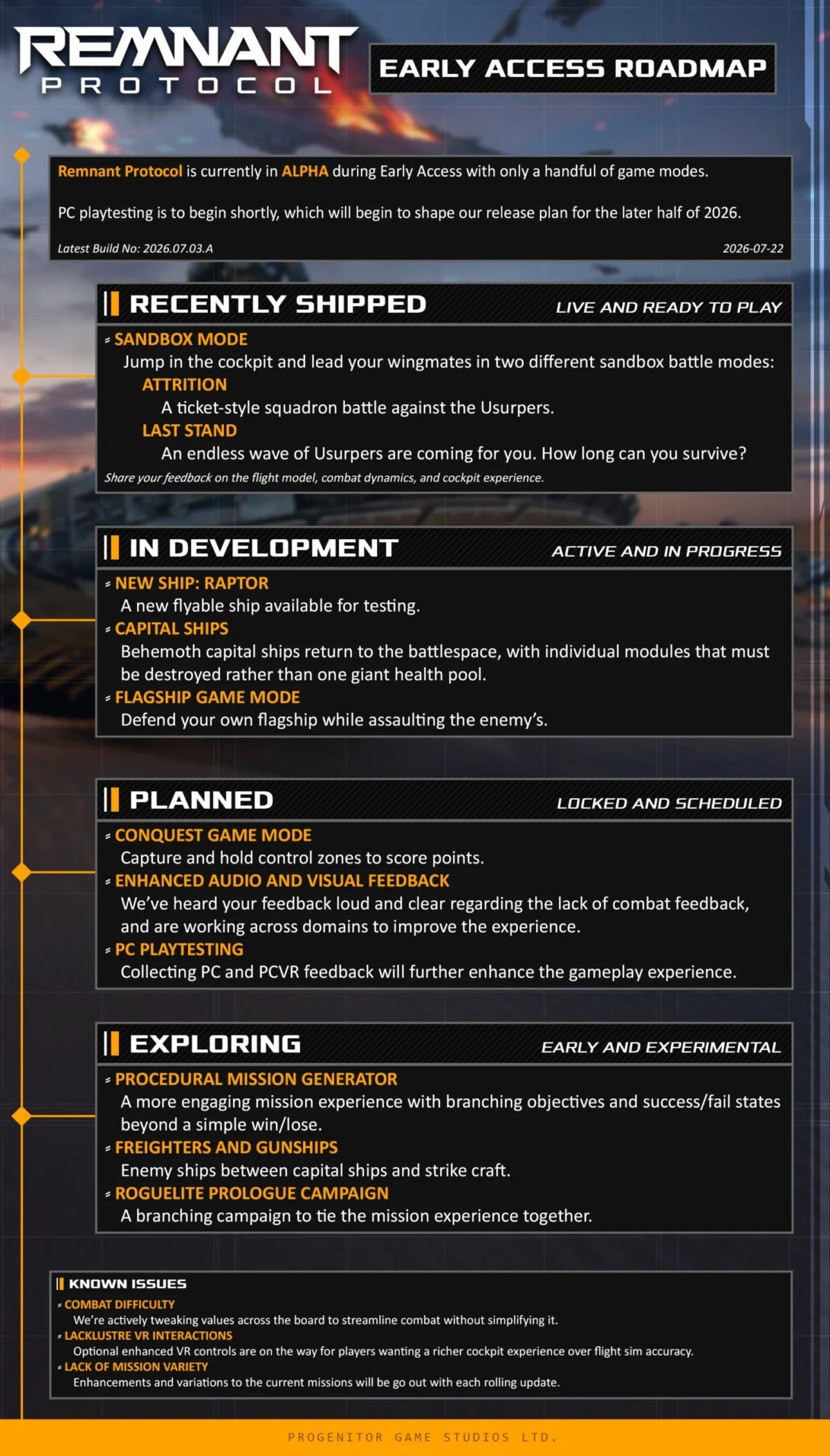
The game is currently available in an Alpha Early Access state on the Meta Quest store. While the core flight mechanics and two initial sandbox modes are functional, the developer has made it clear that the current version is a foundation upon which a much larger structure will be built. The roadmap released by Progenitor Game Studios outlines a transition from a combat-focused flight sim to a multi-faceted tactical experience featuring control-point capture, capital ship defense, and potentially, procedural roguelite elements.
Core Gameplay Modes: Current and Future
The roadmap categorizes the game’s evolution into four distinct sandbox pillars:
- Attrition (Live): A traditional combat endurance mode where players must survive waves of enemies, testing their basic flight and dogfighting skills.
- Last Stand (Live): A defensive-focused mode where the player must protect a specific asset or location against escalating odds.
- Conquest (Planned for 2026): A strategic mode involving "control zones." Players will be tasked with capturing and holding specific sectors of space, likely requiring a mix of tactical positioning and raw firepower.
- Flagship (Planned for 2026): A high-stakes "boss-style" mode. Players must defend their own massive command ship while simultaneously infiltrating or destroying the enemy’s flagship.
Chronology: The Evolution of a Meta-Backed Vision
The journey of Remnant Protocol began in 2022, when it was first introduced to the public as a "hybrid" title. At that stage, the developers were exploring a game that could bridge the gap between traditional flat-screen gaming and the emerging VR market. However, as the VR industry shifted toward standalone hardware, the project’s trajectory changed significantly.
A turning point occurred when Progenitor Game Studios secured funding from Meta (formerly Facebook). This partnership was more than just a financial injection; Meta is now listed as an "official publishing partner." This designation is significant, as it suggests that Meta sees Remnant Protocol as a potential "system seller" or at least a foundational title in the Quest’s library of space simulations—a genre that has seen sporadic success with titles like Star Wars: Squadrons and Endspace.
In June 2024, the game launched in Alpha Early Access on the Meta Quest. This release served as a "soft launch," intended to put the flight model in the hands of the community. Following the initial feedback, the studio released its multi-year roadmap in July 2024, confirming that while the game is playable now, the "full" vision of the conquest and flagship modes is still approximately 18 to 24 months away. Furthermore, PCVR enthusiasts have been promised that playtesting for a Steam version is "expected to begin soon," indicating a move toward cross-platform availability.
Supporting Data: Community Feedback and Technical Hurdles
As is common with Alpha releases, the initial data reflects a project in its infancy. On the Meta Quest store, Remnant Protocol currently holds a 3.3-star rating out of 5, based on 21 initial reviews. While this is a modest start, a deeper dive into the qualitative data reveals specific areas where the game succeeds and where it falters.
The Interactivity Gap
The most prevalent criticism found in player reviews involves the "VR interaction" model. In modern VR, players expect "diegetic" interfaces—meaning they want to reach out and flip switches, pull throttles, and press buttons within the virtual cockpit. Currently, Remnant Protocol relies more heavily on traditional controller inputs, which some users have described as "immersion-breaking."
The Early Access Precedent
Progenitor is following a path blazed by some of VR’s most successful titles. History shows that the Early Access model, when managed correctly, produces superior results.
- Ghosts of Tabor: Initially launched with significant bugs, but through aggressive community engagement, it became a top-grossing VR extraction shooter.
- Into the Radius: Used player feedback to refine its survival mechanics over several years, eventually becoming a cult classic.
- Hot Dogs, Horseshoes & Hand Grenades (H3VR): Has remained in continuous development for nearly a decade, fueled entirely by a symbiotic relationship between the developer and the player base.
The "3.3" rating for Remnant Protocol is a snapshot of an incomplete product, but the data suggests that if Progenitor addresses the interactivity issues, the rating is likely to trend upward as more content is added.
Official Responses: Progenitor’s Commitment to Iteration
Progenitor Game Studios has been proactive in addressing the "Alpha" status of the game. In an official statement accompanying the roadmap, the developers acknowledged the "Known Issues" list, which specifically highlights the lack of cockpit interactivity and the need for more robust tutorial systems.
The studio has stated that updates are already in the pipeline to address the "tactile" feel of the cockpit. "We are listening to the community," a representative noted in a developer log. "The roadmap isn’t just about adding more levels; it’s about deepening the connection between the pilot and their ship."
Regarding the 2026 timeline for the Conquest and Flagship modes, the studio defended the long-term window as a necessity for quality. By focusing on "Sandbox" modes first, they intend to perfect the combat AI and flight physics before layering on the complex strategic elements required for a full-scale galactic war. This "foundation-first" approach is intended to prevent the game from becoming a mile wide and an inch deep.
Implications: The Future of Standalone VR Space Combat
The development of Remnant Protocol carries broader implications for the VR industry and the Meta Quest ecosystem.
1. The Strategy of Meta’s Publishing Arm
Meta’s decision to fund and publish Remnant Protocol suggests a strategic pivot. By backing a space sim with a long-term roadmap, Meta is attempting to build "evergreen" content—games that keep players coming back for years rather than days. As the Quest 3 continues to push the boundaries of mobile processing power, titles like Remnant Protocol serve as a benchmark for what is possible without a tethered PC.
2. The Procedural Frontier
The mention of "procedurally generated missions" and a "roguelite mode" in the roadmap is a crucial development. For a small studio, creating hand-crafted content that matches the scale of a galaxy is nearly impossible. By leaning into procedural generation, Progenitor can offer infinite replayability. This is a strategy used successfully by No Man’s Sky and Elite Dangerous, and its implementation in a Quest-native title could set a new standard for the platform.
3. The Expectations of the VR Pilot
The "interactivity" complaint from the community highlights a permanent shift in VR player expectations. We are past the era where "looking around" is enough. Players now demand a high level of "physicality" in their virtual environments. The success of Remnant Protocol will ultimately hinge on whether Progenitor can transform the cockpit from a static 3D model into a functional, tactile workspace.
4. The PCVR Bridge
By announcing PC playtesting, Progenitor is signaling that they are not abandoning the high-end enthusiast market. A PCVR version would allow for higher-fidelity textures, more complex lighting, and perhaps more expansive fleet battles that the Quest’s mobile processor might struggle to handle. This dual-track development ensures the game remains relevant across the entire VR hardware spectrum.
Conclusion
Remnant Protocol is currently a diamond in the rough—a project with a grand vision and a prestigious partner, yet one that is currently grappling with the growing pains of early development. The 2026 roadmap is a bold promise to the community, outlining a path from a simple dogfighter to a complex strategic simulation. For players, the decision to invest now is a bet on Progenitor’s ability to listen, iterate, and execute. If the studio can bridge the gap between its current Alpha state and the ambitious "Flagship" future it has promised, Remnant Protocol may well become the definitive space opera of the VR era.