Cinga Samson’s "Ukuphuthelwa": A Profound Exploration of Sleeplessness, Symbolism, and the Sublime
Cape Town, South Africa – South African artist Cinga Samson’s latest exhibition, "Ukuphuthelwa," presents a compelling and deeply introspective body of new oil paintings that delve into the multifaceted nature of sleeplessness, the limitations of representation, and the profound encounter with the sublime. The exhibition, which opened its doors and will remain on view through April 18, 2026, offers viewers a unique opportunity to engage with Samson’s signature aesthetic and his philosophical inquiries into the very essence of art and existence.
The Core of "Ukuphuthelwa": Beyond Insomnia’s Shadow
The exhibition derives its title from "Ukuphuthelwa," an isiXhosa word that translates to "unable to sleep." Crucially, unlike the Western connotation of insomnia as a negative ailment, Samson reinterprets this state as one of heightened spiritual awareness and acute sensitivity, particularly in the enveloping darkness. This "sleeplessness" becomes a conduit to a deeper perception of reality, a state where the artist finds himself compelled to grapple with the fundamental question of how to create a "true and honest painting."
Samson’s artistic language is immediately recognizable through his distinctive palette. Dominated by near-blacks, carbon, and deep Prussian blues, these occluded hues create an atmosphere of profound depth and mystery. Within these evocative canvases, figures that appear masculine, dogs in untamed fields, and indigenous South African flora emerge, rendered with meticulous detail and a palpable sense of existential gravity. The works are not designed for fleeting glances; they demand slow, contemplative observation, inviting viewers to ponder the vast, ever-moving reality that Samson endeavors to depict.
The Artist’s Quandary: The Unbridgeable Gulf of Representation
Central to "Ukuphuthelwa" is Samson’s profound contemplation of his role as an artist and the inherent limitations of his medium. He grapples with his inability to capture the totality of truth and the fact that his creations are ultimately symbols, mere gestures towards a reality that may always elude complete representation. Samson posits that an unbridgeable gulf exists between the static, painted sign and the fluid, dynamic experience it seeks to evoke.
While the technical mastery and convincing realism of his paintings might suggest an invitation to straightforward interpretation, Samson asserts that his work confronts the very dilemma of representation itself. He argues that an image can only ever be a relative symbol of what it reflects, never its true equivalent. This acknowledgment of the open-ended nature of symbols and their subjective interpretation is a cornerstone of his artistic philosophy.
Decoding the Symbol: The Dog as a Case Study
To illustrate this point, Samson uses the figure of the dog as a potent example. In a painting like Intsingiselo II (2026), a viewer might readily perceive the conventional association of dogs with loyalty. However, an amaXhosa perspective might imbue the dog with a deeper significance, representing the guiding and protective principles of ancestors. This duality underscores Samson’s exploration of how cultural context and individual perception shape our understanding of symbolic representation.
Despite this inherent challenge, Samson’s paintings, with their painstaking detail and deft brushwork, do not shy away from the limitations of representation. Instead, they aspire to harness his considerable skills towards depicting that which transcends the purely representable. His work ultimately seeks to unearth the authority of the unnameable and to navigate the territory of the sublime, suggesting that the divine is not an external entity but an immanent presence within the vernacular of all things.
Ritual, Enigma, and the Weight of Language
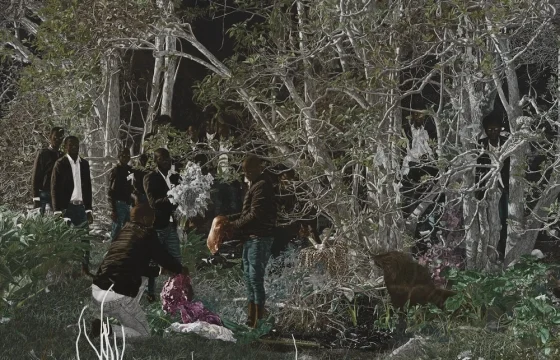
Samson’s larger compositions exude a palpable sense of reverence and ceremony. In Umlindo (Watcher) (2026), figures are depicted gathered in a forest clearing, adorned with wildflower bouquets and lengths of fabric. This scene resonates with the visual grammar of ritual, yet it remains deliberately ambiguous, devoid of specific addressees or prescribed terms.
For Samson, the ritual itself is not the primary focus; rather, it serves as "an opening to what exists beyond." His paintings employ the aesthetics of ritual to address a collective human need for orientation and to explore the capacity of ritual to mediate an encounter with the vast unknown. This thematic resonance is further amplified by the exhibition’s titles, which feature enigmatic isiXhosa words and phrases such as Imfihlo (Secret) and Intsingiselo (Meaning) (both 2026). These titles echo the paintings’ central contention: the instability of interpretation when grappling with both the knowable and the unknowable.
The power of language is a recurring motif. Each isiXhosa word carries a weight and nuance that its English translation can only approximate, never fully capture. This linguistic interstice mirrors the gap between the painted sign and the living referent, where meaning perpetually slips and transforms.
The Sublime in the Mundane: Mystery in Everyday Forms
The objects, people, and settings that populate Samson’s paintings, and indeed his broader oeuvre, are deliberately recognizable and quotidian. Yet, in each instance, Samson imbues these familiar elements with an unexplained mystery. In Tshee (2026), a vast field stretches towards a murky sky, its darkness interrupted by a moonlit cloud. This brilliant white disc destabilizes the eerie, cold atmosphere, infusing it with a majestic, almost unsettling, grandeur.
Samson articulates this duality, noting, "The sky can be so friendly, but sometimes so heavy, dark, so scary. It’s the same energy, but it exists in different forms." This oscillation between the approachable and the overwhelming is a hallmark of the sublime, a concept that resonates deeply within his work. The sensation is further distilled in Sithini ngelilitye (2026), where a detailed rendering of a rocky crag emerges from arid undergrowth, set against a sky of ethereal wash, imbuing the scene with a quality of mute enormity.
The Art of Illusion: Light, Underdrawing, and the Porous Figure
Samson masterfully employs light, which he describes as a "magic trick," to imbue his paintings with a unique rhythm. This flickering effect, which emerges and disperses across the canvas, grants varying degrees of visibility to his often dark, nocturnal scenes. This technique produces an unsteadiness that is both optical and psychical, drawing the viewer into the very process of perception.
Further enhancing this effect, Samson intentionally leaves large sections of the under-drawing visible, introducing moments of transparency that disrupt the illusion of a fully rendered surface. In Isiganeko (2026), for instance, thin layers of glaze are applied and then wiped back, a characteristic method of building color that lends the figures a brooding chromatic density. In contrast, the under-drawing remains exposed in the undergrowth and in a bird caught mid-flight, creating a dynamic interplay between revelation and concealment.
A particularly striking element in Samson’s figures is the absence of painted pupils in their eyes. This deliberate omission allows "light" to circulate more freely, rendering the figures porous and seemingly "completely one with the whole painting." Without pupils, these figures transcend individual personification. They become "human" forms deeply enmeshed with the painting’s landscape and atmosphere, where no single element dominates the others.
Beyond Representation: The Immanent Magic of Existence
In instances where the "trick" of painting reveals itself, Samson’s works seem to step back from the pretense or promise of mere representation. "Ukuphuthelwa" does not advocate for individual transcendence through subordination. Instead, it points towards the profound mystery that can be unearthed in ordinary forms, suggesting an immanent magic accessible to those who are attuned to it.
This exhibition ultimately describes a condition of hypersensitivity, not of absence or deficit. This heightened awareness grants everything in existence an equal potential for eliciting wonder or fear. Samson’s pupilless figures do not "look" outward because their knowing originates from within the world they inhabit. It is a shared knowledge, an interconnectedness that exists between the bowing foliage, the vigilant dog, the bird in flight, and the foreboding night sky that envelops them all.
In Samson’s masterful hands, each optical device and representational motif serves to pry apart that which it cannot fully contain. This deconstruction is in service of painting "a thing that links us to God – by God, I mean everything." Through "Ukuphuthelwa," Cinga Samson invites us to embrace the profound mysteries that lie at the heart of our existence, urging us to look beyond the surface and to find the sublime in the everyday, the spiritual in the tangible, and the profound in the very act of not being able to sleep.