"Disclosure Day": A Flawed Revelation of Faith and the Extraterrestrial
Steven Spielberg’s latest cinematic venture, "Disclosure Day," arrives burdened with the weight of both grand science fiction and profound spiritual inquiry. Following in the illustrious footsteps of his previous alien-centric masterpieces like "Close Encounters of the Third Kind," "E.T. the Extra-Terrestrial," and "War of the Worlds," Spielberg, alongside seasoned screenwriter David Koepp, once again attempts to fuse the wonder of extraterrestrial contact with a nuanced exploration of religion and faith. However, despite its ambitious premise and the rich tapestry of themes it seeks to weave, "Disclosure Day" ultimately falls short, presenting a fragmented and often superficial dialogue on these complex subjects.
This article will parse through the film’s narrative choices and thematic intentions, dissecting where its lofty aspirations meet an uneven execution. Be forewarned: full spoilers for "Disclosure Day" will be discussed, so those who have not yet witnessed its revelations are advised to depart in their inexplicable craft.
A Legacy of the Divine and the Extraterrestrial
Spielberg’s filmography has long served as a fertile ground for exploring the intersection of the unknown and the spiritual. From the awe-struck wonder of encountering benevolent beings in "Close Encounters" and "E.T." to the apocalyptic dread of "War of the Worlds," his narratives frequently employ religious allusions and imagery to ground the fantastical in humanity’s deepest beliefs and fears. "Disclosure Day" aims to continue this tradition, positing a world where alien intervention directly challenges existing theological frameworks.
The film’s central conceit revolves around two individuals, Daniel Kellner (Josh O’Connor) and Margaret Fairchild (Emily Blunt), who receive inexplicable "gifts" following separate, coded as divine, encounters. These abilities are presented as both wondrous and isolating, thrusting their recipients into vastly different existential crises.
Initial Encounters: Gifts and Their Genders
At the tender age of 20, college student Daniel Kellner undergoes a profound conversion experience. Suddenly, he possesses a synaesthetic understanding of mathematics, perceiving equations not just as symbols but as an inherent, sensory language. This ability evolves to encompass an alien tongue, which simultaneously translates into mathematical concepts and English within his mind. Daniel swiftly grasps that mathematics is the fundamental language of the universe. Yet, this profound knowledge becomes a burden, alienating him from his peers, eroding his memories of childhood, and isolating him from humanity – until he encounters Jane (Eve Hewson), who uniquely comprehends his predicament.
Concurrently, Margaret Fairchild’s life is irrevocably altered after an encounter with an uncanny cardinal. She gains instant, unconscious fluency in multiple languages. Further revelations show her possessing a potent form of telepathy fused with empathy; by merely looking into someone’s eyes, she accesses their intimate life details, cuts through their mental clutter, and understands their core intentions. As noted by Reactor Magazine colleague Emmet, her gift allows her to instantly clarify problems and solutions for others, merging deep understanding with compassionate counsel.
These "gifts," as the narrative presents them, are strikingly gendered, as are the characters’ subsequent reactions. Daniel, overwhelmed and alienated, weaponizes his ability, becoming a hacker and later selling his unique intellect to the highest bidder after a prison stint. His motivation for disclosing the truth about aliens is driven by a desire to inflict his own burden of knowledge upon the world, regardless of the chaos it might unleash or the consent of humanity.
Margaret, conversely, initially embraces her gift, despite the headaches and fear it instills. She navigates the film dispensing wisdom and reminding people of their inherent connections. Unlike the exploitative potential perceived by figures like Noah Scanlon, Margaret never considers "using" her power for personal gain or withholding the crucial knowledge she gleans. Her response is consistently compassionate, even when her abilities threaten to overwhelm her.
The Question of Consent and the Echo of Babel
Both Daniel and Margaret’s abilities are ripe for religious interpretation. Daniel’s mathematical synesthesia echoes a mystical knowledge that transcends earthly distractions, akin to Neo perceiving the Matrix’s underlying code. Margaret’s multilingual fluency and empathic telepathy can be likened to glossolalia, or "speaking in tongues"—a miracle bestowed upon the followers of Jesus on the Day of Pentecost, as described in the Book of Acts. This biblical event, where the Holy Spirit enabled disciples to speak languages unknown to them, served both as a sign of their divine blessing and a practical means to transcend linguistic barriers for spreading the Gospel. In contemporary Christian denominations, glossolalia is practiced as a direct, if sometimes inscrutable, communication with the divine.
The imagery of "Disclosure Day" predominantly leans into Christian allusions, making this comparison particularly pertinent. Furthermore, Margaret’s gift subtly reverses the tragic narrative of the Tower of Babel. In Genesis Chapter 11, God, unnerved by humanity’s unified language and collaborative effort to build a monumental city and tower, scatters them across the Earth and confounds their languages. Margaret’s ability to intuitively bridge these linguistic and empathic divides acts as a profound counterpoint to this ancient story of divine fragmentation.
Crucially, the film leaves the mechanics of these alien "gifts" unexplained, and more significantly, both Daniel and Margaret are never given the choice to accept or reject them. They are recipients as "helpless children," a significant thematic failing given the film’s purported focus on choice and consent. The involuntary nature of these transformative experiences undermines the very discussions the film attempts to initiate.
Jane’s Burden: Faith, Doubt, and Disclosure
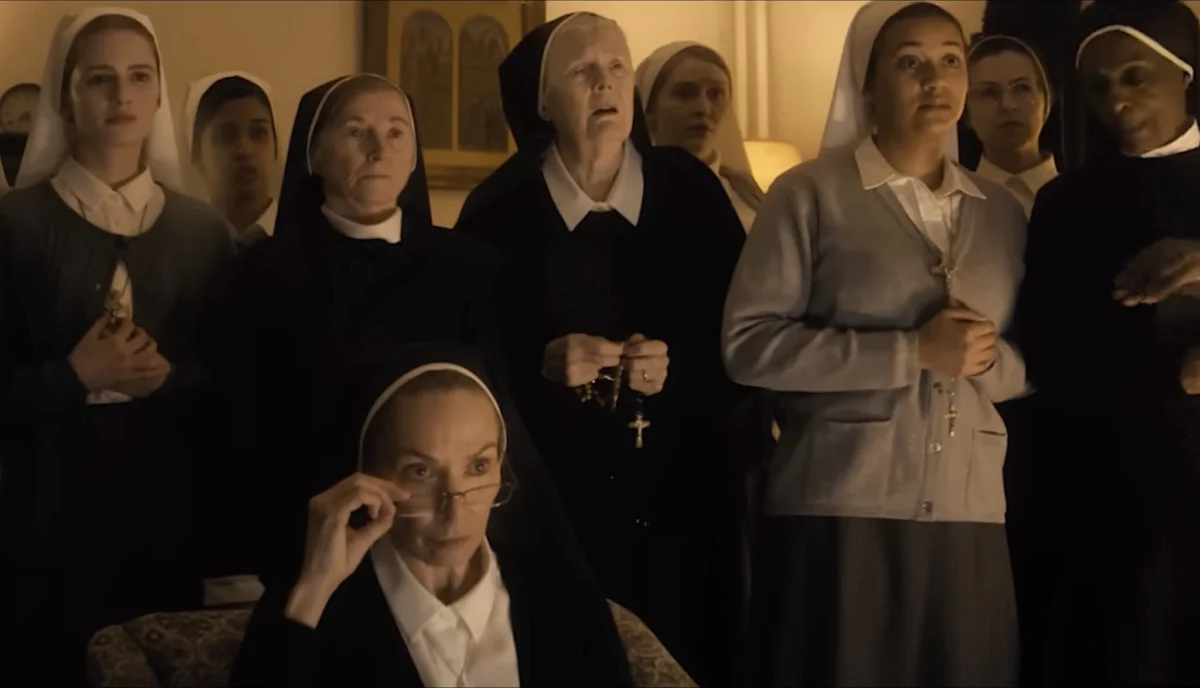
The thematic weight of religion in "Disclosure Day" largely falls upon the character of Jane. As Daniel’s girlfriend of only a few months, her backstory as a former nun-in-training is revealed through dialogue that often feels less like natural conversation and more like exposition.
A Nun’s Past and Daniel’s Blindness
Daniel’s apparent shock at Jane’s religious beliefs, despite her wearing a large, ornate gold crucifix—a piece of jewelry impossible to miss—strains credulity. His question about whether she lost her faith upon leaving the nunnery suggests a profound lack of communication or observation between them. Jane’s response, that she lost her "calling" rather than her faith, opens a fascinating avenue for theological discussion that the film, regrettably, fails to pursue. The distinction between a vocational calling and personal faith is significant, yet Daniel, and by extension the script, shows no further curiosity. This oversight highlights a broader issue: the film uses Jane’s Catholic background as a convenient narrative device without fully engaging with its implications for her character or the larger themes.
The Universal Crisis vs. Personal Struggle
When confronted with the truth of alien existence, Jane immediately posits that such disclosure would shatter humanity’s belief in God. "People have been raised to believe in a supreme being, and now you want to show us actual supreme beings?…the world can’t handle both." This statement, while understandable from her perspective, narrowly frames the global impact of disclosure through a singular, Christian lens. It disregards the vast diversity of religious and philosophical beliefs worldwide, many of which do not define a "Supreme Being" in a way that would be directly threatened by the existence of extraterrestrial life.
Jane’s crisis is deeply personal: she has already questioned her faith enough to leave a nunnery, embarked on a secular life, and entered a complex relationship, only to now confront a reality that might upend her entire worldview. This internal turmoil is compelling, but the film mistakenly projects her individual struggle onto all of humanity, limiting its own spiritual discussion by straitjacketing it within a specific, vaguely Catholic framework.
Torture, Theology, and Perversion of Faith
The film pushes its exploration of consent and choice to disturbing extremes through scenes of torture, intertwining these ideas inextricably with Jane’s spirituality. The alien MacGuffin, initially seen wielded haphazardly by Daniel, is soon revealed in the hands of his adversary, Noah Scanlon (Colin Firth), to be a device capable of a much more aggressive form of mind-meld than Margaret’s empathic telepathy. This invasive process is termed "diving."
Scanlon’s Invasion: A Stigmata of Coercion
Daniel’s attempt to introduce Jane to the alien truth begins with a bizarre tape of Nixon and alien corpses, providing exposition about the shadowy Wardex organization. However, the subsequent scene is one of horrifying torture: an alien screaming in pain, observed by a terrified and weeping Jane. This moment, which works effectively, establishes Jane’s instant, profound empathy for the alien, transcending fear to mourn its suffering. Spielberg skillfully trusts the audience to mirror Jane’s empathy.
Yet, it is Jane who becomes the primary victim of Scanlon’s psychological torment. Already bruised and traumatized from being kidnapped, she endures a mental invasion by Scanlon, who attempts to "dive" into her mind. In contrast, Daniel, the mission’s central figure, is never shown suffering comparable physical or psychological brutality.
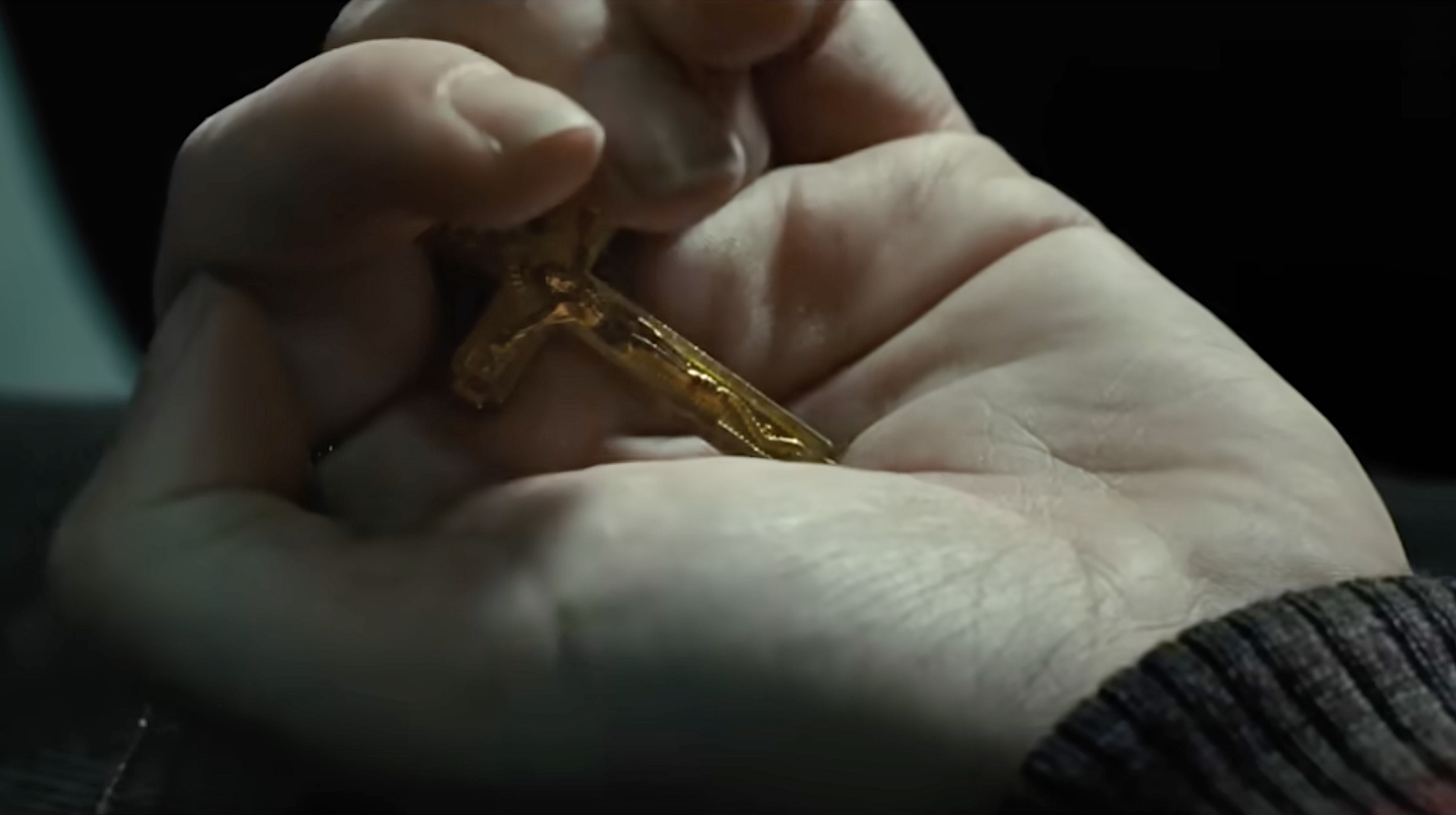
During her interrogation, Jane instinctively recites Latin prayers. She then pulls her ornate crucifix from her neck, clutching it tightly as Scanlon, or his projection, begins his invasion. The scene is ambiguous but powerfully suggestive: Scanlon appears to control her right hand, but it is Jane herself who seems to press the crucifix into her palm, gouging a bleeding wound that resembles stigmata. This act serves as a desperate attempt to ground herself, to resist the invasion using her faith as a shield.
Scanlon mercilessly weaponizes her religion. He mocks her monastery’s name, referencing St. Clare of Assisi’s miracle of bilocation and proclaiming his own similar omnipresence via alien tech. This act fulfills Jane’s fear: that alien technological superiority might indeed supplant humanity’s spiritual beliefs.
The coercion intensifies. Jane fights him, her clenched, bleeding fist visible. Briefly pushing him out, she drops the crucifix into a puddle of her own blood. When Scanlon re-invades, he twists her faith further, forcing her to agree to "stop" Daniel if he cannot be captured. He quotes Jesus’s plea in Gethsemane: "Father, if thou be willing, remove this cup from me," then compels Jane to complete the line: "…nevertheless not my will, but thine, be done."
This perversion of a deeply meaningful scriptural moment is chilling. Jesus’s choice in Gethsemane was a conscious, voluntary submission to divine will, accepting his impending death. Scanlon, however, forces Jane to betray and potentially murder someone she loves, stripping her of any agency. Her will is rendered meaningless. This horrific scene, so central to the film’s themes of choice, consent, and faith under duress, promises a depth of exploration that the rest of "Disclosure Day" struggles to deliver.
A Constricted Canvas: Catholicism as a Stand-In
"Disclosure Day" curiously defaults to a vague Catholicism as its sole representation of religious faith. Unlike films that use Catholic imagery for its inherent dramatic weight, such as Rian Johnson’s "Wake Up Dead Man," "Disclosure Day" lacks significant visual cues like cathedrals or stained glass. The explicit Catholic references are Jane’s backstory, her crucifix, and a fleeting scene where a woman crosses herself before Margaret, prompting Margaret’s cry, "I won’t be your religion!"
Missed Opportunities for Broader Dialogue
This singular focus feels restrictive. With a world rich in diverse spiritual traditions, the film offers no other expressions of faith, nor does it present substantial non-religious viewpoints. Daniel, an agnostic-leaning truth-seeker, scoffs at Jane’s spiritual anxieties but offers no counter-perspective on his own beliefs. Hugo Wakefield (Colman Domingo), the alien empath, speaks of aliens being "nearer to God" due to their empathy, but "God" remains an undefined, generic concept.
Given Spielberg’s Jewish background and Koepp’s upbringing as a Catholic who now identifies as agnostic on both God and aliens, the film’s narrow spiritual lens is a missed opportunity. If the intent was a broader conversation about faith in an alien-contact scenario, it needed to include more diverse perspectives to avoid presenting a binary choice between "Team Catholic" and "Team Alien."
The Understated Act of Self-Sacrifice
The film’s other significant moment of self-sacrificial faith occurs when Scanlon, still invading Jane’s mind, forces her to raise a knife to stab Daniel. Seeing Scanlon’s eyes reflected in the blade, Jane again resorts to her faith, driving the knife into the bleeding wound in her palm. While gesturing towards a powerful act of self-stigmata and resistance, the scene unfortunately pulls back, lacking the brutal commitment that would underscore its profound meaning. The wound, though visible, doesn’t significantly impede her, and Scanlon’s control persists, leading to her unwitting betrayal of Daniel.
This moment, though underdeveloped, powerfully conveys Jane’s struggle: in unimaginable terror, she reaches for faith, and while it aids her resistance, it does not fully vanquish the evil. This failure plunges her into a deeper crisis, shifting from abstract fears about global faith to intensely personal questions: Does God love us? Are humans lesser, or merely different, if other sentient beings exist? Are we elder siblings or babies of the cosmic family?
The Interrupted Revelation: A Crucial Phone Call
This personal crisis leads to a pivotal phone call between Jane and her former Mother Superior, Sister Maura (Elizabeth Marvel). The conversation, occurring while Daniel is arrested to buy Jane time, explores profound questions about God, creation, and humanity’s place in the universe. Sister Maura reassures Jane that an infinite God would surely populate an infinite universe with diverse life, affirming humanity’s unique creation "on Earth" without diminishing the possibility of other superior beings. She challenges Jane’s constricted view of God.
Mundane Interruptions and Missed Emotional Depth
However, the scene’s execution undermines its narrative importance. Jane makes the call from a bustling diner, constantly interrupted by mundane intrusions—men sitting next to her, a couple behind her, a waitress demanding payment for teens she sponsored. While this portrayal of daily life’s relentless intrusion on profound moments has a certain realism, it simultaneously yanks the audience out of the conversation’s philosophical depth. The choppy cutting prevents viewers from settling into the dialogue or fully absorbing Jane’s emotional reactions, particularly given Eve Hewson’s proven ability to convey complex emotions non-verbally in previous scenes. This critical moment, meant to bolster Jane’s resolve and clarify her mission, feels disjointed and emotionally truncated.
Learning from Wake Up Dead Man
A comparison to Josh O’Connor’s scene in Rian Johnson’s "Wake Up Dead Man" highlights this missed opportunity. In that film, a similarly fragmented phone call between Father Jud, Louise, and Benoit Blanc shifts dramatically when Louise reaches for empathy. The camera then holds on Jud’s face, allowing his realization and emotional shift to resonate, directly influencing the film’s latter half. "Disclosure Day" needed such a moment of stillness and focus for Jane, to allow her crisis and subsequent act of faith to fully land. Instead, she largely disappears from the narrative, only to reappear as the deus ex machina hero with "The Last MacGuffin," without further dialogue about her faith or mission.
The Whisper of "Shema": A Final, Faint Echo
The film’s final word, "Listen," holds a powerful, yet subtly placed, religious significance. In Hebrew, "listen" or "hear" is "Shema," the first word of the foundational prayer of Judaism, the "Shema Yisrael." This connection, a literal honoring of Judaism at the film’s close, is incredibly poignant. However, its impact is significantly diluted by appearing only in a single English word after two-and-a-half hours of overwhelmingly Christian-centric imagery and themes, rendering it largely unrecognizable to the broader moviegoing public. It serves as a faint, almost apologetic, whisper rather than a fully integrated part of the film’s spiritual discourse.
Implications: A Missed Opportunity for Deeper Engagement
In conclusion, "Disclosure Day" stands as an ambitious, yet ultimately frustrating, cinematic experience. While Spielberg and Koepp clearly intended to provoke a profound conversation about faith, God, and humanity’s place in a universe inhabited by aliens, their execution leaves much to be desired. The film’s narrative inconsistencies, its narrow representation of religious belief, and its reluctance to fully commit to the emotional and philosophical weight of its most powerful scenes diminish its potential.
Despite a compelling premise and moments of genuine emotional resonance, "Disclosure Day" fails to provide its audience with the necessary space to grapple with the complex questions it raises. The film offers a superficial glimpse into a dialogue that deserved a far more inclusive, consistent, and deeply considered exploration. For filmmakers who possess such a remarkable track record of blending the fantastical with the spiritual, "Disclosure Day" feels like a revelation that remained, regrettably, only partially disclosed.