Excalibur: A Dazzling, Brutal Dive into the Heart of 1980s Arthurian Fantasy
Main Facts
The 1980s stand as a singular epoch in cinematic history, particularly for the fantasy genre. This decade, a fascinating precursor to the polished blockbusters of the 2000s, forged a legacy of films often characterized by their audacious ambition, stark brutality, and a peculiar, unbridled weirdness. In a series dedicated to exploring these canonical yet often unconventional works, we previously delved into the grim realism of 1981’s Dragonslayer and Disney’s audacious, albeit ill-fated, foray into dark fantasy with The Black Cauldron. This installment brings us to a film that embodies the very essence of this era’s unique vision: John Boorman’s 1981 epic, Excalibur.
A capacious and visually arresting retelling of the Arthurian legend, Excalibur plunges viewers into a world of myth, magic, and medieval turmoil. Directed by the acclaimed John Boorman, known for his distinctive auteur vision in films like Deliverance and Zardoz, Excalibur offers a bold interpretation of the timeless saga. Released amidst a burgeoning interest in high fantasy, the film quickly carved out a reputation for its breathtaking visuals, dreamlike narrative, and a cast of then-emerging talents who would later become titans of the screen. It is a film that, even decades later, continues to provoke discussion, admiration, and bemusement in equal measure, cementing its place as a quintessential, if deeply idiosyncratic, artifact of 1980s fantasy cinema.
Chronology: From Vision to Screen
John Boorman’s journey to bring the Arthurian legend to the big screen was a testament to his persistent artistic vision. Having previously explored primal themes and the clash between man and nature in Deliverance (1972) and mind-bending philosophical sci-fi in Zardoz (1974), Boorman harbored a long-standing fascination with the mythic underpinnings of society. His initial attempts to adapt the legend dated back to the early 1970s, at one point even planning a collaboration with graphic novelist Frank Frazetta and actor Clint Eastwood. These early iterations, however, failed to materialize, largely due to the prohibitive costs and the perceived risk of a large-scale fantasy epic.
The project finally gained traction in the late 1970s, benefiting from the success of films like Star Wars (1977), which demonstrated a clear audience appetite for grand fantastical narratives. Boorman secured funding from Orion Pictures and Warner Bros., albeit on a relatively modest budget of approximately $11 million – a sum that forced ingenious creative solutions. Filming primarily took place in Boorman’s native Ireland, specifically in the rugged, mystical landscapes of County Wicklow. These natural settings provided an authentic, ancient backdrop, lending a tangible sense of history and elemental magic to the Arthurian world.
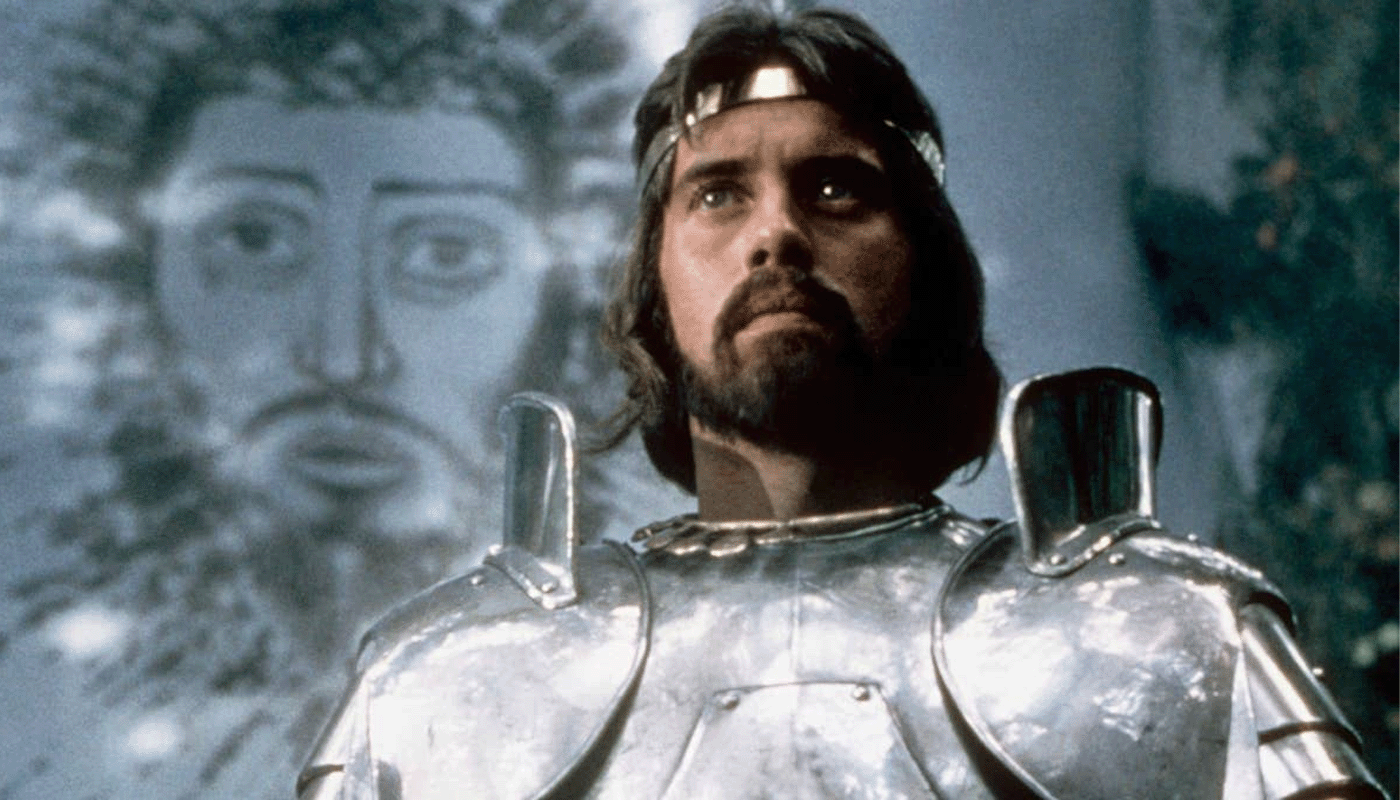
Boorman’s adaptation drew heavily from Sir Thomas Malory’s seminal Le Morte d’Arthur and T.H. White’s more modern interpretation, The Once and Future King. However, he was not content with a mere faithful rendition. Boorman sought to infuse the legend with his signature blend of the visceral and the mystical, aiming for a narrative that felt both deeply rooted in myth and uniquely hallucinatory. This ambition extended to the film’s visual aesthetic, which was meticulously crafted by cinematographer Alex Thomson, earning him an Academy Award nomination. Thomson’s work on Excalibur is celebrated for its striking use of light and shadow, the pervasive "jewel-tone green" filter that evokes a sense of ancient magic and decay, and the dynamic compositions that elevate battle sequences to operatic grandeur. The costumes, designed by B.J. Simmons, were equally opulent and evocative, contributing significantly to the film’s "visual feast" quality.
The casting process proved to be a pivotal moment for a generation of British and Irish actors. Boorman, perhaps due to budget constraints or a desire for fresh faces, eschewed established stars for many key roles, inadvertently assembling an ensemble that would become incredibly influential. Gabriel Byrne, in one of his earliest film roles, portrayed the conflicted and lust-driven Uther Pendragon. Liam Neeson, then a virtual unknown, delivered a memorable performance as Sir Gawain, years before his breakthrough in Schindler’s List. Patrick Stewart, already a respected stage actor, took on the role of Leodegrance, Guinevere’s father, foreshadowing his later global fame in Star Trek: The Next Generation and X-Men. Ciarán Hinds, in his first widely distributed film, also appeared as King Lot.
However, it was the central dynamic between Arthur and Merlin that truly defined the film. Boorman’s initial thoughts for Merlin included screen legends like Lee Marvin, Sean Connery, or Max von Sydow. Ultimately, he chose Nicol Williamson, whose unconventional, arch, and deeply theatrical portrayal of the wizard would become one of the film’s most iconic, and divisive, elements. Williamson’s Merlin, matched against Nigel Terry’s often-befuddled Arthur and a strikingly beautiful, formidable Helen Mirren as Morgana, created a unique tonal landscape that veered between high drama, dark fantasy, and unexpected moments of camp.
Upon its release in 1981, Excalibur garnered mixed to positive critical reviews. While its visual splendor was almost universally praised, critics were often divided on its narrative coherence, performances, and overall tone. Despite this, it performed reasonably well at the box office, grossing over $34 million worldwide against its $11 million budget, indicating a significant audience draw for its epic scope and mystical subject matter.
Supporting Data: An Examination of Boorman’s Arthurian Canvas
Excalibur‘s narrative, while ostensibly a "straightforward retelling" of the Arthurian legend, is anything but conventional in its execution. Boorman meticulously weaves together key events from Malory’s Le Morte d’Arthur and White’s The Once and Future King, presenting a sweeping chronicle from Uther Pendragon’s deceitful conception of Arthur to the tragic demise of the Round Table and Arthur’s final journey to Avalon. However, the film is less concerned with historical accuracy or linear storytelling than with capturing the mythic essence of the legend, often prioritizing mood, symbolism, and psychological depth over strict plot mechanics.
One of Boorman’s most significant alterations to the source material is the conflation of the Sword in the Stone with Excalibur itself. In many traditional accounts, the Sword in the Stone merely signifies Arthur’s rightful claim to the throne, while Excalibur is a separate, magical blade gifted by the Lady of the Lake. By making them one and the same, Boorman imbues Excalibur with an even greater symbolic weight, linking Arthur’s destiny, his power, and the fate of the land inextricably to the single weapon. The sword becomes a living symbol of kingship, magic, and the cyclical nature of power.
Another notable streamlining is the combination of the enchantresses Morgan le Fay and Nimue into a single, complex character, brilliantly portrayed by Helen Mirren. This fusion amplifies the magical feminine presence in the narrative, creating a more concentrated and formidable antagonist for Merlin and Arthur. Mirren’s Morgana is not merely evil but a figure of raw, elemental power, sensuality, and cunning, representing the untamed forces of nature and magic that constantly challenge Arthur’s attempts at order and civilization.
The film also deviates in its portrayal of the Grail quest, making Perceval (Nicholas Clay) the chief finder rather than the more traditionally pure Galahad (who is notably absent from the film). This choice aligns with earlier versions of the legend and allows for a more relatable, human journey of spiritual purification. Perceval’s long, trippy sequences of repeated journeys to castles, bordering on hallucinatory, underscore the film’s exploration of internal struggle and the blurred lines between reality and spiritual vision. Furthermore, Perceval replaces Sir Bedivere as the knight tasked with returning Excalibur to the Lady of the Lake, cementing his role as a key figure in the saga’s conclusion.
Visually, Excalibur is a masterclass in atmospheric filmmaking. The pervasive "jewel-tone green" filter, achieved through careful lighting and filters, saturates the Irish landscapes with an otherworldly glow, making the natural world feel alive with magic. This aesthetic choice contributes to the film’s dreamlike quality, where the lines between objective reality and subjective experience are constantly blurred. The "sparkly" quality, particularly evident in the armor and magical effects, further enhances this sense of fantastical grandeur, even if it occasionally verges on the theatrical.
However, Boorman’s artistic choices extend beyond visual splendor into areas that have often been described as "puzzling" or "inscrutable." The opening title font, "Herkules," with its resemblance to the Cheers title cards, introduces an unexpected anachronism. Camelot itself, depicted with gleaming, almost brutalist stainless-steel blocks, defies conventional medieval aesthetics, suggesting a timeless, perhaps even futuristic, seat of power that feels strangely out of place yet undeniably iconic. Moments like Lady Igrayne’s anachronistic "mid-’90s goth club" dance and Uther Pendragon’s infamous plate-mail sex scene further contribute to the film’s unique, sometimes bewildering, tonal shifts. These elements, rather than being simple flaws, can be interpreted as deliberate attempts by Boorman to detach the legend from historical constraints, presenting it as a timeless myth that resonates across different eras, embracing the inherent weirdness of ancient tales.
The film’s casting, while a launching pad for many, also contributes to its unconventional characterizations. Nigel Terry’s Arthur, often described as "befuddled" and lacking the traditional kingly charisma, presents a more vulnerable, human king, burdened by destiny rather than defined by inherent heroism. His West Country accent, intended to root Arthur in his Cornish origins, adds another layer of realism that contrasts with the film’s fantastical elements, creating an interesting tension. Conversely, Nicol Williamson’s Merlin is a force of nature—a "cranky comedy Merlin" who is simultaneously wise, droll, petty, and deeply connected to the old magic. His scenes with Helen Mirren’s Morgana, a battle of wits and wills, are among the film’s most captivating, showcasing a dynamic that blends gravitas with genuine entertainment. The deliberate embrace of these disparate tones—from the brutal realism of battle to the surrealism of magic and the unexpected flashes of camp—is a hallmark of Boorman’s vision, making Excalibur a film that resists easy categorization.
Official Responses: Critical Acclaim and Enduring Debate
Upon its release, Excalibur was met with a diverse array of critical responses, reflecting its unconventional nature. The film’s visual audacity and commitment to a distinct aesthetic were widely lauded, even by those who found its narrative challenging. Roger Ebert, while acknowledging the film’s "flaws," praised its "visual splendor" and its immersive quality, stating that it creates a world of "magic and beauty, terror and mystery." He noted its ambition to portray the Arthurian legend as a "cycle of seasons, of life and death and rebirth." Vincent Canby of The New York Times, however, was more critical, finding it "pretentious" and "a bore," though he too couldn’t deny its visual impact.
The Academy Award nomination for Alex Thomson’s cinematography underscored the film’s technical achievements and artistic merit in capturing its unique look. However, despite its nominations and generally positive reception, Excalibur failed to secure major awards, perhaps due to its perceived narrative inconsistencies or its polarizing tonal shifts.
Director John Boorman himself has often spoken about his intentions for Excalibur, viewing it as a deeply personal project and a distillation of timeless myths. He aimed to portray the Arthurian legend not as a historical drama, but as a dream, a symbolic journey exploring themes of sovereignty, magic, the sacred feminine, and the decline of an age of myth. He was reportedly pleased with the film’s reception and its eventual cult status, understanding that its particular blend of the epic and the eccentric would resonate strongly with certain audiences.
The cast, particularly the burgeoning stars, have frequently reflected on Excalibur as a pivotal moment in their careers. Liam Neeson, Gabriel Byrne, and Patrick Stewart have all acknowledged the film as an important stepping stone, providing them with early, significant exposure in a major production. Helen Mirren has spoken fondly of her role as Morgana, appreciating the depth and power of the character and the opportunity to work with Boorman’s distinctive vision. Nicol Williamson’s portrayal of Merlin remains a highlight, often cited by fans and critics alike as a definitive, if idiosyncratic, interpretation of the wizard, a performance that fully embraced the theatricality and humor inherent in Boorman’s script.
Over the decades, Excalibur‘s critical standing has evolved. While the initial criticisms regarding its pacing and occasional excesses persist, there’s a growing appreciation for its singular vision and its profound influence on subsequent fantasy cinema. Many now view its "flaws" not as failures, but as integral components of its unique charm and artistic daring, solidifying its reputation as a deeply flawed but utterly mesmerizing masterpiece.
Implications: Legacy, Influence, and Reassessment
The legacy of Excalibur is multifaceted, extending far beyond its initial box office performance and critical reception. It has transcended its status as a mere 1980s fantasy film to become a revered cult classic and a significant touchstone in the broader fantasy genre.
Perhaps the most explicit testament to its enduring influence comes from prominent filmmakers. Zack Snyder, director of Man of Steel and other DC Extended Universe films, famously names Excalibur as his all-time favorite movie. One can trace visible threads of Boorman’s aesthetic in Snyder’s work, particularly his penchant for hyper-stylized visuals, mythological grandeur, and a blend of gritty realism with fantastical elements. The visual language of Excalibur, with its emphasis on gleaming armor, rain-soaked landscapes, and operatic battle sequences, has undeniably shaped the visual vocabulary of modern epic fantasy.
Beyond Snyder, Excalibur‘s DNA can be found in numerous later Arthurian adaptations. The film’s willingness to embrace anachronism and infuse the ancient legend with a contemporary sensibility likely paved the way for films like 1995’s First Knight and Antoine Fuqua’s 2004 King Arthur. While the latter was marketed as a "historically accurate" retelling, its visual style, particularly its portrayal of rugged, battle-hardened knights and a more grounded, yet still epic, sensibility, owes a debt to Boorman’s pioneering work. More recently, the surreal, hallucinatory qualities and philosophical depth of Excalibur resonate strongly with A24’s critically acclaimed The Green Knight (2021) and even Guy Ritchie’s stylized King Arthur: Legend of the Sword (2017), both of which explore the mythic landscape with a similar blend of the visceral and the dreamlike. For many fans, despite preceding the iconic parody of Monty Python and the Holy Grail by six years, Excalibur has ironically become the definitive serious cinematic adaptation of the Arthurian saga, its unique blend of mysticism and brutality capturing the essence of the legend in a way few others have.
Furthermore, Excalibur stands as a remarkable "watershed moment" for British and Irish acting talent. The film provided early, significant roles for actors who would go on to achieve international superstardom. Gabriel Byrne transitioned from Uther Pendragon to a distinguished career in films like Miller’s Crossing and The Usual Suspects. Liam Neeson’s intense portrayal of Sir Gawain was a precursor to his later dramatic and action hero roles. Patrick Stewart, already a respected Shakespearean actor, found global recognition shortly after Excalibur as Captain Jean-Luc Picard in Star Trek: The Next Generation, and later as Professor X in the X-Men franchise. Ciarán Hinds, a versatile character actor, has since built an impressive filmography, often playing complex, authoritative figures. The film essentially served as a prestigious showcase, launching these talents into the global spotlight and establishing them as the elder statesmen of stage and screen that they are today.
In the 21st century, Excalibur continues to be reassessed and appreciated. Its "flaws"—the anachronisms, the abrupt tonal shifts, the occasionally bewildering performances—have, for many, become part of its charm. It is seen as a bold, uncompromising vision, a testament to an era of filmmaking where ambition often outstripped conventional polish. The film’s raw energy, its commitment to exploring the darker, more mystical aspects of the Arthurian legend, and its stunning visual poetry ensure its place as a compelling, if deeply idiosyncratic, work of art.
So, does Excalibur hold up forty-five years after its premiere? Absolutely. While it may not appeal to all, its audacious spirit, visual grandeur, and lasting impact on both cinematic aesthetics and acting careers firmly establish it as a deeply resonant piece of 1980s fantasy cinema. It remains a sparkling, green-tinted fever dream that, despite its quirks, is undeniably epic in its scope and influence.
Join us next time as we descend from the highfalutin world of sword and sorcery to explore its cheapest and sleaziest corners with the Roger Corman-produced Sorceress (1982)!