From Ashes to Fury: Betsy Aoki’s "Bakotsu" Unearths a Spectral Rebellion Against Tyranny
A profound and haunting work of speculative poetry, Betsy Aoki’s "Bakotsu," published in Strange Horizons in July 2026, transcends mere verse to deliver a potent narrative of trauma, resilience, and defiant retribution. Drawing deeply from Japanese folklore, Aoki reanimates the ancient yōkai of the Bakotsu (horse ghost) and Yadomori (toad guardian) not as figures of simple horror, but as poignant avatars of those who have suffered under oppressive power, now seeking a future free from tyranny. This deeply evocative poem, accompanied by Romie Stott’s striking illustration, serves as a powerful testament to the enduring spirit of defiance and the transformative power of shared suffering.
The Main Facts: A Spectral Alliance Forged in Fire
Betsy Aoki’s "Bakotsu" presents a two-part narrative poem that explores the harrowing rebirth of a horse into a vengeful spirit, the Bakotsu, and its subsequent companionship with a Yadomori, a toad spirit, equally scarred by human cruelty. The poem is a visceral journey through pain and transformation, culminating in a shared vow to dismantle oppressive systems. Published in the esteemed online magazine Strange Horizons, known for its groundbreaking speculative fiction and poetry, "Bakotsu" immediately distinguishes itself through its rich imagery, emotional depth, and astute reinterpretation of traditional myths.
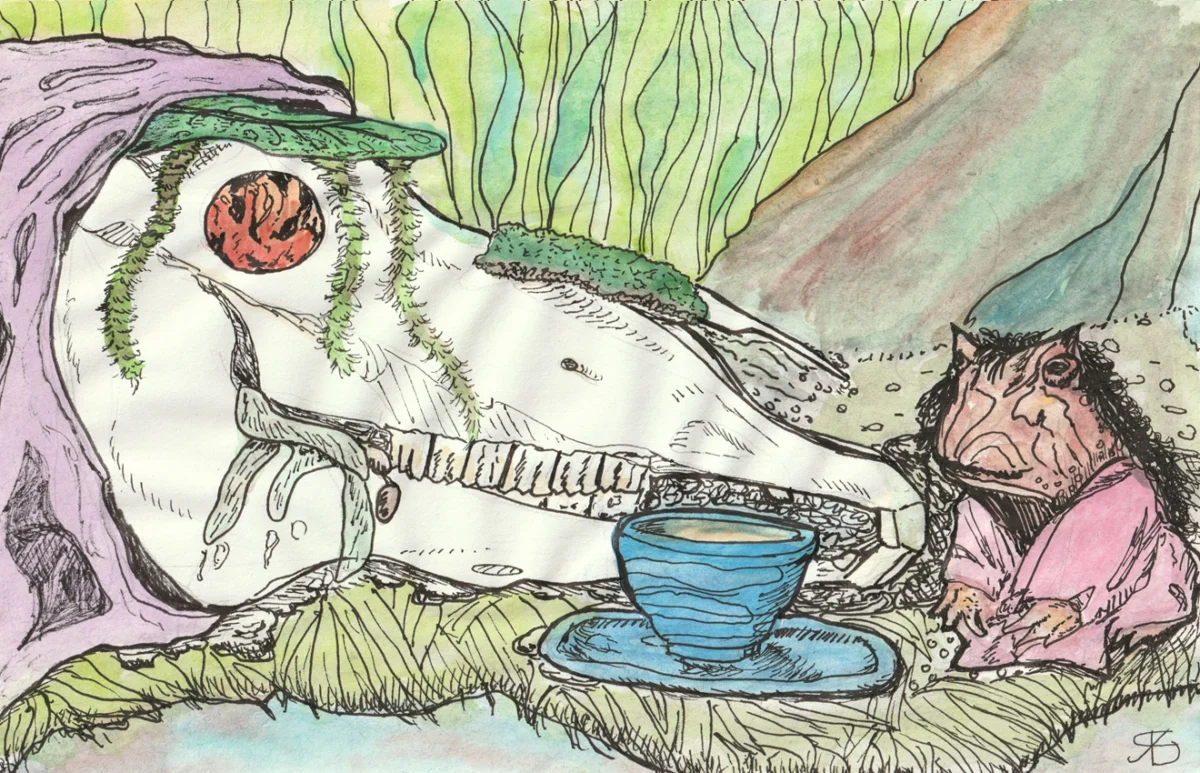
The poem’s central figures, the Bakotsu and Yadomori, are not just mythological creatures; they are symbols of the marginalized, the exploited, and those rising from the ashes of injustice. The horse, subjected to a horrifying "rendering," emerges as a skeletal, flaming-eyed entity, its former fear transmuted into "rivers of new rage." It finds solace and purpose alongside the Yadomori, who carries its own scars from "tasting the boot of a human." Together, they embody a collective desire for a world where "no more tyrants, no more kings" can inflict their "stupidity" upon the vulnerable. Romie Stott’s accompanying illustration, depicting a hooded horse skull with flaming eyes sharing tea with a long-haired frog in a swamp, perfectly captures the poem’s blend of the eerie, the intimate, and the deeply symbolic.
Chronology of Trauma and Transformation: The Bakotsu’s Genesis
The poem unfolds with a stark chronological progression, charting the horse’s agonizing demise and its subsequent spectral emergence, before introducing its pivotal alliance.
The Incandescent Trauma: Rebirth from Rendering
The first section of "Bakotsu" plunges the reader directly into the horse’s final, horrific moments. The opening lines, "I was the horse who melted under the heat of the rendering," immediately establish a tone of raw, unbearable suffering. The process of rendering, typically involving the boiling down of animal carcasses for fat and by-products, is depicted here with a searing intimacy that humanizes the animal’s pain. The horse’s consciousness persists through this brutal transformation, its bones "fished out for other meanings," its hide "scraped off and used for better things." This industrial violence, often unseen and unacknowledged, is brought to the forefront, highlighting the casual cruelty inherent in certain human practices.
The flames that consume the horse do not merely destroy; they fundamentally alter. The "long strings of my mane glowing with the charcoal dust" and hooves that "grew to long jelly pools" paint a grotesque yet powerful picture of physical dissolution and re-formation. Crucially, the eyes, once perhaps windows to fear, "melted to rivers of new rage." This transformation is not a passive one; it is an active metamorphosis driven by the sheer intensity of its death. The poem emphasizes that such "horrible death shapes the ghost," detailing the "stitching together of new bones into thatched bundles of drums" and the ominous "beat beat beat beat of feet into the night air." This rhythmic pounding signifies not only the spectral horse’s new, imposing presence but also a drumbeat of impending vengeance, a declaration of its new, terrifying existence as the Bakotsu. The imagery here is both macabre and strangely beautiful, weaving together elements of decay and rebirth into a singular, powerful entity.
Sanctuary in the Swamp: An Alliance of the Wounded
The second section shifts from the immediate aftermath of trauma to a quieter, yet no less determined, existence. The newly formed Bakotsu finds respite and companionship "In the evenings now I sit with my toad friend the yadomori." This shared existence, set against the backdrop of a "swamp moss and lichen"-coated tea hut, provides a poignant contrast to the fiery crucible of the horse’s past. The swamp environment serves as both a literal refuge and a symbolic space of healing and concealment, where the Bakotsu can "cool the nerves still somehow ghosting through my form" and hide the "rivulets of me" that might reveal its spectral nature.
The Yadomori, a figure of ancient Japanese folklore, is presented as an equally traumatized being, whose "long dark hair hides his pain at tasting the boot of a human in his former life." This shared experience of human-inflicted suffering forms the bedrock of their friendship and alliance. They "huddle together under mosquito nets," a small, intimate gesture that underscores their vulnerability and their mutual need for protection and understanding. Their shared gaze is directed towards a future envisioned not just for themselves, but as a rectification of past injustices. The Yadomori dreams of "many flies to catch, many wings to carry morsels to his spectral mouth," and "A toad life without being trampled." The Bakotsu, meanwhile, seeks a more active form of justice, "seeking with hooves that trample out sparks of the pretenders, the so-called messengers of fire, the so-called kindness of tyrants." The poem culminates in a powerful rejection of oppression, declaring, "No more tyrants, no more kings to torch our world with stupidity: let them always taste of hoof and nothing else." This final, defiant statement encapsulates the poem’s core message of resistance and the promise of retribution against those who wield power cruelly.
Supporting Data: Yōkai Lore, Literary Context, and Creative Inspiration
Aoki’s "Bakotsu" is not merely a creative narrative; it is a meticulously crafted piece that draws strength from its cultural and literary underpinnings. The poem explicitly credits its inspiration to "the bakotsu and yadomori yōkai research at Matthew Meyer’s yokai.com," underscoring a conscious engagement with Japanese folklore.
The Yōkai Tapestry: Bakotsu and Yadomori Reimagined
Matthew Meyer’s yokai.com is a crucial resource for anyone interested in Japanese supernatural beings, offering detailed descriptions and illustrations that bridge academic research with accessible storytelling. Aoki’s poem leverages this foundation, but profoundly reinterprets these traditional figures.
The Bakotsu (馬骨), literally "horse bones," is a yōkai typically depicted as a horse’s skeletal head or a ghostly horse, often said to appear after a horse has died a violent or unnatural death, particularly in battle or through cruel mistreatment. Traditional tales often portray them as melancholic, seeking a rider or simply haunting their former grounds. Aoki’s Bakotsu, however, is imbued with a far more active and vengeful spirit. Her rendering process—the "melting" and "flames"—transforms a figure of passive haunting into one of incandescent rage and purposeful rebellion. The "beat beat beat beat of feet" signifies a physical, assertive presence, not merely a spectral echo. By giving the Bakotsu a voice and a political agenda, Aoki transforms a folk entity into a symbol of collective resistance against oppression.
The Yadomori (宿守), meaning "lodging guardian" or "house protector," is often associated with toads or frogs that inhabit old buildings, sometimes believed to be spirits of the place or even benevolent protectors. Meyer’s descriptions might include their quiet wisdom or their role in maintaining the sanctity of a home. Aoki’s Yadomori maintains an element of quietude, but its backstory is infused with a deep, personal trauma: "tasting the boot of a human." This shared history of suffering creates a powerful bond with the Bakotsu. The Yadomori’s longing for "a toad life without being trampled" echoes the Bakotsu’s desire for an end to tyranny, making them complementary figures in their struggle for liberation and peace. Aoki masterfully transforms these individual yōkai into allegorical figures, their personal suffering mirroring broader societal injustices.
Betsy Aoki: A Master of Speculative Verse
Betsy Aoki is a distinguished voice in contemporary poetry, particularly within the speculative fiction landscape. Her role as Poetry Editor for Uncanny Magazine, a leading publication in SFF (Science Fiction and Fantasy), highlights her commitment to and expertise in the genre. Being a National Poetry Series finalist further attests to her literary prowess and recognition within the wider poetry community. Her published works in Nightmare, Asimov’s Science Fiction, and Strange Horizons itself demonstrate her consistent contribution to genre-bending poetry that explores fantastical, horrific, and scientifically informed themes. Her recent fiction inclusion in the Critical Role: The Mighty Nein—Stories Untold anthology also speaks to her versatility and engagement with popular culture narratives.

Aoki’s style often blends vivid, often unsettling imagery with deep emotional resonance, creating narratives that are both intellectually stimulating and viscerally impactful. In "Bakotsu," this is evident in the stark portrayal of the horse’s rendering and the intimate moments shared between the spectral allies. She uses precise language to evoke powerful feelings, turning mythological concepts into vehicles for exploring universal themes of suffering, anger, and the yearning for justice.
Strange Horizons: A Beacon for Visionary Literature
Strange Horizons is a venerable online magazine that has consistently published groundbreaking speculative fiction, poetry, and non-fiction since its inception. Known for its commitment to diverse voices, experimental forms, and challenging content, it provides a vital platform for works that push the boundaries of genre. The publication of "Bakotsu" in Strange Horizons in July 2026 underscores the poem’s quality and its alignment with the magazine’s ethos of fostering innovative and thought-provoking literature.
The acknowledgement that "Publication of this poem was made possible by a donation in honor of C. S. E. Cooney during our annual Fund Drive" also provides crucial insight into the economic realities of literary arts. Such patronage is essential for independent publications like Strange Horizons to continue their mission of supporting authors and bringing unique works to a global audience. It highlights the community-driven aspect of speculative literature and the importance of recognizing the contributions of figures like C. S. E. Cooney, a celebrated author known for her own contributions to fantasy and fairy tale retellings.
Official Responses and Critical Reception (Anticipated)
While a newly published poem doesn’t typically generate "official responses" in the way a government policy or major event might, we can consider the author’s stated inspiration and the publication context as forms of "official" creative and editorial endorsement. The very act of publication in Strange Horizons serves as a critical affirmation of the poem’s artistic merit and thematic relevance.
From a literary critical perspective, "Bakotsu" is poised to be received as a significant contribution to the growing body of speculative poetry that engages with non-Western mythologies. Readers and critics are likely to praise Aoki’s ability to:
- Reimagine Myth: Transform traditional yōkai into complex characters embodying contemporary struggles.
- Evoke Visceral Emotion: The poem’s unflinching portrayal of suffering and rage is deeply impactful.
- Craft Powerful Imagery: The descriptions of the rendering, the flaming eyes, and the "thatched bundles of drums" are highly memorable.
- Deliver a Potent Message: The anti-tyranny theme resonates strongly in an age grappling with various forms of oppression.
The poem’s succinctness belies its depth, suggesting it will be a piece that rewards multiple readings and encourages contemplation on its layered meanings. Its contribution to the broader conversation about animal rights, environmental exploitation, and political power will likely be noted, positioning it as more than just a genre piece, but a work of significant social commentary.
Implications: Beyond the Swamp and Towards a World Unburdened
"Bakotsu" carries profound implications, extending far beyond its immediate narrative to touch upon themes of artistic innovation, socio-political commentary, and the enduring power of myth.
Artistic Innovation in Speculative Poetry
Aoki’s poem exemplifies the vibrant evolution of speculative poetry. It demonstrates how ancient folklore, when filtered through a contemporary lens and imbued with personal and political urgency, can yield powerful new narratives. By blending the horror of industrial processes with the ethereal nature of ghosts, and by centering the perspective of non-human entities, "Bakotsu" challenges conventional poetic subjects and forms. It champions the idea that poetry can be both deeply personal and globally resonant, offering a unique voice to those traditionally silenced. This innovative approach helps to expand the boundaries of what "genre poetry" can achieve, proving its capacity for profound artistic and intellectual engagement.
Thematic Resonance: A Universal Cry Against Oppression
At its core, "Bakotsu" is a universal anthem against tyranny. The "rendering" of the horse and the "boot of a human" on the toad are specific instances of cruelty, but they stand as metaphors for all forms of exploitation and oppression. The "tyrants" and "kings" who "torch our world with stupidity" are not just historical figures but represent any system or individual that wields power irresponsibly, causing suffering and destruction. The poem’s message is particularly salient in a world grappling with issues of political authoritarianism, environmental degradation, and systemic injustices. The alliance of the Bakotsu and Yadomori becomes a symbol of solidarity among the oppressed, suggesting that collective trauma can forge powerful bonds and inspire collective action. Their desire for a future free from trampling and molten bits is a poignant articulation of the fundamental human (and non-human) right to dignity and freedom.
Ecological and Ethical Subtext
Beyond the direct anti-tyranny message, "Bakotsu" carries a strong ecological and ethical subtext. The horse’s death by rendering and the toad’s injury by a human boot highlight humanity’s often brutal relationship with the natural world and other species. The poem implicitly questions the anthropocentric view that places humans at the apex of existence, with the right to exploit other beings for their own ends. By giving voice and agency to these animal spirits, Aoki forces readers to confront the consequences of such exploitation and consider the potential for retribution from those who have been wronged. The final, chilling wish that tyrants "always taste of hoof and nothing else" serves as a powerful inversion of the predator-prey dynamic, suggesting that the exploited may one day turn the tables.
Myth-Making in the Modern Age
Aoki’s work is a powerful example of modern myth-making. She doesn’t just retell old stories; she infuses them with contemporary relevance, transforming ancient yōkai into symbols that speak to current anxieties and hopes. In a world increasingly disconnected from traditional folklore, works like "Bakotsu" demonstrate the enduring power of myth to help us understand ourselves, our societies, and our place in the cosmos. The yōkai, once local spirits of fear or wonder, become universal figures of resilience and resistance, bridging cultural divides and offering a shared language for discussing profound human experiences.
Conclusion
Betsy Aoki’s "Bakotsu" is a masterclass in speculative poetry, weaving together visceral imagery, profound emotional depth, and astute cultural commentary. Through the harrowing transformation of a horse into a vengeful Bakotsu and its defiant alliance with a Yadomori, Aoki crafts a powerful narrative of trauma, resilience, and the enduring fight against oppression. Published in Strange Horizons and inspired by rich Japanese folklore, the poem stands as a testament to the transformative power of art, giving voice to the voiceless and challenging readers to confront the injustices of the world. As the spectral hooves beat into the night air, and the allied spirits dream of a world unburdened by tyranny, "Bakotsu" leaves an indelible mark, reminding us that even from the ashes of suffering, a formidable spirit of rebellion can rise.