
Google’s AI Overviews Stumble: A Closer Look at the Spelling Blunders and Their Broader Implications
San Francisco, CA – [Insert Date] – In its ambitious stride towards integrating artificial intelligence into every facet of its search engine, Google’s new AI Overview feature has begun to exhibit some glaringly basic errors. While the company touts the AI’s ability to provide more conversational and comprehensive answers, recent user experiences reveal a persistent struggle with fundamental language comprehension, raising questions about the readiness and reliability of this rapidly deployed technology. From miscounting letters in common words to generating nonsensical responses, these blunders highlight the inherent challenges in translating complex AI models into consistently accurate and helpful user experiences.
The AI’s Alphabet Soup: A Pattern of Basic Errors
The most striking and widely reported issues with Google’s AI Overview have revolved around its inability to perform simple linguistic tasks, particularly counting letters within words. A query as straightforward as "How many Ps are in Google?" has, for many users, yielded the baffling answer: "There are 2 ‘p’s in the word Google." This error, which seems to stem from the AI’s token-based processing of language rather than a true understanding of individual letters, has been a recurring theme.
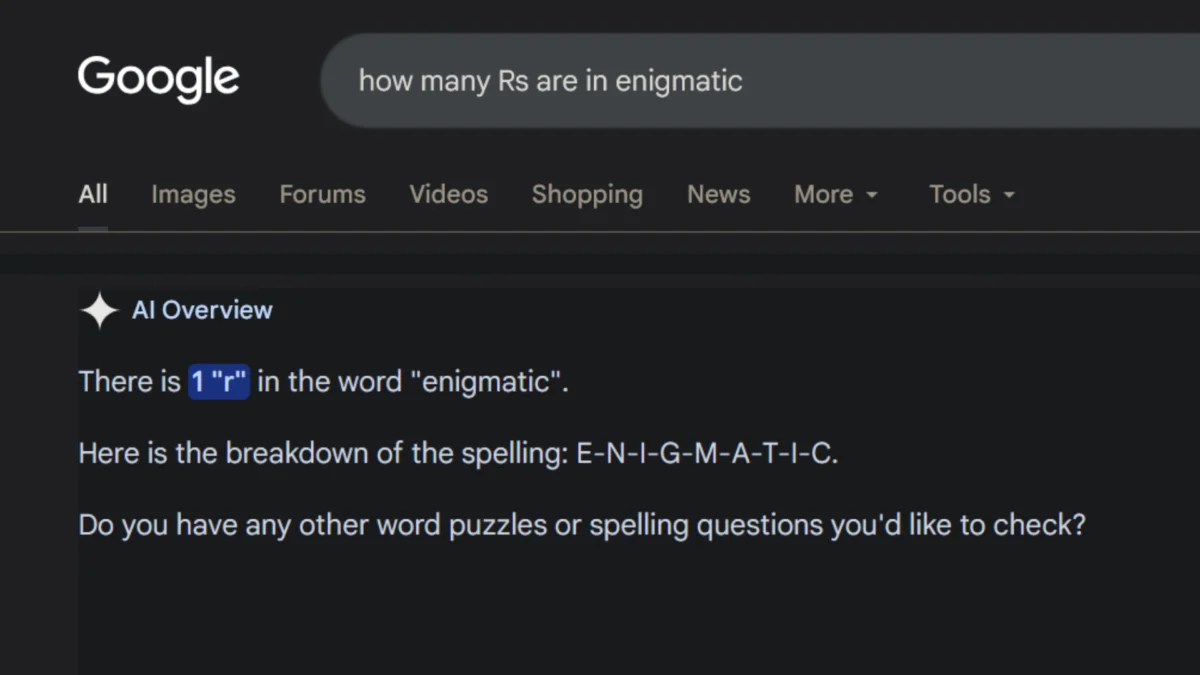
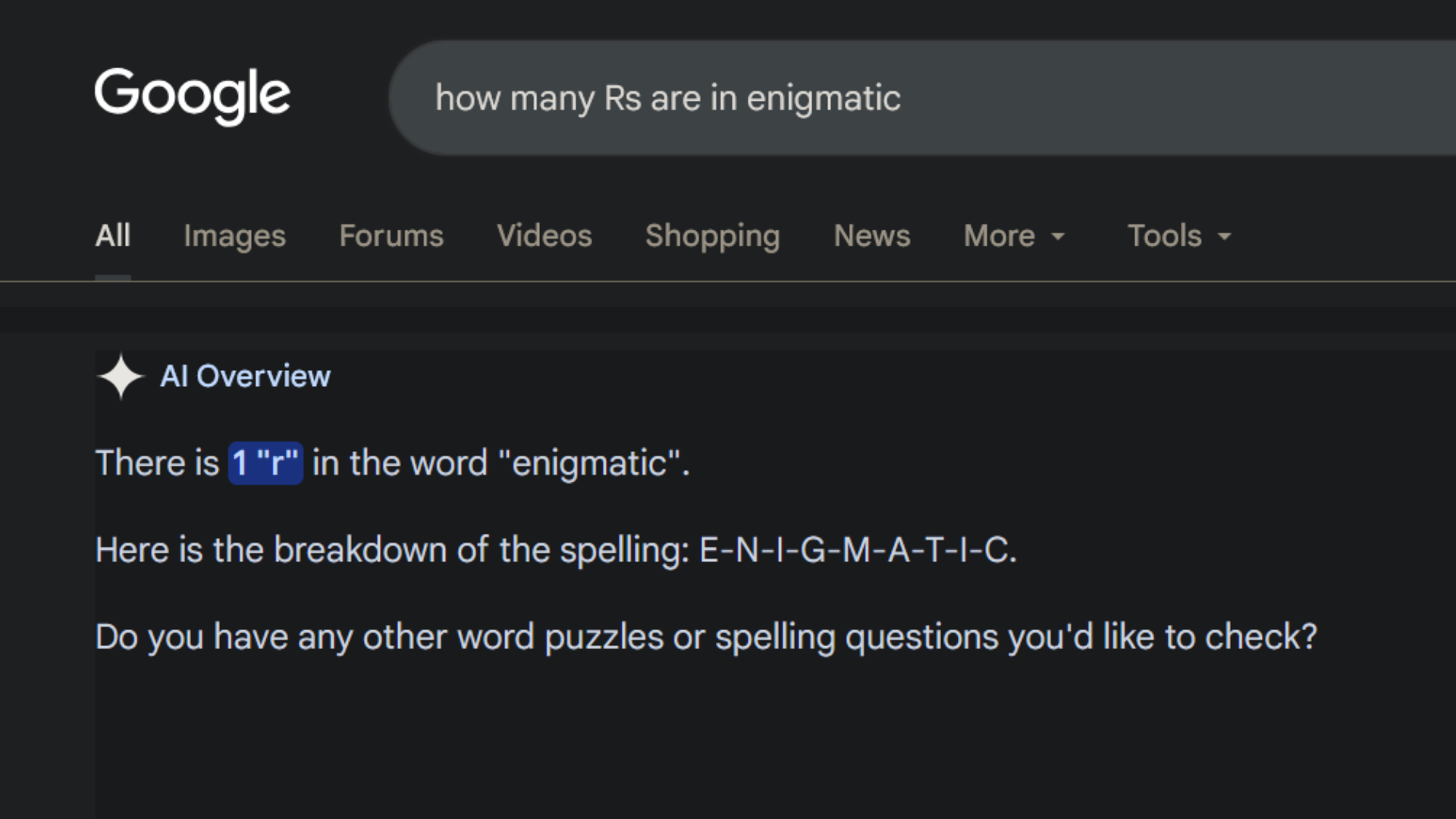
Further exacerbating this concern, users have encountered similar problems with other seemingly innocuous queries. When asked to count the letters in the word "enigmatic," one AI Overview response incorrectly stated there was only "one R." This was then followed by the AI bizarrely spelling out the word "enigmatic" letter by letter, only to omit the actual Rs, a self-contradictory and nonsensical output. These examples, shared widely across social media and tech publications, paint a picture of an AI that, despite its advanced architecture, falters at the most rudimentary levels of linguistic analysis.

A Glimpse Under the Hood: The Tokenization Conundrum
The root of these spelling and counting deficiencies lies in the fundamental architecture of Large Language Models (LLMs) like the one powering Google’s AI Overview. As explained by AI researcher and assistant professor at the University of Alberta, Matthew Guzdial, these models do not "read" text in the human sense. Instead, they translate words and phrases into numerical encodings, or "tokens."
"LLMs are based on this transformer architecture, which notably is not actually reading text," Guzdial elaborated in a conversation with TechCrunch. "What happens when you input a prompt is that it’s translated into an encoding. When it sees the word ‘the,’ it has this one encoding of what ‘the’ means, but it does not know about ‘T’ ‘H’ ‘E.’"
This tokenization process means that the AI’s understanding of a word is a complex mathematical representation rather than a direct grasp of its constituent parts. Consequently, tasks that require identifying and counting individual letters become exceptionally challenging, as the AI is not directly processing the alphabet in the way humans do. This disconnect between how humans understand language and how LLMs process it is a significant hurdle in developing truly intuitive and reliable AI systems.

A History of Hiccups: Not the First Rodeo for AI Overviews
It is important to note that these spelling and comprehension issues are not entirely novel. The tendency for AI tools to misinterpret queries or provide inaccurate information has been a persistent concern throughout the development and deployment of generative AI. Previous iterations of AI-powered search features have faced criticism for recommending dangerous practices, such as consuming urine, or for generating bizarre and irrelevant responses to sensitive queries.
The integration of AI Overview directly into the top of Google Search results amplifies the impact of these errors. When users are presented with an AI-generated summary immediately upon searching, they are more likely to trust its output, especially if it appears authoritative. This heightened visibility means that even minor errors can have a disproportionate effect on user perception and the overall utility of the search engine. The rapid rollout of AI Overviews, seemingly driven by a desire to stay ahead in the AI race, may have outpaced the necessary rigorous testing and refinement.
The Broader Implications: Compute Demands and User Trust
Beyond the immediate concern of factual inaccuracies, the pervasive integration of AI into search raises significant questions about resource allocation and the long-term sustainability of such features. Generating AI responses, especially for simple queries, can be computationally intensive. The example provided in the original report, where a polite human-like response was generated for the phrase "I admire your bravery," illustrates a potentially inefficient use of processing power.
"What can I help you figure out or conquer today?" the AI responded, a polite but ultimately unnecessary conversational flourish for such a basic input. This suggests that Google is not only grappling with the accuracy of its AI but also with the economic and environmental implications of powering these features at a massive scale. Internal presentations have indicated that Google anticipates a significant doubling of its AI serving capacity every six months, highlighting the immense compute demands of its AI ambitions.
Ultimately, the reliability and accuracy of AI Overviews are paramount to maintaining user trust. While the technology holds immense promise for revolutionizing information access, a consistent stream of basic errors erodes confidence. Users turn to search engines for accurate and dependable information. When an AI designed to streamline this process instead introduces confusion and misinformation, it undermines the core value proposition of the platform. The current struggles of Google’s AI Overview serve as a stark reminder that the path to a truly intelligent and helpful AI future is paved with meticulous development, rigorous testing, and a deep understanding of the nuances of human language and cognition. As Google continues to push the boundaries of AI integration, the company faces the critical challenge of ensuring that its innovations are not only advanced but also accurate, reliable, and ultimately, beneficial to its users.




Leave a Comment