
If Kings Ruled America: A Hypothetical Dynasty and Its Modern Heir
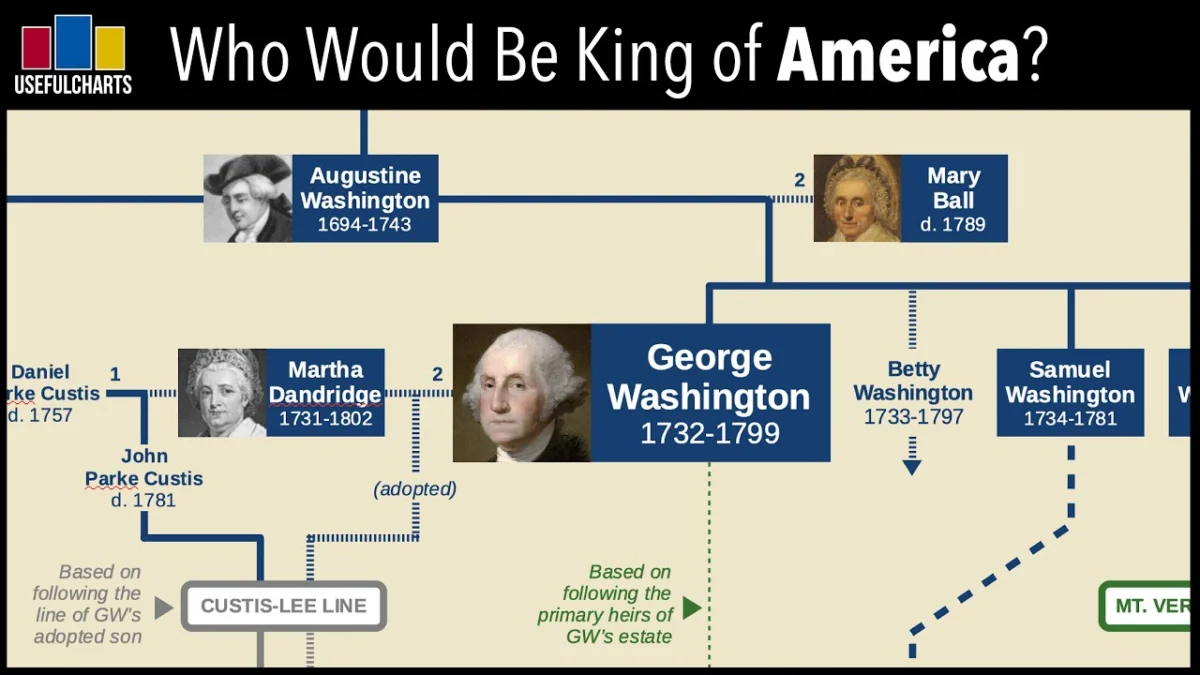
May 25th, 2026 – The annals of American history are rich with tales of revolutionary fervor, democratic ideals, and the steadfast refusal of its foundational figures to embrace absolute power. Yet, beneath the surface of this well-trodden narrative lies a compelling "what if" – a tantalizing thought experiment: what if George Washington, instead of laying down his arms and relinquishing power, had accepted the mantle of monarchy and become the King of the United States? This counterfactual scenario, explored in a recent video by UsefulCharts, not only probes the potential lineage of an American royal family but also delves into the intricate complexities of succession, ultimately highlighting a surprisingly plausible candidate for a modern-day American monarch.
While George Washington famously eschewed the idea of a permanent presidency, setting a precedent for a two-term limit that would later be enshrined in law, his personal life presents a fascinating paradox for any monarchical succession. Unlike hereditary rulers who typically pass their crowns to direct descendants, Washington had no biological children. This absence of a clear heir immediately complicates any attempt to chart a continuous royal line. However, the UsefulCharts video, created by Matt Baker, meticulously navigates these historical and genealogical complexities, offering a series of plausible, albeit hypothetical, succession scenarios.
The exploration of this alternate reality is not merely an academic exercise in speculative history. It forces us to confront the very foundations of American governance and the enduring power of precedent. By considering how an American monarchy might have evolved, we gain a deeper appreciation for the choices made by the nation’s founders and the fragility of the democratic experiment.
The Unsettled Question of the Crown: Succession Scenarios
The absence of direct heirs for George Washington throws open the gates to several potential pathways for a hypothetical American monarchy. Baker’s video meticulously outlines these divergent routes, each with its own set of historical figures and genealogical considerations.
H3: The Adopted Son and the Wife’s First Marriage:
One of the most immediate avenues for succession stems from Martha Washington’s first marriage. Her son from that union, John Parke Custis, while not Washington’s biological child, was adopted by him and played a significant role in his life. In this scenario, the royal line would trace its legitimacy through Custis and his descendants. This path acknowledges the familial bonds that Washington fostered, even outside of direct bloodlines, and suggests a continuity of leadership rooted in his immediate household.
H3: The Chosen Heir and the Estate:
Another compelling possibility arises from Washington’s selection of his nephew as the primary heir to his estate. This option emphasizes Washington’s intentionality in designating a successor, a trait crucial for any monarch. The nephew, by being named as the inheritor of Washington’s considerable wealth and influence, could also be envisioned as the inheritor of his political legacy, including the hypothetical crown. This scenario highlights the importance of Washington’s personal choices and his ability to shape the future of his lineage, both financially and politically.
H3: The Patriarchal Line and the Fabled Cherry Tree:
A third, more symbolic, path traces the lineage back to Washington’s father and his ownership of the famed cherry tree. While this connection is more distant, it taps into the mythos surrounding the Washington family and their early presence in the colonies. This scenario suggests a form of inherited right based on seniority and the historical standing of the family name, even if the direct connection to George Washington himself is less pronounced.
Navigating the Tangled Web of American Monarchy
The challenge of establishing a clear succession for an American monarchy is akin to deciphering the intricate rules of Roman imperial succession, an equally complex hypothetical explored by UsefulCharts in a previous video. The lack of a codified system, the potential for internal disputes, and the sheer passage of time all contribute to a convoluted genealogical landscape.
H3: The Contenders for the Throne in 2026:
Baker’s analysis narrows down the possibilities to a select group of individuals who, under various hypothetical succession rules, could lay claim to the American throne in 2026. These contenders represent a fascinating blend of historical figures and their descendants, each with a unique claim:
-
King Robert III or Robert E. Lee V: This lineage suggests a succession that might have taken a more military or Southern-leaning path. The inclusion of Robert E. Lee V, the great-great-grandson of the Confederate general, introduces a controversial but historically significant figure into the hypothetical royal family tree. This scenario raises questions about how the nation might have reconciled its historical divisions under a monarchical system.
-
Queen Brynda or Brynda Hansen: This candidate introduces a more contemporary and potentially less historically burdened name into the mix. The inclusion of a female claimant suggests that gender might not have been an insurmountable barrier to succession in this alternate timeline, or that the lines of inheritance could have evolved to include women in prominent roles.
-
King Richard or Richard Washington: This name directly evokes the legacy of George Washington, suggesting a continued emphasis on the founding family’s direct lineage, even if the path to this Richard Washington is indirect. The repetition of the Washington name signifies a desire for continuity and a direct connection to the nation’s origins.
-
King Larry II or Lawrence Shaffner: This candidate emerges as the most compelling in Baker’s assessment. Lawrence Shaffner is presented as a descendant of George Washington’s nephew, Bushrod. The appeal of this lineage lies not only in its direct familial connection to Washington but also in the sheer "Americanness" of the name.
H3: The Case for King Larry:
Baker’s argument for Lawrence Shaffner as the most convincing candidate for the American throne is multifaceted. Beyond the genealogical links, the name "King Larry" possesses an undeniable populist resonance. It is a name that feels accessible, ordinary, and distinctly American, standing in stark contrast to the more formal or historically charged names of other contenders. In a hypothetical America that had embraced monarchy, a ruler whose name evoked a sense of commonality might have been a crucial factor in maintaining popular support and legitimacy. The sheer memorability and accessibility of "King Larry" make him a uniquely plausible figure in this thought-provoking alternate history.
Implications of an American Monarchy
The ramifications of George Washington embracing kingship would have rippled through every facet of American society and its trajectory on the world stage. The establishment of a hereditary monarchy would have fundamentally altered the nation’s political, social, and cultural fabric.
H3: Political Stability vs. Democratic Ideals:
While a monarchy could have potentially offered a degree of political stability and continuity, it would have come at the profound cost of the democratic principles that define the United States. The concept of a ruling elite, unburdened by the need for popular election, would have reshaped the relationship between the government and the governed. The checks and balances inherent in a republican system would have been replaced by the authority of a single sovereign, raising questions about accountability and the protection of individual liberties.
H3: Foreign Relations and Global Perception:
The international perception of the United States would have been dramatically different. A monarchical America might have been viewed with a mix of fascination and apprehension by other nations. Its alliances, its diplomatic strategies, and its role in global affairs would likely have been shaped by the interests and lineage of its ruling monarch, rather than by the collective will of its citizens. The very idea of American exceptionalism, often tied to its democratic experiment, would have been reframed in the context of a royal court.
H3: The Enduring Power of Legacy and Symbolism:
Ultimately, the exploration of this hypothetical monarchy underscores the enduring power of legacy and symbolism in shaping national identity. George Washington’s decision to step down from power was a profound act of statesmanship, setting a powerful precedent for the peaceful transfer of authority. Had he chosen a different path, the very symbols and narratives that define America might be entirely different. The "what if" of an American monarchy serves as a potent reminder of the critical junctures in history and the choices that forge a nation’s destiny. The image of "King Larry" ruling over a monarchical America, while whimsical, prompts a serious reflection on the foundations of our republic and the profound impact of its founding principles.


Leave a Comment