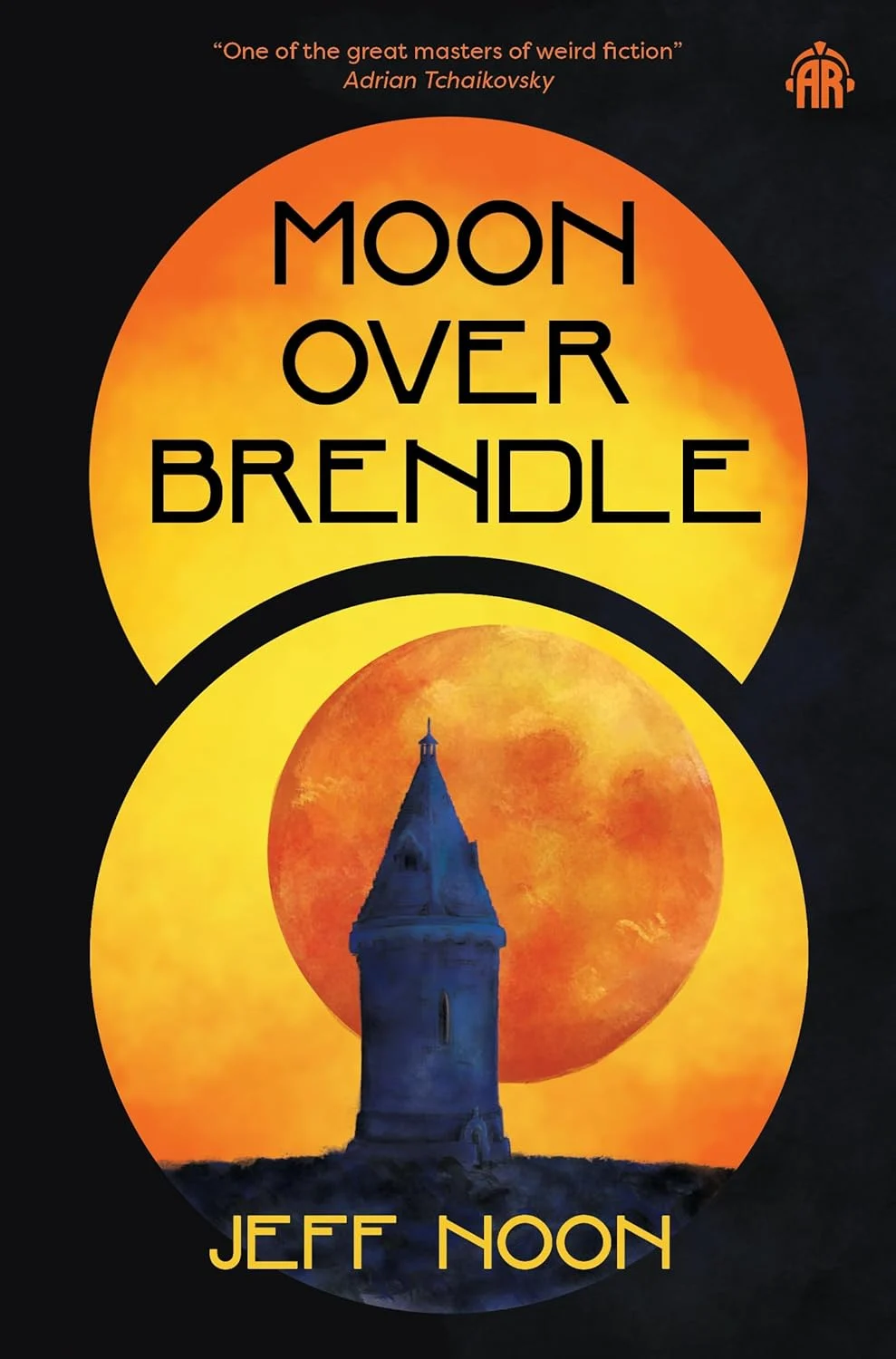
Jeff Noon’s "Moon Over Brendle": A Luminous Exploration of Imagination and the Unseen
Main Facts
Jeff Noon’s latest novel, Moon Over Brendle, emerges as a compelling work of speculative fiction, masterfully weaving a coming-of-age narrative with elements of magical realism and a profound meditation on creativity. Published to considerable anticipation, the book introduces readers to Joe Sutter, a young protagonist in 1968 England, whose perception of the world is uniquely shaped by a mysterious, ubiquitous substance known as "Greot." This enigmatic dust, visible only to a select few, serves as the central speculative element, imbuing the mundane realities of childhood with an extraordinary, almost mystical, dimension.
At its core, Moon Over Brendle is a story about the awakening of artistic consciousness. Joe Sutter, an unassuming secondary school student, finds his nascent creative impulses nurtured through an unexpected mentorship with the enigmatic G.K. Holbrook. Holbrook, a figure steeped in the traditions of classic science fiction, guides Joe not into a world of magic, but into the disciplined yet boundless realm of writing and imagination. The novel subtly explores themes of perception, the power of naming, and the blurred lines between reality and fiction, offering a "cozy reading experience" characterized by its contained setting, low-stakes drama, and an emphasis on profound character growth. While deeply personal in its scope, Moon Over Brendle also engages with broader literary traditions, drawing comparisons to works like Philip Pullman’s His Dark Materials for its exploration of an omnipresent, ineffable material. This blend of intimate introspection and speculative wonder positions Moon Over Brendle as a significant addition to contemporary literary fiction, inviting readers to reconsider the hidden magic within the everyday.
Chronology
The narrative of Moon Over Brendle unfolds primarily in the pivotal year of 1968, grounding its speculative elements within a recognizable historical context. The story opens with Joe Sutter, then an eleven-year-old secondary school student, navigating the familiar landscapes of childhood alongside his best friend, Denny. Their shared world is one of superhero comics and imaginative games, yet for Joe, it possesses an additional layer of wonder: the ability to perceive "Greot," a shimmering, multi-hued dust that permeates his surroundings. This initial revelation sets the stage for Joe’s unique journey, marking him as a "witness" to an unseen reality.
As Joe’s perception of Greot deepens, he develops a personal, almost affectionate, name for it: "Koag," a secret he shares only with Denny. This act of naming is significant, symbolizing Joe’s proprietary sense of wonder and his early engagement with the power of language. The narrative progresses through Joe’s encounters with other individuals who share a connection to Greot, notably his grandmother, who is introduced as a "beholder." This distinction highlights varying degrees of sensitivity to the substance, with beholders possessing the extraordinary capacity to "see through the eyes of Greot, and share the vision."
A pivotal turning point in Joe’s chronological development is his introduction to G.K. Holbrook. This elderly, scholarly figure assumes the classic role of a mentor, but with a distinct twist: Holbrook’s tutelage is not in arcane magic, but in the craft of writing and the cultivation of imagination. Through a series of unconventional exercises—from building an "anti-boredom machine" to "casting a magic spell"—Holbrook guides Joe from a passive observer of wonder to an active participant in its creation. This mentorship parallels Joe’s evolving relationship with Greot/Koag, which transitions from a childish fascination to a deeper understanding of its metaphorical links to creativity, before ultimately returning to the cherished, personal name of "Koag," signifying a full circle of understanding and ownership.
Beyond Joe’s personal development, the book subtly integrates historical and cultural elements. The 1968 setting provides a backdrop of burgeoning counter-culture and shifting societal norms, which, while not overtly central to the plot, subtly informs the atmosphere of discovery and questioning. The presence of scientists like Robert Helme, who supposedly debated the nature of Greot with historical figures like Newton, embeds the substance within a pseudo-historical scientific lineage, lending it a sense of ancient significance within the novel’s worldbuilding. Moon Over Brendle thus chronicles not just a boy’s coming-of-age, but also his initiation into the profound, interconnected worlds of perception, storytelling, and the enduring power of the imagination, all framed within a specific, evocative period.
Supporting Data
The richness of Moon Over Brendle lies in its intricate details and the seamless integration of its speculative premise into a grounded reality. The central concept of "Greot" is undoubtedly the most compelling piece of supporting data, serving as both a narrative device and a profound thematic metaphor.
The Enigma of Greot (or Koag)
Greot is presented as an ineffable, powerful material that permeates the world, yet remains largely unseen. Its nature is both physical and ethereal, manifesting as a shimmering dust of variegated hues. The novel offers exquisite descriptions, such as:
"The dust had stirred into life. Koag was rising, rising from the body. It floated in clusters, and now I saw its varied colours more clearly, ruby red, acid yellow, deep salmon blush, mottled tan and burnt orange. So many strands. Each grouping was separate, but they all flew off in the same general direction, high into the sky and drifting away towards the mill towers to the east. All except for one particular strand—rose-pink tinged with silver—which crept along low to the ground, vanishing into a patch of brier bush tangling the yard’s fence."
This passage not only paints a vivid picture of Greot’s appearance but also hints at its dynamic and directional properties, suggesting a life or will of its own. Unlike the cosmically significant "Dust" in Philip Pullman’s His Dark Materials, which carries profound theological and philosophical weight as an "analogy of consciousness" and a link to "original sin," Greot operates on a more intimate, personal scale. For Joe, it is "Koag," a word born of childhood wonder, signifying imagination and creativity. The evolution of Joe’s relationship with Greot – from calling it Koag, to using its proper name, and then back to Koag – underscores his journey from naive wonder to intellectual understanding, and finally to a re-embraced, mature appreciation of its imaginative power.
The world of Moon Over Brendle categorizes individuals based on their interaction with Greot: "witnesses" like Joe can see it, while "beholders" (such as his grandmother) possess a deeper connection, capable of "seeing through the eyes of Greot, and share the vision." This subtle hierarchy of perception enriches the worldbuilding without resorting to overt fantastical displays, making Greot a natural, albeit extraordinary, part of the fabric of existence. The historical mention of a scientist, Robert Helme, supposedly having an "altercation with Newton about the nature of the dust," further grounds Greot within a pseudo-scientific lore, lending it a sense of established, albeit contested, reality within the narrative.
The Guiding Hand of G.K. Holbrook
The character of G.K. Holbrook embodies a well-trodden archetype in fantasy literature: the elderly mentor. However, Noon brilliantly subverts this trope by positioning Holbrook not as a wizard of magic, but as a sage of storytelling. His influence on Joe is profoundly shaped by his literary tastes, as evidenced by his meticulously curated bookshelf:
"My eyes darted here and there. Ray Bradbury, Arthur C. Clarke, Ursula K. Le Guin, Isaac Asimov, John Wyndham, and so many others. There were a lot of books by someone called Robert A. Heinlein: Have Space Suit, Will Travel; The Puppet Masters; Starship Troopers; Stranger in a Strange Land. Next to Heinlein was Frank Herbert, with fewer books on offer: Destination Void; Dune; The Green Brain. And next to Herbert on the shelf … G.K Holbrook."
This literary roll call is not merely decorative; it serves as a powerful indicator of the intellectual and imaginative landscape Holbrook inhabits and seeks to impart to Joe. These authors—giants of science fiction and fantasy—represent boundless creativity, world-building, and profound philosophical inquiry. Holbrook’s presence "next to Herbert on the shelf" metaphorically places him within this pantheon, a creator of worlds in his own right, mentoring the next generation.
Holbrook’s mentorship takes the form of peculiar, yet insightful, exercises designed to unlock Joe’s creative potential. Tasks like building an "anti-boredom machine," writing a "short story," or "casting a magic spell" are not literal magical incantations but metaphorical prompts for imaginative thought and narrative construction. They teach Joe to observe, to invent, and to translate the unseen into tangible form, thereby directly linking the act of writing to the perception of "Koag." Holbrook explicitly articulates this connection, stating, "Imagine Koag as the ink that writes the stories on the pages of the land," thus firmly establishing Greot as the very essence of creativity and imagination.
Brendleshire: A Landscape of the Mind
Another significant piece of supporting data is the mysterious county of "Brendleshire," a place that "cannot be visited, only written about." Holbrook’s descriptions of Brendle are highly evocative and distinctly metaphorical: it is a place where "all the ages coexist, sharing their stories back and forth," and where "the history of the country folds upon itself." Brendleshire serves as a potent symbol for the imaginative space, the realm of fiction itself. It’s a land shaped by narrative, where time is fluid, and stories are the foundational elements. This concept reinforces the novel’s meta-narrative, blurring the lines between the story being told and the act of telling it, and solidifying the link between Greot, creativity, and the construction of fictional worlds.
The Coming-of-Age Arc and Autobiographical Undertones
Beyond its speculative elements, Moon Over Brendle excels as a coming-of-age story. The limited cast of characters—Joe, his friends Denny and Eileen, Holbrook and his assistant Margery, and Joe’s family—allows for a focused exploration of Joe’s internal world and his evolving relationships. The "cozy reading experience" is derived from this intimate scale, the low-stakes drama, and the genuine emphasis on character development. While the reviewer noted a desire for Denny to play a larger role in Joe’s creative journey, given his initial portrayal as the more imaginative friend, this perhaps highlights the novel’s subtle suggestion that the ability to "see Greot" is inherently tied to a particular type of creative perception, making Joe’s path unique.
The book’s presentation as a memoir or "faux-autobiography" adds another layer of intrigue. The striking parallels between Joe Sutter and author Jeff Noon—both being eleven in 1968, hailing from the same region of England, and ultimately becoming science fiction writers—invite readers to ponder the extent of its autobiographical truth. While the fantastical element of seeing Greot likely remains fictional, the emotional authenticity of the creative journey, the influence of a mentor, and the vivid recollections of childhood are undoubtedly rooted in genuine experience, lending the narrative a profound sense of sincerity and resonance. This interplay between reality and invention further enriches the novel, mirroring its own themes of how imagination shapes and informs our perception of the world.
Official Responses
While Moon Over Brendle is presented as a singular review in the provided text, the internal cues within the article allow for an exploration of its implied reception and the author’s broader standing. The designation of the book as "a memoir, and even a faux-autobiography" suggests a critical understanding of its deliberate blurring of fact and fiction, a sophisticated narrative choice that has likely resonated with literary critics and readers alike. This framing implies a recognition of Noon’s artistic intent, rather than a simple categorization.
Furthermore, the comparison to Philip Pullman’s His Dark Materials is a significant critical touchstone. Pullman’s trilogy is a benchmark for complex, philosophical fantasy, and drawing parallels between "Greot" and "Dust" immediately elevates Moon Over Brendle into a similar intellectual sphere. It signals that Noon is engaging with profound concepts – the nature of consciousness, reality, and human perception – albeit on a more contained and personal scale. This comparison is not merely stylistic but thematic, positioning Noon’s work within a tradition of speculative fiction that uses fantastical elements to explore deep existential questions.
The reviewer’s expressed intrigue about Jeff Noon’s previous work, specifically his acclaimed novel Vurt (1993), serves as an indirect form of "official response." Vurt was a groundbreaking work, winning the Arthur C. Clarke Award and establishing Noon as a distinctive voice in British speculative fiction. Mentioning Vurt‘s acclaim implicitly suggests that Moon Over Brendle is part of a distinguished literary lineage, reinforcing Noon’s reputation as an innovative and thought-provoking author. The desire to "revisit Moon Over Brendle after I read some of his other work, and see if it gives me, too, new powers of perception" is a powerful testament to the book’s immersive quality and its capacity to linger in the reader’s mind, inspiring further exploration of the author’s creative universe. This indicates a strong, positive reception, capable of sparking new interest in his wider bibliography.
Implications
The publication of Moon Over Brendle carries several significant implications, both for Jeff Noon’s literary trajectory and for the broader landscape of speculative fiction.
Thematic Resonance and the Power of Imagination
At a thematic level, Moon Over Brendle profoundly implicates the power of imagination and storytelling as fundamental forces in shaping individual reality. By presenting "Greot" as a tangible yet invisible substance directly linked to creativity and the act of writing, Noon suggests that the world we perceive is not merely objective, but actively constructed and enriched by our imaginative faculties. The novel posits that the ability to "see" beyond the mundane, to name the unnamable (Koag), and to craft narratives (Brendleshire), is not merely an escape from reality but a deeper engagement with it. This has implications for how readers might view their own creative potential, encouraging a more active and imaginative approach to daily life. The blurring of reality, metaphor, and fantasy throughout the book implies that these distinctions are often artificial, and that the most profound truths might reside in the liminal spaces between them.
Literary Impact and Jeff Noon’s Oeuvre
For Jeff Noon, Moon Over Brendle solidifies his unique position within contemporary literature. Known for his distinctive blend of surrealism, urban grit, and philosophical inquiry, this novel demonstrates his versatility and ability to craft a more intimate, reflective narrative while retaining his signature speculative edge. The "faux-autobiography" aspect invites a deeper, more personal connection with the author’s creative journey, potentially drawing new readers who might typically shy away from more overtly fantastical or experimental works. The book’s success in blending genre elements with literary depth reinforces the ongoing trend of speculative fiction gaining wider critical recognition. It encourages a re-evaluation of how "genre" boundaries limit our understanding of complex narratives that explore the human condition through extraordinary lenses. Moon Over Brendle serves as a bridge, connecting Noon’s earlier, more overtly avant-garde works like Vurt to a broader readership, while offering a reflective counterpoint to his established style.
Expanding Perception and Future Readings
Perhaps the most compelling implication lies in the reviewer’s concluding thought: the hope that revisiting the book after exploring Noon’s other works might bestow "new powers of perception." This suggests that Moon Over Brendle is not merely a standalone story but an entry point into a larger, interconnected literary universe. It implies that Noon’s body of work functions as a cumulative experience, where each text enriches the understanding of the others, much like Joe Sutter’s evolving perception of Greot. This encourages a recursive reading practice, where deeper insights are gained through repeated engagement and contextualization within the author’s broader vision. Ultimately, Moon Over Brendle is more than just a novel; it is an invitation—an invitation to wonder, to create, and to perceive the hidden magic that lies just beneath the surface of the ordinary, much like the shimmering, ephemeral Greot itself.