Mastering the Multiverse: Essential D&D Accessories for an Impeccably Organized Campaign
The realm of Dungeons & Dragons is one of boundless imagination, where heroes clash with monsters, spells reshape reality, and epic sagas unfold around a communal table. Yet, beneath the grand narratives and heroic deeds, the practicalities of tabletop gameplay can often descend into a tangle of forgotten rules, misplaced tokens, and a general disarray that can detract from the immersive experience. While players’ antics and the adventures themselves are inherently dynamic and often chaotic, the gaming table need not reflect this same disorganization. In an increasingly fast-paced world where leisure time is precious, streamlining the D&D session has become paramount for many groups, ensuring that every moment is spent on storytelling and strategic play, rather than searching for a die or clarifying a rule.
This era demands efficiency, and the D&D table is no exception. While the unfolding narrative might indeed be a "hot mess" of unexpected twists and turns, there is no inherent reason for the physical space of play to follow suit. A well-organized table not only enhances the aesthetic appeal of the game but fundamentally improves the flow of play, minimizes interruptions, and ensures that all participants remain engaged and informed. The following array of carefully selected accessories stands as a testament to the community’s ingenuity, designed to transform potential sources of friction into seamless components of an unforgettable gaming experience, ensuring no player ever has cause to utter the dreaded phrase, "Where am I again?"
The Foundation of Strategy: Battle Grids and Tactical Visualization
At the heart of many D&D encounters lies the intricate dance of combat, a complex interplay of movement, positioning, and environmental factors. While the "theater of the mind" offers unparalleled narrative freedom, moments of high-stakes combat often benefit immensely from a clear, visual representation of the battlefield.
Hex Battle Grids: Beyond the "Theater of the Mind"
Dungeons & Dragons, at its philosophical core, is often lauded as a "theater of the mind" game, encouraging players to visualize worlds and encounters solely through spoken descriptions and shared imagination. This approach fosters creativity and immersion, painting vivid mental landscapes without the need for physical props. However, the realities of tactical combat, especially in editions like 5th Edition D&D, frequently demand a level of precision that mental imagery alone struggles to provide. Herein lies the indispensable value of the battle grid.
For classes like the nimble Monk, whose entire combat philosophy revolves around rapid movement, positioning, and striking multiple targets, or the Rogue, whose cunning action dictates precise flanking maneuvers, a battle grid becomes an essential tactical canvas. It allows players to accurately gauge distances, visualize lines of sight, and plan intricate movements with confidence, eliminating ambiguity and fostering more strategic decision-making. The grid democratizes information, ensuring that every player has an equal understanding of the battlefield, rather than relying solely on the Dungeon Master’s (DM) interpretation or a player’s potentially flawed mental map. This transparency is crucial for fairness and prevents common misunderstandings that can derail an otherwise thrilling combat sequence.

The featured battle grid offers versatility, available in both traditional square and strategically nuanced hex configurations. While square grids are intuitive for orthogonal movement, hex grids excel at representing equidistant movement in all directions, often preferred by those who find diagonal movement rules in square grids cumbersome. Its foldable design speaks to practicality, making it easy to transport and store, a significant advantage for groups that meet at various locations. Crucially, its compatibility with dry-erase markers transforms it into a dynamic tool. DMs and players can swiftly mark character positions, draw in temporary terrain features like chasms or difficult ground, denote areas of effect for spells, or even jot down quick notes during an encounter. Once the battle concludes, a simple wipe cleans the slate, preparing it for the next epic confrontation without leaving a trace of the previous chaos. This reusability not only offers long-term value but also reduces the environmental impact of single-use paper maps. The transition from abstract thought to concrete visualization facilitated by a battle grid ensures that tactical combat remains engaging, precise, and enjoyable for all.
Navigating Arcane Energies: Spell Management Tools
Magic is a cornerstone of D&D, capable of both immense power and frustrating complexity. Managing spell effects and tracking resources can be a significant cognitive load for both players and DMs.
The Spell Effect Spacer: Precision in Arcane Warfare
The arcane arts in Dungeons & Dragons are a force of nature, capable of shaping battles, influencing outcomes, and providing dramatic flair. However, the exact parameters of these magical effects—how far a spell reaches, the precise area a burst covers, or the dimensions of a cone of chilling frost—are often sources of confusion and protracted discussion. "How far does that spell reach?" "What does a ten-foot radius actually look like on the table?" "Is a thirty-foot cone significantly larger than a fifteen-foot one, and how many enemies can it actually engulf?" These are not trivial questions; they are fundamental to fair play, strategic positioning, and the overall pacing of combat. Misinterpreting a spell’s area of effect can lead to inadvertently harming allies, missing crucial targets, or underestimating an enemy’s capabilities.
The Spell Effect Spacer emerges as an elegant solution to these perennial challenges. This ingenious, all-in-one transparent tool eliminates the guesswork, providing immediate, visual clarity for all standard spell shapes and sizes. Cubes, spheres, cones, and lines are precisely etched onto the template, allowing players and DMs to instantly visualize the impact zone of any spell. Its design is meticulously crafted to align with standard battle grid sizing, ensuring seamless integration with any battle map, whether square or hex. The see-through material means it can be placed directly over miniatures and terrain, allowing for an unobstructed view of the battlefield while simultaneously marking the spell’s reach.
This tool profoundly impacts gameplay by accelerating combat rounds. Instead of pausing to measure with rulers, count squares, or engage in lengthy debates about interpretation, a player can simply place the spacer, instantly revealing the scope of their magic. This not only maintains the flow of the game but also ensures equitable application of rules for both player characters and their adversaries. For a DM, it removes a significant burden of adjudicating tricky spatial questions on the fly, allowing them to focus on narrative and monster tactics. For players, it empowers them to make more informed tactical decisions, understanding the full extent of their magical prowess and potential collateral damage. The Spell Effect Spacer transforms the abstract language of spell descriptions into concrete, undeniable visual information, enhancing fairness, reducing friction, and keeping the focus firmly on the unfolding drama of the encounter.

The Spell Slot Tracker: Sustaining Arcane Power
For the myriad spellcasting classes in Dungeons & Dragons—from the studious Wizard and devout Cleric to the charismatic Sorcerer and nature-attuned Druid—the management of spell slots is arguably the most critical aspect of their character’s power. Each spell cast consumes a valuable resource, and accurately tracking these expenditures is paramount to a character’s effectiveness and survival throughout an adventuring day. Traditionally, this often involves the tedious process of marking off slots on a character sheet with a pencil, then erasing and re-marking as spells are recovered or new ones are prepared. This not only leads to character sheets becoming worn, smudged, and eventually illegible but also introduces a significant cognitive load, pulling players out of the immersive narrative to engage in administrative tasks.
The Spell Slot Tracker offers a simple yet profoundly effective solution to this common problem. Eschewing the impermanence of pencil and paper, this tracker utilizes a physical, tactile method: standard six-sided dice (D6s). Each die represents a spell level, and its displayed face corresponds to the number of remaining spell slots for that level. When a spell is cast, the player simply "cranks down" the corresponding D6 to reflect the new remaining total. This system boasts several distinct advantages. Firstly, it eliminates the need for constant erasing and rewriting, preserving the pristine condition of character sheets and reducing environmental waste from excessive paper usage. Secondly, it provides a clear, immediate, and visual representation of a character’s magical reserves, accessible at a glance by both the player and the DM. This transparency can be particularly helpful for DMs who need to quickly assess a party’s remaining resources.
The beauty of this system lies in its inherent simplicity and the ubiquitous nature of its components. Where will you get all those D6s? Any seasoned D&D player will readily admit to possessing a "big bag of loose dice somewhere," a collection of forgotten D6s accumulated over countless games. This tracker gives those forgotten polyhedrons a new, vital purpose, transforming them from clutter into functional game-management tools. By offloading the administrative burden of spell slot tracking from the character sheet to a dedicated, durable accessory, players can remain more deeply immersed in their characters and the unfolding narrative. It reduces mental fatigue, speeds up gameplay by minimizing interruptions for resource checks, and ensures that spellcasters can focus their minds on strategic spell selection rather than meticulous record-keeping. The Spell Slot Tracker is a testament to how a small, elegant accessory can significantly enhance the quality of life for D&D players, allowing the magic to flow unhindered.
Orchestrating the Chaos: Initiative and Condition Management
Combat in D&D is a turn-based affair, and keeping track of who acts when, and what conditions are affecting whom, is critical for smooth, fair play.
The Sword Initiate Tracker: Mastering the Flow of Battle
The ebb and flow of combat in Dungeons & Dragons are dictated by the initiative order, a crucial sequence that determines who acts when in the chaotic dance of battle. Traditionally, the Dungeon Master (DM) often keeps this vital information squirreled away on a notepad, a whiteboard, or a digital tool, visible only to them. While functional, this DM-centric approach can lead to several common gameplay frustrations. Players might lose track of the turn order, asking "Whose turn is it?" or "When am I up again?" This often results in moments of inaction, where players scramble to remember their character’s abilities or plan their moves only when their turn officially arrives, slowing down the pace of combat significantly.

The Sword Initiate Tracker directly addresses these challenges by transforming the abstract concept of initiative into a tangible, visually prominent display. Crafted from acrylic and designed in the thematic shape of a sword, this innovative accessory allows the DM to clearly write the turn order for up to twelve characters or monsters. Its most significant feature is its elevated design; positioned centrally on the table, it ensures that the initiative order is visible to every single player, regardless of their seating arrangement. This transparency is a game-changer for combat efficiency and player engagement.
By making the initiative order public and easily viewable, the Sword Initiate Tracker empowers players to take greater ownership of their turns. They can see exactly when their turn is approaching, providing ample opportunity to "prepare your moves, people!" This encourages pre-planning of actions, spell choices, and tactical maneuvers, dramatically reducing the downtime between turns. No longer can a player feign surprise when their turn rolls around "again"; the information is literally right in front of them. From a journalistic perspective, this tool represents a practical application of "supporting data" in real-time gameplay. The "official response" from experienced DMs is often a resounding endorsement of tools that distribute information to players, reducing the DM’s cognitive load and fostering a more collaborative play environment. The implications are clear: faster combat rounds, more strategic and thoughtful player actions, and a higher level of sustained immersion as players remain constantly aware of their place within the unfolding battle sequence. The Sword Initiate Tracker is more than just a list; it’s a dynamic conductor for the symphony of combat, ensuring every player hits their cue with precision.
Condition Marker Rings: Clarity in Affliction
In the intricate tapestry of Dungeons & Dragons combat, characters are frequently subjected to a myriad of conditions – statuses like "stunned," "poisoned," "grappled," "prone," "frightened," or "blinded." These conditions profoundly impact a character’s capabilities, altering their AC, imposing disadvantage on rolls, or preventing actions altogether. However, in the heat of battle, amidst dice rolls and descriptive narration, it is remarkably easy for players (and sometimes even the DM) to inadvertently forget that a character is suffering from an ongoing condition. While some instances of forgetting might be genuine oversight, there are also moments where a player might "accidentally" overlook a negative status, leading to disputes or perceived unfairness.
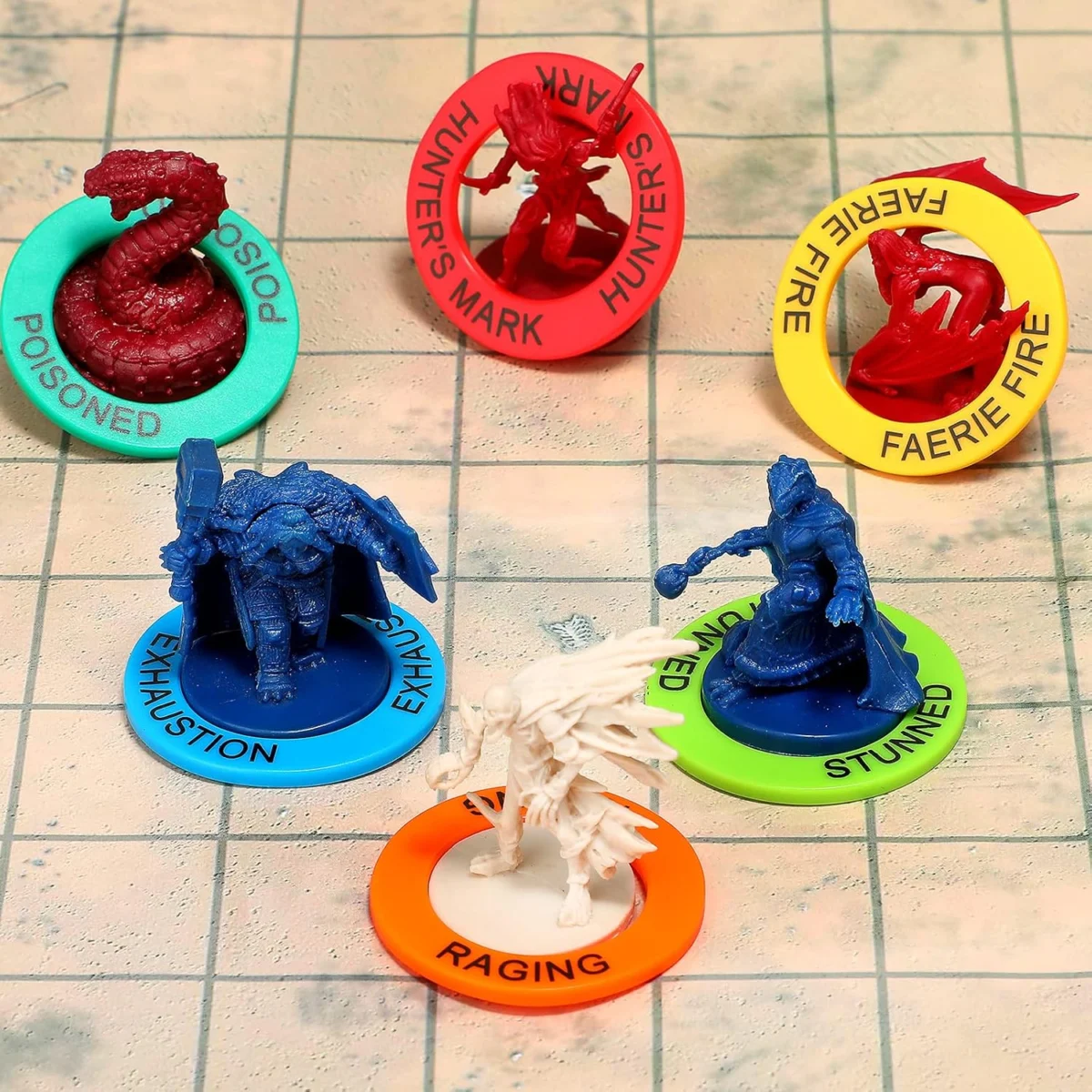
Condition Marker Rings provide an elegant, unmistakable solution to this pervasive problem. These simple, brightly colored rings are designed to fit snugly around the base of character miniatures, serving as an immediate visual cue for any active condition. Each ring typically corresponds to a specific condition, often color-coded or featuring an icon for quick identification. When a character becomes poisoned, a green ring goes around their mini; when stunned, a yellow one. This physical representation ensures that the condition is impossible to ignore.
The benefits of these rings are multifaceted. Firstly, they act as a constant, unambiguous reminder for everybody at the table. This drastically reduces instances of forgotten conditions, whether accidental or intentional, fostering a more honest and fair gameplay environment. Secondly, they streamline combat by eliminating the need for constant verbal reminders from the DM or other players, allowing the narrative flow to continue unimpeded. The visual nature of the rings ensures that information is conveyed instantly and universally. Thirdly, they provide clarity in complex encounters where multiple creatures might be affected by different conditions, allowing for quick assessment of the battlefield.

When a condition is lifted – perhaps a character saves against a poison, or a "stunned" effect ends – the ring is simply removed from the mini and returned to the DM’s toolkit, ready for the next application. This ease of use and reusability makes them an invaluable asset for any Dungeon Master seeking to maintain order and clarity in their games. From a "supporting data" perspective, countless anecdotes from D&D tables recount how forgotten conditions have led to prolonged arguments or skewed combat outcomes. Condition Marker Rings directly mitigate these issues, ensuring that the rules are applied consistently and that the tactical implications of every status effect are visually represented. Their implication for gameplay is profound: less friction, more accurate rule application, and a smoother, more enjoyable combat experience for all participants.
Elevating the Aesthetic: Display and Immersion
Beyond mere utility, the D&D table is a space for shared imagination and personal expression. Even seemingly minor accessories can contribute significantly to the overall atmosphere and player experience.
The Dice Display: Honoring the Fates
For many Dungeons & Dragons players, dice are far more than mere random number generators; they are cherished artifacts, vessels of fate, and sometimes, objects of superstitious reverence. Each set tells a story, imbued with memories of critical successes and abysmal failures. Yet, between rolls, these vital implements often find themselves relegated to a dice tray, a fabric bag, or worse, scattered haphazardly across the table, contributing to visual clutter. While functional, these conventional storage methods often lack the thematic flair and respect that many players feel their dice deserve.
The Dice Display, particularly a tower-style variant, offers a compelling alternative, transforming utilitarian storage into an aesthetic statement. Imagine a miniature tower, a stylized pedestal, or a tiered structure upon which individual dice can rest, poised and ready for their moment of glory. This is more than just a place to put your dice; it’s a stage, a display case that elevates them from simple game components to revered totems. The article provocatively asks, "Are your dice sitting on some kind of high council? Do they need to watch over the rest of the game between turns?" The answer, for many, is an emphatic yes. They are important; they embody the unpredictable nature of adventure, and they should be displayed as such.
The benefits of a dedicated dice display extend beyond mere aesthetics. Firstly, it contributes to overall table organization, providing a designated, elegant spot for dice when they are not actively in use, preventing them from rolling away or getting mixed up with other components. Secondly, it adds a significant layer of thematic immersion to the gaming space. A beautifully crafted dice tower or display can enhance the visual narrative, making the entire setup feel more like a sacred space for storytelling and fate-weaving. It transforms the mundane act of setting aside dice into a small ritual, reinforcing the importance of each roll.

Furthermore, a dice display allows players to showcase their favorite sets, turning them into conversation pieces and personal expressions. For players who invest in unique or custom dice, a display offers an opportunity to appreciate their beauty even when not in play. The implication of such an accessory is subtle but powerful: it elevates the entire gaming experience. By honoring these small, yet crucial, instruments of chance, a dice display contributes to an atmosphere of respect for the game itself, making the D&D table feel more deliberate, more magical, and more personal. It’s a small touch that speaks volumes about the reverence players hold for their adventures and the tools that help bring them to life.
The Broader Implications of Tabletop Organization
The pursuit of an impeccably organized D&D table extends far beyond mere tidiness; it profoundly impacts the quality, pacing, and enjoyment of the entire gaming experience. From a journalistic perspective, the "official response" from the vast D&D community, particularly experienced Dungeon Masters and veteran players, overwhelmingly champions the value of streamlined play. This consensus isn’t about rigid adherence to rules but about fostering an environment where the rules serve the story, not hinder it.
Enhanced Immersion: When players aren’t constantly asking for clarifications, searching for tokens, or waiting for initiative order, their minds remain anchored in the narrative. Less time spent on administrative tasks means more time immersed in the fantastical world, their characters’ dilemmas, and the unfolding drama. Each accessory discussed—from the precise Spell Effect Spacer to the visually clear Condition Marker Rings—directly contributes to this by reducing cognitive load and visual clutter. The "implications" here are clear: deeper engagement leads to more memorable sessions.
Reduced DM Burden: The Dungeon Master carries the heaviest load, juggling narrative, rules, NPCs, monsters, and player interactions. Tools like the Sword Initiate Tracker and Spell Effect Spacer offload significant portions of this burden. By making information transparent and accessible to all players, the DM is freed to focus on what they do best: storytelling, improvisation, and reacting to player choices. This not only makes the DM’s job more enjoyable but also allows them to deliver a richer, more responsive game world.
Improved Player Experience: For players, an organized table translates directly into a more enjoyable and less frustrating experience. Clarity on conditions, precise tactical information from battle grids, and easy spell slot tracking empower players to make better, more informed decisions. This increased agency and reduced friction prevent the common frustration of feeling lost or disadvantaged due to unclear information. The "chronology" of a game session becomes smoother, with fewer pauses and more continuous engagement.

Faster Gameplay: Time is a precious commodity, especially for adult gaming groups. Every moment spent fumbling with rules, re-explaining conditions, or counting squares is a moment not spent advancing the plot, engaging in witty banter, or resolving a tense encounter. These accessories are designed with efficiency in mind, directly contributing to a faster, more dynamic game session. This is particularly relevant in a "busy time of year" context, where maximizing enjoyment within limited time frames is crucial.
Longevity of Campaigns: Ultimately, a well-run, organized game is a more enjoyable game. Groups that consistently experience smooth, engaging sessions are far more likely to maintain their momentum, fostering long-lasting friendships and enduring campaigns. The collective investment in these organizational tools pays dividends in group cohesion and the sustained joy of collaborative storytelling.
In conclusion, the curated selection of D&D accessories—from the strategic utility of Hex Battle Grids and the precision of Spell Effect Spacers to the clarity of the Sword Initiate Tracker, the unambiguous reminders of Condition Marker Rings, the practical resource management of Spell Slot Trackers, and the aesthetic elevation of Dice Displays—are not mere gadgets. They are strategic investments in the shared narrative, ensuring that the epic chaos of adventure can unfold on a tabletop that is anything but. They empower players, ease the DM’s burden, and ultimately, elevate the entire Dungeons & Dragons experience from merely good to truly unforgettable.
The products in this list were carefully curated by a BoLS writer. We may earn a commission when you purchase through links on our site.