
Pope Leo XIV’s Groundbreaking Encyclical: A Nuanced Call for Human Dignity in the Age of AI
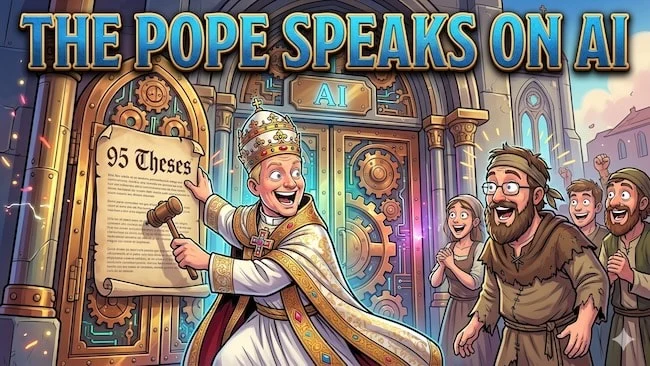
Vatican City, Rome – In a move that has sent ripples through both theological and technological circles, Pope Leo XIV has issued a monumental encyclical, "Magnifica Humanitas," a 42,000-word treatise offering a profoundly intelligent and nuanced critique of artificial intelligence. This comprehensive document, the Pope’s first since his election, applies Catholic social teaching to the burgeoning world of AI, advocating for disarmament, transparency, and robust human oversight to safeguard human dignity in an increasingly AI-driven society.
The encyclical’s release has sparked significant discussion, particularly within the author and creative communities, who are grappling with the implications of AI on their work. This article delves into the core tenets of "Magnifica Humanitas," examining its origins, its surprising depth of understanding, and its far-reaching implications for authors, publishers, and society at large.
The Pope’s Vision: "Magnifica Humanitas" and its Core Tenets
At its heart, "Magnifica Humanitas" is a call to action, urging humanity to approach the development and integration of artificial intelligence with caution, ethical consideration, and an unwavering commitment to human dignity. The document’s title, translating to "Magnificent Humanity," sets a clear tone, emphasizing the inherent value and sanctity of human life in a landscape increasingly populated by sophisticated algorithms and autonomous systems.
The encyclical’s structure and content reveal a Pope deeply engaged with the complexities of modern technology. While the public discourse often sensationalizes AI, Pope Leo XIV’s approach is characterized by a remarkable technical understanding and a measured, insightful perspective. He does not advocate for a Luddite rejection of AI, but rather for its careful stewardship, drawing parallels to historical technological advancements and their societal impacts.
Origins of the Encyclical: A Pope of Mathematics and Morality
The election of Pope Leo XIV, a former mathematician and an American, was seen by many as a sign that the Church was preparing to confront the profound ethical and social challenges posed by AI. This encyclical, therefore, can be viewed not just as a theological document, but as a strategic response to a transformative technological epoch.
"Magnifica Humanitas" delves into a wide array of economic and social issues that have been influenced or exacerbated by AI. The encyclical’s exploration of these themes, many of which are not directly about AI itself but are deeply intertwined with its impact, underscores the Pope’s holistic vision.
A Deep Dive into the Encyclical’s Content
What is an Encyclical? Before delving deeper, it’s crucial to understand the nature of an encyclical. It is a pastoral letter written by the Pope, addressed to the entire Catholic Church and often to all people of good will. Encyclicals are designed to address significant theological, moral, or social issues, serving as authoritative guidance and fostering global dialogue. "Magnifica Humanitas" marks a significant moment as the Pope’s first encyclical, setting a precedent for how the Church will engage with AI.
Why Should Authors Care? The encyclical’s relevance for authors is particularly pronounced. As Thomas, a commentator featured in the discussion surrounding the encyclical, notes, the Pope’s concerns mirror many of the anxieties felt by creators navigating the rapidly evolving AI landscape. The document provides a framework for ethical AI usage, offering guidance on what is permissible and what is not, particularly for Catholic authors and those within the publishing industry.
The Pope’s Technical Acumen and Nuance: Contrary to some preconceived notions, the encyclical demonstrates a sophisticated grasp of AI’s capabilities and limitations. The Pope treats AI as a valuable tool, eschewing alarmist rhetoric and focusing instead on the principles that should govern its application. This measured approach, which avoids a "Butlerian crusade against the machines," has been met with approval by those seeking a balanced perspective.
Did the Pope Use AI to Write It? This question has become a point of intrigue. While the Pope is the author of the encyclical, the writing process involves a team of advisors. Analysis of the text has suggested the potential use of AI in drafting certain sections, particularly the Italian version, which reportedly tested higher for AI-generated content. This raises a fascinating meta-commentary on the very subject matter: a papal document on AI potentially being aided by AI. However, the Vatican’s extensive translation resources likely ensure that human oversight remains paramount in refining and disseminating the document.
The Catholic Church and Science: A Historical Partnership
The encyclical firmly refutes the notion that the Catholic Church is anti-science. As Thomas highlights, the Church has historically been a foundational force in the development of science, moving beyond secretive alchemy towards a paradigm of revelation and shared knowledge. The document implicitly challenges the idea that contemporary science education is always purely objective, suggesting it can sometimes be shaped by ideological underpinnings.
The Pope’s historical perspective on figures like Galileo underscores the Church’s long-standing engagement with scientific inquiry. The narrative often presented – that the Church suppressed Galileo due to dogma – is, according to this interpretation, a misrepresentation of a more complex historical interaction. The Church’s commitment to science is presented as enduring, with its embrace of scientific advancement even sometimes seen as "too pro-science" by more conservative religious observers.
Identifying the "Villains": Technocrats, Transhumanists, and Post-Humanists
Crucially, "Magnifica Humanitas" identifies the true threats not as technology itself, but as certain ideologies that underpin its development and application. The encyclical targets:

- Technocrats: Individuals who view human beings as mere components in a system, prioritizing efficiency and optimization over human value and dignity. Their focus is on economic output, treating people as data points rather than individuals with inherent worth.
- Transhumanists: Those who believe humanity can and should be augmented with technology to transcend its natural limitations. This can manifest in physical augmentation or in the aspiration to upload consciousness into digital realms.
- Post-Humanists: A related concept, often embodied by figures like GLaDOS from "Portal 2," where a consciousness, once human, exists in a machine. This ideology, often rooted in a Gnostic worldview, posits a duality between a flawed physical body and a superior "true self" that can be liberated through technological ascension.
The encyclical strongly rejects these perspectives, particularly the Gnostic idea of escaping the physical body. Christianity, and by extension the Pope’s message, emphasizes spiritual transcendence through Christ, not through technological means. The concept of "dignity," a word repeatedly used in the encyclical, is presented as innate and rooted in God’s love, not merely in being made in God’s image, a subtle yet significant theological distinction.
The Imperative of Disarmament: AI and the Ethics of Warfare
A significant portion of the encyclical addresses the alarming implications of AI in warfare. The Pope expresses deep concern over autonomous weapons systems that can kill without direct human intervention. Examples from the conflict in Ukraine, where drones are increasingly used for lethal strikes, illustrate the slippery slope towards automated warfare.
The core of this concern lies in the removal of human moral judgment and responsibility. When machines make life-or-death decisions, the appearance of accountability is eroded, potentially leading to a desensitization to violence. The Pope argues that humans remain accountable to a higher power for their actions, and delegating killing to machines does not absolve them of this responsibility.
War Without Mercy: A Numbers Game? The discussion around AI in warfare leads to a profound question: does the detachment of human emotion from combat transform it into a mere statistical exercise? The analogy of Stalin’s quote – that killing 100 people is a massacre, while killing a million is a statistic – resonates deeply. When warfare becomes a calculation of attrition, strategic brilliance and the value of individual lives can be lost.
The example of a drone accepting a surrender versus a programmed directive to destroy a bunker highlights the Pope’s emphasis on preserving human discretion and the capacity for mercy in conflict. This call for "disarming AI" in the context of warfare is a plea to retain human moral agency at every critical juncture.
Countering Technocratic Control: The Specter of Chinese-Style Surveillance
The encyclical also takes a strong stance against pervasive AI-powered surveillance systems, particularly those reminiscent of the Chinese Communist Party’s model. This "technocratic leadership" reduces individuals to "cogs" within a system, their worth determined by an AI-generated score based on their behavior. The Church’s opposition to this dehumanizing approach is unequivocal.
A Glimmer of Hope: Uprooting Evil for Future Generations
Amidst the warnings and critiques, Pope Leo XIV offers a message of hope and agency, drawing inspiration from J.R.R. Tolkien. A quote from Gandalf, "It’s not our part to master all the tides of the world, but to do what is in us for the succor of those years wherein we are set, uprooting the evil in the fields that we sow so that those who live after us may have clean earth to till," encapsulates the Pope’s call to action.
This quote serves as a powerful antidote to fatalistic attitudes towards AI. It emphasizes that while we may not control all global forces, we have a responsibility to act within our sphere of influence, to combat the "evil" that emerges, and to cultivate a better future for subsequent generations. This rejects a Gnostic or conspiratorial worldview, advocating instead for practical, grounded action.
Practical Guidance for Catholic Authors and Creators
The encyclical culminates in a series of practical Q&A sessions, offering specific guidance for Catholic authors and creators on how to ethically engage with AI. These guidelines underscore the principle that AI should be a tool to augment human capabilities, not replace human judgment, conscience, or creative vision.
Key Permitted Uses:
- Editing Assistance: AI can be used for grammar, style suggestions, and basic edits, provided the author retains final control and moral judgment.
- Drafting and Idea Generation: AI can assist in initial drafts and brainstorming, but the author must maintain creative ownership and spiritual oversight.
- Research: AI can function as a research assistant, but personal discernment and spiritual reflection remain paramount.
- Plotting and Story Development: AI can offer suggestions, but the author must provide the unifying vision and moral framework.
- Book Blurbs and Marketing Copy: AI can aid in drafting, with the author ensuring truthfulness and dignity in the final output.
- Study Guides and Companion Materials: AI can generate supporting content, but it must foster genuine human and spiritual engagement.
- Developmental and Copy Editing: AI can enhance efficiency, but human editors must retain final responsibility.
- Initial Book Cover Concepts: AI can provide visual ideas, but the final design decision rests with human creators.
- Translation Assistance: AI can aid in translation, but human review is crucial for doctrinal accuracy, cultural sensitivity, and maintaining a human voice.
- Social Media and Branding Content: AI can assist in content creation, but the author must ensure authenticity and avoid deception.
Key Prohibited Uses:
- Autonomous Decision-Making in Publishing: Catholic agents and publishers cannot delegate accept or reject decisions for manuscripts to AI without significant human review. The encyclical warns against systems that cannot show compassion, mercy, or forgiveness, and that surrender the power to define human possibility to algorithms.
- Exclusionary Systems: AI systems designed or used to devalue or exclude certain lives without recourse are deemed unacceptable. The principle of clear accountability at every stage is emphasized.
These guidelines highlight a crucial distinction: AI as a tool to assist human intellect and creativity, versus AI as an autonomous decision-maker that erodes human responsibility and moral agency.
Conclusion: A Blueprint for a Human-Centric Digital Future
Pope Leo XIV’s "Magnifica Humanitas" is more than just a papal document; it is a profound and timely intervention in the global conversation about artificial intelligence. By grounding its critique in centuries of Catholic social teaching and demonstrating a remarkable understanding of contemporary technology, the encyclical offers a blueprint for navigating the AI revolution with wisdom, ethical clarity, and an unwavering commitment to the inherent dignity of every human being. Its impact will undoubtedly be felt across diverse sectors, from academia and industry to the creative arts, urging us all to consider not just what AI can do, but what it should do, and how we can ensure it serves humanity, rather than the other way around.



Leave a Comment