
The Sky is the Limit: How 2,800 Drones Transformed the Dubai Skyline into the World’s Largest Tetris Game
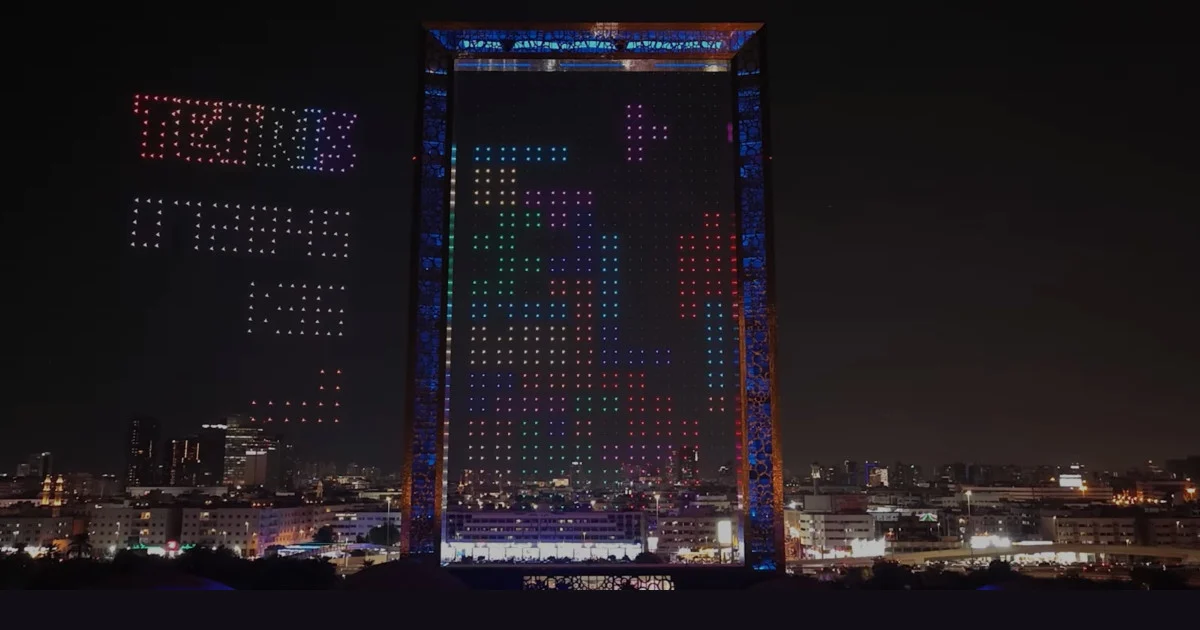
In the late months of 2025, the architectural marvel known as the Dubai Frame—a 150-meter-tall golden rectangle piercing the skyline of Zabeel Park—served as the literal border for a feat of engineering and entertainment that defied the traditional boundaries of gaming. In a historic collaboration between Red Bull and The Tetris Company, the world’s most recognizable puzzle game ascended from the confines of handheld screens and monitors into the open atmosphere. Utilizing a synchronized swarm of 2,800 high-luminosity drones, the Red Bull Tetris World Championship Final became the largest, most technologically advanced iteration of the game ever played, marking a pivotal moment in the evolution of both e-sports and aerial display technology.
Main Facts: A Digital Icon Reimagined in Airspace
The event was not merely a light show or a pre-recorded animation; it was a fully functional, live-playable game of Tetris. For the first time in history, the "well"—the rectangular space where Tetris blocks (Tetriminos) fall—was composed of open air, framed by the massive structure of the Dubai Frame. The dimensions were staggering: the playable area reached a height of 492 feet and a width of 311 feet, effectively turning the park into a coliseum for the digital age.
At the heart of the spectacle were 2,800 custom-engineered drones. These units acted as individual "pixels" or voxels, grouping together to form the iconic geometric shapes that have challenged players since 1984. As the contestants manipulated their controllers on the ground, the drones responded in real-time, shifting positions to rotate and drop the blocks with a precision that mimicked the responsiveness of a traditional computer monitor.
The tournament was the culmination of a massive global search for the world’s best players. Over 7 million qualifier games were played by enthusiasts from more than 60 countries, highlighting the enduring, universal appeal of the franchise. Ultimately, the grand final saw Fehmi Atalar of Turkey face off against Leo Solórzano of Peru in a high-stakes battle that lit up the desert night. Atalar emerged victorious, etching his name into the history books as the first champion of this "sky-high" format.
Chronology: From Soviet Computers to the Clouds of Dubai
To understand the magnitude of the 2025 Dubai event, one must look back at the humble origins of the game. Tetris was created in 1984 by Alexey Pajitnov, a software engineer at the Academy of Sciences of the USSR. Initially a monochrome, text-mode game played on an Electronika 60, it relied on simple brackets to represent blocks. Its journey from a niche Soviet experiment to a global phenomenon was accelerated by its 1989 release on the Nintendo Game Boy, which cemented its status as a cornerstone of pop culture.
Throughout the 1990s and 2000s, Tetris evolved through various iterations—adding color, 3D graphics, and complex multiplayer modes. However, the game remained "screen-bound," confined to the hardware it was played on. The concept for the Red Bull Tetris World Final began years prior to the 2025 event, as drone technology began to catch up with the vision of creating massive, interactive public art.
The road to the Dubai final was a year-long journey. Throughout 2024 and early 2025, regional qualifiers took place across six continents. Millions of players competed in digital arenas, whittling the field down to a handful of elite "Tetris Grandmasters." By late 2025, the stage was set in Dubai, a city known for its penchant for breaking world records and hosting futuristic spectacles. The choice of the Dubai Frame was symbolic; the structure, designed to bridge the "old" and "new" Dubai, served as the perfect metaphor for a 40-year-old game being played with cutting-edge 21st-century technology.
Supporting Data: The Engineering Behind the Swarm
The technical execution of the Red Bull Tetris World Final required a level of precision rarely seen in public entertainment. Coordinating 2,800 drones to act as a single, responsive interface presented three primary challenges: latency, environmental factors, and spatial coordination.
1. Latency and Refresh Rates
In professional Tetris, particularly at the "Grandmaster" level, players operate at speeds where milliseconds matter. Traditional drone shows are pre-programmed, with each drone following a fixed GPS path. This event, however, was interactive. Under the supervision of drone expert Kris Vloemans, the team developed a proprietary low-latency communication protocol.
Vloemans revealed that each player’s moves were processed and transmitted to the swarm 30 times per second (30Hz). This ensured that when a player tapped a button to rotate a Tetrimino, the 1,000+ drones assigned to that block moved almost instantaneously. This "refresh rate" is comparable to standard television broadcasts, a feat previously thought impossible for physical objects moving in three-dimensional space.
2. Drone Density and Visual Scale
The 2,800 drones were divided between the two finalists, with approximately 1,400 drones dedicated to each player’s board during the head-to-head matches. To maintain the visual integrity of the blocks, the drones had to maintain a tight formation while traveling at high speeds to simulate the "drop" of the pieces. The resulting "screen" was 492 feet tall, making it visible from miles away and providing a viewing experience that surpassed any IMAX or LED installation in scale.
3. Safety and Stability
Operating such a large number of drones in the wind-prone environment of Zabeel Park required sophisticated "geo-fencing" and stabilization algorithms. Each drone was equipped with high-precision GPS and collision-avoidance sensors to ensure that even if a sudden gust of wind occurred, the "pixels" would remain in their correct relative positions without colliding.
Official Responses: A "Dream Come True" for the Gaming Community
The reaction from the organizers and the tech community was one of overwhelming triumph. The event represented a successful marriage of high-octane e-sports and public performance art.
Red Bull, the primary sponsor and organizer, emphasized the groundbreaking nature of the gameplay. In an official statement, the company noted: “It was the first official live playable Tetris game in the sky, moving the game from screen-based play to a live, free-standing environment in open airspace. We have pushed the boundaries of what is possible in the competitive gaming world.”
Kris Vloemans, the technical lead, spoke to the sheer complexity of the achievement. “Imagine, we have over a thousand drones in the air per player that are all receiving their individual information, but in the sky, they all have to behave as one,” Vloemans explained. “All of this is happening in a fraction of a second. It’s the ultimate synchronization of hardware and software.”
The Tetris Company also expressed its gratitude and awe at the scale of the tribute. In a social media statement, they remarked: “The first-ever Red Bull Tetris World Final lit up the Dubai Frame with a night of competition, celebration, and record-breaking moments. To the incredible Tetris community: we love you! This was a dream come true.”
Fehmi Atalar, the newly crowned champion, described the experience as "surreal." He noted that playing against the backdrop of the night sky, with blocks the size of buildings falling before him, changed the psychological pressure of the game, making the victory the most significant of his career.
Implications: The Future of Interactive Skies
The success of the Red Bull Tetris World Final in Dubai has profound implications for several industries, ranging from advertising to urban planning and professional sports.
The Rise of "Sky-Displays"
This event proves that the sky is no longer just a canvas for static light shows, but a viable medium for interactive media. We may soon see "sky-advertising" where consumers can interact with aerial displays via their smartphones, or public "sky-cinemas" that use drones to create 3D holographic-style experiences without the need for specialized glasses.
The Evolution of E-sports
Traditionally, e-sports have struggled with the "physicality" of the spectator experience. While fans fill stadiums to watch players on large screens, the Dubai event turned the environment itself into the game. This opens the door for other "environmental e-sports," where games like Pong, Snake, or even simplified versions of modern titles are played on city-scale canvases, turning entire urban centers into arenas.
Technological Advancements in Swarm Intelligence
The low-latency communication used in this event has applications far beyond gaming. The ability to coordinate thousands of independent robots with millisecond precision is a major milestone for swarm intelligence. This technology could be adapted for search-and-rescue operations, where drone swarms must navigate complex environments in perfect unison, or in the logistics industry for highly coordinated autonomous delivery systems.
Architectural Interaction
Finally, the event highlights a new way for cities to utilize their landmarks. The Dubai Frame was not just a backdrop; it was an integral part of the game’s "UI" (User Interface). This suggests a future where architects design buildings specifically to interact with drone swarms, creating "living" facades that can change shape, color, and function based on the needs of the city or the events taking place within it.
As the 2,800 drones landed and the lights over Zabeel Park dimmed, the message was clear: the world of Tetris, and the world of technology, will never be the same. The Dubai final was more than a game; it was a luminous preview of a future where the digital and physical worlds are indistinguishable, and the only limit to our entertainment is the height of the clouds.




Leave a Comment