Rethinking Egypt’s Second Intermediate Period: A Crucible of Transformation, Not Chaos
CAIRO, EGYPT – For centuries, Egyptologists and historians have grappled with the tumultuous era known as the Second Intermediate Period (c. 1782 to c. 1570 BCE). Sandwiched between the grandeur of the Middle Kingdom and the imperial might of the New Kingdom, this period was long characterized as a "dark age"—a chaotic interregnum marked by foreign domination and cultural decline. However, a growing body of archaeological evidence and contemporary textual analysis is challenging this traditional narrative, revealing a far more complex and dynamic era that, far from being a period of mere weakness, served as a crucial catalyst for Egypt’s subsequent rise to imperial power.
This article explores the multifaceted nature of the Second Intermediate Period, focusing on the interwoven destinies of the Hyksos in the north, the Theban rulers in the center, and the burgeoning Kingdom of Kush in the south. It delves into the gradual unraveling of Middle Kingdom authority, the surprising nature of the Hyksos’ arrival and rule, and the profound, often overlooked, impact these "foreign rulers" had on shaping the future of ancient Egypt.
The Unraveling of the Middle Kingdom and the Rise of New Powers
The Second Intermediate Period did not emerge from a vacuum. It followed the Middle Kingdom (2040-1782 BCE), an era often lauded as a "golden age" in Egyptian history. The 12th Dynasty, in particular, witnessed a flourishing of literature, art, and administrative sophistication. Trade routes expanded, military campaigns secured borders, and powerful pharaohs like Amenemhat I and Senusret III fostered stability and cultural vibrancy. It was Amenemhat I who, early in the 12th Dynasty, established the small settlement of Hutwaret, later known by its Greek name, Avaris, in the northeastern Delta. This strategic location, with easy access to the Mediterranean and overland routes to Sinai and Canaan, was destined to become a pivotal center.
The 13th Dynasty’s Retreat
The decline began with the 13th Dynasty. Following the reign of its first king, Sobekhotep I (c. 1802-1800 BCE), the administrative machinery of Egypt began to falter. The precise causes remain elusive due to a scarcity of detailed records, but a succession of less effective rulers, internal political instability, or perhaps even environmental factors, likely contributed. A significant turning point was the decision by the 13th Dynasty pharaohs to relocate the capital from Itj-tawi in Lower Egypt back to the ancient Theban stronghold in Upper Egypt. This strategic withdrawal effectively ceded control over the rich Delta region to burgeoning local powers, creating a vacuum that new arrivals were eager to fill.
Avaris: A Gateway to Influence
During the late 12th and early 13th Dynasties, Avaris blossomed into a thriving trading hub. Its prosperity attracted a significant influx of West Semitic-speaking peoples, primarily from the Levant. These immigrants, initially drawn by trade opportunities, gradually amassed considerable wealth and, with it, political influence. They established a robust community in Avaris, whose non-Egyptian architectural styles, discovered through archaeological excavations, bear striking resemblances to structures found in Canaan and Syria. These "foreigners," known to the Egyptians as Heqau-khasut ("Rulers of Foreign Lands") and later by the Greek appellation "Hyksos," were poised to become the dominant force in Lower Egypt.
The Hyksos: Challenging the Narrative of Destructive Invaders
The traditional understanding of the Hyksos, largely shaped by later Egyptian historians like Manetho (3rd century BCE), portrayed them as barbaric invaders who violently conquered Egypt, pillaged temples, and brutally oppressed the populace. Manetho’s account, preserved through later writers like Flavius Josephus, paints a vivid picture of destruction:
"By main force they easily seized [the country] without striking a blow and, having overpowered the rulers of the land, they then burned our cities ruthlessly, razed to the ground the temples of the gods…Finally, they appointed as king one of the number whose name was Salitis. He had his seat at Memphis, levying tribute from Upper and Lower Egypt and always leaving garrisons behind in the most advantageous positions." (Shaw, 183)
Archaeological Revisions and Cultural Integration
For centuries, this narrative was accepted as historical fact. However, modern archaeology, particularly excavations at Avaris (Tell el-Dab’a), has largely discredited Manetho’s sensationalized version. Researchers have found no evidence of widespread destruction or a violent, sudden conquest. Instead, the picture that emerges is one of gradual assimilation and the peaceful assumption of power in a region where central Egyptian authority had already waned.
The Hyksos, far from being destroyers, proved to be admirers and adopters of Egyptian culture. They embraced Egyptian deities, integrated into local customs, and even adopted Egyptian royal titles and administrative practices. Their rule was centered at Avaris, not Memphis as Manetho claimed, and while they exerted control over Lower Egypt, their interactions with the Egyptian government at Thebes were, for a considerable period, characterized by a precarious but often peaceful coexistence, facilitated by extensive trade. There is no archaeological evidence to support the idea that the Hyksos suppressed Egyptian religion or culture; in fact, the opposite appears true.
The Ascendancy of Kush in the South
While the Hyksos solidified their power in the north, a significant shift was also occurring in Egypt’s southern neighbor: Nubia. During the Middle Kingdom, pharaohs like Senusret III had led numerous expeditions into Nubia, establishing a series of heavily garrisoned forts along the border to secure trade routes and control immigration. These fortifications, manned by Egyptian soldiers, served as vital intermediaries between the two cultures.
From Garrisons to Autonomy
As the 13th Dynasty’s grip weakened, so too did its ability to maintain these distant outposts. The supply lines dwindled, new troops ceased to arrive, and the existing garrisons were effectively abandoned. These soldiers, never recalled to Egypt, settled into their new homes, gradually transitioning from military personnel to merchants and local residents. Trade, however, continued to flourish between these former forts, the struggling Egyptian capital at Thebes, and the rising power in Nubia. Sealings found in these forts, bearing the names of 13th Dynasty kings and even some Hyksos rulers, attest to a vibrant and ongoing commercial exchange.
The Kingdom of Kush at Kerma
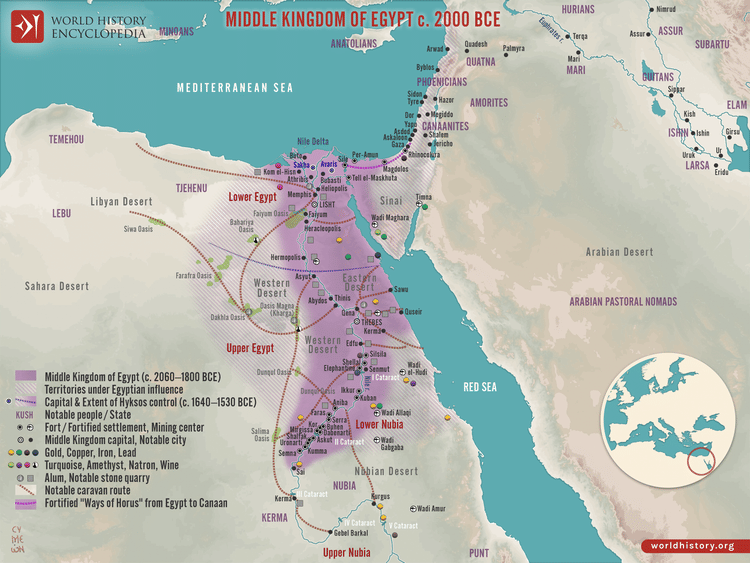
In this climate of Egyptian neglect, the Nubian Kingdom of Kush emerged as a centralized power, with its capital at Kerma. While the term "Nubian" often referred to the region (from the Egyptian word nub, meaning gold), the inhabitants of this burgeoning kingdom proudly called themselves "Kushites." Early Kushite temples and cities show a strong Egyptian influence, particularly in their architecture and religious practices. The Kushite elite admired and adopted many aspects of Egyptian courtly life, including dress and mannerisms, and worshipped Egyptian gods.
However, over time, a distinct Kushite identity began to assert itself, blending Egyptian influences with indigenous Nubian styles. As Thebes remained preoccupied with affairs to its north, the power of Kush grew unchecked, and the southern border became increasingly fluid, blurring the lines between Egyptian and Kushite spheres of influence.
A Divided Egypt: Inter-regional Dynamics and Shifting Alliances
Contrary to the "dark age" narrative, the Second Intermediate Period was not characterized by unremitting warfare between the three dominant powers. Instead, Egypt existed as a divided nation with complex, often interdependent, relationships between the Hyksos in Avaris, the Thebans in Upper Egypt, and the Kushites in Kerma.
Trade and Diplomatic Ties
Evidence suggests extensive trade continued between all three regions. Hyksos ships would sail past Thebes on their way to Kush, and Theban merchants traveled north to trade with the Hyksos. A form of truce, or at least a practical non-aggression pact, seems to have existed between Thebes and Avaris, allowing commerce to thrive. Neither power significantly interfered with the other’s trade networks or their respective relationships with Kush. This suggests a pragmatic acceptance of the political reality, a far cry from constant, destructive conflict.
The Hyksos, in their governance of Lower Egypt, saw themselves as legitimate rulers. The kings recorded for the 13th-16th Dynasties, many bearing non-Egyptian names, underscore this self-perception. While their chronology remains somewhat confused, their presence and influence were undeniable. This period of dynamic interaction, rather than isolated conflict, underscores the complex tapestry of the Second Intermediate Period.
The Theban Resurgence: Unification and the Dawn of Empire
The delicate balance of power began to unravel towards the end of the Second Intermediate Period, culminating in a series of wars initiated by the Theban rulers of the 17th Dynasty.
The Spark of Conflict: Ta’O’s War
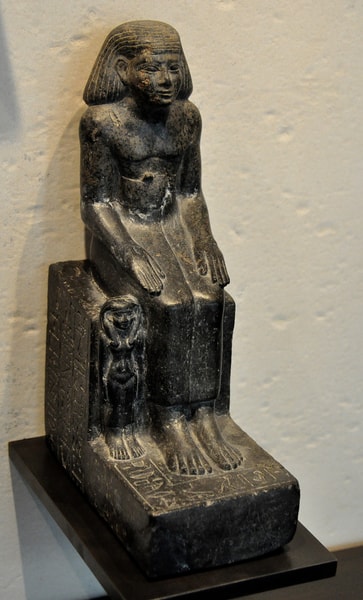
The conflict is famously ignited by an alleged insult from the Hyksos king Apepi of Avaris to the Theban king Seqenenra Taa (also known as Ta’O, c. 1580 BCE). Apepi reportedly sent a messenger demanding that Ta’O dismantle his hippopotamus pool in Thebes, claiming the noise disturbed his sleep in Avaris—a distance of over 300 miles. This audacious demand, widely interpreted as a direct challenge to Theban sovereignty, spurred Ta’O into action. He launched a military expedition against the Hyksos, but his campaign was costly. His mummy, discovered near the Valley of the Kings, bears gruesome wounds consistent with battle, suggesting he was killed in action, likely around 1560 BCE. The Hyksos remained in control of Avaris, indicating an initial Theban defeat.
Kamose’s Nationalist Crusade
Ta’O’s son, Kamose (c. 1575 BCE), inherited the throne and, crucially, his father’s war against the Hyksos. Kamose articulated a fervent nationalist ideology, rejecting the notion of sharing Egypt with foreign powers. His inscriptions powerfully convey his sentiment:
"To what end do know my own strength? One chief is in Avaris, another in Kush, and I sit here associated with an Asiatic and a Nubian! Each man has his slice in this Egypt and so the land is partitioned with me! See he even has Hermopolis! No one can be at ease when they are milked by the taxes of the Asiatics. I shall grapple with him that I might crush his belly for my desire is to rescue Egypt which the Asiatics have destroyed." (van de Mieroop, 143)
Despite his advisors’ caution, Kamose embarked on an ambitious campaign against Avaris, sailing his army up the Nile and launching a devastating attack. He vividly describes the chaos and terror he inflicted: "I caught sight of his womenfolk upon his roof, looking out of their windows towards the river-bank, their bodies frozen at the sight of me. They looked out with their noses on their walls, like young mice in their holes, crying, ‘It is an attack!’" (Watterson, 59). Kamose boasted of razing Avaris and returning to Thebes with immense plunder. However, archaeological evidence contradicts Kamose’s claim of total destruction; the Hyksos retained significant power in the north after his reign. Kamose himself ruled for only about three more years, seemingly capturing Memphis before his death.
Ahmose I: The Unifier and Empire Builder
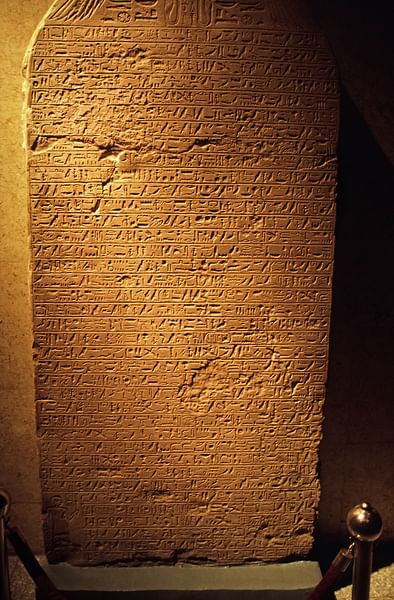
The decisive blow against the Hyksos came with Kamose’s brother and successor, Ahmose I, founder of the 18th Dynasty and the New Kingdom. Ahmose I is universally credited with driving the Hyksos from Egypt and reuniting the fractured land under Theban rule. Accounts, such as the stele at Karnak and the tomb inscription of a soldier also named Ahmose (son of Ibana), detail a protracted and fierce struggle.
The soldier Ahmose recounts multiple intense battles at Avaris, indicating that Kamose’s earlier claims of complete destruction were indeed exaggerated, or that the Hyksos had rebuilt their city. After fierce hand-to-hand combat, the surviving Hyksos retreated to their stronghold of Sharuhen in Canaan, which then endured a six-year siege before finally falling. Ahmose I pursued them into Syria, effectively terminating their political influence in Egypt.
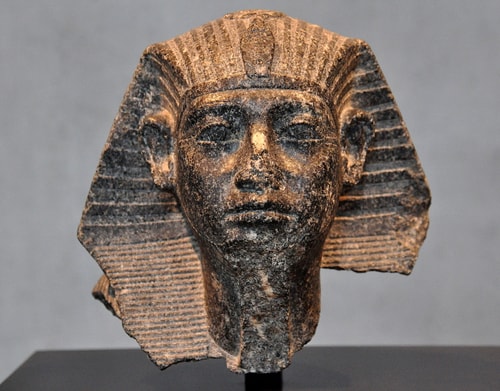
With the Hyksos expelled, Ahmose I turned his attention south, campaigning into Nubia beyond the second cataract of the Nile. He reclaimed lost territories, restored Egyptian control, and re-established the traditional southern borders. Domestically, Ahmose I embarked on a massive restoration program, rebuilding cities and refurbishing temples, and consolidating his power at Thebes by strategically placing trusted family members in key positions. His reign marked the definitive end of the Second Intermediate Period and the glorious dawn of the New Kingdom.
Legacy and Implications: A Catalyst for Empire
The re-evaluation of the Second Intermediate Period moves beyond simply correcting historical inaccuracies; it reveals this era as a pivotal moment in Egypt’s evolution. While there were indeed some cultural shifts, such as the increasing prevalence of hieratic (cursive) script over the more complex hieroglyphic forms, and perhaps a temporary dip in artistic quality, these were adaptations, not degenerations. Literature continued to be produced, and religious rites observed. The "dark age" label, perpetuated by later New Kingdom scribes keen to highlight their own era’s glory, obscures the period’s profound transformative impact.
The Hyksos’ Enduring Influence
Perhaps the most significant legacy of the Hyksos presence was the introduction of revolutionary military technologies. The horse-drawn war chariot, a mobile and devastating weapon, was entirely new to Egypt. Alongside it came the composite bow, offering superior range and power compared to the traditional Egyptian longbow, as well as bronze daggers and short swords. These innovations fundamentally reshaped Egyptian warfare and provided the very "means with which to achieve" the expansionist ambitions of the New Kingdom.
A Paradigm Shift in Egyptian Worldview
Beyond military hardware, the Hyksos invasion had a profound psychological and ideological impact. As Egyptologist Barbara Watterson observes:
"The shock of the Hyksos invasion had had a salutary effect upon the Egyptians, who looked upon other nations with scorn. The Egyptian word for ‘mankind’ (rmt) referred only to Egyptians; they spoke of other ethnic groups in derogatory terms – ‘the vile Kushites’, ‘the wretched Asiatics’. The Hyksos had destroyed their age-old sense of security, for the first time bringing home to them that they were not inviolable." (Watterson, 60)
This shattering of Egypt’s traditional insularity, its belief in its own unique and divinely ordained superiority, was perhaps the most crucial outcome of the Second Intermediate Period. The experience of foreign rule forced Egyptians to confront the reality that other nations possessed comparable power and posed genuine threats.
The Birth of Imperial Ambition
This newfound understanding directly fueled the imperial policies of the New Kingdom. The Theban rulers, having expelled the Hyksos, recognized the necessity of creating a buffer state in Western Asia to prevent future invasions. This strategic imperative drove the aggressive military campaigns of the early 18th Dynasty, leading to the conquest of vast territories and the establishment of an Egyptian empire stretching from Nubia deep into the Levant. The unprecedented wealth and prosperity of the New Kingdom, manifest in its iconic monuments and elaborate tombs, were direct consequences of this expansionist policy, itself a reaction to the lessons learned during the Second Intermediate Period.
In conclusion, the Second Intermediate Period, far from being a mere footnote or a lamentable "dark age," stands as a vital crucible in Egyptian history. It was a time of significant cultural exchange, technological innovation, and a fundamental reshaping of Egypt’s political landscape and worldview. The interactions between Hyksos, Thebans, and Kushites, however complex and occasionally violent, ultimately forged the unified, militarily advanced, and outward-looking Egypt that would dominate the ancient world for centuries to come, laying the groundwork for the most celebrated era of its long and illustrious history.