The Anachronistic Pulse: Nieves González and the Fusion of Spanish Baroque with Contemporary Streetwear
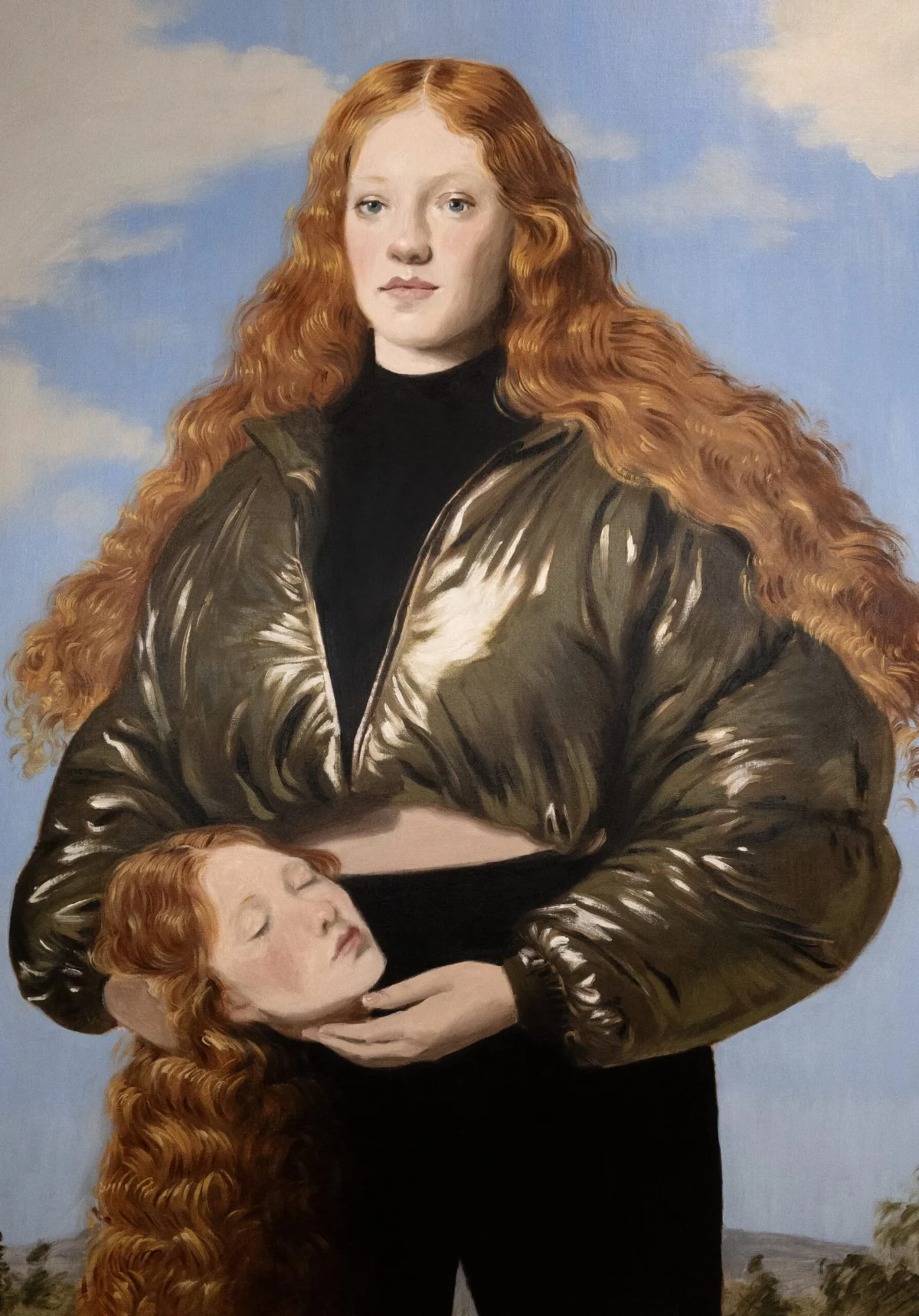
In the quiet, light-filled spaces of contemporary galleries, a new form of dialogue is taking place—one that bridges the gap between the 17th-century Spanish Golden Age and the high-fashion streets of the 21st century. At the center of this conversation is Nieves González, a Spanish artist whose oil compositions are currently redefining the boundaries of portraiture. By placing female protagonists in the voluminous, synthetic silhouettes of modern puffer coats while utilizing the dramatic chiaroscuro of the Baroque era, González creates a tension that is as jarring as it is deeply human.
Her current solo exhibition, A Friendship Story, running through July 25 at the Richard Heller Gallery in Santa Monica, serves as a testament to what she calls an "extraordinary, unbroken creative tradition." In her work, the past is not a static relic but a living, breathing pulse that informs the present.

Main Facts: The Intersection of History and the "Puffer" Aesthetic
Nieves González’s practice is rooted in the rich soil of Spanish art history. She draws direct inspiration from the 16th-century portraiture of El Greco and the 17th-century mastery of Diego Velázquez and Bartolomé Murillo. These historical giants were known for their ability to capture the "soul" of their subjects through theatrical lighting and a profound sense of religiosity.
However, González introduces a radical departure from tradition: her subjects are not draped in the heavy silks or stiff lace collars of the Habsburg court. Instead, they wear contemporary parkas, leopard-print puffer jackets, and metallic gold puffer coats. This juxtaposition creates what art critics call "asynchronous tension"—a visual conflict where the viewer’s brain struggles to reconcile the classical technique with the ultra-modern attire.

The exhibition at Richard Heller Gallery showcases several large-scale oil-on-linen works, including Beati coloro che danzano all’alba del giorno (2025) and The runaway I (2026). These pieces highlight González’s technical prowess, utilizing the traditional medium of oil paint to capture the light reflecting off synthetic, water-resistant fabrics with the same reverence a Renaissance master might have shown to velvet.
Chronology: From the Golden Age to the Digital Meme
To understand the weight of González’s work, one must trace the chronological evolution of the Spanish creative tradition.

The 16th and 17th Centuries: The Foundation
The Spanish Golden Age (Siglo de Oro) was characterized by a move toward realism and emotional intensity. Artists like El Greco introduced elongated figures and haunting expressions, while Velázquez perfected the "painterly" style that would later influence the Impressionists. The 17th century saw the rise of the Spanish Baroque, heavily influenced by the Italian master Caravaggio. His use of tenebrism—a style of painting using very pronounced chiaroscuro, where there are violent contrasts of light and dark—became a staple of Spanish religious and aristocratic art.
The 20th Century: The Rise of the Puffer
The puffer coat, or the "down jacket," was patented by Eddie Bauer in 1936 after a near-fatal bout of hypothermia. By the late 20th century, it had transitioned from utilitarian outdoor gear to a symbol of urban streetwear and high-fashion experimentation (famously championed by designers like Norma Kamali and later, Balenciaga).

2023: The "Puffer Pope" Catalyst
A pivotal moment in the cultural zeitgeist occurred in 2023 when an AI-generated image of Pope Francis wearing a massive, stylish white puffer coat went viral. The image fooled millions, not just because of the technological realism, but because of the symbolic clash. The papacy, an institution 2,000 years old, was suddenly seen through the lens of modern "hypebeast" culture. This moment highlighted a global fascination with seeing historical or traditional figures reimagined in modern "armor."
2025–2026: González’s Contemporary Response
While the "Puffer Pope" was a product of algorithmic generation, González’s work is a deliberate, handcrafted response to this phenomenon. Her paintings, produced between 2025 and 2026, reclaim this "asynchronous tension" from the realm of digital memes and return it to the sacred space of oil painting.

Supporting Data: Artistic Philosophy and Technical Execution
González’s work is supported by a deep philosophical commitment to the idea that creativity is an inherent part of the human condition. "Creating isn’t something we do. It’s something we are," she states. "And I come from that; I carry it in my body."
The Power of the Female Protagonist
Unlike the historical portraits of the 17th century, which often centered on kings, saints, or male philosophers, González centers the female experience. Her subjects possess "demure expressions" and "direct gazes," yet they occupy spaces of power. In La Santa y la Fiera (2025), the subject wears a leopard-print puffer, blending the concept of the "saint" (la santa) with the "beast" (la fiera), suggesting a complex, modern femininity that refuses to be categorized.

Technical Mastery of Synthetic Light
One of the most challenging aspects of González’s work is the rendering of modern materials. Traditional oil painting techniques were developed to mimic skin, fur, and woven fabrics. González applies these same techniques to depict the sheen of nylon and the volume of polyester fill. In Equinox (2025), the gold puffer coat is treated with the same luminosity and "divine light" that Murillo might have used for a saint’s halo. This elevates the "popular" garment to the status of "cultured" art.
Official Responses: The Artist’s Perspective
In statements regarding her solo exhibition A Friendship Story, González emphasizes that her work is not about nostalgia. Instead, she seeks to create a "pulse" that resonates today.

"I’ve never tried to separate the cultured from the popular or the historical from the contemporary," González explains. "What interests me is precisely that these references speak to one another and generate something alive… something with a pulse today."
The Richard Heller Gallery, which has a reputation for representing artists who challenge traditional narratives through a contemporary lens, views González as a vital voice in the current art market. By hosting A Friendship Story, the gallery positions her work alongside other contemporary masters who "reimagine" the past, such as Ewa Juszkiewicz. The gallery notes that González’s ability to evoke "real emotion" is what sets her apart from purely conceptual or decorative artists. "That whoever looks at the painting feels something real. That’s what matters to me," González concludes.

Implications: The Future of Figurative Painting
The work of Nieves González has significant implications for the future of figurative painting and the broader cultural landscape.
1. The Deconstruction of "High" vs. "Low" Culture
By dressing her subjects in "parkas and puffer coats"—garments often associated with the street or mass-market consumption—and painting them with the reverence of the Baroque, González effectively erases the boundary between "high" and "low" culture. This reflects a broader trend in the 21st century where luxury fashion and street style have merged, but it does so through the slow, meditative process of oil painting rather than the fast-paced world of social media.

2. A Humanistic Response to AI
In an era where AI can generate a "Baroque portrait" in seconds, González’s work serves as a reminder of the value of the human touch. The "humanity and emotion" she seeks to capture are elements that AI often struggles to replicate authentically. Her work suggests that the future of painting lies in the artist’s ability to synthesize disparate parts of human history into a cohesive, emotional whole.
3. Reclaiming the Spanish Legacy
González is part of a new generation of Spanish artists who are reclaiming their national heritage without being shackled by it. By acknowledging the "extraordinary, unbroken creative tradition" of Spain, she ensures that the techniques of Velázquez and El Greco remain relevant to a global audience.

4. The "Asynchronous" Aesthetic as a New Standard
The success of A Friendship Story indicates a growing appetite for art that plays with time. As our world becomes increasingly digital and fast-paced, there is a profound comfort and intrigue in seeing the "now" reflected through the "then." González’s paintings offer a sanctuary where the 17th and 21st centuries can coexist, reminding us that while fashion changes, the "search for humanity" remains constant.
As the exhibition at Richard Heller Gallery draws to a close this July, the art world will undoubtedly keep a close watch on Nieves González. Her ability to weave the "theatrical tableaux" of the past into the "urban armor" of the present has not only given Spanish tradition a new pulse but has also provided a mirror in which the modern viewer can see themselves—timeless, complex, and wrapped in a puffer coat.