The Architect of Baroque Surrealism: Jesús Aguado’s Journey from Illustration to Fine Art Mastery

In the contemporary art landscape, a tension often exists between the accessible and the profound. Many artists struggle to bridge the gap between the commercial clarity required for mass communication and the layered complexity demanded by the fine art world. However, Spanish artist Jesús Aguado has spent the last decade demonstrating that these two worlds are not only compatible but can be harnessed to create a revolutionary visual language.
With his latest solo exhibition, Life Milestones, currently on display at Arch Enemy Arts in Philadelphia, Aguado solidifies his position as a leading figure in the "Pop Surrealism" or "Lowbrow" movement. Yet, his work transcends these labels, merging the technical rigor of the Old Masters with the vibrant, narrative-driven energy of modern comic books. This article explores the evolution of Aguado’s career, the technical alchemy of his process, and the philosophical implications of his "Baroque Surrealism."
Main Facts: The Fusion of High Art and Universal Communication
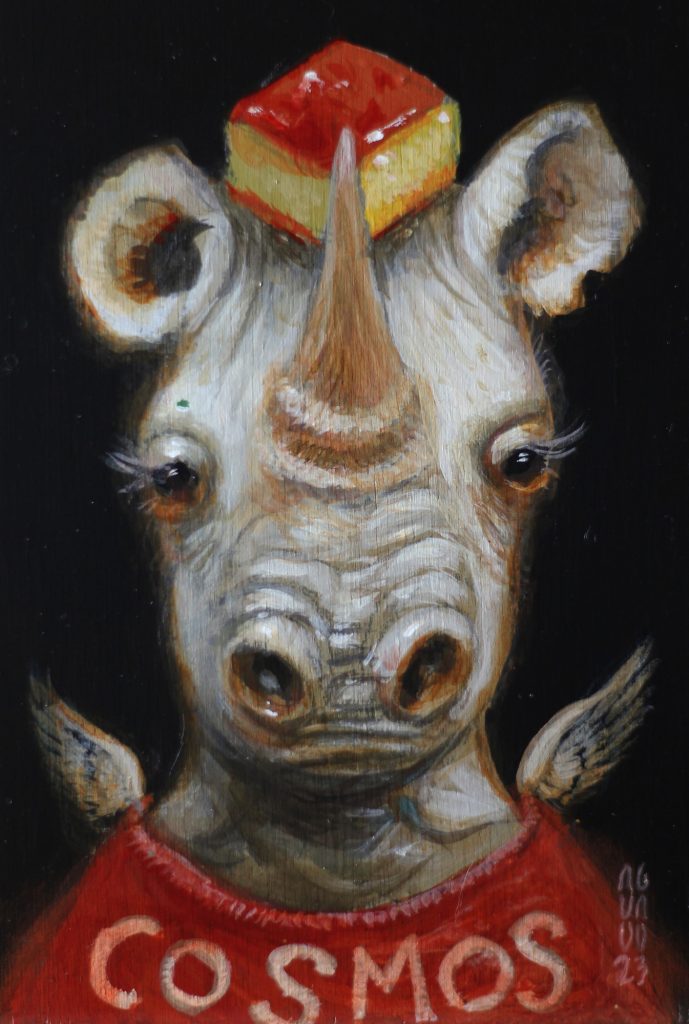
Jesús Aguado (b. 1976) is a Valladolid-born artist whose career is defined by a rare transition. After spending twenty years as one of the world’s most prolific commercial illustrators, Aguado successfully pivoted to fine art in the late 2010s. His work is characterized by "chimerical, often anthropomorphic figures" that inhabit dense, dreamlike environments.

The core of Aguado’s appeal lies in what critics have termed "Baroque Surrealism." This style utilizes classical techniques—such as dramatic chiaroscuro and the horror vacui (fear of empty space) typical of Rubens—and applies them to subjects that feel like they have stepped out of a cosmic graphic novel. By banishing human figures from his canvases, Aguado creates a universal bestiary. His recurring cast of dragons, rabbits, and grotesque worms serves as an emotional shorthand that viewers from any cultural background can interpret.
His current exhibition, Life Milestones, represents a significant biographical shift. Inspired by the birth of his son in 2023, the series explores the transformative moments of human existence—birth, development, and mitosis—through the lens of absurd yet symbolic satire.
Chronology: From the Trenches of Illustration to the Gallery Walls
To understand Aguado’s current success, one must look at the two decades he spent in the "trenches" of commercial publishing.

1976–2000: Foundations in Valladolid and Salamanca
Born in Valladolid, Spain, Aguado’s formal training began at the University of Salamanca, where he earned his Fine Arts credentials. During this period, he mastered classical anatomy and traditional painting techniques, though his personal interests remained rooted in the narrative power of comic books and graphic novels.
2000–2017: The Illustration Era
For twenty years, Aguado worked as an editorial illustrator for global powerhouses. His client list included the Spanish textbook giant Santillana, National Geographic, and numerous children’s publishers in Taiwan and beyond. This era was his "masterclass in universal visual communication." When creating art for diverse audiences—ranging from Spanish schoolchildren to Taiwanese readers—Aguado learned how to convey complex emotions and narratives through imagery alone, bypassing linguistic barriers.
2017–2018: The Pivot to Fine Art
Around 2017, Aguado began transitioning away from digital and commercial constraints toward oil and acrylic painting. This shift was not a rejection of his past but an expansion of it. The creative pressure built up over twenty years of deadlines exploded into a new form of expression. He began experimenting with wood panels and traditional glazing techniques, seeking a depth that commercial illustration could not provide.

2020–Present: The Arch Enemy Arts Partnership
Aguado’s international breakthrough was cemented through his relationship with Arch Enemy Arts in Philadelphia. Since 2020, he has held three solo exhibitions with the gallery, each showing a marked evolution in his "Density Principle" and psychological depth.
2023–2025: The "Life Milestones" Evolution
The birth of his son in 2023 served as a catalyst for his most profound work to date. This biographical milestone shifted his focus from general surrealism to a metaphysical exploration of life’s "crucial moments," leading to the current Life Milestones series.
Supporting Data: The Technical and Stylistic Pillars
Aguado’s work is supported by a rigorous technical framework that distinguishes him from many of his contemporaries in the surrealist genre.

The Density Principle and Horror Vacui
Aguado’s canvases operate on what he calls the "Density Principle." His paintings are visual novels, packed with a "myriad of animals, plants, and creatures." This mirrors the information density of the digital age. However, unlike the chaotic "noise" of the internet, Aguado’s density is strategic. By filling every inch of the canvas (a nod to the Baroque horror vacui), he creates a sense of "strategic overwhelm" that forces the viewer to slow down and process the narrative threads individually.
Technical Alchemy: Glazing and Supports
A signature of Aguado’s work is his use of traditional wood and birch panels, the same supports used by Renaissance masters. This choice provides a physical "gravitas" to his whimsical subjects.
- The Glazing Process: Aguado applies multiple translucent layers of acrylic and oil. This allows light to bounce between the layers, creating a signature shimmer.
- The Luminous Effect: This technique makes his "impossible creatures" feel tangibly present. The luminosity acts as a "visual prescription" for overstimulated minds, offering a depth that digital screens cannot replicate.
The Bestiary of Duality
Aguado’s characters are intentionally "dual animated beings."

- Dragons: Represent ferocity and power.
- Rabbits: Embody innocence and "cuteness."
- Worms/Insects: Suggest the grotesque and the cycle of decay.
By blending these elements—such as a winged caterpillar mother or an octopus with lobster claws—he creates figures that parade on the edge of the endearing and the disturbing.
Official Responses and Critical Reception
The art world has responded with sustained confidence in Aguado’s unique fusion of styles. Noah Antieau, co-founder of Arch Enemy Arts, has noted the artist’s ability to create "worlds that feel both fantastical and emotionally urgent."
Critics often point to Aguado’s work as a "bridge." While his aesthetic fits within the "Lowbrow" movement—a genre often dismissed by traditionalists for being too "pop"—his mastery of classical methods like chiaroscuro (the dramatic use of light and shadow) has earned him respect from fine art circles. One critic described his work as "Renaissance beauty impregnated with the darkest baroque," highlighting that his art is not just "funny" or "weird," but deeply rooted in academic poetry.
The response to his Life Milestones series has been particularly strong. Observers have noted that his exploration of existential paradoxes now carries a "parental urgency." His ability to represent life’s most significant passages through "absurd yet symbolic satires" has been praised for offering a psychological refuge in an era of information fatigue.

Implications: Surrealism for the 21st Century
Jesús Aguado’s success carries significant implications for the future of contemporary surrealism and the broader art market.
1. The Validation of the "Commercial" Path
Aguado’s career proves that a commercial background is not a "contamination" of fine art but can be a "superpower." His years of illustration gave him the tools to communicate with a global audience, a skill that many "pure" fine artists lack. This suggests a shift in how the art world values "applied" artistic experience.
2. Art as a Sanctuary for the Overstimulated
Aguado’s stated mission is to create spaces where viewers can "feel far away from everything." In a world exhausted by opinions and digital noise, his work functions as a "pressure valve." The density of his paintings requires a "sustained looking" that acts as an antidote to the "instant consumption" of the social media age.

3. The "And/Both" Solution to Modernity
Aguado refuses to choose between emotional accessibility and intellectual depth. His work suggests that the future of art lies in "paradoxical thinking"—the ability to hold joy and darkness, the ancient and the modern, the comic book and the Caravaggio, in the same space.
Conclusion: The Visual Vocabulary of the Future
Jesús Aguado has spent the last decade proving that surrealism did not need to choose between pop appeal and art historical significance. By leveraging his twenty years of illustration experience, he has created a visual language that is both ancient and urgently modern.
His current exhibition, Life Milestones, is more than just a collection of paintings; it is a metaphysical exploration of what it means to grow, to change, and to exist in a complex world. As he continues to bridge the gap between the profound and the approachable, Aguado provides the visual vocabulary we need to navigate the contradictions of the 21st century.
Exhibition Details: LIFE MILESTONES by Jesús Aguado
Location: Arch Enemy Arts, Philadelphia
On View: May 24 – June 15, 2025
Opening Reception: First Friday, June 6, 2025
Learn More: archenemyarts.com
Works Cited
- Aguado, J. (2024). Personal Interview on "Life Milestones" and Fatherhood.
- Arch Enemy Arts. (2025). Press Release: Jesús Aguado Solo Exhibition.
- Surrealism Today. (2025). The Baroque Surrealism of Jesús Aguado.
- University of Salamanca. (1998). Alumni Records and Fine Arts Curriculum.
- Santillana Publishing. (2010). Editorial Illustration Archives.