The Architecture of Chimeras: How Jesús Aguado is Redefining 21st-Century Surrealism
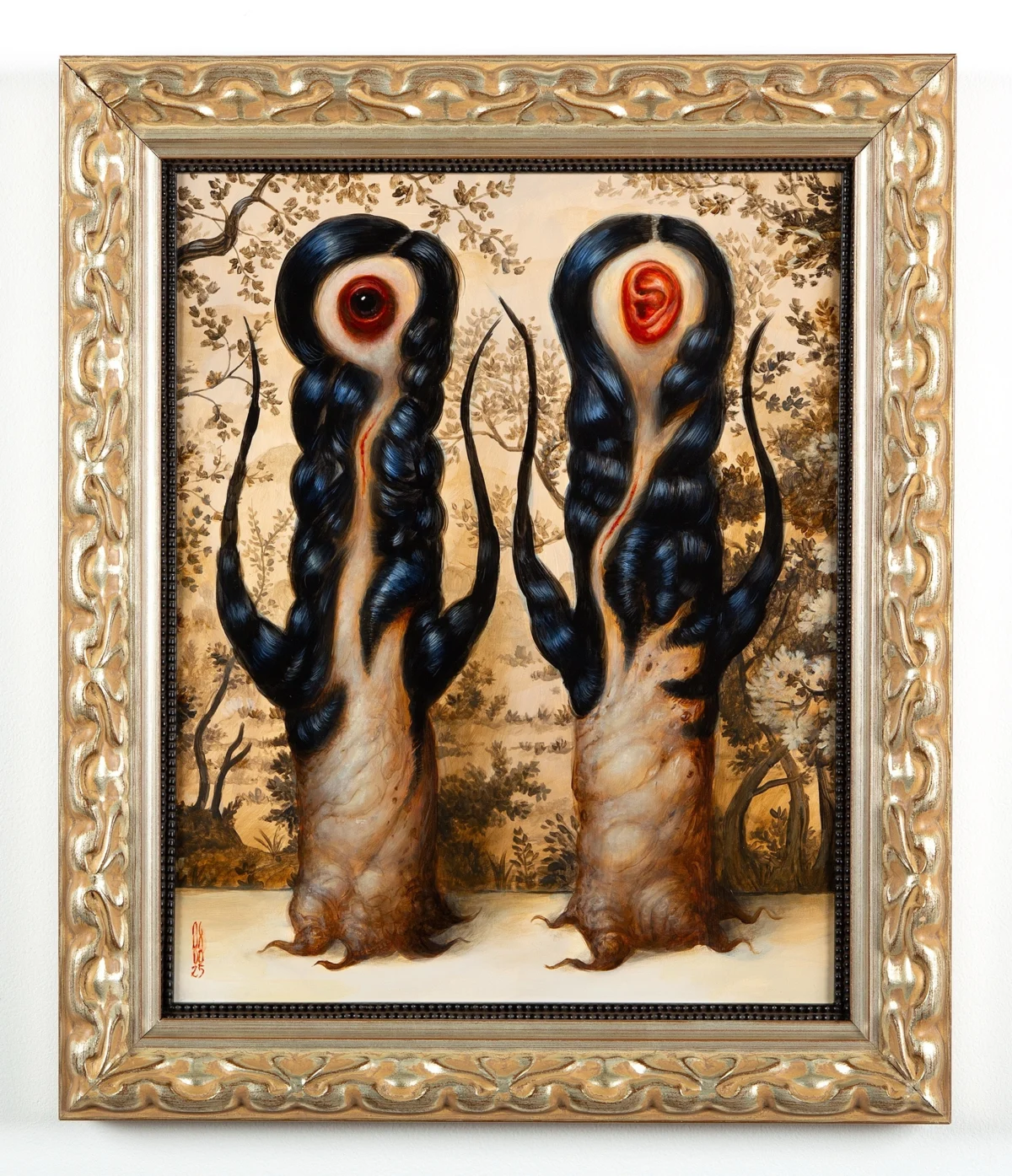
In a contemporary art landscape frequently divided between the intellectual austerity of the avant-garde and the immediate gratification of pop culture, Spanish artist Jesús Aguado has carved out a unique territory where accessibility and profundity are not rivals, but collaborators. Over the last decade, Aguado has transitioned from a high-stakes career in global commercial illustration to becoming a leading voice in "Baroque Surrealism." His latest body of work, currently showcased in the exhibition "Life Milestones" at Arch Enemy Arts in Philadelphia, marks a pivotal moment in his career—one that synthesizes twenty years of technical discipline with a newfound, deeply personal exploration of existence.
Main Facts: The Synthesis of Illustration and Fine Art
Jesús Aguado (b. 1976) represents a rare breed of artist who views commercial constraints as a pedagogical foundation rather than a creative limitation. Based in Valladolid, Spain, Aguado spent two decades as an illustrator for prestigious entities such as National Geographic, Santillana, and various international children’s publishers. This period provided him with a rigorous education in visual communication, forcing him to develop a "universal language" capable of resonating across diverse cultural and age demographics.
In 2017, Aguado made a definitive shift toward fine art, utilizing oils and acrylics to create what he terms "chimerical, often anthropomorphic figures." His work is characterized by several defining features:

- Baroque Technique: The use of dramatic chiaroscuro and horror vacui (the fear of empty space), reminiscent of 17th-century masters.
- Pop Sensibilities: An aesthetic influenced by comic books and graphic novels, resulting in vibrant, bold color palettes.
- Thematic Duality: A recurring exploration of the "endearing and the disturbing," where whimsical creatures inhabit emotionally heavy or grotesque scenarios.
- Technical Traditionalism: A preference for painting on wood panels and birch supports, employing classical glazing techniques to achieve a translucent, luminous finish.
His current exhibition, "Life Milestones," runs from May 24 through June 15, 2025, at Arch Enemy Arts. This collection represents Aguado’s third solo show with the gallery, signaling a sustained interest from North American collectors and critics in his specific brand of psychological surrealism.
Chronology: From the Trenches to the Gallery
To understand Aguado’s current trajectory, one must look at the slow-burn evolution of his creative identity.
1976–2000: The Academic Foundation
Born in Valladolid, Aguado’s formal training began at the University of Salamanca, where he earned his Fine Arts credentials. This period instilled in him a respect for classical European art history—a foundation that would later allow him to subvert Renaissance aesthetics with modern irony.

2000–2017: The Commercial Masterclass
For twenty years, Aguado worked in the "trenches" of the publishing world. This was not merely a way to make a living; it was an intensive study of how images function. Creating textbook art for Santillana (Spain’s educational giant) and publishers in Taiwan required him to distill complex concepts into clear, engaging visuals. This era built the "creative pressure" that eventually necessitated a move into the unconstrained world of fine art.
2017–2018: The Fine Art Pivot
The transition to oil and acrylic painting was a deliberate "engineering" of a new style. Aguado began moving away from the literal requirements of a brief and toward the metaphorical requirements of the subconscious. It was during this window that his signature "Baroque Surrealism" began to crystallize.
2020–2023: Global Recognition and Fatherhood
Aguado’s relationship with Arch Enemy Arts began in 2020, introducing his work to a broader international audience. However, the most significant biographical shift occurred in 2023 with the birth of his son. This event served as the primary catalyst for his current thematic direction, moving his work from general surrealist exploration to a specific, metaphysical investigation of life’s "transformative moments."

Supporting Data: Technical Alchemy and the Density Principle
Aguado’s work is often praised for its "density," both in terms of narrative and physical composition. This is achieved through two primary methods: The Density Principle and Technical Glazing.
The Density Principle
Aguado’s canvases function as visual novels. Critics have noted his use of horror vacui, a style popularized by Rubens, where every inch of the canvas is packed with detail. This density mirrors the information overload of the digital age. However, unlike the chaotic noise of the internet, Aguado’s "strategic overwhelm" offers a structured refuge. By populating his worlds with a recurring bestiary—dragons representing ferocity, rabbits embodying innocence, and worms suggesting the grotesque—he creates a symbolic shorthand that viewers can decode at their own pace.
Light as Philosophy
Technically, Aguado’s work relies on "translucent layers." By using acrylic glazing on traditional wood panels, he allows light to penetrate the paint and bounce back from the surface of the wood. This creates a "shimmer" that makes his impossible creatures feel tangibly present. This method is a deliberate antidote to "instant consumption." To truly see an Aguado painting, one must stand before it and allow the light to shift, a process that demands the very attention span that modern technology often erodes.

The Absence of the Human Form
Data-driven analysis of Aguado’s fine art period shows a near-total banishment of human figures. By utilizing anthropomorphic animals, he removes demographic barriers such as race, age, and gender. This allows the viewer to project their own experiences onto the characters more purely, facilitating a "universal" emotional response.
Official Responses: Critical Interpretations of "Baroque Surrealism"
The reception of Aguado’s work within the "Lowbrow" or "Pop Surrealism" movement has been overwhelmingly positive, though many critics argue he is outgrowing those labels.
Arch Enemy Arts has characterized his work as "Renaissance beauty impregnated with the darkest baroque." Their curatorial stance emphasizes that Aguado is not merely painting "weird animals," but is instead creating "academic poetry" that captures a genuinely revolutionary spirit.

Art Historians have pointed to Aguado’s use of wood and birch supports as a "strategic dialogue with art history." By using the same materials as Hieronymus Bosch or Jan van Eyck, Aguado lends a sense of "gravitas" to subjects that might otherwise be dismissed as whimsical or "comic book-esque."
The Artist’s Perspective: Aguado himself describes his work as a "psychological architecture." In various interviews and artist statements, he has expressed an exhaustion with the "too much information and opinions" that define modern life. He views his paintings as "sanctuaries" where "joy and darkness coexist." Of his latest series, he states: "Experiencing life through your child again makes you think and reconsider everything you’ve been through… These are visual metaphors for those transformative moments that changed your course."
Implications: Surrealism for the Overstimulated Mind
The rise of Jesús Aguado carries several implications for the future of the contemporary art market and the evolution of surrealism as a movement.

1. The Validation of the "Commercial" Background
Aguado’s success challenges the long-standing art world prejudice against commercial illustrators. His career suggests that the discipline required for editorial work—clarity, deadline management, and universal communication—can be a "fine art superpower" when applied to personal, emotive subjects. This may pave the way for more illustrators to transition into the gallery world, bringing a high level of technical craft with them.
2. A New "Accessible Profundity"
In an era where much conceptual art requires a degree to understand, Aguado’s work offers "accessible profundity." It invites the viewer in with "cute" or "vibrant" imagery (the "pop" element) before confronting them with "dark" or "existential" themes (the "baroque" element). This "and/both" approach—being simultaneously funny and metaphorical, endearing and disturbing—provides a roadmap for how art can remain intellectually rigorous while maintaining broad public appeal.
3. Escapism as Consciousness Expansion
While many forms of modern entertainment offer escapism as a way to "shut down" the brain, Aguado’s surrealism offers an escape that "expands" consciousness. By creating spaces where the "free play of imagination" is required, he encourages viewers to stop processing data and start feeling existential paradoxes. As society becomes increasingly overstimulated, the demand for this kind of "visual prescription" is likely to grow.

Conclusion: The Bottom Line
Jesús Aguado has spent a decade proving that surrealism did not need to choose between art historical significance and modern pop appeal. Through his "Life Milestones" series, he has matured into an artist who uses the language of the fantastic to discuss the most grounded of human experiences: growth, fear, love, and transformation.
As his exhibition in Philadelphia demonstrates, Aguado is no longer just an illustrator who paints; he is a master of a new visual vocabulary—one that the 21st century, in all its complexity and contradiction, desperately needs.
Exhibition Details:
LIFE MILESTONES by Jesús Aguado
- On View: May 24 – June 15, 2025
- Location: Arch Enemy Arts, Philadelphia, PA
- Opening Reception: First Friday, June 6, 2025
- More Information: archenemyarts.com