The Cosmos Initiative: Hello Games Unlocks Eye-Tracked Dynamic Foveated Rendering for No Man’s Sky on SteamVR

Introduction
In the ever-evolving landscape of virtual reality, few titles have demonstrated the resilience and transformative capacity of No Man’s Sky. What began as a controversial launch in 2016 has matured into a gold standard for post-launch support and technical innovation. Today, Hello Games has released the "Cosmos" update, a significant milestone that introduces a suite of visual overhauls and technical refinements.
While the update brings sweeping changes to the aesthetics of outer space, the most consequential addition remains tucked away within the technical patch notes: the implementation of eye-tracked dynamic foveated rendering (ETDFR) for SteamVR. This move not only bridges the performance gap between PC VR and the PlayStation VR2 (PSVR 2) but also signals a strategic preparation for the next generation of PC-tethered and standalone hardware, most notably the anticipated arrival of Valve’s "Steam Frame" headset.
1. Main Facts: A Technical Leap for the Final Frontier
The "Cosmos" update represents a pivot toward extreme optimization for the PC VR community. By enabling eye-tracked dynamic foveated rendering, Hello Games is utilizing one of the most sophisticated optimization techniques available in modern computer graphics.
What is Dynamic Foveated Rendering?
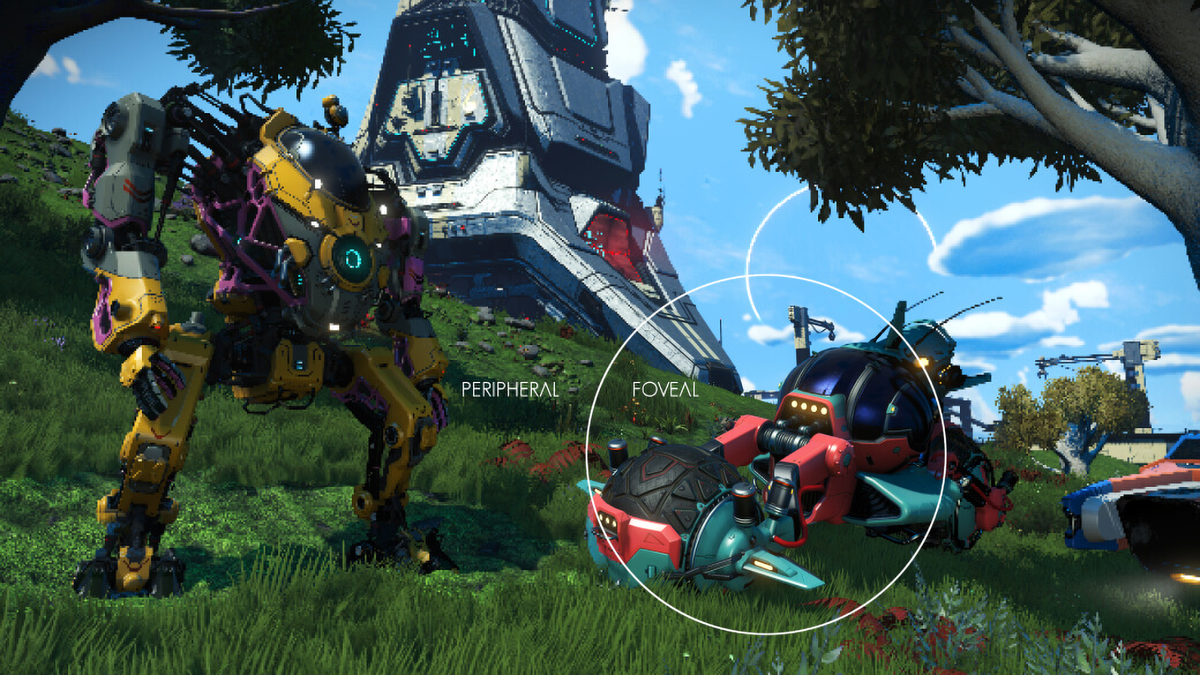
Dynamic Foveated Rendering (DFR) is a technique that utilizes eye-tracking hardware to determine exactly where a user is looking within a VR headset. The system then concentrates the highest graphical fidelity and resolution on that specific point—the "fovea"—while significantly reducing the resolution in the user’s peripheral vision.
Unlike "Fixed Foveated Rendering," which keeps the high-resolution zone static in the center of the lens, ETDFR follows the pupil. This allows for a massive reduction in GPU workload without a perceptible loss in visual quality for the user. In a game as procedurally dense as No Man’s Sky, where the engine must constantly calculate terrain, flora, and atmospheric effects, this performance "headroom" is transformative.
The Scope of the Cosmos Update
Beyond the rendering tech, the Cosmos update overhauls the "outer space experience." This includes:
- Enhanced Nebulae and Starfields: A complete visual redesign of the interstellar medium, providing more depth and color to the vacuum of space.
- Improved Lighting Models: Better light scattering and bloom effects within planetary atmospheres and station interiors.
- SteamVR Parity: Ensuring that PC users with high-end eye-tracking hardware can finally match the visual clarity previously exclusive to the PSVR 2 version of the game.
2. Chronology: The Road to Optimization
The journey to this point has been marked by several key developmental milestones. Hello Games has spent years refining the VR experience, often using one platform as a testbed for the other.
The 2019 "Beyond" Update
VR support was first introduced to No Man’s Sky in the "Beyond" update. While revolutionary at the time, the PC version was notorious for its high hardware requirements. Players struggled with stuttering and "shimmering" edges, a byproduct of the game’s complex procedural generation taxing both the CPU and GPU simultaneously.
The 2023 "Echoes" Milestone
In August 2023, Hello Games released the "Echoes" update, which introduced foveated rendering specifically for the PlayStation VR2. Before this update, the PSVR 2 version was often criticized for looking "soft" or "blurry" due to the headset’s high-resolution panels outstripping the console’s ability to render the game natively.
The introduction of ETDFR on PSVR 2 was described by the community as a "night-and-day" difference. For the first time, the console version of the game arguably looked better and ran smoother than many high-end PC builds, thanks to the efficiency of the PS5’s eye-tracking integration.
The 2024-2026 Transition
As we moved into the mid-2020s, the PC VR market began to see a slow but steady influx of eye-tracking capable hardware. However, software support lagged behind. The "Cosmos" update in late 2026 (per recent hardware survey cycles) serves as the final bridge, bringing the optimizations pioneered on Sony’s hardware back to the open ecosystem of SteamVR.
3. Supporting Data: The Hardware Bottleneck and Market Trends
To understand why this update is critical, one must look at the performance data and the current state of the SteamVR hardware market.
The Performance Challenge
No Man’s Sky is uniquely demanding. Unlike traditional games with baked-in assets, No Man’s Sky uses procedural generation for almost everything. This places an immense burden on the CPU to calculate geometry and the GPU to shade it.
Internal testing and user reports highlight the "brute force" problem:
- Mid-Range Hardware (e.g., RTX 3070 / Ryzen 5 5600X): Users often report having to drop resolution scales to 50% and use "Low" to "Medium" settings to maintain a stable 72Hz or 80Hz refresh rate.
- High-End Hardware (e.g., RTX 5070 Ti / Ryzen 7 9850X3D): Even on cutting-edge 2026 hardware, maintaining "Ultra" settings in VR remains a challenge without the aid of upscaling technologies like DLSS or, now, ETDFR.
SteamVR Hardware Survey (August 2026)
The adoption of eye-tracking hardware has been a slow burn. According to the most recent Steam Hardware Survey:
- PlayStation VR2 (via PC Adapter): 2.24%
- Meta Quest Pro: 1.51%
- Vive Focus Vision / Pimax Crystal Series: Combined ~0.8%
While these percentages seem small, they represent a significant portion of the "enthusiast" market—the users most likely to purchase and play deep, complex titles like No Man’s Sky. With SteamVR averaging between 1.8 million and 3 million active monthly users, the "eye-tracking ready" population is estimated at over 110,000 individuals. This is a large enough cohort to justify the engineering hours required for ETDFR implementation.
4. Official Responses and Developer Philosophy
Hello Games has remained characteristically focused on the "show, don’t tell" approach. While Sean Murray, the studio’s founder, has not released a lengthy manifesto regarding the Cosmos update, the studio’s patch notes reflect a commitment to "technological longevity."
A Focus on Visual Fidelity
In the official patch notes, the rendering team noted:

"Our goal with the Cosmos update was to ensure that No Man’s Sky remains a premier VR experience as hardware evolves. By integrating eye-tracked dynamic foveated rendering into the SteamVR pipeline, we are allowing players to see the universe as we intended—with crisp detail and fluid performance, even on the most alien of worlds."
The "Under-Promise, Over-Deliver" Strategy
Industry analysts note that Hello Games frequently releases "foundational" updates. By adding ETDFR now, they are effectively future-proofing the game for the next five years of VR hardware. This proactive stance has earned them significant goodwill within the VR community, which often feels neglected by AAA developers who view VR as a niche or "experimental" platform.
5. Implications: Preparing for the "Steam Frame" Era
The timing of the Cosmos update is perhaps its most intriguing aspect. For months, rumors and leaks regarding Valve’s next hardware venture, the "Steam Frame," have dominated industry discourse.
The Steam Frame Catalyst
The Steam Frame is widely expected to be a high-end, eye-tracking-enabled headset designed to leverage the SteamVR ecosystem. By updating No Man’s Sky to support ETDFR today, Hello Games is positioning its title as a "day-one" showcase for Valve’s new hardware.
If the Steam Frame utilizes a mobile chipset for standalone play or a wireless link, foveated rendering will be mandatory—not optional—to achieve the fidelity users expect from a Valve product. Hello Games is essentially "greasing the wheels" for a seamless transition to this new hardware tier.
The End of Brute Force
This update signals a broader shift in the VR industry. The era of "brute-forcing" performance through raw GPU power is coming to an end. As display resolutions push toward 4K-per-eye and beyond, even the most powerful desktop cards cannot keep up without intelligent rendering techniques.
Hello Games’ implementation of ETDFR on SteamVR sets a precedent for other developers. It proves that even complex, procedurally generated engines can be optimized for eye-tracking, potentially paving the way for other demanding titles (such as Microsoft Flight Simulator or Star Citizen) to follow suit.
Conclusion
The "Cosmos" update is more than just a visual refresh; it is a technical manifesto. By embracing eye-tracked dynamic foveated rendering, Hello Games has once again proven its ability to stay at the vanguard of gaming technology. For the 110,000+ users currently equipped with eye-tracking hardware—and the thousands more waiting for the Steam Frame—the universe of No Man’s Sky has never looked clearer. As the lines between console optimization and PC flexibility continue to blur, the real winners are the players standing on the surface of a distant planet, looking up at a sky that is finally, perfectly in focus.