The Deepening of Character: Unpacking the "Lie the Character Believes" Beyond a Simple Misconception
In the intricate tapestry of storytelling, few concepts are as foundational to compelling character development as the "Lie the Character Believes." For years, this cornerstone of narrative theory has been presented as the primary obstacle preventing characters from achieving their full potential, a fundamental misunderstanding that must be overcome for growth. However, a closer examination reveals a more nuanced and profound understanding of this concept, moving beyond a mere falsehood to encompass a spectrum of limited perception, egoic identification, and even the very fabric of social reality.
The Genesis of a Narrative Trope: The Lie as a Misconception
At its core, the "Lie the Character Believes" has been understood as the central tenet of a character’s arc. It represents a deeply ingrained, yet ultimately flawed, perspective that shapes their worldview and dictates their actions. This limited viewpoint acts as an invisible cage, preventing characters from embracing the story’s thematic truth until the narrative’s crucible forces them to confront and transcend their misconceptions.

In the realm of positive change arcs, characters embark on a journey of evolution, shedding their ingrained falsehoods to adopt a more expansive and enlightened understanding of themselves and the world around them. Conversely, negative change arcs depict characters who, by clinging to their "Lie," devolve into more constricted or even destructive states of being, their inability to adapt leading to their downfall. Essentially, this "Lie" signifies a state of being from which characters must grow in order to positively alter their circumstances.
Beyond Deception: The "Lie" as a Truth That Was
However, as narrative theorists and writers delve deeper into the mechanics of transformational fiction, a compelling re-evaluation of this concept emerges. The "Lie the Character Believes" is not always a deliberate deception or a factual inaccuracy. Instead, it often represents a truth that, while once functional, has become outdated or insufficient for the character’s current stage of development.

This refined understanding suggests that the "Lie" is less of an outright falsehood and more of a comparatively limited belief that exists on a continuum with a comparatively expansive truth. At the outset of a story, this "Lie" often functions as the character’s genuine truth, a perspective that served them well up to the narrative’s commencement.
Illustrative Example: Consider Feyre in Sarah J. Maas’s A Court of Thorns and Roses series. In the initial stages of her journey, her unwavering focus on survival skills and self-reliance is precisely what allows her to protect her family. This "Lie" of self-sufficiency, however, becomes a limitation when she is thrust into the Fae world, demanding an evolution of her perspective to encompass interdependence and vulnerability. The truth she learns at the end of the first book—that love is worth sacrifice—is itself a stepping stone, as subsequent narratives reveal the limitations of this truth when it devolves into perpetual self-abnegation.

This continuous evolution highlights a fundamental aspect of human experience: yesterday’s truth can become tomorrow’s limitation as our horizons expand. The journey of a character, much like the journey of an individual, is a constant leveling up along this continuum of understanding.
The Deeper Layers: Ego Identity and the Fissure in Consciousness
Further introspection reveals that the "Lie" is not merely a mistaken belief but can also be understood as a profound fissure in consciousness. It represents a disconnect between a character’s conscious, ego-driven identity and the deeper, more authentic truth of their being. This separation arises from an ego identity that has been constructed to navigate the world, often as a coping mechanism stemming from past wounds or unmet needs—what is often termed the "Ghost" in a character’s backstory.

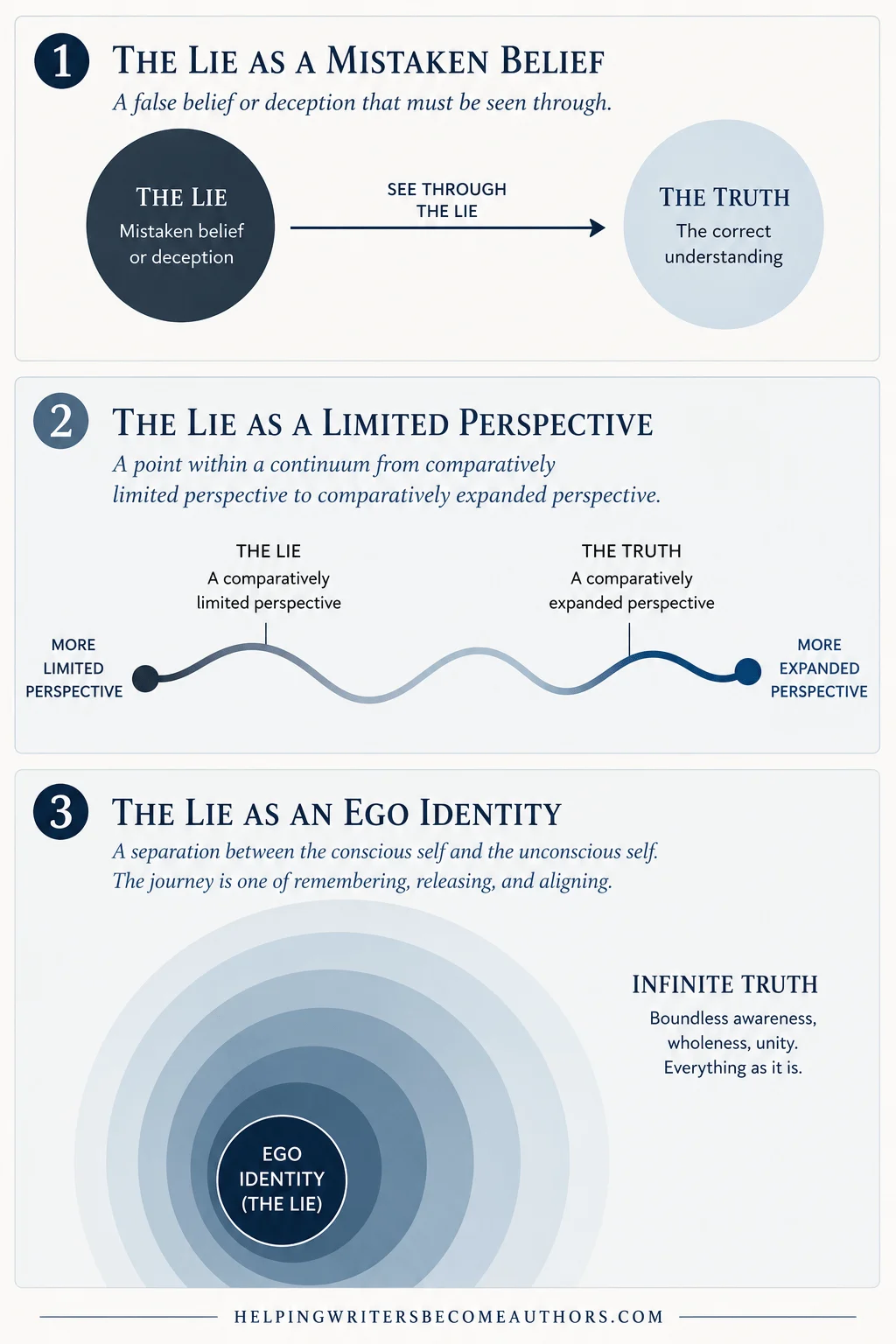
Three Models of the "Lie the Character Believes":
- The Mistaken Belief: This is the most straightforward interpretation, where the character holds an outright false notion that they must discard.
- The Limited Perspective: Here, the "Lie" is a relative truth, a point on a spectrum between a confined viewpoint and a broader, more encompassing understanding. Neither the "Lie" nor the "Truth" are absolute, but rather reference points in a character’s evolving perception.
- The Ego Identity/Limited Consciousness: This is the most complex model, where the "Lie" represents an identification with an ego structure that creates separation from a more expansive consciousness. It is a fundamental disconnect between the surface-level self and the deeper essence of being.
The Ego’s Grip: Separation and the Illusion of Self
The ego, as a limited awareness of the self, often defines identity through external markers—name, profession, gender, trauma, or social roles. This creates a fractured perception of reality, where the world is seen only through the narrow lens of the ego’s constructs. The ego’s insistence on maintaining these identities, even when they are no longer serving the individual, leads to a state of separation from a larger, more integrated consciousness. This separation is often so subtle that it goes unnoticed, yet it fuels the character’s internal conflict and resistance to growth.

Thematic Truth as a Counterpoint: In opposition to the "Lie," the thematic "Truth" in a story offers a more expansive perspective. While a specific story might present a truth like "family love endures even in failure," the underlying, universal truth often relates to the destructive nature of ego identification and the pain it perpetuates.
The Backstory Ghost: The Architect of Limiting Beliefs
The origins of these limiting ego identifications often lie in the character’s backstory, embodied by the "Ghost." This "Ghost," often a past trauma or wound, shapes the ego’s formation and its subsequent need to cling to defensive mechanisms. These early experiences, influenced by neurochemical responses, wire the brain to perceive the world in specific ways, forming personality and, consequently, the narratives characters tell themselves about who they are.

These coping mechanisms, initially effective, become the character’s "Lie" when they cease to be helpful. The story begins at the precise moment these ingrained patterns start to falter, initiating the character’s slow journey toward recognizing that they are more than their limiting coping mechanisms. This journey is often fraught with resistance, as the ego, programmed for survival, perceives transformation as dangerous.
Character Arc: Alignment Over Transformation
This deeper understanding of the "Lie" suggests that character arc might be more accurately described as a process of alignment rather than pure transformation. It is less about fundamentally changing who a character is and more about shedding the false self, the egoic layers that obscure their true nature. It is about stripping away what is not true to allow for clearer perception.

Soul-driven character arcs, often characterized by less resistance to change, demonstrate an embrace of this movement toward truth. Even amidst struggle, these characters recognize the inevitability and benefit of growth. This contrasts with ego-driven arcs, where the character’s resistance to confronting their "Lie" creates significant plot conflict.
The Union of Consciousness and the Unconscious: A Mythic Quest
Ultimately, the "Lie the Character Believes" can be understood as a manifestation of separation from our deeper selves. This separation is not solely personal; it is deeply intertwined with the social realities we inhabit. Societal constructs, customs, and shared beliefs can reinforce these limiting ego identities, creating a collective "Lie" that influences individual perception.

The journey of individuation, as described by Carl Jung, involves the ego moving from its limited self-importance into a conscious relationship with the larger Self, the totality of the psyche. This process involves recognizing the ego’s limitations and allowing the deeper, unconscious contents of the mind to come into play.
In this light, character arc becomes a narrative embodiment of this psychological process. It is a quest for the union of conscious awareness and the unconscious self, a movement away from the ego’s identification with a stagnant social reality toward a more authentic and integrated existence. This journey, while often painful, leads to a profound sense of self-responsibility, accountability, freedom, and the deep health of alignment.

The Enduring Power of Story
The power of story, therefore, lies in its ability to mirror this fundamental human journey. Every positive change arc, at its deepest level, resonates with our innate recognition that growth is about discovering who we are beneath the accumulated layers of fear, defense mechanisms, and imposed identities. The structure of narrative, the archetypal patterns it follows, taps into a primal human drive for wholeness and evolution. As Joseph L. Henderson noted, a sense of completeness is achieved through the union of consciousness with the unconscious.
Ultimately, the "Lie the Character Believes" is not merely a plot device; it is a profound exploration of the human condition. It is the narrative manifestation of our internal struggles, our ingrained habits, and our societal conditioning, and the arduous yet ultimately liberating journey toward a more conscious and aligned existence. Through the lens of story, we are reminded that life’s inherent program is to grow and evolve, and that true fulfillment lies in embracing that inherent truth.