The Digital Canvas Awakens: How Infinidream.ai is Resurrecting the ‘Dead Screen’
In the modern workspace, the computer monitor is a dominant architectural feature. Yet, for several hours a day, these high-resolution windows into the digital world sit dormant. They are either shrouded in the obsidian void of power-save mode or, perhaps more depressingly, displaying a utilitarian clock—a giant, glowing reminder of passing time against a black vacuum. This phenomenon, often referred to by designers as the "Dead Screen Problem," represents a vast, untapped territory for aesthetic and psychological enrichment.
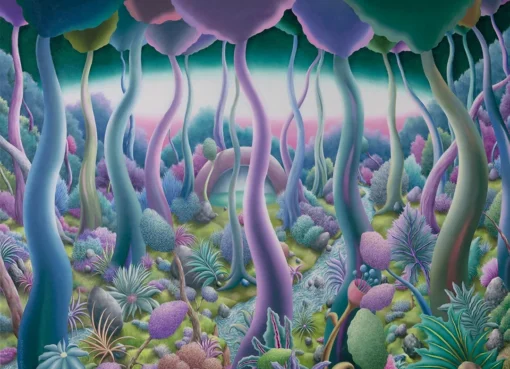
Enter Infinidream.ai, a sophisticated new application for macOS and Windows that seeks to transform these idle moments into a continuous stream of living, breathing art. Developed by legendary digital artist and engineer Scott Draves, Infinidream.ai is not merely a collection of images or a library of video loops. It is a generative engine that utilizes artificial intelligence to create "living paintings" that evolve in real-time, ensuring that a user’s display is never truly dark and never exactly the same twice.
Main Facts: The Convergence of Generative AI and Ambient Design
Infinidream.ai functions as both a dedicated screensaver and a standalone fullscreen application. Unlike traditional digital art frames that cycle through static JPEGs or short, repetitive MP4 files, Infinidream leverages generative AI to produce fluid transitions. The result is a visual experience that mimics the organic movement of a kinetic sculpture or a Calder mobile.
The core features of the platform include:
- Generative Evolution: The art is "thinking" in the background, morphing through latent spaces to create a sense of duration and life.
- Curated Artist Portfolios: The app does not rely on generic AI prompts. Instead, it features curated works from dozens of professional AI artists, spanning styles from the hyper-surreal to the minimalist-abstract.
- Atmospheric Control: Users can adjust the "tempo" of the art. At slow speeds, the changes are nearly imperceptible, altering the mood of a room over hours. At higher speeds, the visuals become more dynamic and energetic.
- Zero-Interface Immersion: Designed for "Slow Tech" consumption, the app strips away notifications, menus, and UI elements, leaving only the art.
By treating the screen as a source of ambient light and energy rather than just a data portal, Infinidream.ai positions itself at the intersection of software engineering and interior design.
Chronology: From Distributed Supercomputers to Latent Space
To understand the significance of Infinidream.ai, one must look back at the career of its creator, Scott Draves. Draves has been a seminal figure in the world of algorithmic art for over three decades, and his latest venture is the spiritual successor to a project that defined the early internet era.
1999: The Birth of Electric Sheep
In 1999, Draves released Electric Sheep, one of the first and most ambitious experiments in distributed computing and collective intelligence. Named after Philip K. Dick’s Do Androids Dream of Electric Sheep?, the project turned thousands of participating computers into a networked supercomputer. While a computer was idle, it would render "fractal flames"—complex, mathematical animations. These "sheep" were then shared across the network. Users could vote on the sheep they liked, influencing a genetic algorithm that allowed the most popular visual "genes" to reproduce and evolve.
2000s – 2010s: Institutional Recognition
Electric Sheep became a global phenomenon, at one point involving over 450,000 computers. It was more than a screensaver; it was a living organism of code. The project earned Draves international acclaim, with installations appearing at the Museum of Modern Art (MoMA) in New York and the Los Angeles County Museum of Art (LACMA). It proved that screensavers could be a legitimate medium for high art.
2023 – 2024: The AI Revolution
With the explosion of Generative Adversarial Networks (GANs) and Diffusion models, the tools for creating evolving imagery changed overnight. Draves saw an opportunity to move beyond the rigid mathematics of fractals into the fluid, dreamlike potential of AI.
2024: Launch of Infinidream.ai
Infinidream.ai was conceived to bridge the gap between the complex "Sheep" of the past and the accessible AI of the present. While Electric Sheep required massive rendering power and technical setup, Infinidream.ai utilizes modern GPU acceleration to bring high-fidelity, AI-curated art to any standard consumer laptop or desktop.
Supporting Data: The Psychology of Ambient Visuals
The move toward "living screens" is supported by burgeoning research into the psychological effects of our environments. According to Attention Restoration Theory (ART), urban environments and traditional computer tasks (which require "directed attention") lead to mental fatigue. Conversely, "soft fascination"—the kind of effortless attention we pay to clouds moving or waves crashing—allows the brain to recover.
Infinidream.ai leverages this principle. By providing a visual stimulus that is non-repetitive but slow-moving, it creates a state of soft fascination.

- Visual Complexity: Data suggests that humans prefer a specific level of "fractal dimension" in art—not too simple to be boring, but not too complex to be chaotic. Infinidream’s AI models are tuned to stay within this "Goldilocks zone" of visual interest.
- The "Black Hole" Effect: Interior designers have long noted that large, black screens in a room act as "dead zones" that absorb light and create a sense of emptiness. By replacing this with a low-light, shifting color palette, Infinidream.ai effectively turns a $1,000 monitor into a $10,000 dynamic light installation.
Furthermore, the "dozens of artists" cited in the platform’s launch represent a growing economy of AI creators. By curating specific artists, the platform addresses the "prompt fatigue" many users feel when trying to generate their own AI art, offering a professional, "gallery-ready" experience instead of a random generator.
Official Responses and Creator Philosophy
Scott Draves has been vocal about the philosophy behind the app, emphasizing that the goal is not to distract, but to enhance. "There’s a moment every few hours when your computer just sits there," Draves noted during the launch. "Scott Draves thinks that moment is wasted."
In communications regarding the project, the development team emphasizes that Infinidream.ai is an antidote to the "Attention Economy." While most apps are designed to steal as many seconds of your active attention as possible through pings and scrolls, Infinidream is designed for the periphery.
"It’s the kind of thing that makes a space feel different without demanding anything from you," the company stated. This sentiment is echoed by the participating artists, many of whom view the platform as a new way to exhibit work that is meant to be lived with over time, rather than viewed for three seconds on an Instagram feed.
The technical response from early testers highlights the app’s efficiency. Unlike crypto-miners or heavy video editors, Infinidream is optimized to run on the "fumes" of modern processors, ensuring that while the art is complex, the energy draw and system heat remain low—a crucial factor for an app intended to run during "idle" time.
Implications: The Future of the Digital Home
The emergence of Infinidream.ai signals a broader shift in how we perceive consumer electronics. We are moving away from the era of "Tools" and toward the era of "Atmospheres."
1. The Death of the Static Environment
As displays become cheaper and more integrated into our homes—from smart fridges to wall-mounted tablets—the demand for content that isn’t "television" or "work" will grow. Infinidream.ai provides a blueprint for how these devices can serve a decorative function. We may soon see "Digital Wallpaper" subscriptions that sync across every screen in a home to create a unified aesthetic mood.
2. A New Revenue Stream for Digital Artists
The platform provides a structured way for AI artists to monetize their work. By curating artists into a subscription-based or "freemium" model, Infinidream.ai creates a sustainable ecosystem for creators who specialize in moving-image AI, a medium that has previously struggled to find a home outside of NFT marketplaces or high-end galleries.
3. The Environmental and Aesthetic Balance
There is a valid critique regarding the energy consumption of keeping screens on. However, Infinidream.ai argues that if a screen is going to be on—as many are in offices and homes for 12 to 16 hours a day—it should provide a net positive to the inhabitant’s mental state. The aesthetic value of a "living painting" may, for many, outweigh the marginal cost of the electricity used to power it.
4. AI as a Collaborative Partner
Finally, Infinidream.ai changes the narrative of AI from a "replacement for the artist" to a "medium for the artist." The artists involved are using AI as a brush to create something that would be impossible to animate by hand: a painting that can change and flow forever without ever repeating a single frame.
Conclusion
Infinidream.ai is more than a utility; it is a statement about the value of our visual environment. By reclaiming the "dead screen" and filling it with generative, curated beauty, Scott Draves is once again pushing the boundaries of what our machines do when we aren’t looking at them.
For the user, the proposition is simple: your screen is already a part of your room. It might as well be a masterpiece. As the app rolls out for Mac and Windows, it invites us to stop viewing our computers as mere workstations and start seeing them as windows into an infinite, dreaming landscape. In an age of digital noise, Infinidream.ai offers a rare commodity: digital silence that is nonetheless full of life.