The Visual Philosophy of Christian Quintin: A Transatlantic Synthesis of Surrealism and Nature
By [Your Name/Journalist Name]
In an era of contemporary art often dominated by rapid-fire digital spectacle and ironic detachment, Christian Quintin stands as a deliberate and profound outlier. For over four decades, the French-born, California-based artist has cultivated a body of work that functions less like a gallery exhibition and more like a "wondrous sanctuary for the soul." Quintin does not merely paint what is visible to the eye; he captures the echoes of memory and the pre-linguistic feelings of the human psyche. His canvases—ranging from meticulous pen-and-ink surrealism to luminous, emotive landscapes—offer a unified vision that bridges the gap between the internal world of consciousness and the external majesty of the natural world.
Main Facts: The Unified Vision of a Modern Master
Christian Quintin’s work defies the easy pigeonholing of the modern art market. While often categorized under the umbrella of Surrealism, his approach is fundamentally different from the movement’s mid-century origins. Where the early Surrealists sought to shock or tap into the Freudian "uncanny," Quintin seeks to reveal and harmonize. His art is a "visual philosophy," a term that encompasses his belief that the psyche and the landscape are not separate entities but mirrors of one another.

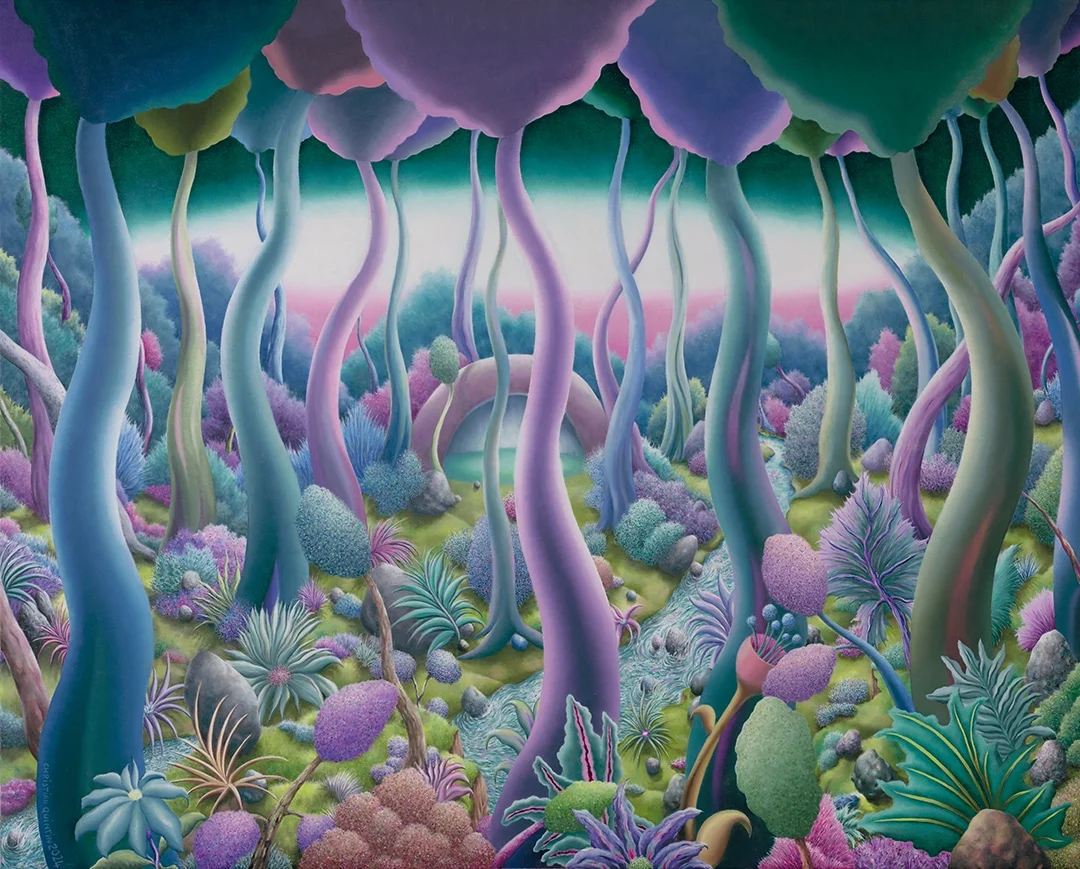
Working in a variety of media—including oil, ink, graphite, and pastel—Quintin produces works that are as technically rigorous as they are emotionally resonant. His surrealist compositions are often the result of months of painstaking labor, utilizing crosshatching and layered symbolism to create "interior constellations." Simultaneously, his landscapes—often inspired by the rugged coastlines of his native Brittany and the rolling vineyards of his adopted Northern California—are what he calls "emotional terrains." In these works, trees do not merely grow; they dance, embrace, and speak, functioning as avatars for human emotion and spiritual presence.
Chronology: From the Moody Cliffs of Brittany to the Valleys of Sonoma
To understand Quintin’s work is to understand the geography of his life. His artistic DNA was first formed in 1957 in Saint Brieuc, a port town on the northern coast of Brittany, France. This region, characterized by its storm-lashed cliffs, ancient ruins, and a pervasive sense of Celtic melancholy, instilled in the young Quintin a deep sensitivity to nature’s grandeur. One specific landmark, the L’Île de la Comtesse, became a mythic anchor for his imagination—a recurring dream of solitude and storybook aura that would manifest in his paintings decades later.
In 1975, Quintin moved to Paris to study at the prestigious Beaux Arts Academy. It was here that his romantic sensibilities met classical discipline. Under the tutelage of masters, he honed the precise draftsmanship and control of form that define his current output. While he absorbed the influence of French Surrealism, he found himself more aligned with the Symbolists and Romantics—artists who used technical perfection to explore the boundaries of the invisible.

The most pivotal shift in Quintin’s career occurred in 1981, when he relocated to Northern California. Settling in Sonoma County, he found a landscape that resonated with the "spirit" he felt within himself. The oak-studded hills and misty valleys of the American West provided a second vocabulary for his art. This transition did not lead to a split practice but rather a synthesis; the old myths of the Old World began to merge with the sacred ecology of the New World.
By the late 1980s and early 1990s, Quintin’s technical mastery began to garner institutional recognition. He received the Grumbacher Award in 1987 and an Award of Excellence from the California State Fair in 1990. However, a major commercial breakthrough occurred in 1999 when he began exhibiting with the Vorpal Gallery. This was a significant association, as Vorpal was famously responsible for introducing the mathematical and surreal works of M.C. Escher to the American public. This placement cemented Quintin’s status as a premier practitioner of visionary, high-concept art.
Supporting Data: The Mechanics of "Kaleidoscopic Consciousness"
The depth of Quintin’s work is perhaps best understood through the lens of his production timeline and specific thematic pillars. His "kaleidoscopic consciousness" paintings are characterized by a level of detail that borders on the devotional.

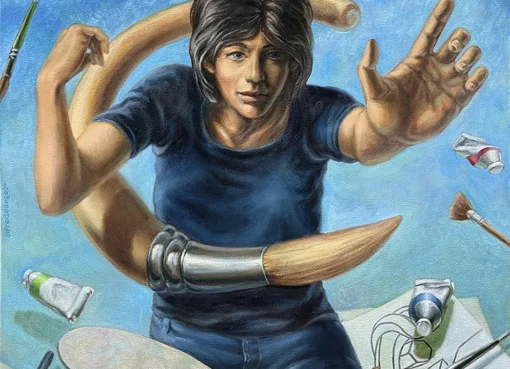
For instance, his work The Aviary—a piece where the artist’s own face emerges from a crystal, his neck transforming into a tree trunk and his hair into a leafy canopy—took six months to complete. Another seminal work, La Porte Ouverte (The Open Door), inspired by the poetry of Rumi, required seven months of intense crosshatching. These timelines are not merely a result of slow work but of a philosophy of "building" an image. Quintin describes the process as a negotiation between spirit and form, where "when you draw a tree, you also draw yourself."
His landscapes provide further data on his use of color as a psychological tool. In A Lake Color of Emeralds, Quintin deviates from literal representation to prioritize emotional accuracy: "The sky is brown-orange with violet, the lake bright emerald, the sea olive green." This use of non-naturalistic color serves to elevate the landscape into a realm of "symbolic language," where the viewer is invited to "read the art as one would read poetry."
The 2020s have seen Quintin’s data points expand globally. Now represented by Lorin Gallery (Los Angeles/Paris), his work has moved from regional California acclaim to international art fairs, including KIAF in Seoul and Art Central in Hong Kong. This expansion suggests a growing global appetite for art that prioritizes beauty and intricacy over conceptual minimalism.

Official Responses: Critical Acclaim and the "Diagnosis of Beauty"
Critics and curators have long struggled to categorize Quintin, often landing on the word "mystery" as a central theme. Alhia Warren, in a noted review, described his portfolio as a "beautiful intimate mystery," while Suzanne Munich characterized his output as "Mental Landscapes."
However, it was a 2022 review from the Calabi Gallery that perhaps most accurately captured Quintin’s relevance in the current art market. The review stated: "In an era largely devoid of it, his work is beautiful. We could all use more beauty in our lives." This was not merely a compliment but a cultural diagnosis. Curators have noted that Quintin’s work fills a psychological gap left by decades of art world cynicism and irony.
Dan Taylor, writing for the Press Democrat, highlighted this "emerging beauty," noting that Quintin’s technical skill allows the viewer to bypass the "shock" of surrealism and enter directly into a state of wonder. Official responses from the Lorin Gallery emphasize that Quintin did not change his style to meet modern trends; rather, the "art world caught up" to his steadfast commitment to classical technique and romantic themes.

Implications: Art as Resistance and the Visionary Continuum
The implications of Christian Quintin’s career extend beyond the frames of his paintings. He represents a vital link in the "Visionary Continuum"—a lineage of artists that includes Dalí, Magritte, and Escher, but also touches upon the psychedelic spiritualists of the 1960s Northern California art scene.
However, Quintin’s legacy is distinct in its quietude. Unlike the aggressive, often jarring nature of traditional Surrealism, Quintin’s work implies that beauty itself is a form of defiance. In a culture characterized by speed and digital transience, his six-month production cycles are a radical act of slowness. His refusal to offer "slogans or manifestos" implies a trust in the viewer’s intuition that is increasingly rare in didactic contemporary art.
Furthermore, Quintin’s work suggests a new way of viewing the relationship between humanity and ecology. By blurring the lines between a human face and a forest, or a room and a landscape, he offers a visual argument for interconnectedness. His art serves as a reminder that the "outer terrain" and "inner consciousness" are a single, seamless environment.
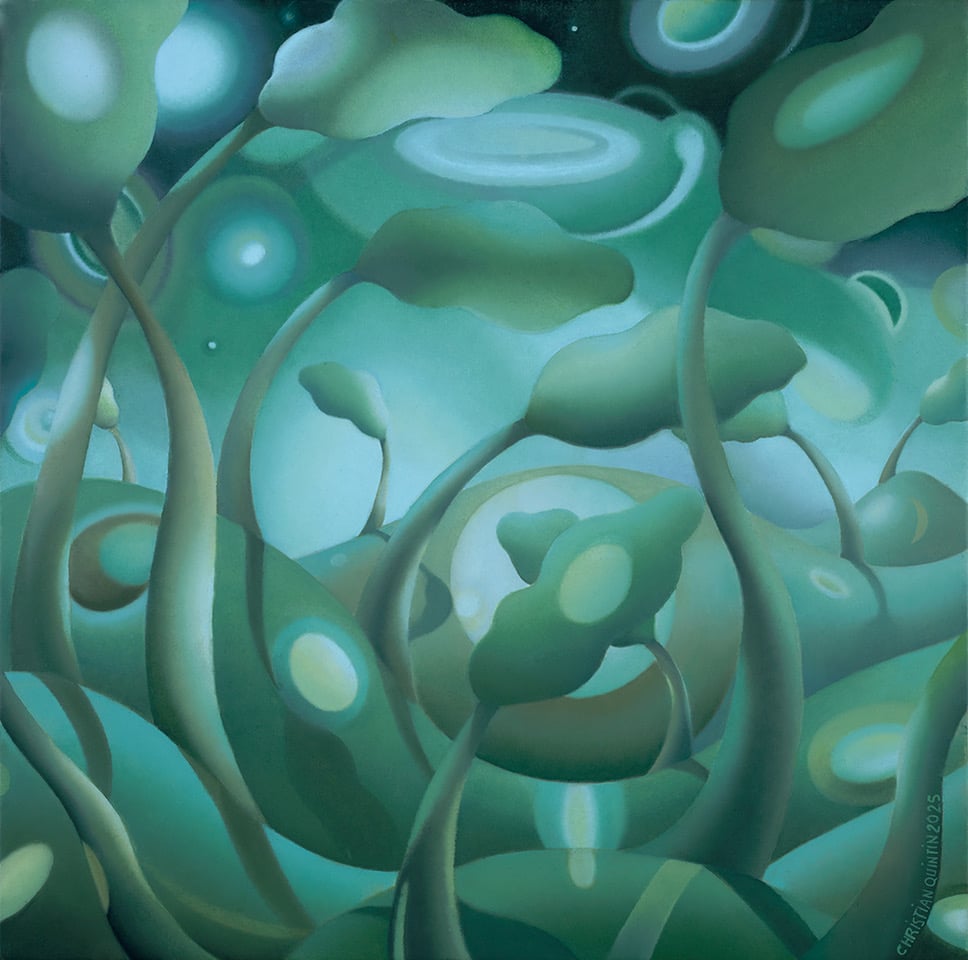
As he prepares for upcoming exhibitions at the Morrison Gallery in Connecticut and continues his representation in Paris and Los Angeles, Quintin’s influence is likely to grow among those seeking "sanctuary." His career stands as a testament to the enduring power of the hand-drawn line and the human need for wonder. In the final analysis, Quintin’s work is not an escape from reality; it is an invitation to re-enter reality with a more profound sense of sight—to see the world not just as it appears, but as it feels before we have words for it.
For further information and to view the artist’s extensive portfolio, visit christianquintin.com.