The Enduring and Problematic Myth of the "Indian Burial Ground" Trope
In the vast tapestry of North American folklore and popular culture, few tropes are as pervasive, instantly recognizable, and ultimately problematic as the notion that a haunted place is built upon an "Indian burial ground." This urban legend has transcended its origins to become a deeply ingrained cultural touchstone, serving as a convenient plot device in horror, a comedic cliché, and even a widespread internet meme. Yet, beneath its surface lies a complex history rooted in settler anxieties, cultural appropriation, and a profound misrepresentation of Indigenous peoples and their sacred traditions.
This article delves into the origins, evolution, and implications of the "Indigenous burial ground" trope, tracing its journey from early colonial fears to its ubiquity in modern media, and examining the significant harm it inflicts on Indigenous communities and historical accuracy.
The Genesis of a Ghostly Trope: From Colonial Fear to Pop Culture Staple
The idea of spirits rising from disturbed Indigenous graves is not a new phenomenon; its roots stretch back to colonial fears and the anxieties of European settlers encroaching upon Indigenous lands. This undercurrent of unease, often fueled by a mix of guilt and misunderstanding, laid the groundwork for the trope’s eventual mainstream explosion.
Early Whispers of Indigenous Hauntings
Long before its crystallization in horror films, the concept of Indigenous spirits haunting settler spaces appeared in nascent forms. Renee L. Berland, in her work The National Uncanny: Indian Ghosts and American Subjects, highlights how many early American writers were preoccupied with Indigenous ghosts. This fascination reflected a broader colonial dread, particularly evident in the late 19th century.
A stark example of this fear manifested during the Ghost Dance movement of the 1890s. This ceremonial dance, practiced by various Indigenous nations across North America, aimed to revitalize Indigenous cultures and, in some interpretations, to raise the spirits of deceased tribal members for protection against settler injustices. Colonist newspapers, however, frequently misconstrued the movement, painting it as a hostile, supernatural threat. This widespread fear tragically culminated in the 1890 Wounded Knee Massacre, where the U.S. Army killed between 150 and 300 Lakota people, predominantly women, children, and Elders. The irony is chilling: settlers, fearing resurrected ghosts, had no qualms about creating new ones.
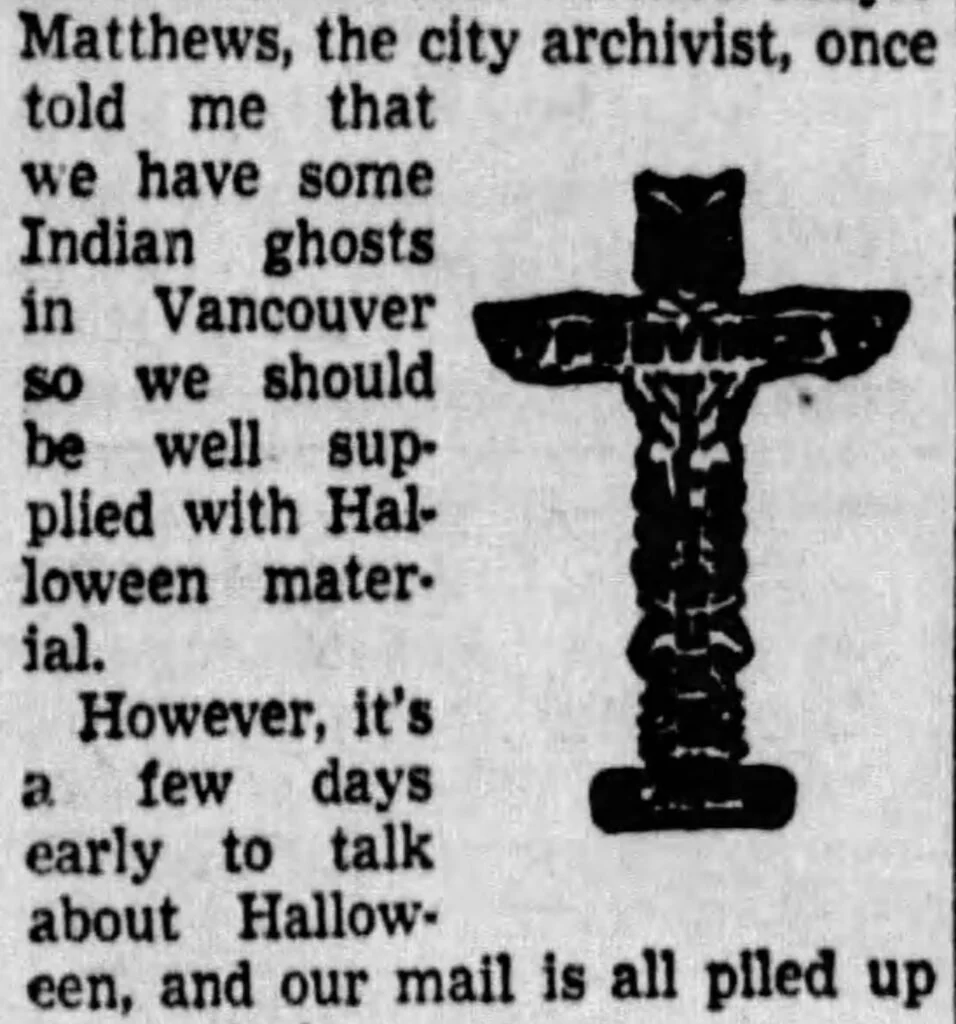
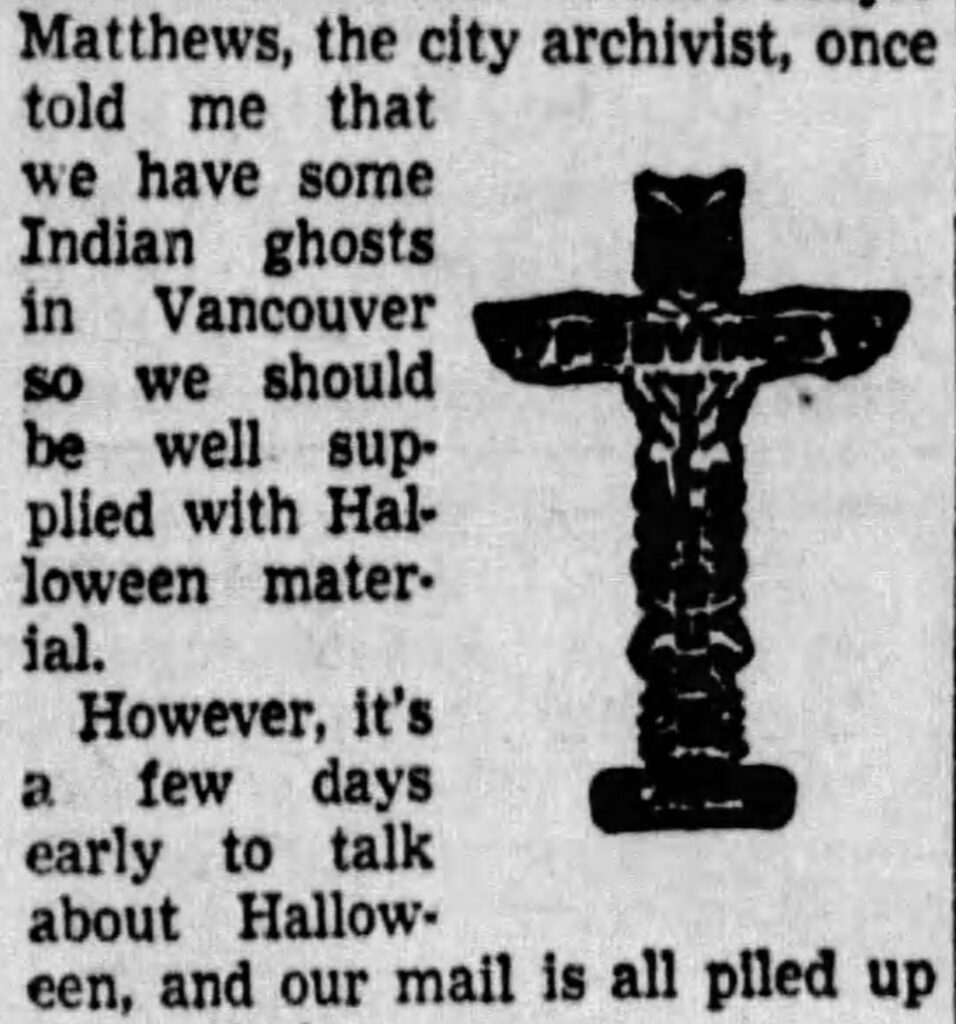
Even in Canada, early accounts reveal similar settler anxieties. In 1924, the Victoria Daily Times reported on seven road builders in British Columbia who experienced four nights of "whishing" sounds and rapping noises. Unable to find a rational explanation, they concluded their camp was built on the grave of a "Red Indian" and promptly relocated. Years later, in 1940, Vancouver City Archivist Major Mathews cryptically mentioned "Indian ghosts" in a newspaper article, offering no elaboration but underscoring the casual presence of such ideas.
Further examples include a 1946 Vancouver Sun story about a headless woman’s ghost near the rumored grave of Tecumseh, the famed Shawnee chief who united Indigenous groups against American expansion. The inclusion of an Indigenous burial site, even a rumored one, was deemed significant enough to be part of the haunting narrative. In 1950, pulp writer Bjarne Kirchhoff published "The Ghost of Graveyard Flats" in the Vancouver Sun, featuring an Indigenous burial ground haunted by a wendigo – a full 33 years before Stephen King’s iconic use of the creature. These early instances demonstrate a pre-existing cultural susceptibility to the idea of disturbed Indigenous graves as sources of paranormal activity, often conflating Indigenous spiritual beliefs with settler fears of the unknown and the "other."
The Trope’s Mainstream Ascent: From Bestsellers to Theme Parks
The 1970s and 80s proved to be a pivotal era for the "Indigenous burial ground" trope, launching it from regional folklore into the global consciousness through hugely influential books, films, and even family entertainment.
The Amityville Horror: A Catalyst for Misinformation
The 1977 bestseller Amityville Horror: A True Story by Jay Anson is often mistakenly credited as the origin point of the trope. Anson’s narrative claimed the infamous Amityville house was built on a Shinnecock "enclosure for the sick, mad, and dying," where individuals were "penned up" and left to die, not buried, due to the Shinnecocks’ belief that the land was demon-infested. Crucially, Anson’s original account did not explicitly mention a burial ground.
The narrative took a significant turn later that year when celebrity TV ghost hunter Hans Holzer, accompanied by medium Ethan Johnson Meyers, investigated the house. According to Holzer, Meyers channeled the ghost of an Indigenous chief who confessed to possessing Ronald Defeo Jr. and murdering his family. This dramatic shift redirected blame from Defeo, or the house’s inherent malevolence, to an Indigenous spirit, effectively legitimizing Holzer and Meyers’ positions as paranormal experts. The 1979 Amityville Horror movie subsequently adapted Holzer’s unsubstantiated claims, cementing the "Indigenous ghost" as the true culprit in the public imagination.
However, these claims were swiftly debunked by the Shinnecock Nation. Numerous statements confirmed that the Shinnecocks never inhabited the Amityville area, nor was it part of their traditional territory. There was no archaeological evidence or oral history supporting the existence of any burial ground or "enclosure" at the site. Holzer and Meyers had successfully co-opted a lesser-known but prevalent Indigenous burial ground narrative to bolster Anson’s already sensationalized "tainted Indigenous land" story, illustrating how easily misinformation can be manufactured and disseminated for profit and notoriety.
Disney’s Unintended Normalization
Around the same time, Disney theme parks unwittingly became a massive amplifier of the trope. In 1979, Big Thunder Mountain Railroad opened in California, followed by its Florida counterpart in 1980. While specific details of the ride’s evolving lore are scarce, the popular narrative describes a runaway train hurtling through a haunted mine and ghost town ostensibly built on Indigenous burial grounds. A 2020 Disney blogger recounted an employee claiming Indigenous spirits could be heard chanting on the ride, though the blogger only perceived drums. Regardless of the nuanced details, hundreds of thousands, if not millions, of visitors, including impressionable children, were exposed to and normalized the "Indigenous burial ground" trope through this beloved attraction.
Stephen King and the Wendigo’s Appropriation
In 1983, Stephen King further solidified the trope’s place in popular culture with his chilling novel Pet Sematary. King not only utilized an Indigenous burial ground as a central literary device but also appropriated a version of the Algonquian wendigo story. The book’s immediate success and subsequent film adaptation cemented its status as a horror classic, simultaneously embedding the problematic trope deeper into the collective consciousness. As Berland noted, while earlier writers explored Indigenous ghosts, King’s novel became "one of the most popular novels that has ever been published," granting the trope unprecedented reach and cultural weight.
The trope also made appearances in other prominent works: Stanley Kubrick’s 1980 adaptation of King’s The Shining hinted at it, and the 1982 film Poltergeist famously featured a suburban house built over an Indigenous cemetery (though it was explicitly stated that this was not the cause of the haunting, instead blaming a developer who only moved the headstones, not the bodies). From Buffy the Vampire Slayer to The Real Ghost Busters cartoon and numerous other TV shows, books, and games, the "Indigenous burial ground" had become a shorthand for supernatural menace.
From Horror to Humor: The Trope’s Pervasive Evolution
The sheer ubiquity of the Indigenous burial ground trope eventually led to its transformation from a chilling horror device into a comedic cliché and, ultimately, a widely shared meme.
Satire and Self-Awareness
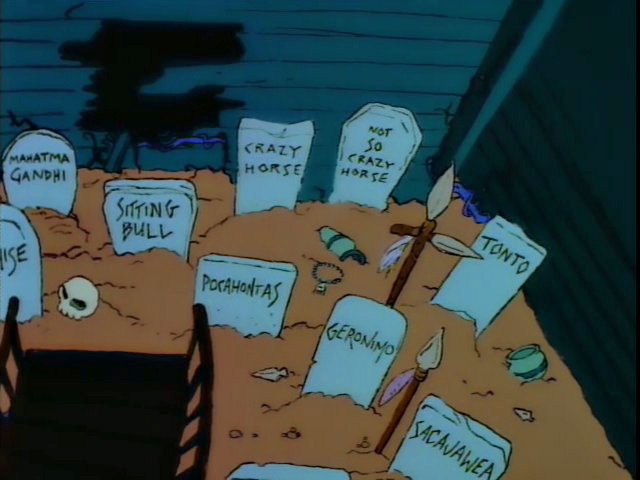
Popular comedy series began to playfully mock the trope, recognizing its overuse and often absurd application. Shows like The Simpsons, Friends, South Park, Family Guy, and Parks and Recreation have all poked fun at the idea, highlighting its predictability and often nonsensical explanations for hauntings. Seth Grahame-Smith’s satirical guide, How to Survive a Horror Movie, even suggests a definitive way to confirm a house is haunted: "Are Native Americans constantly showing up to ask, ‘What happened to our cemetery?’" This comedic turn, while acknowledging the trope’s ridiculousness, also underscored its deep entrenchment in popular culture.
Ghost Hunting TV and the Blame Game
Despite its comedic turns, the trope continues to be employed seriously, particularly in North American ghost hunting television shows. Programs like Ghost Adventures frequently resort to Indigenous burial grounds as an explanation for "demonic" entities or intense paranormal activity. These shows often follow a predictable formula, concluding that Indigenous ghosts are responsible for malevolent hauntings. This strategy, echoing Holzer’s original "shift-the-blame-to-nonwhite-ghosts" approach, has become an alarmingly mainstream tactic, perpetuating harmful stereotypes and simplifying complex spiritual beliefs into sensationalized entertainment.
The Memeification of a Myth
The trope’s journey into the digital age culminated in its transformation into an internet meme. In 2011, the satirical news source The Onion released a video titled "Report: Economy Failing Because U.S. Built on Ancient Indian Burial Grounds," a brilliant piece of comedy that resonated widely. Panelists in the video humorously discuss a fictional congressional report attributing national problems, including economic woes and poverty, to the nation’s foundation on ancient burial grounds, with Republicans demanding "blood offerings" from poltergeists.
Since then, thousands of posts on Twitter and threads on Reddit have echoed this sentiment, creating photo memes and videos that encapsulate the trope’s absurdity. While Atlas Obscura may have been an early non-academic source to critically examine the trope in 2008, the underlying memes and original stories that fueled its popularization have rarely received the same critical attention, allowing the myth to persist and mutate.
Disentangling Fact from Fiction: Indigenous Perspectives and Cultural Appropriation
To truly understand the "Indigenous burial ground" trope, one must examine its folkloric origins and, more importantly, differentiate it from genuine Indigenous spiritual beliefs and historical realities. This is where the narrative becomes significantly more complicated and sensitive.
The Harmful Distortion of Indigenous Beliefs
While real burial grounds exist, and some Indigenous peoples hold beliefs about spirits associated with specific sites, the settler-generated "burial ground" trope rarely reflects these authentic traditions. Instead, it often projects traditional Christian fears of "uncivilized" people and concepts of "consecrated ground" onto Indigenous contexts. The idea that the name of Christ can solve paranormal activity, or that Heaven is exclusive to denominational believers, further illustrates how settler theological frameworks have been superimposed onto Indigenous spiritualities, framing Indigenous spirits as inherently "inferior" or "earthbound."
This "inferior-earthbound ghosts" perspective stands in stark contrast to the richness and diversity of Indigenous spiritual traditions, where traditional versions of the afterlife are often depicted as beautiful, complex, and less judgmental than many settler beliefs. Many Indigenous communities have designated storytellers and knowledge keepers who are entrusted with sharing narratives, many of which are intentionally private and not for public consumption. Furthermore, a widespread traditional belief in some communities is that even speaking about a deceased person can inadvertently invite a haunting, highlighting a profound respect for the departed that is completely absent from the sensationalized trope. The abusive teachings of residential schools, which often instilled in Indigenous children the belief that Jesus was the only cure for evil, also played a role in distorting and suppressing traditional spiritual practices.
Settler Guilt and the Legacy of Injustice
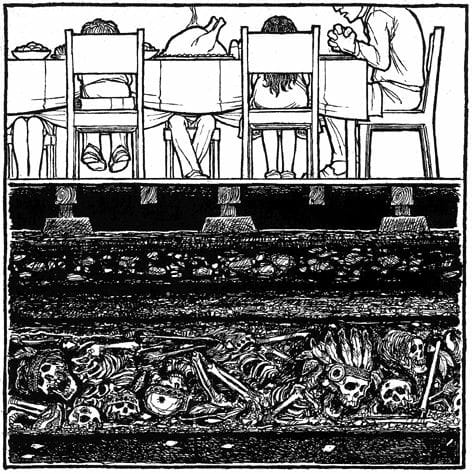
A powerful counter-argument to the problematic trope is the concept of "Settler Guilt." If ghosts are often seen as spirits of people wronged in life, then the pervasive belief in vengeful Indigenous ghosts can be interpreted as a subconscious manifestation of collective guilt over historical injustices. This theory suggests that the descendants of colonizers, who continue to benefit from resources, food, and trade gained through the dispossession of Indigenous lands, are, on some level, haunted by the "sins of our forefathers and foremothers." Ron Cobb’s 1968 illustration, "Thanksgiving in America," vividly captures this sentiment, depicting a settler family enjoying Thanksgiving dinner atop skeletal remains.
However, even settler guilt, while understandable, can inadvertently perpetuate harm when it fuels the spread of inaccurate burial ground myths. Claiming that all places are Indigenous burial grounds delegitimizes actual sacred sites and minimizes the very real crimes and injustices committed against Indigenous peoples – from individual acts of violence to systemic genocides like those uncovered at residential school graveyards.
The Case of Victoria, BC: A City Haunted by Misinformation
The city of Victoria, British Columbia, provides a poignant example of how these myths proliferate. By the 1980s, local ghost hunters Robin Skelton and Jean Kozacari, both self-proclaimed psychics, helped transform Victoria from a city with "few hauntings" (as noted by a 1958 reporter) into one of Canada’s "most haunted." The two most common explanations given for its paranormal activity? Its proximity to water and, problematically, its construction on an "Indigenous burial ground."
While the "water theory" sounds simplistic, the burial ground stories are particularly shameful. Recent news articles, quoting historians, have pointed to well-known burial mounds in Beacon Hill Park and around Cadboro Bay, or even on Saltspring Island, as evidence. Yet, prior to Victoria’s ghost tourism boom, Beacon Hill Park claimed 23 mounds, none of which were built upon. Cadboro Bay is in a neighboring city, not Victoria proper, and Saltspring Island is irrelevant. This narrative ignores the historical reality that local First Nations in ancient times primarily used cairns, with bodies often placed in trees, on raised platforms, or within shoreline caves for millennia. Early settlers even collected Indigenous bones as souvenirs, further disrupting these sites. While Indigenous remains are indeed found, the city was not built on a "mega burial ground" as widely claimed.
The misrepresentation extends to published works. In Skelton and Kozacari’s 1989 book Gathering of Ghosts, the chapter "The Indian Inheritance" attributes a cult’s actions near Nanaimo to "tainted land." Incorrectly identifying the territory as Kwakiutl and a "slave-body dump site," the authors stated: "It seems not unlikely that the long history of Indian raids, feasts, and ritual killings accounted in part for the way in which Brother Twelve’s initially peaceful and gentle community became disturbed… The problem was the land and its history. It was crying out for blood. The evil was in the earth itself." These claims, like those in Amityville, were demonstrably false. Yet, Indigenous people were painted as the culprits, or their "evil soil" made sentient. The brutal irony is that Skelton was a respected university professor and public figure, lending an air of academic credibility to these hateful depictions of "body dumps," "ritual killings," and "evil feasts."
Urban Legends and the Absence of Indigenous Voices
The author’s personal experience further illustrates the pervasive nature of these urban legends. Stories of neighborhoods built on Indigenous burial grounds, complete with tales of chiefs in headdresses appearing to residents, circulated in Prince Albert, Saskatchewan, and in various locations across British Columbia. These tales, typically shared by people of European background, often feature a "friend-of-a-friend" as the source, reinforcing their urban legend status.
Crucially, these narratives almost entirely exclude authentic Indigenous voices and perspectives. While actual stories of spirits associated with ancestral remains exist within Indigenous communities, these accounts are often private and not suitable for consumerism or sensationalized media. The Alutiiq Museum’s chart on protocol for recording Indigenous oral stories serves as a vital reminder of the respect, cultural sensitivity, and ethical guidelines required when engaging with Indigenous narratives. The continued use of disrespectful burial ground terminology and the appropriation of Indigenous spiritual concepts demonstrate a profound lack of respect and understanding.
Implications: Moving Towards Respectful Engagement
The enduring popularity of the "Indigenous burial ground" trope reveals deeply unsettling truths about North American society. Its prevalence as a mainstream explanation for evil hauntings points to a collective subconscious grappling with historical wrongs. Indigenous people are not evil or demonic; their traditional spiritual beliefs are rich, complex, and often more profound and less judgmental than many settler perspectives.
The trope actively harms Indigenous communities by:
- Delegitimizing actual sacred sites: By indiscriminately labeling countless sites as "burial grounds," the trope trivializes genuine ancestral lands and graves that hold deep cultural and spiritual significance.
- Minimizing real historical injustices: It distracts from the tangible and ongoing impacts of colonization, land dispossession, and violence, replacing them with a generalized, supernatural grievance.
- Perpetuating harmful stereotypes: It reduces diverse Indigenous cultures to a monolithic, vengeful "other," reinforcing racist caricatures that strip Indigenous peoples of their humanity and agency.
- Promoting cultural appropriation: It takes sacred or sensitive concepts from Indigenous cultures and distorts them for entertainment, without understanding, consent, or respect.
Moving forward requires a fundamental shift in how these narratives are understood and propagated. It demands critical examination of popular culture, a willingness to challenge ingrained biases, and a commitment to seeking out and amplifying authentic Indigenous voices. Respectful engagement means understanding that "traditional belief" is not "myth or legend" to be casually appropriated, but a living, evolving spiritual framework that deserves deference and protection.
The path toward reconciliation necessitates dismantling these harmful tropes and replacing them with narratives that honor the truth, respect Indigenous sovereignty, and acknowledge the profound spiritual and cultural legacies of the First Peoples of North America. Only by confronting the uncomfortable truths embedded within our popular myths can we begin to foster genuine understanding and build a more just and equitable future.