The Enduring Resonance of The Far Side: Celebrating Gary Larson’s 76th Birthday and a Digital Renaissance
Main Facts: A Milestone for a Master of the Surreal
On August 14, 2026, the world of sequential art paused to celebrate the 76th birthday of Gary Larson, the visionary creator behind The Far Side. While a 76th birthday may not carry the traditional weight of a "diamond" or "platinum" jubilee, the occasion sparked a massive wave of tributes across the "blogiverse," social media platforms, and within the funny pages themselves. The celebration underscores a fundamental truth in the world of illustration: Gary Larson’s influence has not only survived his 1995 retirement but has flourished in the digital age.
The festivities were headlined by industry peers and major media outlets. The Daily Cartoonist, a premier trade publication for the industry, issued formal birthday greetings via Facebook and Bluesky, while Reuben Award-winning cartoonist Mark Tatulli dedicated a panel of his popular strip Lio to honor Larson. Simultaneously, major entertainment news sites including Screen Rant, CBR, and Collider released retrospective analyses and updates regarding Larson’s recent digital output.
Despite having officially retired from daily syndication over three decades ago, Larson remains a central figure in cultural discourse. The recent flurry of activity surrounding his birthday highlights a "new era" for The Far Side, characterized by a sophisticated digital presence and the occasional release of new, digitally rendered work that proves Larson’s wit remains as sharp—and as weird—as ever.
Chronology: From Nature’s Way to a Digital Frontier
To understand the weight of Larson’s 76th birthday, one must look at the timeline of a career that redefined humor.
1979–1980: The Genesis
Gary Larson’s career began in earnest with a strip titled Nature’s Way in the Seattle Times. It was here that he began honing his signature style: a single-panel window into a world where animals possessed human neuroses and humans were often the victims of their own absurdity. In 1980, the strip was syndicated by Chronicle Features and renamed The Far Side.
1980–1995: The Golden Era of Syndication
For fifteen years, The Far Side was a staple of the Sunday funnies and daily newspapers worldwide. Larson’s work was eventually carried by more than 1,900 newspapers and translated into dozens of languages. During this time, Larson won the National Cartoonists Society’s Reuben Award for Outstanding Cartoonist of the Year twice (1990 and 1994), cementing his status as a titan of the medium.

1995–2019: The Long Sabbatical
On January 1, 1995, Larson retired from daily syndication, citing a desire to go out while the strip was still at its peak and to avoid the "graveyard of the funny pages." For twenty-four years, Larson largely retreated from the public eye, though his calendars and anthology books (such as The PreHistory of The Far Side) continued to sell millions of copies.
2019–Present: The Digital Resurrection
In late 2019, the official The Far Side website was completely redesigned. This was not merely an archival project; Larson announced that he had discovered the joys of the digital tablet. This led to the "New Stuff" section of the website, where Larson began posting brand-new cartoons for the first time in a quarter-century. The most recent of these, a tribute to primatologist Jane Goodall titled "Club Gombe," continues to be a focal point for fans eager for new content.
Supporting Data: Why Larson Remains the "Greatest of All Time"
The birthday tributes were accompanied by several deep-dive articles that quantify Larson’s impact. Robert Wood of Screen Rant recently argued that one specific Far Side comic remains the "greatest comic strip of all time." The strip in question features "The Midvale School for the Gifted," depicting a young student named Jerry Miller straining with all his might to push open a door clearly labeled "PULL."
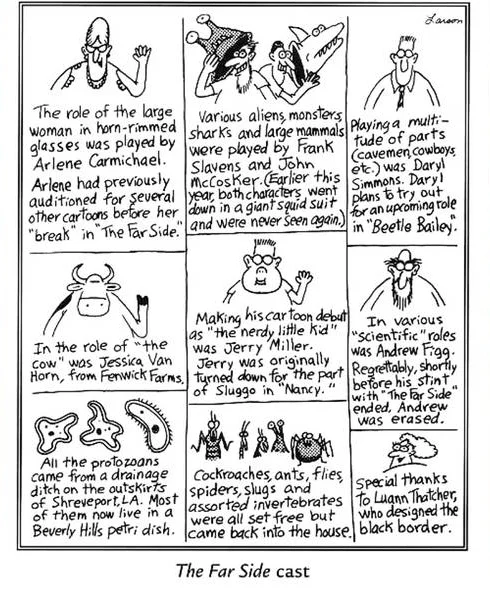
This single panel encapsulates the "Larsonesque" philosophy: the juxtaposition of perceived intelligence with fundamental human fallibility. This "nerdy little kid" has become an icon for the absurdity of the human condition.
Supporting the claim of Larson’s enduring relevance, CBR’s Annie Banks recently published a list of "10 Obscure Facts About The Far Side," noting that Larson’s work has had a tangible impact on the scientific community. Larson is one of the few cartoonists to have a species named after him—Strigiphilus garylarsoni, a species of chewing louse found only on owls. This intersection of science and humor is a hallmark of his data set; his cartoons frequently appear in biology textbooks and laboratory doors worldwide.
Furthermore, the "New Stuff" section on the official website represents a significant pivot in Larson’s artistic data. By moving from pen and ink to digital media, Larson has been able to experiment with textures, colors, and lighting that were impossible in the four-color newsprint era. This evolution has allowed him to maintain his relevance among a younger, digitally native demographic.

Official and Peer Responses: A Community in Celebration
The cartooning community’s response to Larson’s 76th birthday reflects a deep-seated professional respect. Mark Tatulli’s tribute in Lio is particularly noteworthy. Tatulli, himself a Reuben Award winner, has often been cited as a spiritual successor to Larson, utilizing a wordless, often dark, and surrealist approach to humor. By honoring Larson in his own strip, Tatulli acknowledges the "genealogy of the surreal" that Larson pioneered.
The Daily Cartoonist, acting as the record of note for the industry, emphasized that while 76 is not a "round" number like 75 or 80, the outpouring of affection for Larson is a constant. The publication noted that the "blogiverse" is perpetually fueled by Far Side discourse, ranging from "best of" rankings to deep dives into strips that "only make sense to Gary Larson."
Recent reporting from Collider also addressed a moment of confusion among the fanbase. After a brief hiatus in updates on the official website, some speculated that Larson had stopped producing content. Collider clarified that the "Daily Dose"—the rotation of classic strips—had resumed after a "weeks-long absence," though the "New Stuff" section remains static for now. This level of granular media attention to the update schedule of a 76-year-old’s website is a testament to his unique standing in the media landscape.
Implications: The Future of the Single-Panel Format
The continued celebration of Gary Larson at 76 carries several implications for the future of the medium and the business of syndication.
1. The Longevity of Surrealism
Larson proved that "smart" humor—humor that requires a basic understanding of evolution, physics, or classical literature—has a permanent market. In an era of shrinking attention spans, the single-panel format remains a powerful tool. Larson’s success implies that there is a path forward for cartoonists who eschew traditional character-driven narratives in favor of conceptual, one-off gags.
2. The Power of Direct-to-Consumer Digital Platforms
By bypassing traditional syndicates for his "New Stuff," Larson has demonstrated the viability of the creator-owned digital model. His website serves as a museum, a retail store, and a new-release platform all at once. This model is being increasingly adopted by younger artists on platforms like Instagram and Patreon, but Larson’s success shows that even "legacy" artists can thrive by reclaiming their digital rights.

3. The "Larson Gap" in the Funny Pages
The fact that major publications are still ranking his strips 30 years after his retirement suggests a "Larson Gap" in modern newspapers. While strips like Pearls Before Swine or Lio carry the torch of cynicism and surrealism, the sheer density of Larson’s cultural impact remains unmatched. This suggests that the market for "intellectual absurdity" is underserved in the current syndication landscape.
4. Scientific Literacy Through Humor
Finally, Larson’s birthday reminds us of the role humor plays in scientific communication. By making scientists and animals his protagonists, Larson humanized the natural world. As we face global challenges regarding climate and biology, the "Far Side" lens—which views humans as just another species of bipedal animal struggling to understand the rules—remains a vital, if eccentric, perspective.
As Gary Larson enters his 77th year, his legacy appears less like a relic of the 20th century and more like a bridge to the 21st. Whether he ever posts another "New Stuff" panel or simply continues to let his "Daily Dose" of classics circulate, his place in the pantheon of great American satirists is secure. The nerds at the "Midvale School for the Gifted" are still pushing on pull doors, and as long as they do, Gary Larson will have an audience.