The Fragility of the Present: Marc Padeu’s ‘Memento Vivere’ and the Stoic Reclamation of Time
“It’s not that we have a short time to live, but that we waste much of it,” wrote the Stoic philosopher Lucius Annaeus Seneca nearly two millennia ago. In his seminal essay De Brevitate Vitae (On the Shortness of Life), penned around 49 A.D., Seneca challenged the Roman elite to stop squandering their most precious resource—time—on trivialities and the pursuit of hollow status. Today, these ancient words find a vibrant, contemporary resonance in the work of Cameroonian artist Marc Padeu.
Opening at the Larkin Durey gallery in London, Padeu’s latest exhibition, Memento Vivere, offers a profound visual meditation on the intersection of labor, spirituality, and the temporal nature of existence. By transposing the grand iconographic traditions of the Italian Renaissance onto the sun-drenched cocoa plantations of Cameroon, Padeu invites viewers to reconsider the value of the "now" against the backdrop of eternity.
Main Facts: A New Suite of Works in London
Marc Padeu’s Memento Vivere is a collection of large-scale acrylic paintings that serve as both a philosophical inquiry and a cultural bridge. The exhibition, hosted by Larkin Durey, marks a significant moment in the artist’s career, showcasing his ability to weave complex theological themes into the fabric of contemporary West African life.
The title, Memento Vivere, translates from Latin as "remember to live." It is a deliberate and optimistic inversion of the more common art-historical motif memento mori ("remember you will die"). While the latter focuses on the inevitability of the grave to humble the powerful, Padeu’s focus is on the urgency of the present. He argues that the true tragedy of the human condition is not death itself, but the failure to truly inhabit the life one is given.

Central to this body of work is Padeu’s signature technique of merging scenes of everyday communal labor with the compositions of Renaissance religious masterpieces. In works like La promesse et l’agneau (The Promise and the Lamb), Padeu utilizes the structural logic of the "Adoration of the Magi" to elevate the status of cocoa plantation workers, casting them not as mere laborers, but as participants in a divine, timeless narrative.
Chronology: From Antiquity to the Contemporary Canvas
The intellectual timeline of Memento Vivere spans centuries, connecting the papyrus of 1st-century Rome to the digital age of the 21st century.
- 49 A.D.: Seneca writes De Brevitate Vitae, establishing the philosophical groundwork for the "shortness of life" and the concept of time as a non-renewable resource.
- The Renaissance (14th–17th Centuries): European artists like Leonardo da Vinci and Caravaggio develop the iconography of the Nativity and the Adoration, establishing a visual language for the "sublime" and the "divine."
- Late 20th/Early 21st Century: Marc Padeu begins his artistic journey in Cameroon, developing a style that balances technical precision with deep social and spiritual commentary.
- 2020–2025: Padeu gains international recognition for his "Cocoa" series, which highlights the socio-economic realities of his homeland through the lens of high-art traditions.
- July 17, 2026: The exhibition Memento Vivere officially opens at Larkin Durey in London, scheduled to run through August 14.
This chronology illustrates how Padeu is not merely "copying" old masters but is participating in a long-standing dialogue about human value. By placing modern Cameroonian figures in poses traditionally reserved for saints and kings, he collapses the distance between the historical "then" and the urgent "now."
Supporting Data: Visual Symbolism and Narrative Depth
Padeu’s work is characterized by its immense scale and vibrant use of acrylics, which allow him to capture the specific textures of the Cameroonian landscape—the waxy leaves of cocoa trees, the rough skin of melons, and the soft drape of white cotton garments.

Iconographic Transposition
In La promesse et l’agneau, the composition is anchored by a mother and child. To a Western viewer, the reference to the Madonna and Child is instantaneous. However, the "gifts" being brought are not gold, frankincense, or myrrh, but the fruits of the land and the livestock of the community. This transposition serves a dual purpose: it sanctifies the act of labor and local production, while simultaneously de-Westernizing the concept of the "holy family."
The Dialectic of Life and Death
The exhibition features several key works that illustrate the "fragile gift" of life:
- "Sous le poids de la coupe" (Under the Weight of the Cup): A poignant 2026 work measuring 66 7/8 x 78 3/4 inches. It depicts three distraught women in white, huddled together while a man lies on the ground. The title suggests both the physical weight of the harvest and the metaphorical "cup" of suffering or destiny.
- "Le prix de la promesse" (The Price of the Promise): This painting shows a trio of men in a wooded glade skinning a white rabbit. The clinical, yet communal nature of the act reflects the cycle of life and the sacrifices required for survival.
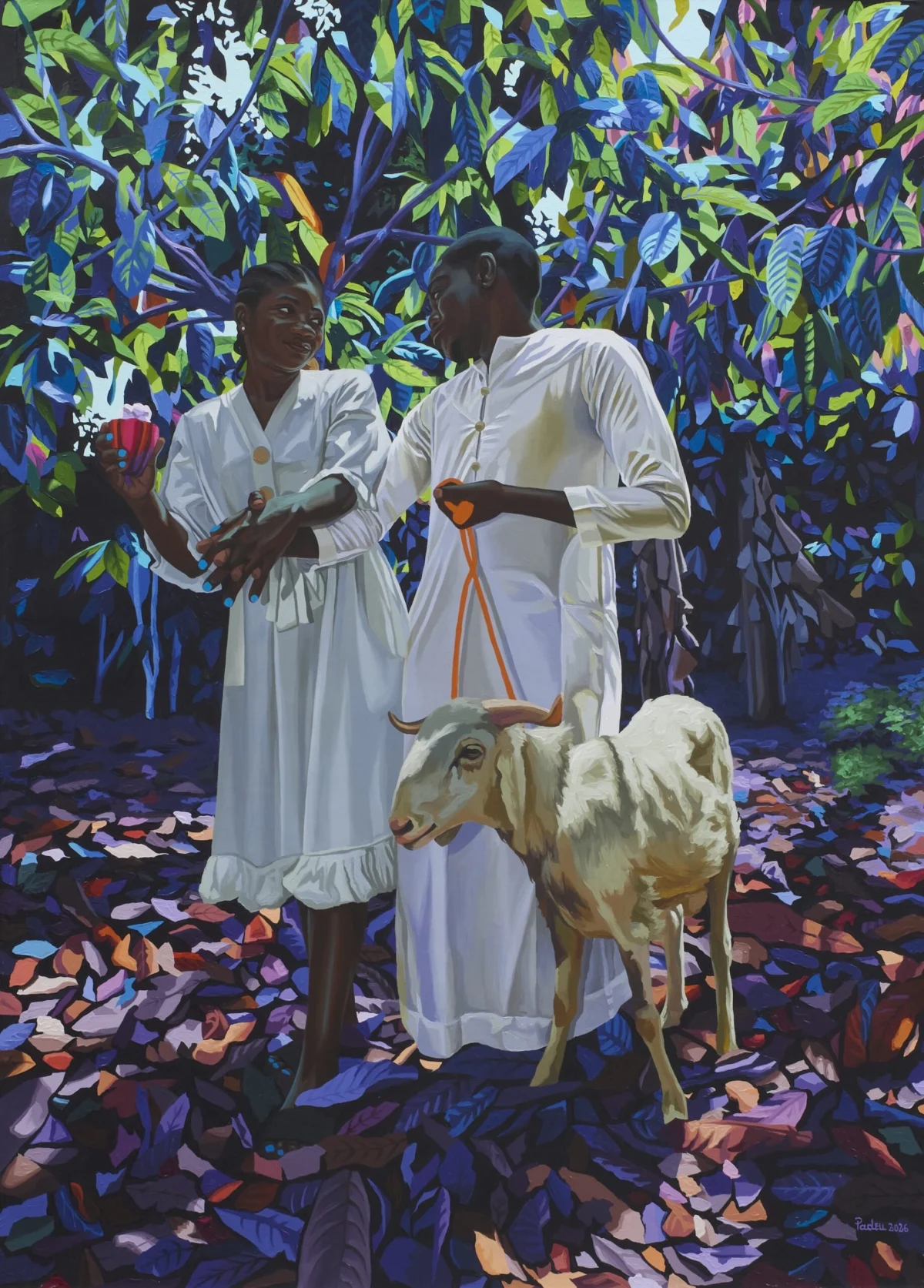
- "Le chemin partagé" (The Shared Path): A vertical composition featuring two young people and a goat. The direct gaze between the figures suggests a deep, human connection—the "family and craft" that Seneca argued were the only worthy pursuits.
Technical Specifications
The works are predominantly large-format acrylics on canvas. The use of acrylic allows Padeu to achieve a certain flatness that recalls medieval frescoes, yet with a modern saturation that makes the scenes feel immediate and "alive." The scale (often exceeding six feet in width) forces the viewer into a physical relationship with the subjects, demanding that their humanity be acknowledged on a grand scale.
Official Responses: The Curatorial Perspective
The Larkin Durey gallery has positioned the exhibition as a significant exploration of the "mysterious sublime." In their official statement, the gallery notes that Padeu’s figures exist in a state of temporal flux:

“Days follow one another, harvests come round again and yet, despite this ebb and flow of life, his figures are caught outside of time, slipping between past, present and future. Each painting is poised between promise and fate, light and shade; the figures existing simultaneously in a spiritual and secular realm, neither saints nor heroes but with a growing awareness that life is a fragile gift.”
Curators highlight that Padeu’s work does not shy away from the realities of the cocoa industry—an industry often associated with exploitation and grueling labor. However, instead of presenting a purely documentary or political view, Padeu chooses to find the "divine" within that labor. The "growing awareness" mentioned by the gallery refers to the figures’ own realization of their place in the universe—a core tenet of Stoic philosophy.
The gallery’s focus on the "secular and spiritual" suggests that Padeu is attempting to heal the rift between the two. In his world, the act of harvesting cocoa or skinning a rabbit is as much a spiritual rite as a prayer, provided it is done with the awareness of the "now."
Implications: The Intersection of Tradition and Globalism
The implications of Marc Padeu’s work extend far beyond the walls of the London gallery. His art speaks to several critical contemporary dialogues:

1. The Decolonization of Art History
By utilizing Renaissance structures, Padeu is not submitting to Western standards; he is "occupying" them. He proves that the "universal" themes of European art—birth, death, sacrifice, and adoration—are equally present in the rural communities of Cameroon. This challenges the Eurocentric notion that high-concept philosophical art is the sole domain of the Global North.
2. The Global Cocoa Trade
While the paintings are beautiful and spiritual, they are inextricably linked to the cocoa plantations. Cameroon is one of the world’s largest producers of cocoa, and the industry is a cornerstone of its economy. Padeu’s work forces the viewer to see the people behind the commodity. The chocolate consumed globally is the result of the "daily life" Padeu depicts. By elevating these workers to the status of religious icons, he demands a higher level of respect and ethical consideration for their labor.
3. A Modern Stoic Revival
In an era of digital distraction and "wasted time," Padeu’s call to Memento Vivere is a necessary intervention. Much like Seneca’s audience in Rome, modern society is often preoccupied with the "future" or the "accumulation of wealth," forgetting to inhabit the present. Padeu’s paintings, with their still, quiet dignity, serve as a visual "pause button." They suggest that the "things that really matter"—family, nature, and craft—are available to everyone, regardless of their station in life.
4. The Enduring Power of the Figurative
At a time when much of the contemporary art market is dominated by abstraction or digital media, Padeu’s commitment to the human figure and the "hand-crafted" nature of painting is a statement in itself. It reaffirms the power of the image to convey complex philosophical truths through the simple representation of the human form.

Conclusion
Marc Padeu’s Memento Vivere is more than an art exhibition; it is a philosophical manifesto rendered in acrylic. By drawing a direct line from Seneca’s stoicism through the religious fervor of the Renaissance to the cocoa fields of Cameroon, Padeu creates a timeless space where the viewer is forced to confront the brevity of their own existence.
As the figures in his paintings move between "light and shade," they remind us that life is not something to be managed or controlled, but something to be lived with intention. In the shade of the cocoa trees, Padeu finds the sublime, proving that even in the most mundane of daily tasks, there is a promise of the divine—if only we remember to look.
Memento Vivere runs from July 17 to August 14, 2026, at Larkin Durey, London. For those unable to attend in person, the artist continues to document his process and the evolution of his "divine secularism" through his digital archives and social platforms, ensuring that the message of Seneca remains as relevant today as it was on papyrus two millennia ago.