The Gamification of Survival: How a Design Sketch Helped Visualize the Pandemic
By [Your Publication Name] News Desk
Six years after the initial tremors of the COVID-19 pandemic began to reshape global society, a retrospective look at the intersection of game design and public health reveals a surprising story of how digital simulations were used to bridge the gap between complex epidemiological data and public understanding. What began as a frustrated Facebook post by a veteran game designer evolved into a series of educational tools that were eventually used in classrooms and vetted by medical professionals.
Main Facts: Bridging the Literacy Gap Through Simulation
In early 2020, as the world struggled to grasp the implications of a novel coronavirus, the primary challenge for public health officials was not just the virus itself, but a widespread "numerical illiteracy" regarding exponential growth. While epidemiologists and statisticians saw a looming catastrophe in the Infection Fatality Rates (IFR) and R values (the basic reproduction number of a virus), the general public often struggled to visualize how a small number of cases could lead to millions of deaths.
Raph Koster, a renowned game designer known for his work on Ultima Online and Star Wars Galaxies, recognized that the same mathematical principles used to balance complex virtual economies and combat systems were identical to those governing the spread of a virus. On March 24, 2020, Koster published a "design sketch" on social media, outlining a simple but scientifically grounded simulation.
This sketch served as the blueprint for two notable independent projects: Covid Ops, developed by John Albano, and In the Time of Pandemia, a Philippine-based project led by Khail Santia. These games did not just aim to entertain; they sought to provide a "visceral understanding" of the choices faced by policymakers—testing, social distancing, and the high cost of medical intervention. By the time the pandemic reached its peak, these simulations had been played by tens of thousands of people, providing a stark, interactive counter-narrative to the denialism and misinformation prevalent at the time.
Chronology: From Rumors to Viral Simulations
The timeline of this digital intervention mirrors the rapid escalation of the pandemic itself.
Late 2019: The Early Warnings
As early as November 2019, individuals within the tech and gaming communities who monitored global data patterns began noticing anomalies in China. Koster notes that his earliest social media warnings date back to this period, long before the virus became a household name.
March 2020: The Design Sketch
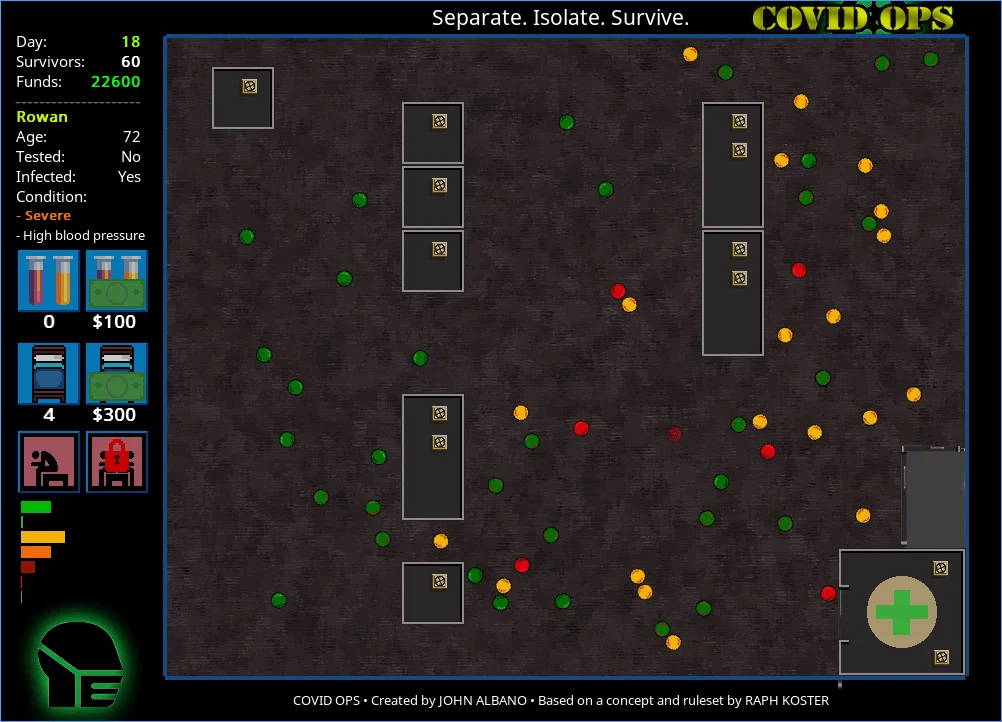
By March 2020, as the United States and Europe entered their first wave of lockdowns, Koster realized that the public discourse was failing to account for the mathematical reality of the situation. On March 24, he posted a detailed game design document on Facebook. He proposed a simulation involving "little circles on a plain field," where each circle represented a person with specific attributes: age, a name, and statistically valid chances of having comorbidities like diabetes or hypertension.
April 2020: The First Prototypes
The response from the development community was near-instantaneous. Within six days, developer John Albano released Covid Ops on the indie game platform Itch.io. Albano’s version was a faithful recreation of Koster’s mechanics, allowing players to manage resources, order tests, and observe the devastating impact of the virus on "high-risk" digital citizens.
Simultaneously, in Cebu City, Philippines—then a major COVID-11 hotspot—developer Khail Santia began work on In the Time of Pandemia. Developed during a strict community quarantine, Santia’s project was part of "Jamdemic 2020," a game jam dedicated to pandemic-related education.
July 2020: Global Recognition
By July 2020, In the Time of Pandemia had grown into a massive collaborative effort involving 48 people, including mathematical biologists and medical doctors. The game launched on Newgrounds, where it topped the charts and gained significant press coverage across the Pacific Rim, eventually becoming a tool for university classrooms to teach the complexities of public health management.
Supporting Data: The Mathematics of Mortality
The core of these simulations was built upon the grim reality of the data. Koster’s original calculations—often dismissed by skeptics at the time—suggested that even with a low average death estimate of 0.4% and a 60% infection rate for herd immunity, the death toll would be in the millions.
Real-World Outcomes vs. Initial Estimates
History has largely validated these early warnings. Current estimates suggest the following:
- United States: 1.2 to 1.4 million deaths.
- Worldwide: 15 to 28.5 million deaths.
The simulations were designed to show that "herd immunity" was not a simple goal but a moving target influenced by viral evolution. The games also highlighted the massive segment of the population that fell into the "at-risk" category—a fact many people underestimated.
The Impact of Comorbidities
To ensure medical plausibility, the developers integrated data from the American Heart Association and the American Diabetes Association. The simulations emphasized that the at-risk population was not a small, isolated group. According to data cited in the project:
- Hypertension: Affects roughly 46% of adults in the U.S.
- Diabetes: Affects over 10% of the population, with many more being pre-diabetic.
- Age: The IFR was shown to be strongly tilted toward older demographics, but the games demonstrated that because the virus spreads primarily within households, protecting the vulnerable required isolating entire families, not just individuals.
Official Responses: Academic and Medical Validation
Unlike many commercial games, these pandemic simulations received direct feedback and validation from the medical and academic communities. This collaboration transformed the projects from simple indie games into "serious games"—a genre of software designed for a primary purpose other than pure entertainment.
The Academic Perspective
Gregg Victor Gabison, Dean of the University of San Jose-Recoletos College of Information, Computer & Communications Technology, utilized In the Time of Pandemia for student playtesting. He noted, "This is the kind of game that mindful individuals would want to check out. It has substance and a storyline that connects with reality." The game’s ability to force players to make difficult choices about resource allocation was seen as a vital educational tool.
The Medical Perspective
Dr. Mariane Faye Acma, a resident physician who consulted on the medical plausibility of the simulations, emphasized the cognitive benefits of the game. "You decide who are the high risks, who needs to be tested and isolated… The game will make players realize how challenging the work of the health sector is in this crisis."
The developers also included real-world resource links within the games, directing players to official health guidelines and support systems, effectively turning the software into a portal for public health advocacy.
Implications: Preparing for the Next "Exponential Curve"
The legacy of these 2020 simulations extends beyond the COVID-19 pandemic. They represent a significant moment in the history of "serious games," proving that interactive media can communicate complex systemic risks more effectively than static graphs or news reports.
The Failure of Traditional Communication
A recurring theme in the reflections of the developers is the frustration with how traditional discourse focused on the economic impact of lockdowns while ignoring the mathematical inevitability of the virus’s spread. Koster argues that the health response was often "too soft" or "too lenient" because the public and policymakers failed to "feel the challenges in their bones." Games, by their nature, force players to experience the consequences of their actions, making them uniquely suited for teaching crisis management.
The Threat of H5N1 and Future Pandemics
As of late 2024 and early 2025, the world is facing new threats, including the first human cases of H5N5 (and H5N1) bird flu. The developers of these simulations warn that the lessons of 2020 are being forgotten. Denialism regarding death tolls and the long-term impacts of disease (such as Long COVID) continues to permeate social media.
Conclusion: Games as a Tool for Resilience
For the developers involved, these projects were a way to "transcend the chaos outside." Khail Santia noted that the process of building the simulation provided a "thread connecting [him] to a diversity of talents" during a time of extreme isolation.
The success of these projects suggests that in the future, public health agencies might benefit from partnering with the gaming industry to create interactive simulations before a crisis reaches its peak. By allowing the public to play through "what-if" scenarios, society may become better equipped to understand the "exponential curves" that define modern global risks.
As Raph Koster concluded in his retrospective, the goal of a game can be more than just high scores—it can be about making a difference in how we perceive our survival. "That’s not a bad thing for a game to aspire to."