The Gamification of Survival: How Game Design Principles Decoded the Pandemic’s Exponential Math
Six years after the initial shockwaves of the COVID-19 pandemic, the global discourse has largely shifted toward economic recovery, educational deficits, and the retrospective analysis of lockdown efficacy. However, a significant chapter in the history of the pandemic remains under-examined: the role of game designers in bridging the gap between abstract mathematical modeling and public understanding.
When traditional health communication failed to convey the gravity of exponential growth, a group of developers led by industry veteran Raph Koster leveraged systems design to create interactive simulations. These "serious games" transformed static spreadsheets into visceral experiences, providing a segment of the population with their first "bone-deep" understanding of epidemiological mechanics.
I. Main Facts: Bridging the Gap Between Math and Intuition
The central challenge of the early COVID-19 era was not just a lack of data, but a widespread "innumeracy"—an inability to grasp the implications of exponential growth. While epidemiologists and statisticians saw a looming catastrophe in late 2019, the general public and many policymakers struggled to visualize how a low-percentage fatality rate could translate into millions of deaths.
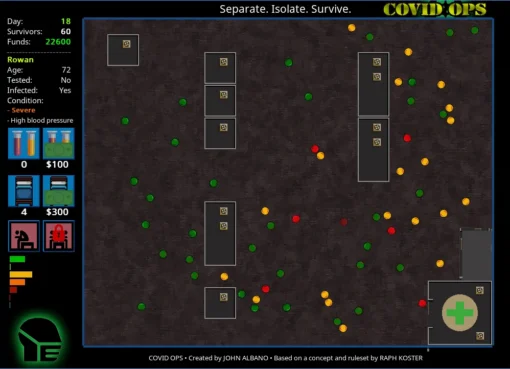
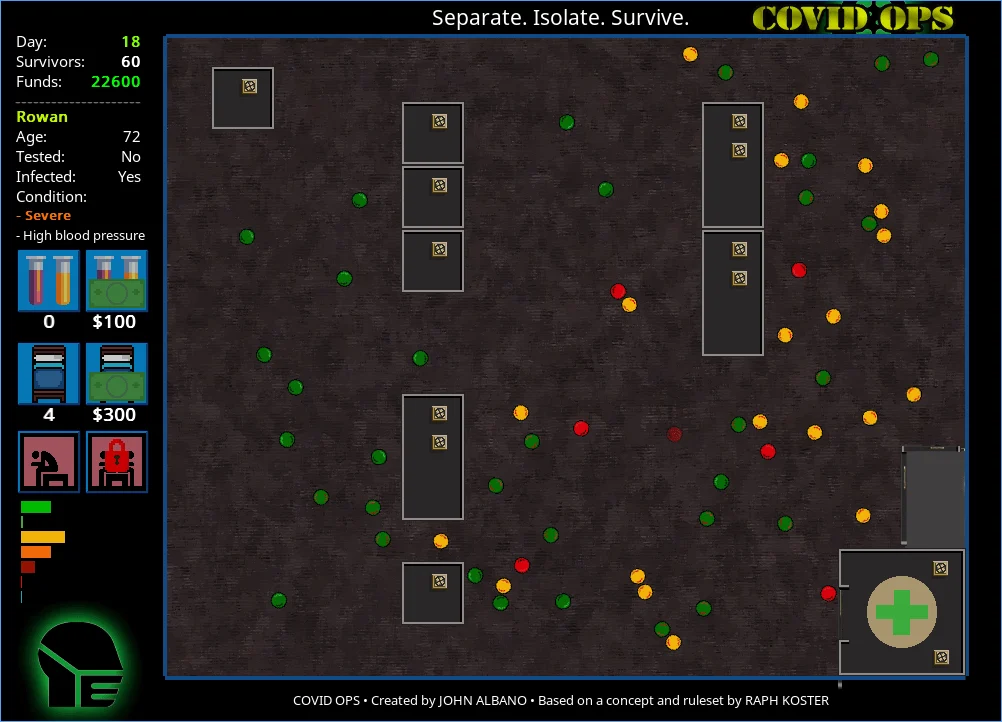
Raph Koster, a renowned game designer known for his work on Ultima Online and Star Wars Galaxies, recognized that game designers are uniquely equipped to understand these systems. By March 2020, Koster published a "design sketch" on social media—a blueprint for a simplified pandemic simulator. This sketch served as the foundation for two notable projects: Covid Ops, developed by John Albano, and In the Time of Pandemia, led by Khail Santia.
These games were not intended for entertainment in the traditional sense. Instead, they were "procedural rhetorics"—simulations designed to make a point through interaction. By allowing players to manipulate variables like social distancing, testing capacity, and lockdown timing, these games demonstrated the fragility of healthcare systems and the lethal reality of comorbidities.
II. Chronology: From Rumors to Viral Simulations
Late 2019: The Early Warnings
The timeline of this initiative begins in November 2019. Koster, monitoring reports out of China, began posting early warnings on social media. At the time, the Infection Fatality Rate (IFR) and the R value (the average number of people one infected person will infect) suggested a catastrophic trajectory. Koster’s early calculations, which projected millions of deaths based on a conservative 0.4% IFR and 60% population infection rate, were met with widespread skepticism and even ridicule from the public.
March 2020: The Design Sketch
By March 24, 2020, as the world entered various stages of lockdown, Koster realized that raw data was failing to persuade. He posted a detailed design specification for a "little game" that would visualize the spread of the virus. The concept was simple: "Little circles on a plain field. Each circle simply bounces around."
The design included:
- Variable States: Healthy, Asymptomatic, Symptomatic, Hospitalized, and Deceased.
- Comorbidities: Assigning circles real-world risk factors like age and underlying health conditions.
- Player Agency: Buttons for "Order Social Distancing," "Contact Trace," and "Build More ICU Beds."
April – July 2020: Rapid Prototyping and Global Reach
The response from the development community was near-instantaneous.
- March 30, 2020: John Albano released Covid Ops on Itch.io, just six days after Koster’s post. The game was a faithful recreation of the sketch, allowing players to see how quickly a single "asymptomatic circle" could overwhelm a local hospital system.
- April 6, 2020: Khail Santia and his team in Cebu City, Philippines, developed the first version of In the Time of Pandemia for the "Jamdemic 2020" game jam.
- July 2020: In the Time of Pandemia launched on Newgrounds. It eventually topped the charts, reaching tens of thousands of players across the Pacific Rim.
III. Supporting Data: The Mechanics of Risk
The power of these simulations lay in their grounding in statistical reality. Koster and the subsequent development teams utilized real-world data to ensure the games were medically plausible.
The Comorbidity Factor
One of the most significant hurdles in public perception was the belief that the "at-risk" population was a small, isolated group. To counter this, the games integrated data regarding the prevalence of comorbidities in the United States:
- Hypertension: According to the American Heart Association, nearly 46% of U.S. adults have high blood pressure.
- Diabetes: The American Diabetes Association notes that over 10% of the population is diabetic, with another 34.5% being pre-diabetic.
- Pulmonary Issues: Data from JAMA indicates significant portions of the population suffer from chronic respiratory issues.
By assigning these traits to the "circles" in the game, players realized that "protecting the vulnerable" actually meant isolating or treating nearly half of the population—an impossible task without broader community mitigation.
The Math of Overload
Koster’s original calculations used a low-end estimate of a 0.4% death rate. When applied to a population the size of the United States (approx. 330 million), with a 60% infection rate for herd immunity, the math resulted in:
330,000,000 x 0.60 x 0.004 = 792,000 deaths.
As the pandemic progressed, the actual toll in the U.S. reached between 1.2 and 1.4 million, confirming that the early "low-end" estimates used in these games were, in fact, conservative. Worldwide, estimates now place the death toll between 15 and 28.5 million.
IV. Official Responses and Expert Validation
Unlike many "indie" games, In the Time of Pandemia underwent rigorous vetting by the medical and academic communities, particularly in the Philippines, which was a COVID-19 hotspot at the time.
Medical Plausibility
Dr. Mariane Faye Acma, a resident physician who consulted on the game, emphasized its educational value: "The game will make players realize how challenging the work of the health sector is in this crisis. You decide who are the high risks, who needs to be tested and isolated, where to focus, and how much funds to allocate."
Academic Integration
Gregg Victor Gabison, Dean of the University of San Jose-Recoletos College of Information, Computer & Communications Technology, utilized the game for student play-testing. He noted that the game possessed a "storyline that connects with reality," providing a mindful way for individuals to process the chaos of the pandemic.
Global Press Coverage
The success of these simulations caught the attention of international media. Outlets such as IGN Southeast Asia, The Star Malaysia, and Yahoo Style Singapore covered the games, highlighting them as essential tools for "flattening the curve." The Filipino team eventually grew to 48 contributors, including mathematical biologists who validated the underlying simulation code.
V. Implications: Serious Games as Public Policy Tools
The legacy of the COVID-19 design projects extends beyond the 2020 lockdowns. It highlights a critical shift in how society can communicate complex, life-threatening information.
1. The Democratization of Systems Thinking
Epidemiology is a science of systems, and games are the most effective medium for teaching systems thinking. By allowing the public to "play" with the variables of a pandemic, these games bypassed the political and emotional barriers that often hinder public health messaging. They provided a "sandbox" where the consequences of inaction were visible and immediate, rather than abstract and distant.
2. Readiness for Future Threats
As Koster noted in his recent reflections, the threat of zoonotic diseases remains present, citing the recent emergence of human cases of H5N5 bird flu. The frameworks established by Covid Ops and In the Time of Pandemia provide a blueprint for rapid-response educational tools. Should another pandemic occur, the ability to deploy verified, interactive simulations within days could save lives by fostering earlier public compliance.
3. Psychological Resilience for Creators
For the developers, the act of creation was a form of "transcending the chaos." Khail Santia described the process as a "thread connecting me to a diversity of talents," providing a sense of agency during a time of global helplessness. This suggests that "civic hacking"—the use of technology and design to solve public problems—has significant mental health benefits for the contributors themselves.
4. The Enduring Value of the "Design Sketch"
The fact that a single Facebook post by a game designer could catalyze two international projects and reach tens of thousands of people speaks to the power of open-source collaboration. It suggests that in the digital age, the most effective responses to global crises may not come from top-down government mandates alone, but from decentralized networks of experts sharing their "design sketches" with the world.
In conclusion, the pandemic simulators of 2020 were more than just games; they were a necessary evolution in public health communication. By making the invisible math of a virus visible, Raph Koster and his peers demonstrated that in the face of an exponential threat, understanding the system is the first step toward surviving it.