The Physicality of Sound: An In-Depth Analysis of the Woojer Vest 4 and the Future of Haptic Immersion
The trajectory of extended reality (XR) has always been defined by "firsts." There is the first time a user dons a VR headset and realizes the world moves with them; the first time a motion controller simulates the weight of a virtual object; and the first time mixed reality allows a digital entity to occupy physical space. However, as the visual and auditory fidelity of these systems reaches a plateau of excellence, the industry is turning toward the "third pillar" of immersion: haptics.
The Woojer Vest 4 represents the current zenith of consumer-grade haptic wearables. Far from the subtle, localized vibrations found in a standard game controller, the Vest 4 is a full-torso "physical sound" system designed to turn low-frequency audio into a visceral, tactile experience. At its highest intensity, it is a device that does not merely suggest presence—it enforces it.

Main Facts: The Architecture of Tactile Audio
The Woojer Vest 4 is a high-fidelity haptic suit that translates audio frequencies between 1Hz and 250Hz into mechanical kinetic energy. Priced between $349 and $499 depending on regional promotions and retailers, it occupies a premium niche in the gaming and home cinema accessory market.
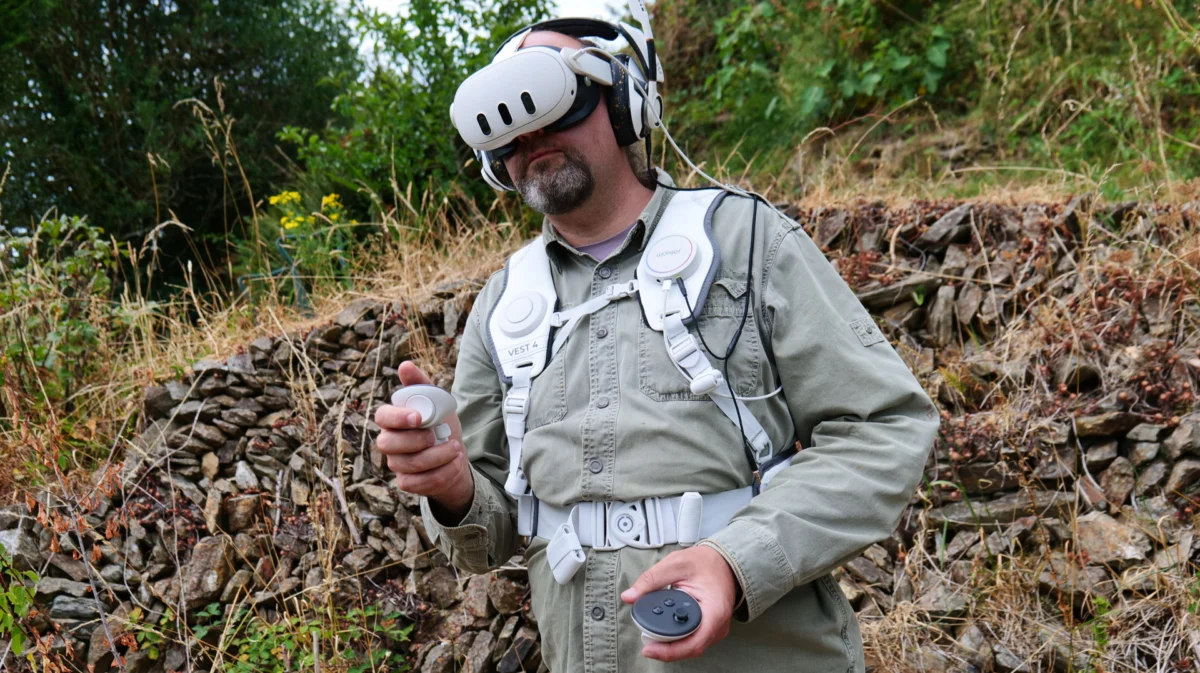
Unlike traditional haptic systems that rely on software-specific integration, the Vest 4 is audio-driven. It functions effectively as a wearable surround-sound subwoofer. The device utilizes six patented OSR (Oscillating Frame) transducers: two positioned on the chest, two on the back, and two on the flanks (waist). This configuration is designed to provide a 360-degree haptic field, allowing the user to feel the directionality of explosions, the rumble of engines, and the rhythmic pulse of music.

The unit is constructed from a combination of high-grade neoprene and faux leather, weighing approximately 3.3 lbs (1.5 kg). It features a dedicated control unit on the left-hand side, a companion mobile app for fine-tuning, and a battery life rated for up to 10 hours of continuous use.
Chronology: From Kickstarter Curiosity to Generation Four
To understand the Vest 4, one must look at the evolution of the haptic wearable market. The concept of "feeling" sound gained mainstream traction in the mid-2010s, largely driven by the now-defunct Subpac. The original Subpac was a relatively blunt instrument—a single large transducer that vibrated the spine. While effective for music producers, it lacked the nuance required for modern gaming.

Woojer entered the scene via crowdfunding, promising a more distributed and sophisticated approach. The first-generation Woojer products were small, clip-on transducers. As the technology matured, the company moved toward the "Vest" form factor.
- Generation 1 & 2: Focused on proving the concept of bone-conduction haptics in a wearable format.
- Generation 3 (The Vest Edge): Introduced a more streamlined design and improved the frequency response range, making it a favorite among VR enthusiasts.
- The Vest 4 (Current): Represents the most significant hardware refinement to date. It introduces a more breathable mesh interior, improved Bluetooth 5.0 connectivity, and a more sophisticated signal processing unit that allows for "Modes" (Gaming, Cinema, Music) to better interpret the incoming audio stream.
This chronological progression reflects a broader industry trend: moving away from "vibration" as a gimmick and toward "haptics" as a high-fidelity data stream.

Supporting Data: Technical Specifications and Performance Metrics
The efficacy of the Woojer Vest 4 is rooted in its technical specifications, which separate it from entry-level haptic "rumble" vests.
Transducer Technology and Frequency Range
The Vest 4’s six transducers are tuned to the infrasonic and subsonic ranges (1Hz to 250Hz). For context, most human hearing begins at 20Hz. By capturing frequencies as low as 1Hz, the Woojer Vest 4 can simulate "pressure" rather than just "shaking." This is critical for simulating the atmospheric pressure of a nearby explosion or the heavy thrum of a helicopter rotor.

Connectivity and Latency
The device offers a trifecta of connection options:
- Bluetooth 5.0: Offers the most freedom but introduces roughly 140ms of latency. While acceptable for movies and casual music, it can be detrimental in competitive gaming.
- 3.5mm Analog: The gold standard for zero-latency haptics, though it necessitates a "cable spaghetti" setup when used with wired headphones and VR headsets.
- USB-C: Provides a high-fidelity digital path, ideal for PC and PlayStation 5 setups.
Ergonomics and Thermal Management
At 1.5kg, the vest is designed to distribute weight across the shoulders and waist. Testing indicates that while the weight is negligible during active play, the thermal profile is not. Because the vest must be worn snugly to ensure the transducers have contact with the body, it acts as an insulator. In high-intensity VR titles like Beat Saber or Pistol Whip, users can expect a significant increase in perspiration, a factor that Woojer addresses by selling optional washable liners.

Performance Analysis: The "Audio-Driven" Paradigm
The most significant distinction in the haptic market is between "Audio-Driven" and "Telemetry-Driven" systems.
The Universal Advantage
Because the Woojer Vest 4 reacts to audio, it is universally compatible. It does not require developers to write specific code for it. Whether playing a 20-year-old classic on an emulator, watching a blockbuster on Netflix, or listening to a lossless audio track on Tidal, the Vest 4 functions immediately. In Battlefield 6, the low-end roar of a collapsing building translates into a sustained wave of pressure across the torso that adds a level of "threat" the eyes and ears cannot achieve alone.

The Positional Limitation
The trade-off for this universal compatibility is a lack of true positional awareness. A telemetry-driven suit (like the bHaptics TactSuit) can tell the user exactly where they were shot because it receives data from the game engine. The Woojer Vest 4, however, only knows what is in the left or right audio channel. While the six transducers create an "enveloping" sensation, they cannot distinguish between a bullet hitting your back and a grenade exploding in front of you if both sounds are centered in the audio mix.
Official Positioning: Target Audience and Market Context
Woojer has positioned the Vest 4 as a premium lifestyle accessory rather than a niche gaming peripheral. Their marketing emphasizes a "Sync" between the digital and the physical, targeting three distinct pillars:

- The VR Enthusiast: For users of the Meta Quest 3 or PSVR2, the Vest 4 provides the "physical body" that is often missing in virtual environments. It bridges the gap between seeing a world and feeling part of it.
- The Sim-Racer: In the sim-racing community, haptics are essential for "feeling" the car. The Vest 4 allows drivers to feel gear shifts, engine RPMs, and curb strikes without the multi-thousand-dollar investment of a motion rig.
- The Audiophile/Cinephile: By allowing users to "feel" a concert or a film’s score without waking the neighbors with a physical 12-inch subwoofer, the Vest 4 offers a private, high-impact cinema experience.
Industry analysts suggest that Woojer’s decision to remain audio-driven is a strategic move to avoid the "walled garden" problem that plagues many VR accessories. By remaining platform-agnostic, they maximize their potential user base across PC, console, and mobile.
Implications: The Future of Sensory Friction
The Woojer Vest 4 highlights the primary tension in modern tech: the balance between Immersion and Friction.

The Vest 4 undeniably increases immersion. It adds a literal new dimension to media. However, it also increases "friction"—the effort required to begin a session. A user must charge the vest, put it on, adjust the straps for a snug fit, route the audio cables or pair Bluetooth, and manage the mobile app to ensure the "Mode" matches the content.
As XR moves toward "frictionless" experiences (like the Apple Vision Pro’s eye-tracking or the Quest’s controller-free hand tracking), the Woojer Vest 4 stands as a reminder that true, high-fidelity immersion still requires hardware.

The Path Forward
The success of the Vest 4 suggests a growing appetite for "Full-Body Gaming." As haptic technology continues to shrink and become more efficient, we may see these transducers integrated directly into gaming chairs or even standard clothing.
For now, the Woojer Vest 4 is a "pro-sumer" device. It is for the player who wants to turn their immersion "up to 11" and is willing to deal with the heat, the cables, and the cost to get there. It is not a necessary component for gaming, but once a user has experienced the rhythmic "kick" of a shotgun or the rolling bass of a synth-wave track through their ribcage, going back to "silent" gaming feels like watching a movie with the colors turned off.

The Woojer Vest 4 doesn’t just play sound; it makes sound a physical reality, marking a significant, albeit expensive, milestone in the quest for the ultimate sensory experience.