"The Pit of Loch-Durnan": A Retrospective on a Critically Flawed Yet Conceptually Brilliant D&D Module
Main Facts
In the annals of tabletop role-playing game history, some modules fade into obscurity, while others become touchstones of excellence or infamy. Mystic Eye Games’ The Pit of Loch-Durnan, an adventure designed for 2nd to 4th level characters within the D20 system, falls into a unique category: a product simultaneously lauded for its innovative core concept and condemned for its abysmal execution. Originally reviewed in March 2002, this module sparked controversy not only for its inherent quality but also for the heated exchange it provoked between its publisher and a prominent independent reviewer. The module presents a seemingly straightforward quest – cleansing a mine of goblins – that quickly devolves into a sinister trap orchestrated by a powerful, imprisoned demon, designed to enslave the very adventurers dispatched to save the day. Despite its significant flaws, including amateurish production values and glaring narrative inconsistencies, the underlying premise offered a tantalizing subversion of classic fantasy tropes, leaving many to wonder what could have been.
Chronology
The Module’s Genesis and Initial Release (Early 2000s)
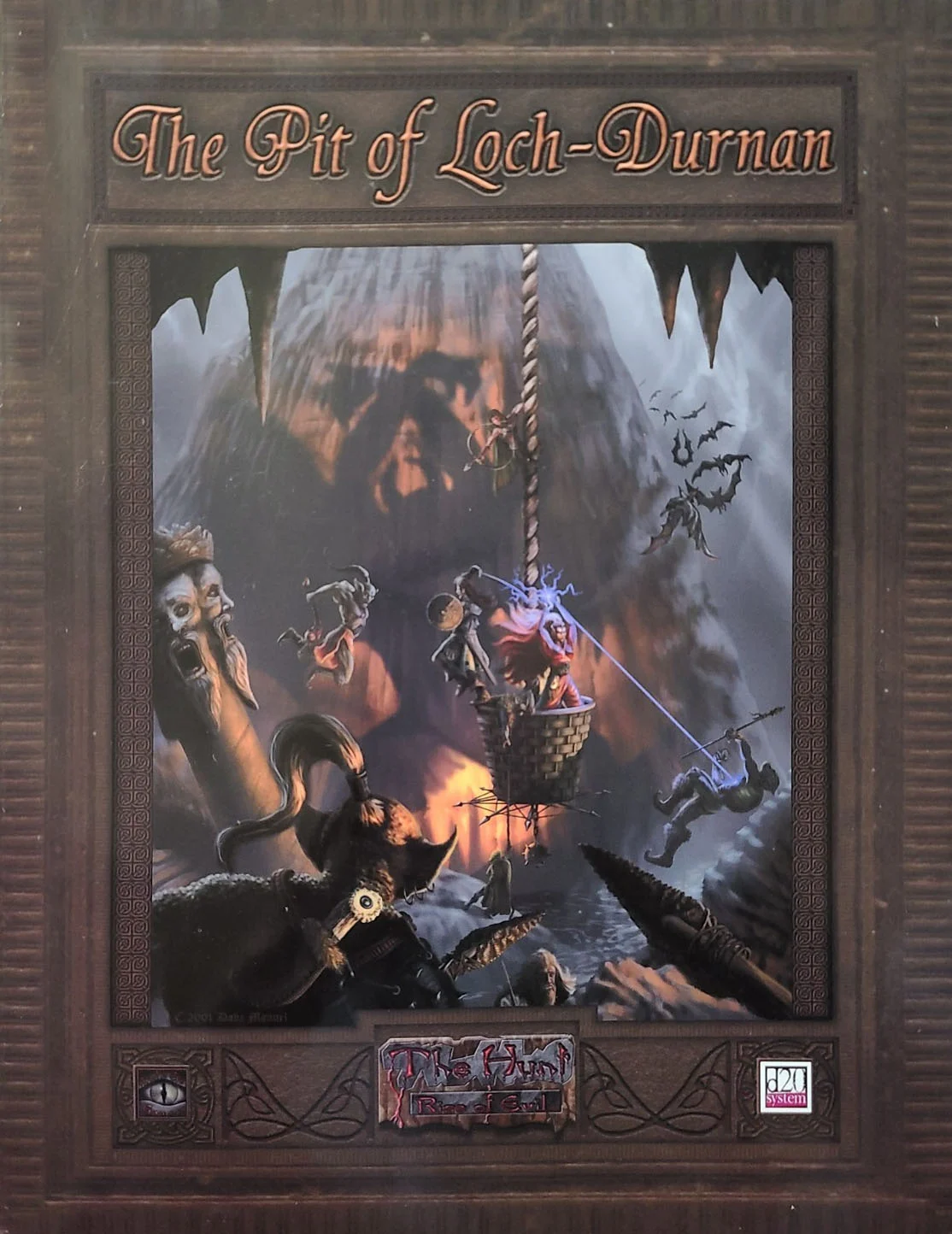
The Pit of Loch-Durnan, authored by Doug Herring and Andrew Thompson and published by Mystic Eye Games, emerged during a vibrant period for the D20 system, a time when numerous third-party publishers were releasing content for Dungeons & Dragons 3rd Edition. The module’s striking cover art, often cited as its single most polished element, likely contributed to an initial wave of positive buzz. Indeed, early reviews, distinct from the critical assessment that would follow, reportedly "raved" about the adventure, culminating in its nomination for the Best Adventure ENnie Award in 2001 – a decision that later reviewers, including the one central to this article, would find perplexing given the module’s pervasive issues.
The Alexandrian’s Critical Review (March 13th, 2002)
On March 13th, 2002, a detailed review of The Pit of Loch-Durnan was published, offering a stark contrast to the module’s initial reception. The review, which would later become a source of contention, meticulously dissected the adventure, highlighting its numerous shortcomings while acknowledging its latent potential. The reviewer, a figure now widely recognized for his analytical approach to RPG design, employed an unusual format: first outlining the module’s plot, then immediately diving into a comprehensive list of its "bad stuff" before finally discussing its "good stuff." This structural choice underscored the sheer volume of problems identified, suggesting that the flaws were so fundamental they overshadowed any positive elements.
The "Scandal" of Cross-Posting (2002)
The review’s impact extended beyond its critique of the module itself. In an era predating unified review platforms, the reviewer practiced cross-posting his articles across multiple independent RPG review sites, including RPGNet, ENWorld, and the now-defunct d20reviews.com. Each site often utilized its own distinct scoring rubric – for instance, RPGNet’s "Style & Substance" vs. a simple "X out of 5 Stars" or a more granular breakdown of "Playability, Mechanics, and Graphics." When The Pit of Loch-Durnan received varying numerical scores across these platforms, despite the textual content of the review remaining consistent, Mystic Eye Games seized upon this discrepancy.
The publisher privately contacted the reviewer, demanding the removal of the reviews under threat of withholding future review copies. Upon the reviewer’s refusal, Mystic Eye Games went public, accusing him of attempting to "tank" their review scores through inconsistent ratings. They argued for a simple mathematical conversion between different rubrics, a position the reviewer staunchly rejected, asserting that different criteria inherently lead to different evaluations. This public "kerfuffle" highlighted the nascent industry’s struggles with independent criticism, publisher relations, and the standardization of review methodologies.
Retrospective Insights (Years Later)
Years after its initial publication, the reviewer revisited the article, adding a retrospective commentary that offered further context and solidified his assessment. He candidly admitted that his original attempt to explain the module’s failures by detailing his extensive revisions (a staggering 35 pages of fixes) might have been unclear to readers who hadn’t engaged with the original text. He reaffirmed his belief that The Pit of Loch-Durnan was "quite likely the worst published adventure" he had ever run, even while acknowledging that, after his comprehensive overhaul, the play experience at the table had been "really fantastic." This paradox underscored the module’s unique position: a deeply flawed product containing a truly brilliant, albeit buried, core idea. The retrospective also cemented the reviewer’s skepticism regarding the early ENnie Awards, given the module’s seemingly unmerited nomination.
Supporting Data
The review provided a wealth of specific examples to support its claims regarding The Pit of Loch-Durnan‘s quality.
The Plot: A Subversive Core
The central plot twist served as the module’s most compelling feature. What begins as a classic "goblin problem in the village mine" quickly transforms into a far more insidious scenario. The villagers who beg for aid are, in fact, enslaved by a powerful demon trapped within the mine. Their plea is a ruse, an "elaborate trap" designed to lure capable adventurers into the demon’s clutches, thereby increasing its power through their enslavement. The PCs, once abandoned in the titular pit, must navigate undead minions, goblin slaves (also victims of the demon), destroy the demon’s crystal, infiltrate the mansion of the twin brothers responsible for the demon’s release, defeat them, and ultimately free the village. This deconstruction of a fundamental adventure cliché was hailed as a stroke of genius, albeit one that required significant effort to unearth and properly implement.
The "Bad Stuff": A Litany of Flaws
The criticisms were extensive, focusing on both the module’s production and its narrative design:
- Amateurish Production Values: The "biggest and most glaring problem" was the "atrocious" layout and "god-awful" illustrations. Radically different fonts were "rammed up against each other," bold, italic, and underline text were "rampantly overused," and paragraph spacing was "inconsistent at best, illegible at worst." This created a product that "reeks of amateurism." The only saving grace was the front cover, which was of significantly higher quality than the interior.
- Silly NPC Naming: Character names like "Gormon," "Warphit," "Sheepo the Goblin," and "Tippi the Ghoul" were criticized for being "oddly jarring" and creating a "Sesame Street of Horrors" vibe, undermining the module’s potential for dark fantasy.
- Lack of Logical Coherence: The module failed to provide essential narrative connective tissue. There was no clear explanation for why the demon wanted to attract adventurers, how the goblins came to be in the pit, or their purpose within the dungeon. Similarly, the backstory for key NPC Barlan lacked credibility and internal consistency.
- Missed Betrayal Opportunity: Crucially, the adventure as written failed to capitalize on its core concept of betrayal. PCs would only learn the truth about the villagers’ complicity after defeating the demon, effectively nullifying any sense of mystery, build-up, or dramatic tension. The reveal was a narrative afterthought rather than a central, unfolding plot point.
- Unresolved Endings: The module neglected to consider the villagers’ actions or reactions once the demon was defeated, and the reaction tables for the final confrontation with the demon crystal were deemed impractical.
The "Good Stuff": Diamonds in the Rough
Despite the extensive criticisms, the reviewer identified several key strengths that hinted at the module’s underlying potential:
- Exceptional Maps: The maps for the "Pit" itself were praised as "well thought out," providing a solid foundation for encounters, even if the goblin inhabitants weren’t designed to be sufficiently proactive.
- The Subversive Concept: The core idea of turning the classic "save the village" cliché into a demon-orchestrated trap was recognized as brilliant and worthy of the effort required to fix the module’s shortcomings.
- Strong Characters and Memorable Scenes: Beyond the silly names, some NPCs had strong potential, particularly the antagonists. A standout scene involved a rescued family confronting their son, now a "decayed and rotting zombie," requiring the PCs to physically restrain the father from approaching the monstrous remains of his child. This moment was cited as a classic example of poignant horror.
Official Responses
Mystic Eye Games’ official response, as detailed by the reviewer’s retrospective, was aggressive and defensive. Rather than engaging with the substantive criticisms, the publisher focused on discrediting the reviewer and his methodology. Their initial private demand for the reviews’ removal, followed by public accusations of "tanking" scores based on perceived mathematical inconsistencies across different review platforms, constituted their primary "official" response. This approach suggested a publisher more concerned with managing public perception and protecting sales than with addressing the legitimate feedback on their product’s quality. Their actions created a "scandal" that, while ultimately proving inconsequential to the review’s content, illustrated the nascent industry’s unpreparedness for robust, independent critique. There is no record provided of Mystic Eye Games publicly addressing the specific design flaws or production quality issues outlined in the review.
Implications
The saga of The Pit of Loch-Durnan and its controversial review carries several significant implications for the tabletop RPG industry, game masters, and reviewers alike.
For Game Publishers: The Perils of Poor Execution and Defensive Reactions
This case serves as a cautionary tale for game publishers. The Pit of Loch-Durnan demonstrates that a compelling concept, no matter how brilliant, can be severely undermined by poor execution across multiple facets:
- Production Quality: The abysmal layout, art, and typesetting alienated readers from the outset, making the content difficult to access and lending an air of amateurism to the entire product. Publishers must invest in professional editing, layout, and art direction to ensure their products are presentable and legible.
- Narrative Coherence and Polish: Gaps in logic, unexplained motivations, and missed dramatic opportunities indicate a lack of thorough developmental editing and playtesting. A strong editor could have helped the authors refine the plot, deepen character motivations, and ensure the core betrayal concept was effectively delivered to the players.
- Responding to Criticism: Mystic Eye Games’ defensive and aggressive reaction to critical feedback was counterproductive. Instead of engaging constructively with the specific points raised – which, as the reviewer later proved, highlighted genuinely fixable issues – they chose to attack the messenger. A more mature and professional approach would have involved acknowledging the feedback, perhaps promising improvements in future products, and fostering a better relationship with the review community. This incident likely damaged their reputation more than the review itself.
For Game Masters: The Power of Revision and Personalization
For Game Masters (GMs), The Pit of Loch-Durnan embodies the concept of a "diamond in the rough." It highlights the GM’s crucial role in transforming raw material into a memorable experience:
- The GM as an Editor and Designer: The reviewer’s extensive revisions—35 pages of fixes—demonstrate that a dedicated GM can salvage even the most flawed adventure. This includes refining plot points, clarifying motivations, enhancing dramatic tension, and personalizing content to fit their campaign. The module served as "unmolded clay," requiring significant effort to become a "sculpture."
- Prioritizing Core Concepts: Despite its flaws, the module’s core idea of a subverted cliché resonated. GMs can learn to identify and extract these strong concepts from published materials, even when the surrounding execution is weak, and then build upon them using their own creativity.
- Cost-Benefit Analysis: The reviewer explicitly stated he felt he "got a decent bang for my buck" because the module "slotted very nicely into one of the D&D campaigns I’m currently running," despite the "massive amount of revision." This illustrates that for some GMs, the time investment in revision can be justified if the core idea perfectly fits their needs.
For RPG Reviewers and the Industry: Navigating Objectivity and Publisher Relations
The controversy surrounding the review of The Pit of Loch-Durnan also offers insights into the evolving landscape of RPG criticism:
- The Challenge of Objective Scoring: The "scandal" over inconsistent scores across different platforms underscored the difficulty of establishing universally applicable rubrics for subjective creative works. It highlighted the valid point that different criteria (e.g., "Style & Substance" vs. "Graphics") will naturally yield different scores, and a simple mathematical conversion is often inappropriate. This debate contributed to the ongoing discussion about how to best evaluate and communicate the quality of RPG products.
- The Importance of Independent Criticism: The reviewer’s refusal to bow to publisher pressure affirmed the critical role of independent reviewers in holding publishers accountable and providing honest feedback to consumers. Without such independence, the industry risks becoming an echo chamber of marketing rather than a space for informed discussion and improvement.
- Credibility of Awards: The ENnie Award nomination for a module later deemed "quite likely the worst published adventure" by a respected critic raises questions about the initial assessment processes for industry awards and the potential for early hype to overshadow objective quality. It emphasizes the need for rigorous, consistent evaluation standards in award selections.
Conclusion: A Flawed Gem or a Diamond in the Rough?
Ultimately, The Pit of Loch-Durnan stands as a complex artifact in the history of D20 adventures. It is a module plagued by a "lot of problems," ranging from its amateurish production to its underdeveloped narrative elements. Yet, it simultaneously possesses a "salvageable" core, boasting "strong encounters" on well-designed maps, a "subversive core concept" that brilliantly deconstructs a classic trope, and "memorable characters" capable of delivering genuinely poignant moments.
The consensus remains that while "there are definitely better D20 modules on the market," The Pit of Loch-Durnan offers "enough material to chew on" for a dedicated Game Master willing to invest "a little elbow grease." The reviewer’s personal success in transforming it into a "highly entertaining module" for his group, albeit after 35 pages of revisions, attests to its latent potential.
Mystic Eye Games, the publisher, undoubtedly missed an opportunity to deliver a truly exceptional product. The raw talent and promising ideas embedded within the adventure hinted at what could have been. As the reviewer expressed, "it would be a shame to see the value of some of the raw material I see here go to waste." The module serves as a potent reminder that in game design, execution often trumps initial concept, and that the path to a memorable adventure often lies in the hands of a dedicated Game Master prepared to mold the "unmolded clay" into a masterpiece.
Module Details:
- Style: 2/5
- Substance: 2/5
- Authors: Doug Herring, Andrew Thompson
- Company: Mystic Eye Games
- Price: $11.95
- ISBN: 0-9708265-1-6
- Production Code: MYG0002
- Pages: 72