The Enduring Allure of the Weird: Weird Tales’ Second Issue and the Dawn of Genre Pulp
Chicago, IL – April 1923 – In the burgeoning landscape of early 20th-century pulp fiction, a new contender sought to carve out a niche, daring to publish stories deemed too "unusual" for mainstream periodicals. The second issue of Weird Tales, appearing on newsstands from March to April 1923, solidified its nascent identity as "The Unique Magazine," offering readers a potent cocktail of thrills, mystery, and terror. This early edition, a tangible artifact of genre fiction’s formative years, not only reflected the cultural anxieties and curiosities of its time but also engaged in a sophisticated editorial dialogue with its readership and the broader publishing world, articulating a vision for a new kind of storytelling.
This article delves into the physical and editorial composition of Weird Tales Vol. 1, No. 2, tracing its evolution and positioning within the competitive pulp market. By examining its visual design, ancillary content, and the explicit rhetoric of its editor, Edwin Baird, alongside comparisons with pioneering and contemporary genre magazines like The Thrill Book and Hugo Gernsback’s science fiction ventures, we uncover the deliberate strategies employed to cultivate a dedicated audience for the bizarre and the fantastic.
The Second Outing of Weird Tales: A Striking Identity Emerges
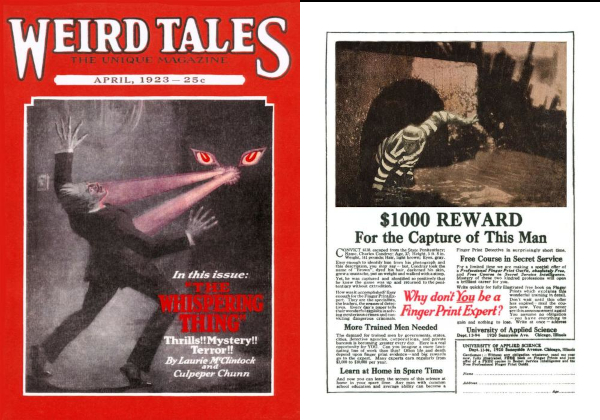
The physical presentation of the second Weird Tales issue largely mirrored its predecessor, maintaining the characteristic pulp magazine dimensions of 6.5 by 9.5 inches and a substantial 192 pages. However, subtle yet significant refinements marked a step towards a more distinct brand identity. The black, white, and red color palette of the cover was notably more striking, with the central illustration—a grotesque tableau of gigantic, mysterious eyes staring from darkness, emitting pink rays that strike a screaming man—contained within a thick red frame. This graphic enhancement made the issue’s date and price more prominent and introduced a smoother, more refined logo. Crucially, this cover departed from the shared format previously observed with its "older sister publication," Detective Tales, signaling an intentional move towards visual autonomy.
While perhaps lacking the artistic sophistication of later pulp art, the cover illustration effectively communicated the magazine’s core promise. The imagery, crude yet compelling, instantly conveyed a world where "things supernatural and horrific lurk within these pages." The explicit promises emblazoned on the cover—"Thrills!! Mystery!! Terror!!"—perfectly complemented this visual declaration, setting clear expectations for the reader.
Internally, the magazine maintained a minimalist aesthetic, devoid of illustrations beyond small decorative devices used to fill blank spaces at the end of stories. A minor structural change from the first issue was the absence of inset boxes on story pages, which had previously advertised other works by the same author in upcoming issues. This simplification, while seemingly minor, might have been a move to streamline production or to ensure a more uninterrupted reading experience. The sole story advertised on the cover, "The Whispering Thing" by Laurie McClintock and Culpeper Chunn, was presented in a font style that, to a modern eye, evokes the lurid charm of 1980s horror paperbacks, underscoring the enduring visual tropes of the genre.
Advertising and Ancillary Curiosities
A significant portion of any pulp magazine’s revenue and character was defined by its advertisements. Weird Tales Vol. 1, No. 2, carried a diverse array of ads, many repeated from its inaugural issue. The back cover prominently featured a sensational headline: "$1000 REWARD For the Capture of This Man." This dramatic call to action, however, was merely a hook for a course in becoming a "Finger Print Detective," offered by the "University of Applied Science," complete with a "Free Course in Secret Service Intelligence." This ad mirrored the first issue’s, indicating a consistent advertising partner.
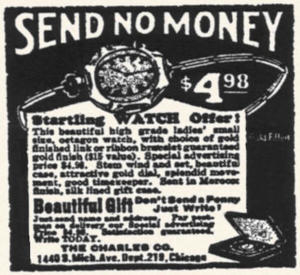
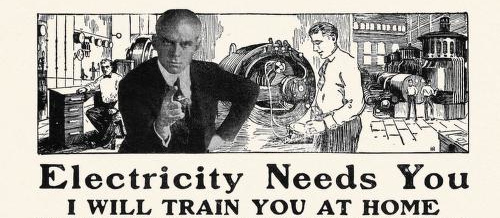
Flipping through the pages, readers encountered full-page advertisements for vocational training—"electrical expert" or draftsman courses—alongside offers for a book of etiquette or a competing fingerprint school. The absence of ads within the fiction sections ensured an uninterrupted narrative flow, but before the editorial pages, a full-page advertisement for Detective Tales served as a cross-promotional effort. Further ads dotted the latter half of the magazine, ranging from watches and diamond rings to guns, tires, shaving sets, and serge dresses. Opportunities to become a tailoring agent or a railway mail clerk were presented alongside a course from Arthur Murray, "America’s foremost authority on social dancing."
Perhaps the most intriguing advertisement was for the "Elco Electric Health Generator," promising a cure for lethargy and a host of other ailments. This device, operating "on the electric light in your house or on their own motive power at less than 50 cents per year," claimed to uniquely combine "Electricity, Violet Ray—Vibration and Ozone—the four greatest curative agents." These varied, generally non-specific advertisements suggested that Weird Tales, in its infancy, had not yet developed a strong enough identity to attract niche advertisers, relying instead on broad-appeal consumer and vocational products. The lack of genre-specific ads, such as those for typewriters or astrological readings seen in the first issue, further underscored this initial advertising agnosticism.
Interspersed among the stories were short non-fiction "news" items, strategically placed to fill residual page space. These snippets served to heighten the magazine’s "weird" atmosphere, reflecting the public’s fascination with the unusual, the mysterious, and the sensational. One piece, "Thrillers Make Audiences Warm," cited an MIT professor’s study and theatre managers who claimed mystery plays elevated theatre temperatures, a notion curiously echoed by modern research on audience exhalations and cinema atmosphere. Another, "Murderous Sheik Flees to Forest," recounted an unsubstantiated true crime story of an "obsessed Moroccan sheik" attacking a woman in France, playing into exotic and perilous tropes.
Two extensive articles capitalized on the prevalent "Egyptomania" following the November 1922 discovery of Tutankhamun’s tomb. "Has ‘Tut’s’ Tomb Really Been Found?" presented contrasting viewpoints: Cornell University Dean W.A. Hammond critically questioned the ethics of archaeological excavation in a colonial context, drawing parallels between the desecration of pharaohs’ tombs and future invasions of American historical sites. This was juxtaposed with Egyptologists’ doubts about the tomb’s authenticity, citing its unusual smallness—a detail later explained by Tutankhamun’s unexpected death and subsequent hurried burial in a pre-existing modest tomb. A third piece, "More About the Egyptians," bylined "J.K.," briefly explored ancient Egyptian laws.
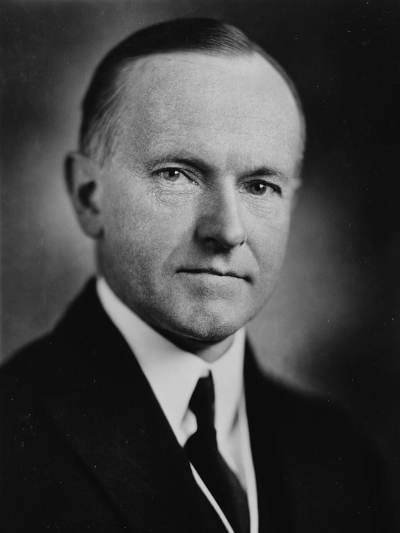
Other non-fiction curiosities included "Find Skull of Man Million Years Old," which reported Dr. J.G. Wolfe’s purported discovery of a million-year-old skull and an ancient city in Patagonia. Subsequent investigations, however, revealed Wolfe to be an amateur who fabricated "extravagant stories" for profit, with the skull being a curiously shaped stone and the city an ancient lava bed. Even more fantastical was "Did Solomon Give Queen of Sheba an Airship?", quoting Colonel Lockwood Marsh of the Royal Aeronautical Society on a reference in the 14th-century Ethiopian epic Kebra Nagast to King Solomon bestowing an "air (or wind)" vessel upon the Queen. The collection concluded with a factual, one-sentence report, "Send Photographs By Radio," confirming the successful broadcast of images of President Harding, Vice President Coolidge, and Governor Pinchot on March 3, 1923.
These articles, whether sensationalized, critical, or factual, collectively worked to reinforce Weird Tales‘ thematic focus. They offered glimpses into "weird" phenomena of the era: the mysteries of ancient civilizations, the frontiers (and frauds) of science, and the allure of true crime. By surrounding its fiction with such diverse, yet thematically aligned, non-fiction, the magazine expertly cultivated an atmosphere that primed readers for the strange and unsettling narratives within its pages.
The Editor’s Vision: "The Unique Magazine"
The editorial section, aptly titled "The Eyrie," served as Edwin Baird’s direct conduit to his burgeoning readership, outlining the magazine’s philosophy and appealing for its survival. Baird opened by acknowledging a deluge of positive letters, yet quickly pivoted to the economic realities of publishing: "WEIRD TALES is an experiment. There has never been another magazine quite like this, hence nobody knows whether or not such a magazine will pay. And, of course, if a magazine doesn’t pay it promptly ceases to exist." This candid appeal framed the magazine’s very existence as a collaborative effort, asserting that its success was contingent on reader support: "It’s our job to publish the right sort of magazine. It’s yours to buy it."
Baird then lamented the volume of poor-quality manuscripts flooding his desk, emphasizing the arduous task of sifting through "rivers of manuscripts." He showcased letters from readers like Harold Ward (a writer with fiction in this and the previous issue), who expressed delight in "stories of the ‘Dracula’ type and that Sax Rohmer stuff." Another reader, C.L. Austin, urged the editor to "stick for his ideals, regardless of his job," warning against "vacillation." Baird responded with a firm declaration of editorial independence: "…the editorial policy of WEIRD TALES is not dictated by the business office. We will stand or fall on our platform of ‘something new in magazine fiction.’… In any event, there will be no compromise. WEIRD TALES, as long as it lives, will always be ‘The Unique Magazine.’"
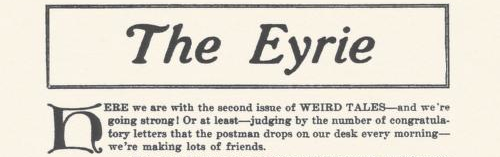
This rhetoric, emphasizing "something new" and "the unique," was a cornerstone of Weird Tales‘ self-promotion. Reader letters further bolstered this narrative, praising the magazine for daring to publish "horror" and "grim" stories despite a "general editorial prejudice against weird stories." Many correspondents invoked Edgar Allan Poe as a touchstone, implying Weird Tales was a worthy successor. Baird himself noted the paradox of claiming novelty while aligning with a writer who had died nearly 75 years prior, yet the invocation of Poe served to lend a literary legitimacy to the "weird" genre, connecting it to an established master of the macabre. This blend of bold innovation and venerated lineage became a defining characteristic of Weird Tales‘ editorial stance.
Precedent and Parallel: The Thrill Book‘s Proto-Pulp Vision
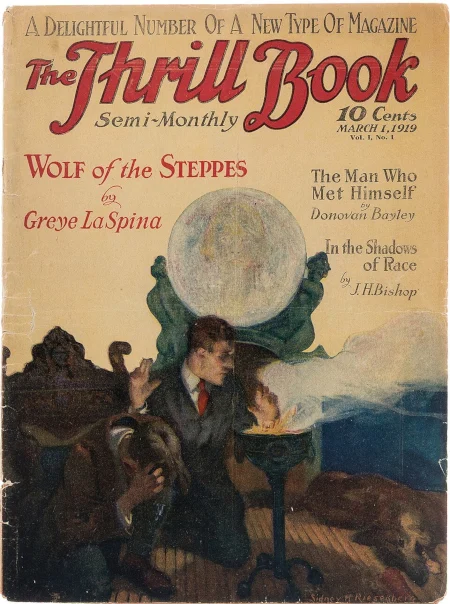
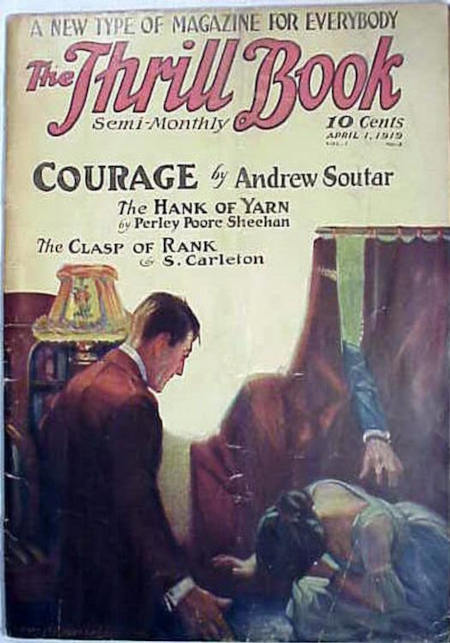
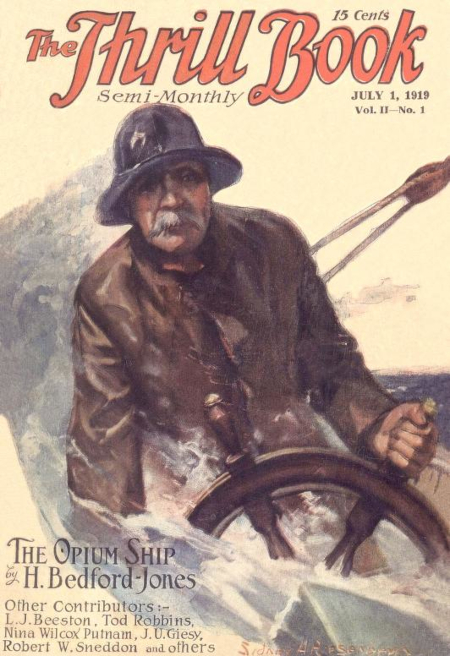
While Weird Tales proclaimed its uniqueness, it was not without precedent. In 1919, Street & Smith, a titan of pulp and dime novel publishing, launched The Thrill Book, a bi-monthly magazine that ran for 16 issues. Often regarded as an early, albeit mixed, attempt to specialize in fantasy and horror, The Thrill Book offers a crucial comparative lens for understanding Weird Tales‘ positioning.
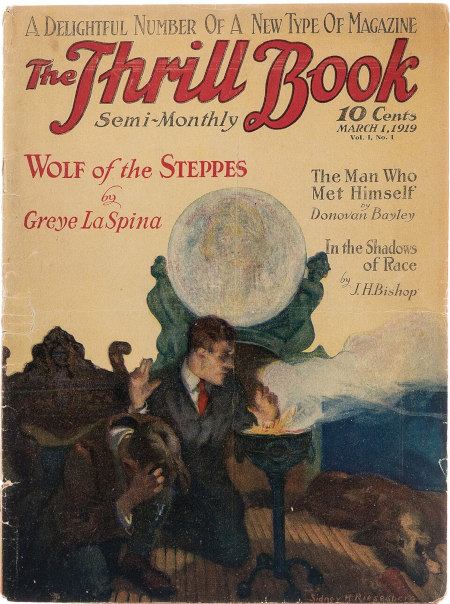
Edited initially by Harold Hersey and later by Ronald Oliphant, The Thrill Book featured more interior art than early Weird Tales and used Romantic poems to fill space, but its core mission, as articulated by Hersey, strikingly prefigured Baird’s rhetoric. Hersey’s back-cover editorials were a masterclass in self-promotion, relentlessly hammering home themes of novelty, courage, and virility. In its first issue, Hersey declared a mission to publish "the unusual, the illogical, the bizarre, swiftly moving story," arguing that other editors "lacked the temerity to publish" such material. He praised the discerning "American reader" who "wants the truth" and implicitly linked the magazine’s daring to intellectual freedom, while also assuring readers the content would be "clean."
Hersey’s editorials frequently contrasted The Thrill Book‘s "red-blooded" and "virile" fiction with "mawkishness and cheap sentiment," "innocuous, milk-and-water fiction," and "silly femininity"—a reflection of contemporary gendered biases in literature. He explicitly connected the demand for such "tough" stories to the transformative experience of World War I, arguing that "the terrors of war have opened to us all the unseen, the previously unbelievable." This post-war sensibility, he posited, prepared readers for "darkened worlds of feeling" and "mysteries capable of solution" in the realms of the occult and spiritual. Hersey positioned The Thrill Book as a pioneer, providing a "necessary outlet" for stories exploring "the weird, the bizarre, the fantastic type of story," aligning itself with literary giants like Poe and Bierce.
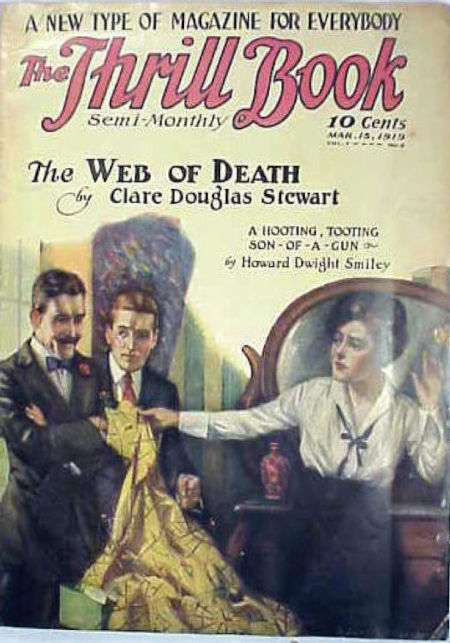
Ronald Oliphant, Hersey’s successor, adopted a more restrained tone in his "Cross-Trails" editorial section, yet he continued to champion "the bizarre, the fantastic, the unusual, the adventurous." Oliphant even delved into spiritualism, soliciting reader letters on life after death, mind-reading, and mental telepathy, phenomena he asserted were "established to our minds beyond dispute." This willingness to embrace the unexplained, positioning the fantastic as unusual but potentially real, mirrored a cultural fascination with the occult that Weird Tales would also tap into.
Despite its ambitious rhetoric, The Thrill Book‘s content was often a mixed bag, encompassing westerns, comedies, and adventure stories alongside its proto-fantasy and sci-fi. Its quality was inconsistent, and under Hersey, it was demonstrably more racist than early Weird Tales. Yet, its impact was undeniable. Several Thrill Book writers, including Greye La Spina, Francis Stevens (Gertrude Barrows Bennett), and Seabury Quinn, later became mainstays of Weird Tales. Even a specific story, P.A. Connolly’s "Crawling Hands," was minimally rewritten and republished in Weird Tales as "The Crawling Death," highlighting the direct lineage and shared pool of talent.
The similarities in editorial rhetoric between The Thrill Book and Weird Tales are striking, despite the possibility that Edwin Baird may never have encountered Hersey’s short-lived venture. Both magazines recognized an underserved market for "weird" and "unusual" fiction and adopted a pioneering, almost defiant, stance against perceived literary stagnation. While The Thrill Book ultimately failed, its existence proved the market’s appetite for such material, paving the way for Weird Tales‘ more focused and ultimately more successful enterprise.
The Scientific Frontier: Gernsback’s Vision of Novelty
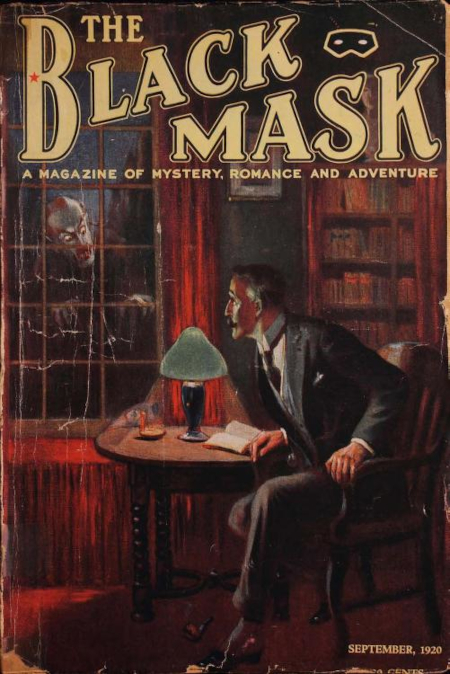
To fully appreciate Weird Tales‘ unique position, it is useful to compare its editorial strategies with other pioneering genre pulps, particularly those emerging in the nascent field of science fiction. Magazines like Black Mask (1920) and early detective/western pulps generally lacked explicit editorial manifestos, focusing instead on delivering genre-specific content without grand declarations of novelty. Even Hugo Gernsback, widely credited as the "father of science fiction," displayed varying degrees of rhetorical flair in his early publications.
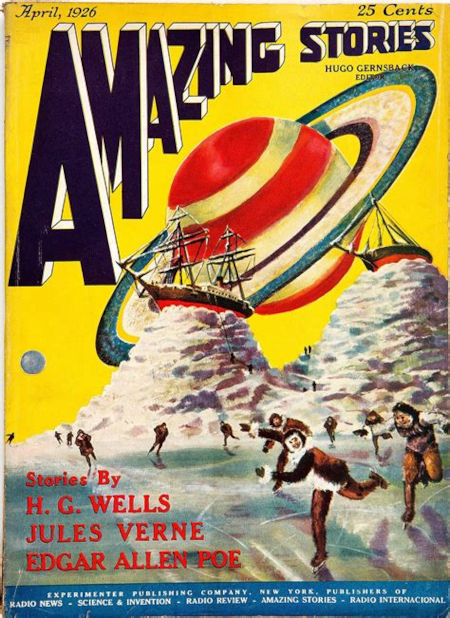
Gernsback’s Amazing Stories (1926) did, however, explicitly champion its "newness." Its first editorial declared, "Amazing Stories is a new kind of fiction magazine! It is entirely new — entirely different — something that has never been done before in this country." This "newness," for Gernsback, was often framed in opposition to "sex-appeal" type stories, emphasizing an appeal to the intellect and imagination over sensational emotions. He sought to establish a clear lineage for "scientifiction," tracing its roots to Edgar Allan Poe and even Leonardo da Vinci, much as Baird and Hersey invoked Poe for "weird fiction."
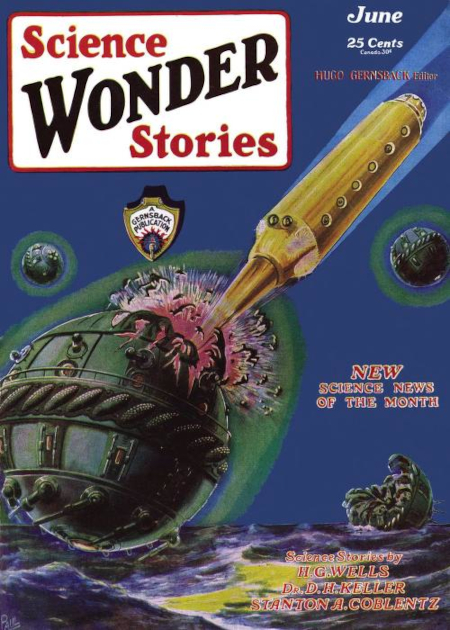
Later Gernsback ventures, like Science Wonder Stories (1929), further refined this approach. While acknowledging the transient nature of "sexy" literature and modern detective stories, Gernsback argued for the enduring importance of science fiction because science itself was becoming an everyday reality. His magazine’s novelty lay not just in the fiction itself, but in its rigorous "scientific grounding." He proudly stated, "It is the policy of SCIENCE WONDER STORIES to publish only such stories that have their basis in scientific laws as we know them, or in the logical deduction of new laws from what we know," guaranteeing a "false scientific education" would not be imparted. This unique selling proposition, backed by an "array of authorities and educators," distinguished his publications.
Reader responses to Gernsback’s editorial vision also illuminate the evolving landscape of genre appreciation. In a contest for "What science fiction means to me," Jack Williamson, a future titan of the genre, penned a poetic paean to SF as a "wonderful new art," displaying "new vistas, new ideals, new worlds" and lifting readers into "the glorious realm of deathless romance." Conversely, E.E. "Doc" Smith, another legendary SF author, articulated a scientist’s disdain for "valueless," "poorly-written" ordinary fiction and "high-brow" magazines, finding in science fiction a "concrete foundation and steel framework of science" that appealed to "trained minds" even in moments of relaxation.
These comparisons reveal distinct strategies for claiming novelty. While The Thrill Book and Weird Tales emphasized the daring exploration of the supernatural and the bizarre, Gernsback’s magazines championed the pioneering spirit of scientific imagination. All, however, leveraged a rhetoric of "newness" and a clear articulation of their specific literary mission to attract and define their respective audiences, challenging the conventional literary tastes of the era.
A Legacy Forged in the Unique
Weird Tales‘ second issue, and the editorial pronouncements within it, stands as a testament to the magazine’s deliberate effort to forge a distinct identity. Unlike The Thrill Book‘s broader, more eclectic approach, Weird Tales quickly honed its focus, delivering a consistent diet of horror and the supernatural. This consistency, coupled with Baird’s assertive editorial stance, allowed it to not only survive where The Thrill Book failed but to thrive and become the foundational publication for what would become known as "weird fiction."
The speculation surrounding The Thrill Book‘s potential survival and H.P. Lovecraft’s hypothetical involvement offers a fascinating alternate history. Lovecraft, who never saw an issue of The Thrill Book in his lifetime, would undoubtedly have found a suitable home for his cosmic horror within its pages, had it endured. His decision to decline the editorship of Weird Tales due to his reluctance to relocate to Chicago suggests that geographical proximity to a vibrant publishing hub like New York City (where The Thrill Book was based) might have altered the course of speculative fiction history. An editor Lovecraft, even if for a short period, could have profoundly shaped the genre.
However, the enduring success of Weird Tales suggests that the market for such "unique" and "weird" stories was robust enough that a dedicated magazine was destined to emerge. Whether it was The Thrill Book transforming into a Weird Tales-esque entity, or Weird Tales filling the void, the confluence of post-WWI anxieties, cultural fascinations with the occult and ancient mysteries, and a growing readership hungry for imaginative escapes ensured that a home for the bizarre would be found.
Weird Tales Vol. 1, No. 2, therefore, represents more than just an early issue of a pulp magazine. It is a snapshot of a cultural moment, a declaration of editorial intent, and a foundational document in the history of genre fiction. Its blend of striking covers, sensational non-fiction, and an unwavering commitment to "something new in magazine fiction" laid the groundwork for a legacy that would profoundly influence horror, fantasy, and science fiction for generations to come, truly earning its moniker as "The Unique Magazine."