
The Shadow of the Master: Re-evaluating Dennis L. McKiernan’s Iron Tower Trilogy and Its Tolkien Legacy
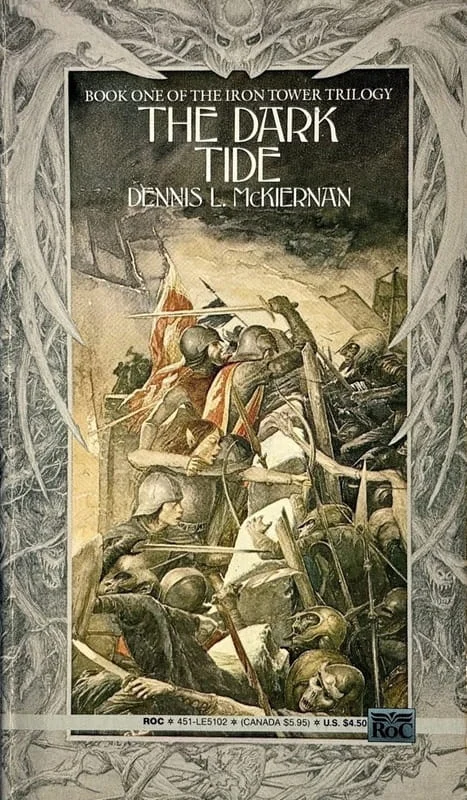
An examination of a foundational, if controversial, work in modern high fantasy.
Main Facts
In the annals of high fantasy literature, few works cast as long a shadow as J.R.R. Tolkien’s The Lord of the Rings. Its monumental success not only defined a genre but also inspired, and in some cases, directly influenced, generations of writers. Among the earliest and most direct inheritors of this tradition stands Dennis L. McKiernan’s Iron Tower trilogy, a debut series comprising The Dark Tide, Shadows of Doom, and The Darkest Day. Published individually by Signet in quick succession in August, September, and October of 1985—following an initial hardcover release by Doubleday in 1984—and later collected in an omnibus edition by Roc in 2000, this trilogy immediately established itself as a significant, albeit contentious, entry into the fantasy canon.
The Iron Tower trilogy is widely recognized for its profound and undeniable resemblance to Tolkien’s magnum opus. Indeed, as noted by reviewer Charles Gramlich, the series is "definitely High Fantasy written very strongly in the Tolkien tradition," to the extent that it often invites the label of "pastiche." This characteristic, born from the author’s initial intent to write a direct sequel to The Lord of the Rings, shaped its reception and cemented its place in the ongoing discourse surrounding literary influence versus originality in fantasy. Despite these strong parallels, McKiernan’s debut managed to carve out its own niche, captivating readers with its epic scope and memorable characters, even as it navigated the shadow of its illustrious predecessor. The original Signet paperback editions featured evocative covers by the renowned fantasy artist Alan Lee, while the 2000 omnibus edition sported new artwork by Jerry Vanderstelt, further illustrating the series’ enduring presence in the market.
Chronology
The Author’s Journey: From Accident to Epic
The genesis of the Iron Tower trilogy is as compelling as its narrative. Born in 1932, Dennis L. McKiernan embarked on his literary career under circumstances that were both challenging and serendipitous. The pivotal moment arrived in 1977 when a severe motorcycle accident left him laid up for several months. During this period of convalescence, McKiernan, a lifelong admirer of J.R.R. Tolkien, began to weave a tale. His initial ambition was not merely to write in the world of Middle-earth, but to extend it directly, crafting a sequel to The Lord of the Rings. This audacious plan, however, ultimately proved unfeasible. The complexities of securing permission from the Tolkien Estate, combined with the formidable challenge of genuinely adding to a work of such hallowed status, led McKiernan to pivot.
Instead of abandoning his creative impulse, he chose to recalibrate. The core ideas, themes, and narrative structures he had envisioned for a sequel were meticulously re-imagined and transplanted into a new, yet strikingly familiar, world of his own creation. This shift marked the true birth of the Iron Tower trilogy. McKiernan’s dedication during his recovery period laid the groundwork for a sprawling epic that would introduce readers to Mithgar, the primary setting for the Iron Tower and many of his subsequent works. The period of 1977 to 1984 was dedicated to this intense creative endeavor, transforming a personal setback into a professional breakthrough.
The Books’ Genesis and Publication: A Stepped Release
The journey from manuscript to published work for the Iron Tower trilogy was a multi-stage process that reflected the evolving landscape of fantasy publishing in the early to mid-1980s. McKiernan’s completed work first found a home with Doubleday, a prominent American publishing house, which released the trilogy in hardcover in 1984. This initial publication was a significant achievement for a debut author, signaling the publisher’s confidence in the series’ potential.
However, it was the subsequent paperback release by Signet, a division of Penguin Group, that brought the Iron Tower trilogy to a much wider audience. In a strategic move to capitalize on the burgeoning fantasy market, Signet opted for a rapid-fire release schedule. The Dark Tide hit shelves in August 1985, followed swiftly by Shadows of Doom in September, and concluding with The Darkest Day in October of the same year. This aggressive serialization ensured that reader interest remained high and provided a continuous narrative experience, crucial for a long-form epic fantasy. The choice of Alan Lee, already a celebrated illustrator with a deep connection to fantasy literature (including work on Tolkien’s The Hobbit and The Lord of the Rings), to grace the covers of these paperback editions was a masterstroke. His atmospheric and detailed artwork not only lent prestige to the series but also visually reinforced its high fantasy credentials and its thematic lineage.
Years later, recognizing the trilogy’s enduring appeal and the convenience for new readers, Roc Books (another imprint of Penguin Group) released a comprehensive omnibus edition in 2000. This collection, featuring new cover art by Jerry Vanderstelt, offered the entire saga in a single volume, further cementing its place as a recognizable work within the genre. The progression from hardcover to serialized paperback to omnibus illustrates the sustained commercial viability and reader engagement that McKiernan’s debut trilogy commanded.
Supporting Data
Narrative Parallels and Homage: The Tolkienian Blueprint
The most striking and frequently discussed aspect of the Iron Tower trilogy is its profound resemblance to The Lord of the Rings. This isn’t merely a subtle influence but a deeply embedded structural and thematic blueprint. McKiernan’s world of Mithgar, while possessing its own distinct lore, operates on principles immediately familiar to any reader of Tolkien.
At the heart of both narratives is the struggle against an overwhelming, malevolent force embodied by a Dark Lord. In McKiernan’s case, this is the powerful wizard-wraith, Modru, who seeks to plunge Mithgar into an eternal night, mirroring Sauron’s ambition for Middle-earth. The forces arrayed against Modru include races that bear strong resemblances to Tolkien’s archetypes: the Elves (Elves), the Dwarves (Dwarves), and most notably, the Warrows (a clear analogue to Hobbits), a small, gentle folk from a peaceful land called the Boskydells, who are unexpectedly thrust into the epic conflict. The protagonist, a young Warrow named Tuck, embarks on a perilous quest, reminiscent of Frodo Baggins’s journey, carrying a burden of great significance. His companions form a fellowship that echoes Tolkien’s diverse group, comprising various races united against a common foe.
The narrative arc follows a classic high fantasy quest structure: a peaceful homeland threatened, a gathering of heroes, a journey through dangerous lands populated by monstrous foes (ranging from Trolls and Orc-like creatures to more unique horrors), battles on an epic scale, and ultimately, a climactic confrontation with the Dark Lord. Even specific plot devices, such as ancient magical artifacts (e.g., the Iron Tower itself, a dark fortress), prophecies, and the presence of wise, powerful mentors (like the wizard-ranger Galen, who shares traits with Gandalf), contribute to the strong sense of déjà vu.
However, to simply label it as mere imitation would be to overlook McKiernan’s own contributions. While the framework is undeniably Tolkienian, McKiernan imbues his world with a slightly darker, more visceral edge in places, and his characters, though archetypal, develop their own personalities and struggles. The strength of the narrative lies in its ability to deliver a satisfying high fantasy experience for readers who craved more of the specific flavor Tolkien provided, offering a new story within a beloved, familiar paradigm. It serves as both an homage and an accessible entry point for new fantasy enthusiasts.
World-Building and Characters: Familiarity with a Twist
Mithgar, the setting of the Iron Tower trilogy, is a world rich with history and distinct geographical features, even if its foundational elements echo Tolkien’s Middle-earth. McKiernan crafted a detailed cosmology, complete with creation myths, ancient wars between light and shadow, and a pantheon of deities. The geography spans from the idyllic Boskydells to the formidable mountains, vast forests, and desolate plains, all leading to the menacing Iron Tower itself, Modru’s stronghold.
The races inhabiting Mithgar, while clearly inspired, are given McKiernan’s own nomenclature and some unique cultural nuances. The Elves are depicted as ancient and ethereal, the Dwarves as stout and skilled artisans, and the Humans as diverse and often caught in the middle of larger conflicts. The Warrows, arguably the most direct parallel, are portrayed with a deep love for their comfortable homes, a strong sense of community, and an unexpected courage when faced with adversity.
The characters the reviewer found "memorable" often fit established fantasy archetypes but gain depth through their trials and interactions. Tuck, the Warrow protagonist, embodies the "unlikely hero" trope, growing from a simple farm-boy to a key figure in the resistance. His companions, including the valiant Elf warrior Elgo, the stoic Dwarf Lugwiler, and the wise Ranger Galen, each contribute distinct skills and perspectives to the quest. McKiernan’s skill lies in making these archetypes relatable and in orchestrating their individual journeys and sacrifices within the grand tapestry of the war against Modru. The emotional beats, the camaraderie, and the moments of personal struggle resonate, even if the overall narrative arc feels familiar.
Literary Context of the 1980s Fantasy Boom: A Genre in Flux
The publication of the Iron Tower trilogy in the mid-1980s placed it squarely within a vibrant and rapidly expanding period for the fantasy genre. The enduring popularity of The Lord of the Rings had created a vast readership eager for more epic tales. This era saw the rise of numerous fantasy authors attempting to capture a piece of the market Tolkien had forged. Many early works in this "post-Tolkien" era explicitly or implicitly borrowed elements from Middle-earth. Authors like Terry Brooks with The Sword of Shannara (1977) had already demonstrated the commercial success of Tolkien-esque narratives, albeit often drawing criticism for their perceived derivativeness.
McKiernan’s trilogy arrived as part of a wave that included new voices and established authors pushing the boundaries of high fantasy. While some authors like Stephen R. Donaldson were exploring darker, more morally ambiguous themes, others, like McKiernan, embraced the more traditional, heroic fantasy mold. The Iron Tower series found an audience among readers who cherished the classic "good vs. evil" struggle, the clear delineations of hero and villain, and the comfort of familiar tropes. It served as a bridge for many, introducing them to the sprawling narratives and intricate world-building that defined high fantasy, even if it did so through a well-trodden path. The 1980s were characterized by a burgeoning paperback market, making epic fantasy accessible to millions and fostering a diverse range of styles and interpretations, with McKiernan’s work occupying the traditionalist end of the spectrum.
Critical Reception and Fan Base: A Divided Legacy
The critical reception of the Iron Tower trilogy was, predictably, mixed. While some critics praised McKiernan’s storytelling ability, his engaging characters, and the sheer scope of his epic, many others could not overlook the pervasive similarities to Tolkien. The term "Tolkien pastiche" became a recurring descriptor, often used with a pejorative connotation, suggesting a lack of originality. Some reviewers found the parallels too close for comfort, arguing that it ventured beyond homage into outright imitation.
Despite these critical reservations, the Iron Tower trilogy quickly garnered a dedicated fan base. Readers, particularly those new to the genre or those simply craving more of the comfort and grandeur of Tolkien’s style, embraced the series enthusiastically. Its accessibility, its clear moral compass, and its ability to deliver a satisfying, epic adventure resonated deeply. The series sold well, demonstrating that there was a significant appetite for this type of fantasy, even if it wasn’t groundbreaking in its inventiveness. McKiernan’s ability to create memorable characters and sustain a compelling narrative over three volumes ensured that the books found a lasting audience, proving that familiarity, when executed with conviction, could be a strength rather than a weakness for many readers.
Official Responses
Authorial Intent and Acknowledgment: Embracing the Influence
Dennis L. McKiernan has been remarkably open and consistent regarding the origins of the Iron Tower trilogy. Far from denying the influence, he has openly acknowledged his initial aspiration to write a direct sequel to The Lord of the Rings. This candidness frames the Iron Tower not as an attempt to hide its inspirations but as a conscious act of channeling a beloved master. In interviews and author’s notes, McKiernan has often explained the evolution of his project: how the initial sequel concept transitioned into creating his own world, Mithgar, populated by races and cultures that bore undeniable resemblances to Tolkien’s creations.
McKiernan’s approach suggests a deep reverence for Tolkien’s work. His intention was not to usurp or diminish Tolkien, but to pay tribute and, perhaps, to explore further narratives within a framework he admired so profoundly. This acknowledgment serves to contextualize the "pastiche" label, shifting it from an accusation of unoriginality to an understanding of deliberate homage. He effectively invites readers to enjoy his stories on their own terms, even as they recognize the echoes of Middle-earth. This transparency has likely endeared him to many fans who appreciate his honesty and shared love for the foundational texts of high fantasy.
Publisher’s Perspective: Marketing the Familiar
The publishers of the Iron Tower trilogy—Doubleday for the hardcover and Signet/Roc for the paperbacks and omnibus—demonstrated a clear understanding of the market and McKiernan’s unique position within it. While they would naturally promote the series as an original epic, they subtly, and sometimes overtly, leveraged the inherent comparisons to Tolkien. The artwork by Alan Lee for the Signet editions, an artist synonymous with Tolkien, was a powerful visual cue that signaled the trilogy’s lineage.
Marketing materials likely emphasized the epic scope, the struggle of good versus evil, and the traditional high fantasy elements, all of which would appeal to Tolkien fans seeking their next fix. Rather than distancing the series from its influences, publishers seemed to understand that the "Tolkien-esque" quality was a significant selling point for a large segment of the fantasy readership in the 1980s. For a debut author, positioning his work within a recognizable and beloved tradition provided a valuable shortcut to reader engagement. The continued availability of the omnibus edition further suggests that the publishers recognized the enduring appeal of the series, confident that its inherent familiarity would continue to attract new generations of fantasy readers.
Implications
McKiernan’s Legacy and Subsequent Works: Forging a Path
While the Iron Tower trilogy served as McKiernan’s entry point into publishing and established his voice, it was by no means the entirety of his career. The reviewer’s observation that McKiernan went on to write "much more original material later" holds significant truth. Following the Iron Tower, McKiernan expanded the world of Mithgar considerably, delving into its deeper history and diverse cultures. His subsequent series, such as The Dragon’s Eye trilogy, The Silver Call duology (which serves as a direct sequel to Iron Tower), and standalone novels like Dragondoom, began to explore different aspects of Mithgar, showcasing a gradual evolution in his narrative approach.
In these later works, McKiernan continued to employ classic fantasy tropes but started to develop more distinctive plots, complex character motivations, and unique elements within his established world. He explored different historical periods of Mithgar, delved into the intricacies of its magic system, and introduced new conflicts that were less directly beholden to the Tolkien blueprint. This evolution demonstrates an author finding his stride, moving from the comfort of strong influence to a more individual storytelling voice, while still maintaining the epic scope and earnest tone that characterized his debut. His extensive bibliography within the Mithgar saga attests to his dedication to building a comprehensive and engaging fantasy world over several decades.
The "Tolkien Pastiche" Debate in Fantasy: Influence vs. Imitation
The Iron Tower trilogy remains a quintessential case study in the broader "Tolkien pastiche" debate that has long simmered within fantasy literature. This discussion centers on where the line lies between legitimate influence or homage and uninspired imitation. For some, any work that too closely mirrors Tolkien’s world-building, character archetypes, or narrative structure is inherently derivative and lacks true artistic merit. They argue that such works merely rehash familiar ground without offering anything new or challenging.
However, another perspective suggests that "pastiche" can serve a valuable function. For many readers, particularly those just discovering fantasy, works like Iron Tower provide a comforting and accessible entry point into the genre. They offer the familiar grandeur and moral clarity that drew them to Tolkien, but with new stories and characters to explore. In this sense, a well-executed pastiche can act as a gateway drug, nurturing a love for fantasy that eventually leads readers to more experimental or original works. Furthermore, the act of writing within an established tradition can be seen as a form of apprenticeship, allowing authors to hone their craft before venturing into more unique territory. The debate highlights the subjective nature of literary appreciation and the complex relationship between a genre’s foundational texts and its subsequent evolution. McKiernan’s work exemplifies the challenges and opportunities inherent in building upon the legacy of a literary giant.
Enduring Appeal and Re-evaluation: A Place in History
Despite the ongoing critical discussion regarding its originality, the Iron Tower trilogy has maintained a consistent presence in fantasy literature. Its continued availability, particularly in omnibus editions, speaks to an enduring appeal among readers. For many, it represents a nostalgic return to a specific era of fantasy, a time when epic quests and clear-cut battles between good and evil dominated the landscape.
In a contemporary fantasy market that often favors darker, grittier, and more morally ambiguous narratives, the Iron Tower trilogy stands as a testament to the enduring power of traditional high fantasy. It offers a straightforward, heroic adventure that provides comfort and escapism. While it may not be heralded as a revolutionary work, its place in the history of modern fantasy is secure as an earnest and heartfelt homage that helped bridge the gap between Tolkien’s singular achievement and the subsequent explosion of the genre. It reminds us that sometimes, the greatest influence isn’t about breaking entirely new ground, but about building upon the foundations laid by those who came before, offering new journeys through familiar, beloved landscapes. The Iron Tower trilogy is not just a curiosity; it is a significant stepping stone in the development of post-Tolkien fantasy, a work that, for many, was a cornerstone of their own fantastical awakening.



Leave a Comment