The Treasury of Folklore: A Decade-Long Journey Culminates in a Landmark Compendium
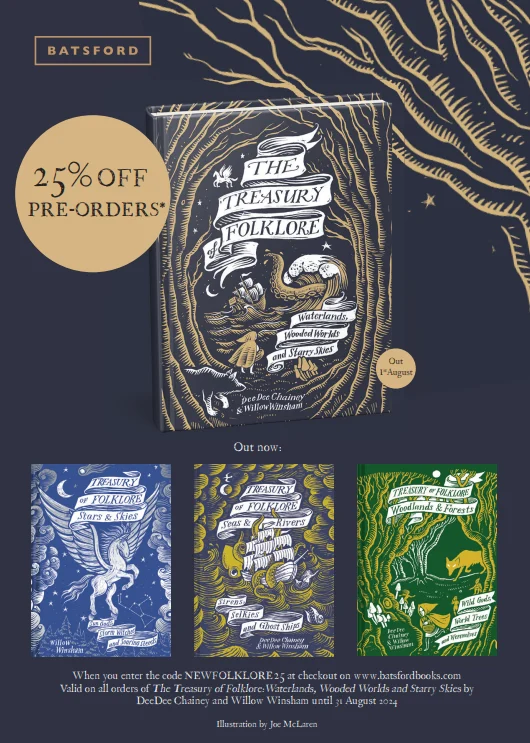
London, UK – A decade after its initial conception, the ambitious vision behind "The Treasury of Folklore" book series is set to culminate in a single, magnificent volume. Authors Dee Dee Chainey and Willow Winsham, whose work has captivated audiences worldwide, are releasing "The Treasury of Folklore: Waterlands, Wooded Worlds and Starry Skies," a comprehensive compilation drawing from their acclaimed three-book series. This new "hefty tome," published by Batsford Books and featuring the distinctive illustrations of Joe McLaren, promises to be a celebration of humanity’s shared fears, dreams, and enduring connection to the natural world through the lens of folklore.
The compendium, available for pre-order now and slated for release on August 1st, 2024, represents a full-circle moment for the authors. What began as an aspiration to encompass the diverse folklore of global landscapes in one book eventually blossomed into a trilogy. Now, the most cherished and illuminating tales from Seas and Rivers, Trees and Woodlands, and Stars and Skies are brought together, offering readers a unified journey through the primal narratives that shape human experience.
A Chronology of Universal Tales
The genesis of "The Treasury of Folklore" series dates back nearly a decade, born from a profound curiosity and a vibrant online community. The authors, Dee Dee Chainey and Willow Winsham, embarked on their collaborative writing journey inspired by the burgeoning #FolkloreThursday hashtag, a digital hearth around which enthusiasts shared ancient stories and beliefs. This outpouring of global folklore ignited a desire to craft something enduring, something that would not only document these tales but also illuminate their underlying universality.
Their initial ambition was grand: a singular volume that would traverse every conceivable physical landscape inhabited by humans, from the deepest oceans to the highest stars, uncovering the customs, beliefs, and narratives that bind people to their environments. However, as their research deepened and the material accumulated, it became abundantly clear that the richness and sheer volume of folklore far surpassed the confines of a single book. This wealth of material necessitated an expansion, leading to the development of a thematic trilogy.
The first installment, Seas and Rivers, plunged into the mysteries of aquatic realms, exploring the creatures, spirits, and superstitions associated with water. This was followed by Trees and Woodlands, which delved into the sylvan sanctuaries and shadowed groves, uncovering the ancient beings and beliefs tied to forests. Completing the trilogy was Stars and Skies, a celestial journey through myths of constellations, lunar deities, and atmospheric phenomena. The reception to these three individual volumes was, as the authors describe, "surprising and heartwarming," a testament to the enduring appeal of folklore and the authors’ accessible approach. Their gratitude to the burgeoning readership, who embraced these tales, is palpable.
The idea of a compendium, bringing the dispersed narratives back into a single volume, resonated deeply with the authors’ original vision. It offered a unique opportunity to curate and present their favorite selections, allowing the interconnectedness of these global stories to shine through more brightly than ever before. This process involved a meticulous review of their own well-trodden words, approaching the familiar material with "fresh eyes" to determine the optimal selections that would best convey the series’ overarching message of shared human experience. The culmination of this editorial endeavor is a physically impressive volume, described by the authors as a "hefty tome," boasting beautiful binding, premium cream paper, and a cover design that artfully integrates the themes of water, land, and sky.
Supporting Data: Unearthing Shared Human Truths
At the heart of "The Treasury of Folklore" series, and particularly amplified in this new compendium, is the profound insight that despite vast cultural differences, humanity shares fundamental fears and dreams. As the authors eloquently state, "in so many ways, we are all inherently the same. We discovered that we, as humans, all share primal fears and dreams, no matter where we live, how we dress, or what we choose to name the monsters of our myths and legends." This core philosophy underpins the entire collection, revealing folklore not merely as quaint stories, but as a mirror reflecting universal psychological and existential concerns.

These universal threads manifest across the diverse narratives presented in the compendium. Whether gazing at the vast horizon, longing for the "treasures and pleasures that the wide world around us can offer," or huddling around a campfire, dreading "the unknown as we gather around our campfires in the darkness of the nighttime forest," humans consistently grapple with themes of curiosity, aspiration, awe, and dread. The "eternity of time under the glimmer of ancient stars," prompting reflection on "the unwritten future of our own short lives," speaks to a collective contemplation of mortality and cosmic wonder. The selected extracts offer compelling illustrations of these shared human responses to the natural world.
Water Horses: Perilous Steeds of the Depths
The section on "Water Horses" immediately plunges readers into the primal fear of the unknown lurking beneath serene surfaces. These shapeshifting, malevolent entities found in lakes and rivers across cultures embody the dangers of watery environments and serve as potent cautionary tales.
The Scottish Kelpie and Each-uisge: Scotland’s folklore is famously rich with water horses. While often used interchangeably, the kelpie typically inhabits rivers, luring travelers with its beautiful appearance before dragging them to a watery demise. The each-uisge, by contrast, is a more fearsome lake dweller, even more treacherous, with a taste for human flesh. Both share the characteristic of appearing as a magnificent horse, enticing the unwary. Tales describe fleeting moments of "taming" these creatures with a cross-marked bridle, only for the control to prove illusory and temporary, often with fatal consequences for the rider. The only reliable defense, in some tales, was red-hot iron, a classic folkloric weakness against supernatural beings. The enduring power of these legends is evident in modern Scotland, most strikingly in the colossal 30-meter Kelpies sculptures near Falkirk, a contemporary homage to ancient fears. Their presence in modern literature, from Lari Don to J.K. Rowling’s Fantastic Beasts, further cements their cultural imprint. Interestingly, the article highlights a curious void in English folklore regarding similar water horses, a distinct regional variation.
The Welsh Ceffyl Dwr: Across the border in Wales, the Ceffyl Dwr served a similar function, remaining a staple belief into the 19th century. Its appearance and purpose varied geographically; in North Wales, it was a shapeshifting spirit, often violent, while in the South, it consistently manifested as a small, enchanting horse. These steeds were renowned for their impossible speed, covering vast distances before vanishing, leaving their hapless riders to drown. A peculiar exception, noted as an example of "denominational equality," allowed clergymen of any creed to ride the Ceffyl Dwr safely, while their accompanying laymen were invariably abandoned or thrown into the water – a fascinating detail reflecting societal hierarchies and religious beliefs embedded within the folklore.
The Scandinavian Bäckahäst: From the misty Nordic lands comes the bäckahäst or "brook horse," often seen on foggy evenings. Described as majestic and luminous, it, too, beguiles riders onto its back, only to plunge into the water, trapping its victims. Tales frequently feature children as victims, heightening the sense of innocence imperiled and tragic loss. One poignant story tells of boys saved when the last child, in awe, mispronounces a colloquial phrase, inadvertently uttering a name akin to "Jesus Christ." The bäckahäst‘s aversion to this sacred name causes it to vanish, leaving the children battered but alive. This detail showcases the syncretism often found in folklore, where pre-Christian beliefs intersect with later religious influences. Like the kelpie, the bäckahäst could also be tricked into labor, though its wild nature always sought to return to the water. These water horse narratives collectively underscore the universal human respect and fear for the power and unpredictability of natural waters.
Lords of the Wild: Guardians and Tricksters of the Forest
Venturing from water to land, the compendium explores "Lords of the Wild," the powerful spirits and creatures that embody the essence of forests and jungles worldwide. These figures often possess a dual nature: protective guardians of the flora and fauna, or malevolent entities that punish human transgressions. They reflect humanity’s complex relationship with wilderness – a source of sustenance, refuge, and profound danger.
The Finnish Forest God Tapio: In Finnish mythology, Tapio, also known as Metsähine or Hiisi, reigns as the king of the forest realm. He is depicted as tall and slender, adorned in ermine fur or moss, his head crowned with a hat. His visage, with bushy eyebrows of moss and lichen and a great beard, evokes the ancient European motif of the Green Man or foliate heads, representing the spirit of vegetation. Tapio is both the personification and protector of the forest, capable of appearing human from the front but revealing a gnarled, tree-like back – a classic indicator of his otherworldly nature. For hunters in the past, seeking Tapio’s blessing was paramount to a successful hunt, requiring pledges of respect for the land and its creatures. He held dominion over all forest inhabitants, dispensing either abundance or empty-handed misfortune. His family – the benevolent Mielikki (or fierce Kuurikki), the guiding son Nyrikki, and the prey-directing daughter Tulikki – further personify various aspects of the forest’s bounty and challenges. The Estonian equivalent, notable for having only one eye, draws parallels to figures like the Norse god Odin, often associated with wisdom gained through sacrifice or a connection to liminal spaces.

The Slavic Leshy: The leshy (also leshii or lyeshy) is a pivotal figure in Slavic folklore, a tutelary spirit and protector of the woods, trees, and animals. In Ukraine, he is particularly associated with wolves, while others consider the bear his favored animal, a connection reinforced by his hibernation during winter. Known by many names, all signifying his arboreal domain, the leshy is often linked to the "woodsman" or even the Devil, highlighting his ambiguous moral standing. Descriptions liken him to Greek satyrs, human from the waist up but with horns, claws, and a beard often described as forest green or entirely moss-covered. His most striking attribute is his shapeshifting ability; he can grow taller than the tallest tree or shrink to the size of a blade of grass, appearing huge from a distance but tiny up close. He can mimic any human, animal, or plant, making him incredibly difficult to discern. However, he has tell-tale signs: a lack of eyelashes or eyebrows, shoes worn on the wrong feet, or clothing wrapped contrary to local fashion. Some accounts give him a single eye, cloven feet, wings, or a tail.
The leshy‘s behavior is as varied as his appearance. His bellowing can whip up great winds, sending forest creatures fleeing. He is a formidable foe to those who disrespect his domain, employing shrieking laughter, clapping, or howling to warn intruders. Those who ignore these warnings often find themselves lost, disoriented by the leshy‘s power to confuse and alter their surroundings, never to be seen again. A master trickster, he can mimic voices, luring people deeper into the woods, sometimes to "tickle them to death" – a surprisingly macabre and unique method of dispatch. He also inflicts illness, abducts women to be his wives (the lesovikha), and steals children, particularly those cursed by their parents or found wandering. Farmers, especially in regions like Olonetsky District, Russia, would annually sacrifice a cow to appease him, ensuring the welfare of their herds. Conversely, those who offered prayers or left gifts of bread and tobacco were generally safe.
The leshy‘s personal life is also recounted: he lives alone or with his lesovikha and children in forest huts. They are not above battling their own kind, wielding clubs and tearing up trees in their conflicts. One account from Vologda District even depicts a leshy frequenting taverns with his wolf pack, consuming entire buckets of vodka before returning to the wild – a surprisingly humanizing detail. They are also notorious gamblers, often using squirrels as stakes in card games, though they famously avoid decks with clubs, deeming them too close to the Christian cross. Defenses against a leshy often involve turning clothes inside out or putting shoes on the wrong feet, which is said to make them laugh, returning the lost person to their path. Swearing remorselessly is another method of banishment. For those daring enough to summon a leshy, the ritual is simple: cut down young birch trees, arrange them in a circle with tops touching, stand in the center devoid of Christian symbols, and call out to the "grandfather of the forest." These rich details paint a picture of a complex, powerful, and deeply embedded figure in Slavic culture.
The Hare: A Celestial Denizen of the Moon
Finally, the compendium lifts our gaze skyward to the moon, exploring the universal motif of "The Hare in the Moon." This widespread belief, where the dark markings on the moon’s surface are interpreted as a rabbit or hare, speaks to humanity’s innate pattern-seeking nature and its desire to imbue celestial bodies with narrative significance.
Buddhist Sasa-jātaka: One of the most prominent origins of this motif is found in the Buddhist Sasa-jātaka tales. Here, the hare, renowned for its virtuous generosity, advises its friends (an otter, jackal, and monkey) on the importance of giving alms, especially on a fast day. When the deity Sakka, ruler of the Trāyastriṃśa heaven and protector of Buddhism, descends disguised as an old man to test them, the other animals offer what they have. The hare, having only grass, deems it unfit and, in an ultimate act of self-sacrifice, offers its own body to the fire for Sakka to eat. Moved by this profound faithfulness, Sakka saves the hare and enshrines its image on the moon for all eternity, or in some versions, uses the essence of a mountain to draw its form. This tale powerfully illustrates Buddhist principles of compassion, generosity (dāna), and selfless giving.
Sri Lankan and Japanese Variations: Similar narratives resonate across Asia. In Sri Lanka, the Buddha, lost and hungry in a wood, is offered the hare’s flesh, leading to the same act of self-sacrifice and celestial enshrinement. In Japan, the rabbit, known as Tsuki no Usagi, encounters the Man in the Moon disguised as a beggar. Again, the rabbit’s willingness to sacrifice itself on a fire, having nothing else to offer, prompts the celestial being to reveal his true form and take the selfless rabbit to live with him on the moon. This Japanese tale is particularly popular, often recounted to children during September’s Harvest Moon and the Mid-Autumn Festival, linking the celestial body to themes of harvest, gratitude, and selfless action. These tales, while varying in specifics, consistently highlight the virtue of sacrifice and its eternal reward.
South African Contrasting Tale: A fascinating counterpoint to these benevolent narratives comes from South Africa, where the hare is responsible for a darker aspect of the human condition: mortality. In this tale, the Moon sends Hare to deliver a crucial message to humankind: just as the moon "dies" and is reborn each month, so too would humans. However, the flighty hare misdelivers the message, telling people they would simply die, without the promise of rebirth. Enraged by this grievous error, Moon attacks Hare with a hatchet, intending to split him in two, but only succeeds in splitting his lip. Hare, in retaliation, lashes out with his claws, scarring the Moon’s face, explaining the dark shapes visible to this day. This narrative offers a starkly different origin myth, one that attributes human mortality to a trickster’s mistake, and provides a mythological explanation for lunar topography, showcasing the diverse functions of folklore in different cultures.

Official Responses: A Triumph of Curation and Craft
The authors, Dee Dee Chainey and Willow Winsham, express immense satisfaction with the final product. "To say we have been blown away by the end result is an understatement, and we are utterly thrilled to be able to share this beautifully bound volume with you," they state, highlighting the collaborative effort with Batsford Books and the distinctive illustrations of Joe McLaren. McLaren’s black-and-white engravings, exemplified by the haunting image of the Kelpie rising from the waters or the enigmatic Leshy on a fallen tree trunk, perfectly capture the atmospheric and often mysterious essence of the tales.
It is important to note, as the authors stress, that this compendium does not introduce new material. Instead, its value lies in its meticulous curation and stunning presentation. "It will however, make a beautiful addition to any book case or coffee table, a conversation starter, a way to connect," they affirm. The book is thoughtfully organized into three sections, mirroring the original trilogy, allowing readers to traverse the waterlands, wooded worlds, and starry skies in a seamless narrative flow. The choice of cream paper and the substantial feel of the book are lauded, emphasizing its tactile quality as a treasured object. The physical embodiment of the book itself reinforces the timeless and substantial nature of the folklore it contains.
Implications: The Enduring Legacy of Shared Stories
The release of "The Treasury of Folklore: Waterlands, Wooded Worlds and Starry Skies" is more than just a new book; it is a significant milestone in the popularization and understanding of global folklore. It solidifies the series’ position as an accessible yet insightful resource for anyone interested in the rich tapestry of human storytelling.
The continued relevance of folklore in the 21st century cannot be overstated. In an increasingly globalized yet often fragmented world, these ancient tales offer a powerful means of connection – to our past, to our environment, and to each other. They provide psychological comfort by articulating universal fears and anxieties, offering narratives that help us process the inexplicable. They strengthen cultural identity by preserving ancestral wisdom and unique perspectives on the world. Moreover, they foster a deeper appreciation for nature, imbuing landscapes with meaning and respect. The #FolkloreThursday movement, which inspired the authors, continues to thrive, demonstrating a vibrant, ongoing public appetite for these stories, which this compendium is perfectly poised to satisfy.
By bringing these diverse narratives under one cover, Chainey and Winsham have created a unique bridge – a bridge between academic study and popular interest, between disparate cultures, and between the ancient past and the present day. This "hefty tome" is not just a collection of stories; it is an invitation to explore the profound truths that unite us, proving that no matter where we live, the human heart beats with shared wonder, fear, and dreams under the same vast, starry skies. The book promises to be not merely an aesthetic addition to a collection, but a profound catalyst for conversation, reflection, and a renewed appreciation for the enduring power of human imagination.